Tunguska Event
Historical Overview
The Tunguska event was a massive explosion that occurred in Siberia, flattening roughly 80 million trees over an area of more than 2,000 square kilometers. The primary consensus among modern scientists is that the blast was caused by the airburst of a stony asteroid or comet disintegrating in Earth's atmosphere. Because the object detonated several kilometers above the ground, it left no impact crater, yet it released energy equivalent to hundreds of times the power of the Hiroshima atomic bomb, making it the largest impact event in recorded history.

Tunguska event

Tunguska event

Tunguska event

Tunguska event

Tunguska event

The Abandoned museum Tungusskiy Meteorite.Заброшенный музей Тунгусского Метеорита.

Tunguska event. Trees were knocked down and burned over hundreds of square km by the Tunguska meteoroid impact. This image is cropped from the original, taken in May 1929 during the Leonid Kulik expedition in 1929.

Первое описание Тунгусского метеорита сделанное "по слухам" через 12 дней после его падения. Адрианов А. В. Пришелец из небеснаго пространства // Сибирская жизнь. 1908. № 135. Стр. 4.
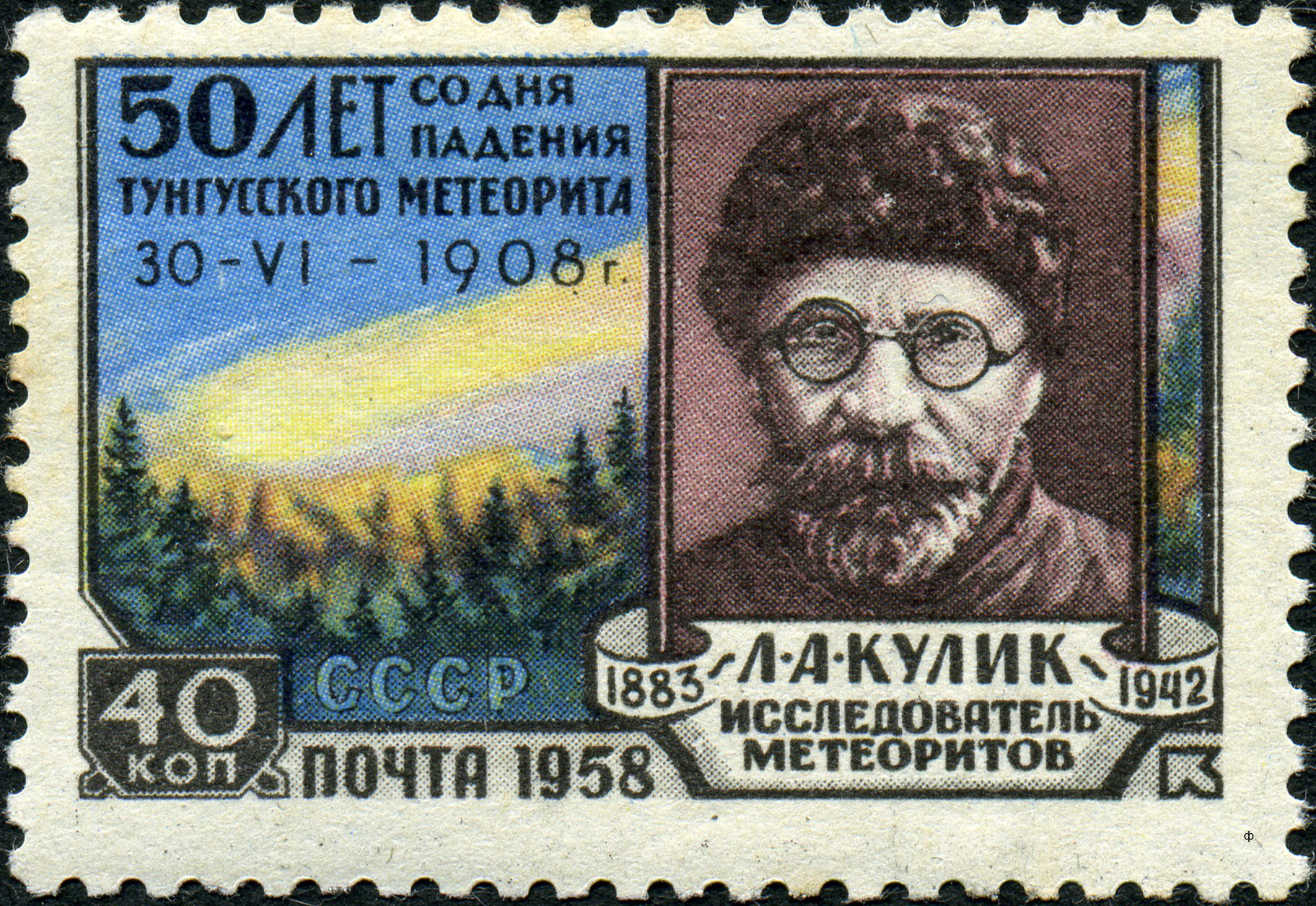
Leonid Alekseyevich Kulik, Russian mineralogist

Comparison of the dimensions of 2024YR 4 and other bodies. The dark inner circle indicates the minimum diameter, the light outer circle indicates the maximum diameter.

Editor’s note: Today’s Image of the Day kicks off a week of stories featuring some of our most captivating images of impact sites around the planet. The many impact craters scattered across Earth's surface offer ample reminders of past cataclysms. However, one of Earth’s best-known encounters with a near-Earth object in recent history—the Tunguska Event—left no permanent mark. Early in the morning on June 30, 1908, an object that scientists estimate was between 50 and 100 meters (150 and 300 feet) across plunged into Earth’s atmosphere, creating a brilliant fireball that exploded over a remote part of Siberia. The explosion, an airburst, likely occurred about 6 to 10 kilometers (4 to 6 miles) above the surface of the present-day Evenkiysky district of Krasnoyarsk Krai, vaporizing the vast majority of the incoming bolide, injuring eyewitnesses, and toppling and scorching trees across hundreds of square kilometers. More than a century later, on July 6, 2024, the OLI (Operational Land Imager) on Landsat 8 captured this image of part of the area affected by the explosion. The image shows no visible signs of the impact or damage—just healthy pine forests, marshes, and rivers. Labels show the approximate epicenter of the damage based on field surveys and one possible trajectory of the incoming bolide. (Published estimates of the trajectory vary considerably.)

Bronshten Vitaliy Aleksandrovich

Comparison of approximate sizes of notable impactors by CMG Lee. The Boeing 747 drawing is from http://commons.wikimedia.org/wiki/File:Boeing_747.svg and the bus drawing is from http://commons.wikimedia.org/wiki/File:London_bus_stop_illustration_1.svg .

Thin section of a fragment of "John's stone" from the epicenter of the Tunguska event. "John's stone" was suspected of being a Tunguska meteorite fragment, but is a metamorphic, terrestrial rock.

Pressure, wind and sound of diameter 60 m stony meteor
![Tunguska’s trajectory and the locations of five villages projected onto a plane normal to the Earth’s surface and passing through the fireball’s approach path. The scale is given by an adopted beginning height of 100 km. Three zenith angles ZR of the apparent radiant are assumed and the trajectories plotted by the solid, dashed, and dotted lines, respectively. The parenthesized data are the distances of the locations from the plane of projection: a plus sign indicates the location is south-south west of the plane; a minus sign, north-north east of it. The transliteration of the village names in this figure and the text is consistent with that of Paper I[1] and differs somewhat from the transliteration in the current world atlases.
↑ Krinov, E.L. (1966) Giant Meteorites, Oxford: Pergamon](https://upload.wikimedia.org/wikipedia/commons/6/6a/Trajectory_Models_of_The_Tunguska_Fireball.svg)
Tunguska’s trajectory and the locations of five villages projected onto a plane normal to the Earth’s surface and passing through the fireball’s approach path. The scale is given by an adopted beginning height of 100 km. Three zenith angles ZR of the apparent radiant are assumed and the trajectories plotted by the solid, dashed, and dotted lines, respectively. The parenthesized data are the distances of the locations from the plane of projection: a plus sign indicates the location is south-south west of the plane; a minus sign, north-north east of it. The transliteration of the village names in this figure and the text is consistent with that of Paper I[1] and differs somewhat from the transliteration in the current world atlases. ↑ Krinov, E.L. (1966) Giant Meteorites, Oxford: Pergamon

Comparison of sizes of Empire State Building and Eiffel Tower to Chelyabinsk (CM) and Tunguska (TM) meteoroids.

Velikostní srovnání (před vstupem do atmosféry) Čeljabinského meteoritu (ČM) a Tunguzského meteoru (TM) s vysílačem na Ještědu a Žižkovskou věží.
![Стримергласы – небольшие обломки стекловидных иголочек видимые только под микроскопом. По теории, развиваемой Е.В. Дмитриевым и поддержанной многими учёными, они входят в состав ядер эруптивных комет извергнутых со спутников Юпитера и спутников других планет-гигантов. В настоящий момент стримергласы обнаружены в месте падения Тунгусского метеорита. Находку стримергласов в Восточных Альпах учёные связывают с падением кометы и массовым вымиранием биологических объектов 65 миллионов лет назад. Стримергласы обнаружены также вокруг озера Смердячее и других озёр Шатурского кратерного поля.[1][2][3]](https://upload.wikimedia.org/wikipedia/commons/d/d6/%D0%A1%D1%82%D1%80%D0%B8%D0%BC-1.jpg)
Стримергласы – небольшие обломки стекловидных иголочек видимые только под микроскопом. По теории, развиваемой Е.В. Дмитриевым и поддержанной многими учёными, они входят в состав ядер эруптивных комет извергнутых со спутников Юпитера и спутников других планет-гигантов. В настоящий момент стримергласы обнаружены в месте падения Тунгусского метеорита. Находку стримергласов в Восточных Альпах учёные связывают с падением кометы и массовым вымиранием биологических объектов 65 миллионов лет назад. Стримергласы обнаружены также вокруг озера Смердячее и других озёр Шатурского кратерного поля.[1][2][3]
![Стримергласы – небольшие обломки стекловидных иголочек видимые только под микроскопом. По теории, развиваемой Е.В. Дмитриевым и поддержанной многими учёными, они входят в состав ядер эруптивных комет извергнутых со спутников Юпитера и спутников других планет-гигантов. В настоящий момент стримергласы обнаружены в месте падения Тунгусского метеорита. Находку стримергласов в Восточных Альпах учёные связывают с падением кометы и массовым вымиранием биологических объектов 65 миллионов лет назад. Стримергласы обнаружены также вокруг озера Смердячее и других озёр Шатурского кратерного поля.[1][2][3]](https://upload.wikimedia.org/wikipedia/commons/f/f3/%D0%A1%D1%82%D1%80%D0%B8%D0%BC-2.jpg)
Стримергласы – небольшие обломки стекловидных иголочек видимые только под микроскопом. По теории, развиваемой Е.В. Дмитриевым и поддержанной многими учёными, они входят в состав ядер эруптивных комет извергнутых со спутников Юпитера и спутников других планет-гигантов. В настоящий момент стримергласы обнаружены в месте падения Тунгусского метеорита. Находку стримергласов в Восточных Альпах учёные связывают с падением кометы и массовым вымиранием биологических объектов 65 миллионов лет назад. Стримергласы обнаружены также вокруг озера Смердячее и других озёр Шатурского кратерного поля.[1][2][3]

"Картосхема" места Тунгусского феномена. Из журнала "Вокруг света", 1931 год. Оригинальная схема сделана между 1927 и 1930 годом. Автор в первоисточнике (журнале) не указан.

Топи Тунгуски, в районе которых упал феномен. Фотография из журнала "Вокруг света", 1931 год. Оригинальное фото сделано между 1927 и 1930 годом (предположительно, 1930, до 14 сентября). Автор в первоисточнике (журнале) не указан.