Execution of John Wayne Gacy
Historical Overview
The execution of American serial killer John Wayne Gacy by lethal injection at Stateville Correctional Center in Illinois concluded one of the most notorious criminal cases in US history. Gacy, infamously known as the "Killer Clown," had been convicted of the abduction, rape, and murder of at least 33 young men and boys during the 1970s. His execution drew massive national media attention, prompting public gatherings of victims' families as well as protests by anti-death penalty activists.

Booking photo of Gacy taken by the Des Plaines Police Department, December 1978

This file is a work of an employee of the Executive Office of the President of the United States, taken or made as part of that person's official duties. As a work of the U.S. federal government, it is in the public domain.

This file is a work of an employee of the Executive Office of the President of the United States, taken or made as part of that person's official duties. As a work of the U.S. federal government, it is in the public domain.

Chicago Tribune press photograph of victim recovery at serial killer John Wayne Gacy's home.

Elizabeth and Kerry Piest, mother and sister of John Wayne Gacy victim Robert Piest, announce the formation of the Robert Piest foundation

This area was a favorite spot for John Wayne Gacy, Jr. to cruise for victims. Pulling up in his black Oldsmobile, he would compliment strangers and offer them marijuana and other enticements to get into his car. Then he would then pummel them or knock them out with chloroform, drive them to his house and rape and murder them. One such victim was thought to be 14-year old Michael Marino who was last seen outside a hamburger restaurant on Clark St. (left side of this photo). DNA evidence produced in 2012 proved that the body in his coffin was not him after all. He still remains missing. On Broadway (right side) was Times Square Video Arcade, one of the places Gacy would find victims. Corner of Diversey Parkway, Broadway Street and Clark Street (looking north).

After the Office of the coroner was abolished, the Cook County Medical Examiner's Office was founded here in the 1976. This office serves one of the bloodiest cities in the world, half the population of the entire state of Illinois. More then 16,000 deaths are reported here annually. The autopsy report for the St. Valentine's Day Massacre is kept here. In 1978, the remains of John Wayne Gacy, Jr.'s victims were brought here for examination after they were discovered buried under his house. The office lost its national accreditation in 2011 due to a shortage of staff and stacked bodies. A morgue vault designed to hold 300 bodies was piled with over 360. The limbs of corpses were sticking out and decomposition covered the floor. Located at 2121 W. Harrison St.

Gregory J. Godzik. Victim of serial killer John Wayne Gacy. Published 23 December 1978.

James Mazzara. As published in the March 13, 1980 edition of the Chicago Tribune. Direct link here

John Butkovich. Published in the 13 March 1980 edition of the Chicago Tribune.

Spolszczony szkic przedstawiający dom i posesję Johna Wayne’a Gacy’ego, opublikowany pierwotnie w „Kokomo Tribune” 28 grudnia 1978.

28 December 1978 Kokomo Tribune illustration of John Wayne Gacy's property

John Wayne Gacy, as published in the 28 December 1978 edition of The Atlanta Constitution

John Wayne Gacy, his first wife, Marlynn, plus Mr and Mrs Leroy Schnoor, as published in the 18 December 1967 edition of the Waterloo Courier (p. 8). Direct link here

John Mowery. As published in the February 9, 1980 edition (p. 81) of the Chicago Tribune. Direct link here

Booking photo of Gacy taken by the Des Plaines Police Department, December 1978

Drawing of a serial killer John Wayne Gacy
![Scan of original John Wayne Gacy certificate of death. Gacy, a serial killer, was executed after being convicted of raping, torturing, and murdering 33 boys and men, so the manner of death is stated to be [state-sanctioned] homicide (i.e., killed by one or more people, rather than through natural causes, accident, or suicide).](https://upload.wikimedia.org/wikipedia/commons/d/da/John_Wayne_Gacy_certificate_of_death.jpg)
Scan of original John Wayne Gacy certificate of death. Gacy, a serial killer, was executed after being convicted of raping, torturing, and murdering 33 boys and men, so the manner of death is stated to be [state-sanctioned] homicide (i.e., killed by one or more people, rather than through natural causes, accident, or suicide).

John Wayne Gacy, as pictured in the 29 December 1978 edition of the Altoona Mirror
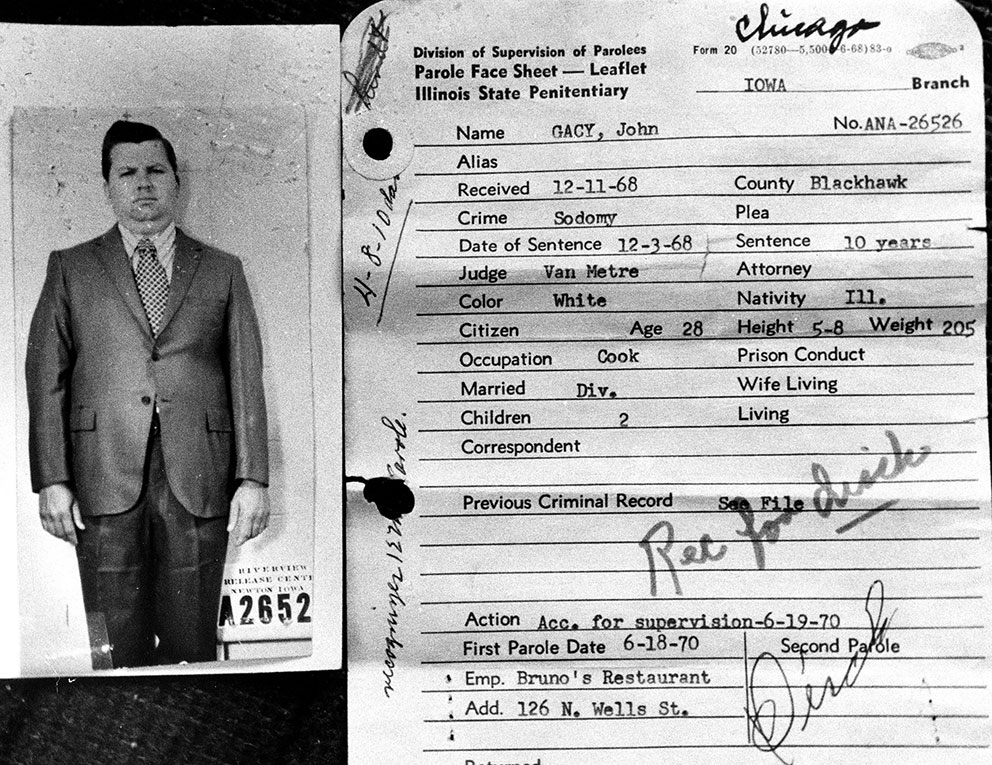
Serial killer John Wayne Gacy's release paperwork from Iowa. Gacy was convicted on sodomy charges in 1968 but was released on parole in 1970.

"We've got you now, you jagoff." Five police detectives pulled over John Wayne Gacy, Jr. and arrested him in front of this McDonald's on December 21, 1978 at fifteen minutes after noon. Although they only had him on a minor drug charge, they were afraid Gacy might try to kill someone else and himself before they had enough evidence to get a search warrant. The police eventually discovered 29 bodies on his property--26 in his crawlspace and three buried elsewhere. Four other victims were dumped in the Des Plaines River. Gacy was executed in 1994. Located at 7969 N. Milwaukee Avenue, Niles

“It was the longest night of my life.” This cheerful building was the location of the law office of Sam Amirante, one of John Wayne Gacy's attorneys. Just before Christmas on the evening of Dec. 20, 1978, with the police closing in on him, Gacy stopped by Amirante's office. He drank a couple of shots of whiskey and said "I’ve been the judge, jury and executioner of many, many people." For the next few hours until early morning, Gacy confessed in detail to the kidnapping, torture, rape & murder of 33 young men and boys. Amirante didn't say a word as Gacy spoke. The next day Gacy was arrested by police outside a McDonald's in Niles, Illinois. He was eventually convicted of murder and executed at Statesville prison in 1994. Located at 222 S. Prospect Ave., Park Ridge

This bar is said to have been frequented by two of the most notorious serial killers in US history, John Wayne Gacy, Jr. and Jeffrey Dahmer. Dahmer used to sit at the window on the left and "chickenhawk" kids at the Dunkin' Donuts across the street. Once in the 70s, Gacy showed up in his clown outfit. Located at 3207 N Clark St.

Michael Bonnin. As published in the March 13, 1980 edition of the Chicago Tribune. Direct link here
![John Wayne Gacy Typewriter displayed at the National Museum of Crime & Punishment, Washington, D.C.
“
Notorious Typewriter
Gacy "The Clown Killer" used this typewriter to type his legal papers and his book "A Question of Doubt", which was written in 1984.
Also shown is a (copy) of the original property receipt for this typewriter indicating his prisoner number (# N00921), along with the rules and regulations that come with possessing personal property while incarcerated at Statesville Correctional center in Joliet, Illinois.
Gacy is listed in the Guinness Book of World records for the longest sentence imposed on a mass murderer; he was given 21 consecutive life sentences and 12 death sentences.
”
“
From his father's approval, to his performances as "Pogo the Clown," Gacy always sought attention. In an interview before his execution, Gacy declared, "There's been 11 hardback books on me, 31 paperbacks, 2 screenplays, 1 movie, 1 off-Broadways play, 5 songs, and over 5,000 articles. What can I say about it?" before adding, "I have no ego for any of this garbage." However Gacy himself added to the mass of material, using this typewriter to write his own version of events, the book A Question of Doubt. [1]
”](https://upload.wikimedia.org/wikipedia/commons/e/ef/National_Museum_of_Crime_and_Punishment_-_John_Wayne_Gacy_Typewriter_%282868562343%29.jpg)
John Wayne Gacy Typewriter displayed at the National Museum of Crime & Punishment, Washington, D.C. “ Notorious Typewriter Gacy "The Clown Killer" used this typewriter to type his legal papers and his book "A Question of Doubt", which was written in 1984. Also shown is a (copy) of the original property receipt for this typewriter indicating his prisoner number (# N00921), along with the rules and regulations that come with possessing personal property while incarcerated at Statesville Correctional center in Joliet, Illinois. Gacy is listed in the Guinness Book of World records for the longest sentence imposed on a mass murderer; he was given 21 consecutive life sentences and 12 death sentences. ” “ From his father's approval, to his performances as "Pogo the Clown," Gacy always sought attention. In an interview before his execution, Gacy declared, "There's been 11 hardback books on me, 31 paperbacks, 2 screenplays, 1 movie, 1 off-Broadways play, 5 songs, and over 5,000 articles. What can I say about it?" before adding, "I have no ego for any of this garbage." However Gacy himself added to the mass of material, using this typewriter to write his own version of events, the book A Question of Doubt. [1] ”