All Conflicts

West. Front 44/45

nullongoing0 battles

A LCVP (Landing Craft, Vehicle, Personnel) from the U.S. Coast Guard-manned USS Samuel Chase disembarks troops of the U.S. Army's First Division on the morning of June 6, 1944 (D-Day) at Omaha Beach.

A LCVP (Landing Craft, Vehicle, Personnel) from the U.S. Coast Guard-manned USS Samuel Chase disembarks troops of the U.S. Army's First Division on the morning of June 6, 1944 (D-Day) at Omaha Beach.

Author: Chief Photographer's Mate (CPHOM) Robert F. Sargent, U.S. Coast GuardLicense:PD
Source
The pilot of a C-47 cargo transport crash lands safely after having dropped supplies to elements of the 101st Airborne Division which has successfully repulsed all attempts to capture the besieged city of Bastogne, Belgium. 30 Dec 1944

The pilot of a C-47 cargo transport crash lands safely after having dropped supplies to elements of the 101st Airborne Division which has successfully repulsed all attempts to capture the besieged city of Bastogne, Belgium. 30 Dec 1944

Author: Post-Work: User:W.wolnyLicense:PD
Source
Briealf, Germany - C-47s of the 101st Airborne Division drop supplies on the 4th Infantry Division Sector. This became necessary when rains and early thaw made roads impassable in this area. The supplies consisted of rations, gas, and ammunition. 13 February 1945
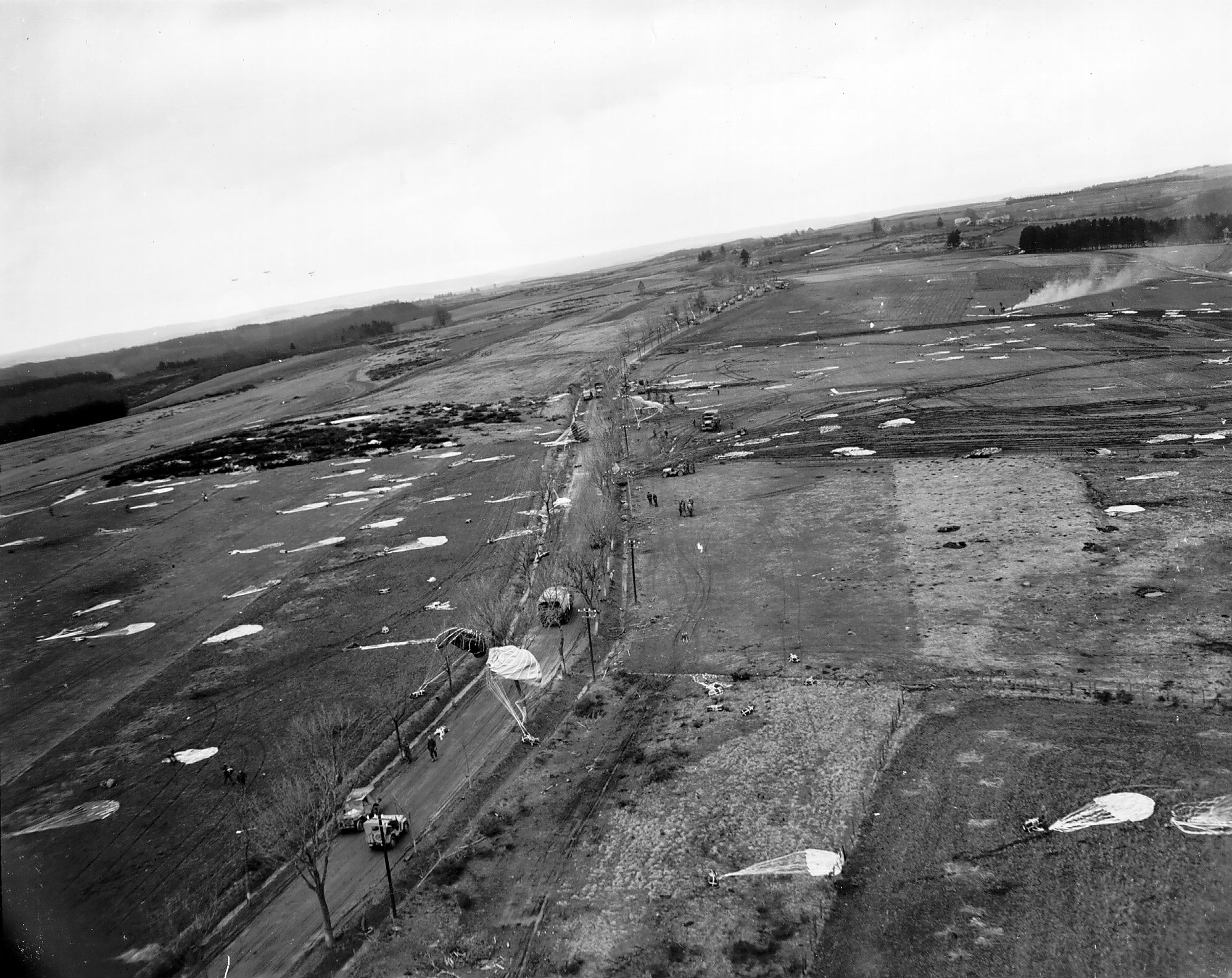
Briealf, Germany - C-47s of the 101st Airborne Division drop supplies on the 4th Infantry Division Sector. This became necessary when rains and early thaw made roads impassable in this area. The supplies consisted of rations, gas, and ammunition. 13 February 1945

Author: Post-Work: User:W.wolnyLicense:PD
Source
Briealf, Germany (probably: Bleialf)- C-47s of the 101st Airborne Division drop supplies on the 4th Infantry Division Sector. This became necessary when rains and early thaw made roads impassable in this area. The supplies consisted of rations, gas, and ammunition.

Briealf, Germany (probably: Bleialf)- C-47s of the 101st Airborne Division drop supplies on the 4th Infantry Division Sector. This became necessary when rains and early thaw made roads impassable in this area. The supplies consisted of rations, gas, and ammunition.

Author: Post-Work: User:W.wolnyLicense:PD
Source
PFC R. Larock, Helena, Mont., relaxes after battle by playing piano in a wrecked German beer hall. Co. E, 119th Infantry Regiment, 30th Infantry Division, Ubach, Germany.

PFC R. Larock, Helena, Mont., relaxes after battle by playing piano in a wrecked German beer hall. Co. E, 119th Infantry Regiment, 30th Infantry Division, Ubach, Germany.

Author: U.S. Signal CorpsLicense:PD
Source
Co. C, 2nd Battalion, 30th Infantry Regiment, 3rd Infantry Division.

Co. C, 2nd Battalion, 30th Infantry Regiment, 3rd Infantry Division.

Author: U.S. Signal CorpsLicense:PD
Source
Deep in the Hurtgen forest, in Germany, American infantrymen move across a bridge over a small stream. A tank, part of the new Allied offensive, can be seen in the background.

Deep in the Hurtgen forest, in Germany, American infantrymen move across a bridge over a small stream. A tank, part of the new Allied offensive, can be seen in the background.

Author: U.S. Signal CorpsLicense:PD
Source
Co. K, 398th Infantry Regiment, 100th Infantry Division. Rosteig Area, France. December 5, 1944.

Co. K, 398th Infantry Regiment, 100th Infantry Division. Rosteig Area, France. December 5, 1944.

Author: U.S. Signal CorpsLicense:PD
Source
American infantrymen move through Hurtgen, Germany, on their way to the front lines. Company I, 181st Regiment, 8th Infantry Division.

American infantrymen move through Hurtgen, Germany, on their way to the front lines. Company I, 181st Regiment, 8th Infantry Division.

Author: U.S. Signal CorpsLicense:PD
Source
A wounded soldier is carried back to the aid post by his comrades, on a stretcher improvised from a door on which straw has been placed. They are all members of H Company, 2nd Battalion, 119th Infantry Regiment, 30th Infantry Division, in Belgium.

A wounded soldier is carried back to the aid post by his comrades, on a stretcher improvised from a door on which straw has been placed. They are all members of H Company, 2nd Battalion, 119th Infantry Regiment, 30th Infantry Division, in Belgium.

Author: U.S. Signal CorpsLicense:PD
Source
A wounded soldier is carried back to the aid post by his comrades, on a stretcher improvised from a door on which straw has been placed. They are all members of H Company, 2nd Battalion, 119th Infantry Regiment, 30th Infantry Division, in Belgium.

A wounded soldier is carried back to the aid post by his comrades, on a stretcher improvised from a door on which straw has been placed. They are all members of H Company, 2nd Battalion, 119th Infantry Regiment, 30th Infantry Division, in Belgium.

Author: U.S. Signal CorpsLicense:PD
Source
A wounded soldier is carried back to the aid post by his comrades, on a stretcher improvised from a door on which straw has been placed. They are all members of H Company, 2nd Battalion, 119th Infantry Regiment, 30th Infantry Division, in Belgium.

A wounded soldier is carried back to the aid post by his comrades, on a stretcher improvised from a door on which straw has been placed. They are all members of H Company, 2nd Battalion, 119th Infantry Regiment, 30th Infantry Division, in Belgium.

Author: U.S. Signal CorpsLicense:PD
Source
PFC George Cap, from Prior Lake, Minn., and Pvt. James McFarland, of Zanesville, Ohio, both of the 1st Division, U.S. First Army, play cards, as they wait for orders to move out of Vettweiß, Germany. Co. I, 3rd Battalion, 16th Infantry Regiment, 1st Infantry Division, 2/28/45.

PFC George Cap, from Prior Lake, Minn., and Pvt. James McFarland, of Zanesville, Ohio, both of the 1st Division, U.S. First Army, play cards, as they wait for orders to move out of Vettweiß, Germany. Co. I, 3rd Battalion, 16th Infantry Regiment, 1st Infantry Division, 2/28/45.

Author: U.S. Signal CorpsLicense:PD
Source
PFC George Cap, from Prior Lake, Minn., and Pvt. James McFarland, of Zanesville, Ohio, both of the 1st Division, U.S. First Army, play cards, as they wait for orders to move out of Vettweiß, Germany. Co. I, 3rd Battalion, 16th Infantry Regiment, 1st Infantry Division, 2/28/45.

PFC George Cap, from Prior Lake, Minn., and Pvt. James McFarland, of Zanesville, Ohio, both of the 1st Division, U.S. First Army, play cards, as they wait for orders to move out of Vettweiß, Germany. Co. I, 3rd Battalion, 16th Infantry Regiment, 1st Infantry Division, 2/28/45.

Author: U.S. Signal CorpsLicense:PD
Source
7th U.S. Army infantrymen of the 7th Inf. Reg prepare to rush house in which Nazi snipers are hidden. Guiderkirch, France. March 15, 1945. 1st Bn., 7th Infantry Regiment, 3rd Infantry Division.

7th U.S. Army infantrymen of the 7th Inf. Reg prepare to rush house in which Nazi snipers are hidden. Guiderkirch, France. March 15, 1945. 1st Bn., 7th Infantry Regiment, 3rd Infantry Division.

Author: U.S. Signal CorpsLicense:PD
Source
German prisoners taken in drive south of Colmar carry a wounded American with them as they are marched out of the battle area, 4 February, 1945. The American soldier is Pvt. Charles P. Deathrage, 225 Madison St., Jefferson, Mo.; Unit censored, U.S. National Archives

German prisoners taken in drive south of Colmar carry a wounded American with them as they are marched out of the battle area, 4 February, 1945. The American soldier is Pvt. Charles P. Deathrage, 225 Madison St., Jefferson, Mo.; Unit censored, U.S. National Archives

Author: U.S. Signal CorpsLicense:PD
Source
German prisoners taken in drive south of Colmar carry a wounded American with them as they are marched out of the battle area, 4 February, 1945. The American soldier is Pvt. Charles P. Deathrage, 225 Madison St., Jefferson, Mo.; Unit censored, U.S. National Archives

German prisoners taken in drive south of Colmar carry a wounded American with them as they are marched out of the battle area, 4 February, 1945. The American soldier is Pvt. Charles P. Deathrage, 225 Madison St., Jefferson, Mo.; Unit censored, U.S. National Archives

Author: U.S. Signal CorpsLicense:PD
Source
How 81mm mortar observers work, is demonstrated by SSGT Glenn K. Keller, Fairfield IA., left, and PFC Virgil Williams, Pitcairn PA., using binoculars and phone, near Oberwampach, Luxembourg. Both Men are with the 90th Infantry Division. Co. D, 358th Inf. Regiment, 90th Infantry Division, Jan 25 1945.

How 81mm mortar observers work, is demonstrated by SSGT Glenn K. Keller, Fairfield IA., left, and PFC Virgil Williams, Pitcairn PA., using binoculars and phone, near Oberwampach, Luxembourg. Both Men are with the 90th Infantry Division. Co. D, 358th Inf. Regiment, 90th Infantry Division, Jan 25 1945.

Author: U.S. Signal CorpsLicense:PD
Source
Co. D, 692nd Tank Destroyer Battalion.

Co. D, 692nd Tank Destroyer Battalion.

Author: U.S. Signal CorpsLicense:PD
Source
A .50 caliber machine gun and crew are set to repel attack by advancing Germans near Malmedy, 22nd December, 1944. 120th Regiment, 30th Division.

A .50 caliber machine gun and crew are set to repel attack by advancing Germans near Malmedy, 22nd December, 1944. 120th Regiment, 30th Division.

Author: U.S. Signal CorpsLicense:PD
Source
Members of 3rd Battalion, 417th Regiment, 75th Infantry Division, clean their weapons before moving up to the line. L to R: Pvt. Dom Bocci: 379 Boyleston St., Newton Centre, Mass.; Pvt. Russell J. Sacriol, (?) 151 Canterbury St., Worcester, Mass.; Pvt. John Ducharme, Glover Road, Millbury, Mass. 8 February, 1945. Echternach, Luxembourg.

Members of 3rd Battalion, 417th Regiment, 75th Infantry Division, clean their weapons before moving up to the line. L to R: Pvt. Dom Bocci: 379 Boyleston St., Newton Centre, Mass.; Pvt. Russell J. Sacriol, (?) 151 Canterbury St., Worcester, Mass.; Pvt. John Ducharme, Glover Road, Millbury, Mass. 8 February, 1945. Echternach, Luxembourg.

Author: U.S. Signal CorpsLicense:PD
Source
Vielsalm, Belgium.

Vielsalm, Belgium.

Author: U.S. Signal CorpsLicense:PD
Source
Infantrymen of Company B, 120th Infantry Regiment, 30th Division, cut through a field alongside a road to avoid crossing in the open and giving German snipers a target.

Infantrymen of Company B, 120th Infantry Regiment, 30th Division, cut through a field alongside a road to avoid crossing in the open and giving German snipers a target.

Author: U.S. Signal CorpsLicense:PD
Source
Four infantrymen, members of two patrols that closed the escape gap east of Metz cutting off the escape of the encircled Germans in the town, shake hands after their mission has been accomplished. Left to right: S/Sgt Henry Tackett, Portsmouth, Ohio, S/Sgt Leonard Malicole, Cleveland, Ohio, and Tec 5 Ancil T. Horbison, Rockville, Ind. 5th Infantry Division & 95th Infantry Division. 19 November, 1944.
Four infantrymen, members of two patrols that closed the escape gap east of Metz cutting off the escape of the encircled Germans in the town, shake hands after their mission has been accomplished. Left to right: S/Sgt Henry Tackett, Portsmouth, Ohio, S/Sgt Leonard Malicole, Cleveland, Ohio, and Tec 5 Ancil T. Horbison, Rockville, Ind. 5th Infantry Division & 95th Infantry Division. 19 November, 1944.

Author: U.S. Signal CorpsLicense:PD
Source
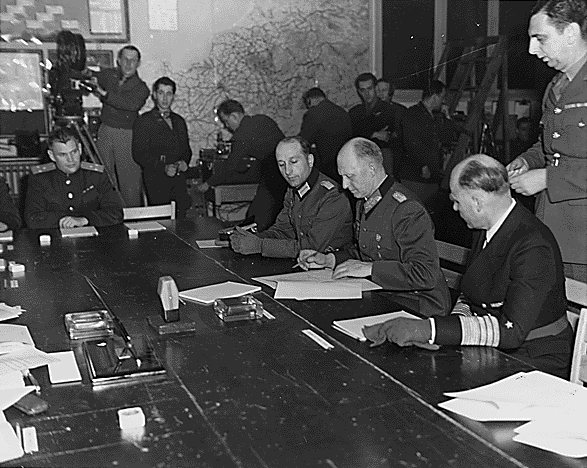
From left to right: Major Wilhelm Oxenius (Colonel General Jodl's Adjutant), Colonel General Alfred Jodl, Chief of OKW Operation Staff (who signed the Instrument of Surrender on behalf of the OKW), General admiral Hans-Georg von Friedeburg, Commander-in-Chief of the German navy (OKM), Major General Kenneth W. D. Strong (standing), G-2, SHAEF. Location: Reims, France, American Headquarters

From left to right: Major Wilhelm Oxenius (Colonel General Jodl's Adjutant), Colonel General Alfred Jodl, Chief of OKW Operation Staff (who signed the Instrument of Surrender on behalf of the OKW), General admiral Hans-Georg von Friedeburg, Commander-in-Chief of the German navy (OKM), Major General Kenneth W. D. Strong (standing), G-2, SHAEF. Location: Reims, France, American Headquarters

Author: Unknown authorUnknown authorLicense:PD
Source
v.l.n.r: Major Wilhelm Oxenius (Adjutant von Generaloberst Jodl), Generaloberst Alfred Jodl, Chef des dt. Wehrmachtführungsstabes (die Kapitulationsurkunde i.A. des OKW unterzeichnend), Generaladmiral Hans-Georg von Friedeburg, Oberbefehlshaber der dt. Kriegsmarine (OKM), Major General K.W.D. Strong, G-2, SHAEF. 
Ort: Reims, Frankreich, Amerikanisches Hauptquartier

v.l.n.r: Major Wilhelm Oxenius (Adjutant von Generaloberst Jodl), Generaloberst Alfred Jodl, Chef des dt. Wehrmachtführungsstabes (die Kapitulationsurkunde i.A. des OKW unterzeichnend), Generaladmiral Hans-Georg von Friedeburg, Oberbefehlshaber der dt. Kriegsmarine (OKM), Major General K.W.D. Strong, G-2, SHAEF. Ort: Reims, Frankreich, Amerikanisches Hauptquartier

Author: Unknown authorUnknown authorLicense:PD
Source

Historical Overview

Final phase of the Western Front in World War II from 1944 to 1945.

Outcome & Quick Facts

Outcome

German victory.

Related Literature

Cover of Berlin: The Downfall 1945

Berlin: The Downfall 1945

Antony Beevor

Non-fictionWW2WW2 Eastern Front

English
World Wars Era
Cover of Gulag: A History

Gulag: A History

Non-fiction20th CenturySoviet Union

English
World Wars Era
Cover of Red Famine: Stalin's War on Ukraine

Red Famine: Stalin's War on Ukraine

Non-fiction20th CenturySoviet Union

English
World Wars Era
Cover of Stalingrad

Stalingrad

Antony Beevor

WW2ReportWW2 Eastern Front

English
World Wars Era
Cover of The Gulag Archipelago

The Gulag Archipelago

Non-fiction20th CenturySoviet Union

English
World Wars Era
Cover of Der Gulag

Der Gulag

Non-fiction20th CenturySoviet Union

German
World Wars Era
Cover of Die Schlacht um Berlin und das Ende des Dritten Reichs 1945

Die Schlacht um Berlin und das Ende des Dritten Reichs 1945

Non-fictionWW2WW2 Eastern Front

German
World Wars Era
Cover of Hunde, wollt ihr ewig leben: ein Stalingrad-Roman

Hunde, wollt ihr ewig leben: ein Stalingrad-Roman

WW2WW2 Eastern FrontHistorical Noval

German
World Wars Era
Cover of Roter Hunger: Stalins Krieg gegen die Ukraine

Roter Hunger: Stalins Krieg gegen die Ukraine

Non-fiction20th CenturySoviet Union

German
World Wars Era
Cover of So weit die Füße tragen

So weit die Füße tragen

20th CenturySoviet UnionGulag

German
World Wars Era
Cover of Söldner ohne Sold: Die deutschen Freikorps 1918–1923

Söldner ohne Sold: Die deutschen Freikorps 1918–1923

Report20th CenturyGerman History

German
World Wars Era
Cover of Vom Massensturm zur Stoßtrupptaktik: Die deutsche Landkriegtaktik im Spiegel von Dienstvorschriften und Publizistik 1906 bis 1918

Vom Massensturm zur Stoßtrupptaktik: Die deutsche Landkriegtaktik im Spiegel von Dienstvorschriften und Publizistik 1906 bis 1918

Non-fiction20th CenturyGerman History

German
World Wars Era
Cover of Wir Wehr-Wölfe: Erinnerungen eines Freikorps-Führers

Wir Wehr-Wölfe: Erinnerungen eines Freikorps-Führers

Report20th CenturyGerman History

German
World Wars Era
Cover of Zweiter Weltkrieg Erlebnisbericht Apokalypse Stalingrad: Untergang der 6. Armee 1942-1943

Zweiter Weltkrieg Erlebnisbericht Apokalypse Stalingrad: Untergang der 6. Armee 1942-1943

Walter Mönch

Non-fictionWW2WW2 Eastern Front

German
World Wars Era
Rise And Fall Of The Third Reich

Rise And Fall Of The Third Reich

William Shirer

20th CenturyGerman HistoryNational Socialism

World Wars Era