Reconquista

Ejército moro (derecha) de Almanzor durante la Batalla de Reconquista de San Esteban de Gormaz.

Statue of Alfonso II of Asturias (760–842) at the Plaza de Oriente (square) in Madrid (Spain). Sculpted in white stone by José Oñate between 1750 and 1753.

Statue of Alfonso III of Asturias, the Great (c.848–910), at the Plaza de Oriente (square) in Madrid (Spain). Sculpted in white stone by Luis Salvador Carmona (1709–1767) between 1750 and 1753.

Statue of Alfonso V of León (994–1028) at the Plaza de Oriente (square) in Madrid (Spain). Sculpted in white stone by Domingo Martínez between 1750 and 1753.

Arco de Santa María, Burgos.

Placa en Covadonga.Texto: «Aquí, en el monte Auseva, morada inmemorial de la Virgen renació la España de Cristo con la gran victoria de Pelayo y de sus fieles sobre los enemigos de la cruz. Años 718–722».

Statue of Pelayo I of Asturias († 737) at the Plaza de Oriente (square) in Madrid (Spain). Sculpted in white stone by Domingo Martínez between 1750 and 1753.

Mural from the castle of Alcañiz representing the entrance of James I of Aragon in Valencia

Ortigueira emblemasses

A Jineta sword.

Jineta sword made in the Nasrid Kingdom of Granada in the 14th or 15th century, with a steel blade and a brass (copper and zinc alloy) hilt. It was at San Marcelo church in León.

Hilt of a Jineta sword.

Genoa Cathedral Wall paintings related to the conquest of Tortosa.
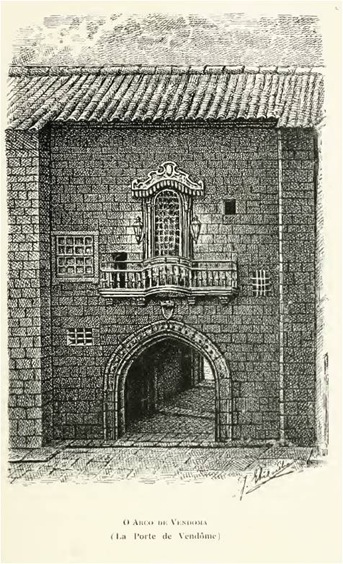
O Arco de Vandoma (La Porte de Vendôme) in COELHO, José Júlio Gonçalves – Notre-Dame de Vendome et les armoiries de la ville de Porto: mémoire historique et archéologique

Crusade against the Moors of Granada

Estatua de Íñigo Arista en la Plaza de Oriente (Madrid)
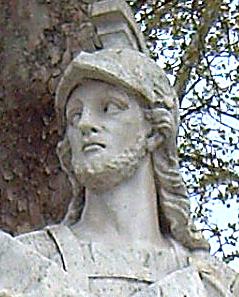
Statue of Íñigo I of Pamplona (c.781–852) at the Plaza de Oriente (square) in Madrid (Spain). Sculpted in white stone by José Oñate between 1750 and 1753.
Includes bibliographical references Subjects:

Descrição Uma coluna de pedra é cercada por cavaleiros cristãos e mouros derrotados. O monumento representa a conquista de Silves pelos cavaleiros cristãos em 1189. Durante o reinado de D. Sancho I, o segundo tenente, D. Mendo de Sousa, planeou um ataque surpresa aos mouros. Escultor José Laranjeira Santos (1930), escultor português. https://statues.vanderkrogt.net/object.php?webpage=ST&record=ptag019" rel="noreferrer nofollow">statues.vanderkrogt.net/object.php?webpage=ST&record=...

Descrição Uma coluna de pedra é cercada por cavaleiros cristãos e mouros derrotados. O monumento representa a conquista de Silves pelos cavaleiros cristãos em 1189. Durante o reinado de D. Sancho I, o segundo tenente, D. Mendo de Sousa, planeou um ataque surpresa aos mouros. Escultor José Laranjeira Santos (1930), escultor português. https://statues.vanderkrogt.net/object.php?webpage=ST&record=ptag019" rel="noreferrer nofollow">statues.vanderkrogt.net/object.php?webpage=ST&record=...

Descrição Uma coluna de pedra é cercada por cavaleiros cristãos e mouros derrotados. O monumento representa a conquista de Silves pelos cavaleiros cristãos em 1189. Durante o reinado de D. Sancho I, o segundo tenente, D. Mendo de Sousa, planeou um ataque surpresa aos mouros. Escultor José Laranjeira Santos (1930), escultor português. https://statues.vanderkrogt.net/object.php?webpage=ST&record=ptag019" rel="noreferrer nofollow">statues.vanderkrogt.net/object.php?webpage=ST&record=...

Muslim invasion of Spain from 711 to 732

This is an achronological map of the Norman conquests starting with the Norman arrival in Normandy and ending with the Kingdom of the Canary Islands in the 1400s. Credit to Breakinger for doing the cartography, credit to me for the research.

Statue of Ordoño I of Asturias († 866) at the Plaza de Oriente (square) in Madrid (Spain). Sculpted in white stone by Andrés de los Helgueros between 1750 and 1753.

Statue of Ordoño II of León († 924) at the Plaza de Oriente (square) in Madrid (Spain). Sculpted in white stone by Luis Salvador Carmona (1709–1767) between 1750 and 1753.

the Port of Vendoma (Vendôme), Porto, Portugal
Historical Overview
The Reconquista or the fall of al-Andalus was a series of military campaigns by northern Iberian Christian polities against Muslim-ruled al-Andalus, which had previously been part of the Visigothic Kingdom before the Muslim Conquest of 711. The Reconquista concluded in 1492 with the capture of Granada by the Catholic Monarchs of Spain, thereby ending the presence of any Muslim rule on the Iberian Peninsula.
Key Battles
Battle of Covadonga
722Spanien
Battle of Simancas
939Spanien
Siege of Toledo
1084 - 1085Spanien
Battle of Sagrajas (Zallaqa)
1086Spanien
Battle of Las Navas de Tolosa
1212Spanien
Siege of Granada
1482 - 1492Spanien
Outcome & Quick Facts
Outcome
Christian victory; foundation of the Kingdom of Asturias.
Related Literature


1177 v. Chr.: Der erste Untergang der Zivilisation

Byzanz: Die erstaunliche Geschichte eines mittelalterlichen Imperiums

Das Mittelalter: Europa von 500 bis 1500

Die Karolinger

Im Mittelalter: Handbuch für Zeitreisende

Im Rausch des Vergnügens: Eine Reise in das England von Jane Austen und Lord Byron

Militärgeschichte des Mittelalters

Nach 1177 v. Chr.: Wie Zivilisationen überleben
Der ferne Spiegel: Das dramatische 14. Jahrhundert
Barbara Tuchman