Battle of Wuhan

Japanese naval landing force blasting Chinese pillbox and marching with the naval flag during the Canton Operation
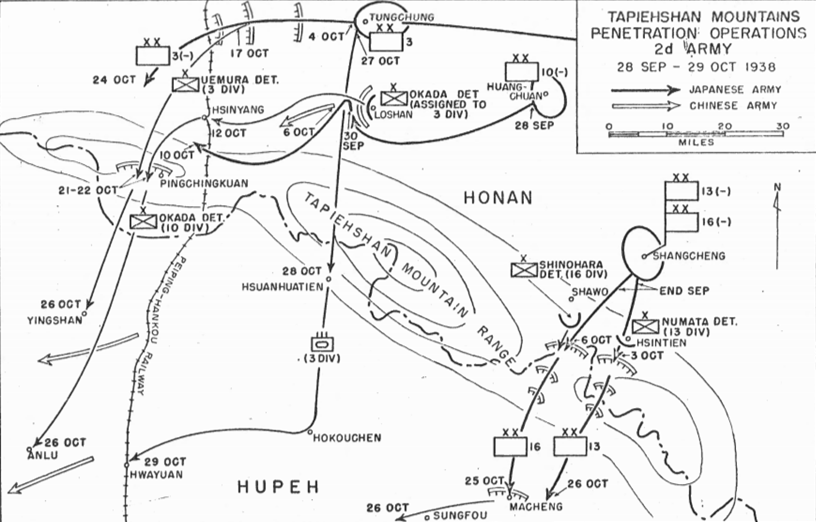
The Japanese 2nd Army breaks through the determined defenses of the Chinese 5th War Area during the Battle of Wuhan, 1938

The Japanese 106th Division is encircled by Chinese forces during the Battle of Wanjialing, 1938.

Lược đồ trận Vũ Hán. Thể loại:Chiến tranh Trung-Nhật
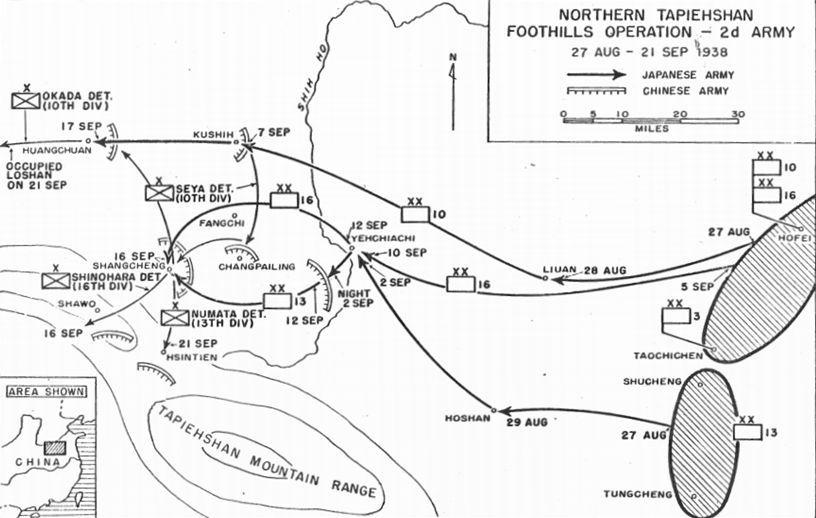
The Japanese 2nd Army moves out from its jump-off points to attack Chinese positions in the Dabie Foothills during the Battle of Wuhan, 1938

Map of Japanese and Chinese dispositions after the Battle of Xuzhou, 1938

The Japanese 11th Army makes its final assault on Wuhan. (Operations of the 2nd Army in the north are omitted.)
Historical Overview
The Battle of Wuhan, popularly known to the Chinese as the Defense of Wuhan, and to the Japanese as the Capture of Wuhan, was a large-scale battle of the Second Sino-Japanese War. Engagements took place across vast areas of Anhui, Henan, Jiangxi, Zhejiang, and Hubei provinces over a period of four and a half months. It was the single largest, longest, and bloodiest battle of the entire Second Sino-Japanese War. More than one million National Revolutionary Army troops from the Fifth and Ninth War Zones were put under the direct command of Chiang Kai-shek, defending Wuhan from the Central China Area Army of the Imperial Japanese Army led by Shunroku Hata. Chinese forces were also supported by the Soviet Volunteer Group, a group of volunteer pilots from Soviet Air Forces.
Quick Facts
Empire of Japan
- Commander: Yasuji Okamura
- Strength: ca. 350.000
- Casualties: ca. 35.000
Rep. of China
- Commander: Chiang Kai-shek
- Strength: ca. 1.100.000
- Casualties: ca. 225.000
Strategic Context
Defending the heart of Central China.
Related Literature


Der Gulag

Die Schlacht um Berlin und das Ende des Dritten Reichs 1945

Hunde, wollt ihr ewig leben: ein Stalingrad-Roman

Roter Hunger: Stalins Krieg gegen die Ukraine

So weit die Füße tragen

Söldner ohne Sold: Die deutschen Freikorps 1918–1923

Vom Massensturm zur Stoßtrupptaktik: Die deutsche Landkriegtaktik im Spiegel von Dienstvorschriften und Publizistik 1906 bis 1918

Wir Wehr-Wölfe: Erinnerungen eines Freikorps-Führers

Zweiter Weltkrieg Erlebnisbericht Apokalypse Stalingrad: Untergang der 6. Armee 1942-1943
Walter Mönch
Rise And Fall Of The Third Reich
William Shirer
Historical Locations
Exact location not recorded in historical records