Mount Tumbledown

The decaying remains of a 1982 Argentine field kitchen on the eastern approach to Mount Tumbledown that would once have provided hot foot and drink to the soldiers dug in to defend the mountain and the approach to Stanley.

Mount Tumbledown, Two Sisters, and Wireless Ridge from Stanley Harbour, Falkland Islands

veterano de guerra del atlantico sur-barbeito juan carlos

The position has been constructed against a rocky crag using local rock to build a wall front and sides, and steel rails that are likely to have come from the narrow gauge railway between Camber Point fuel depot and Moody Brook radio station. Corrugated iron sheet nearby suggests this was also used to weatherproof the shelter. I have called this a command post because of the large size and both the effort and materials that have been used to construct it. It could also have served as an observation post due to the commanding views over the ground to its front.
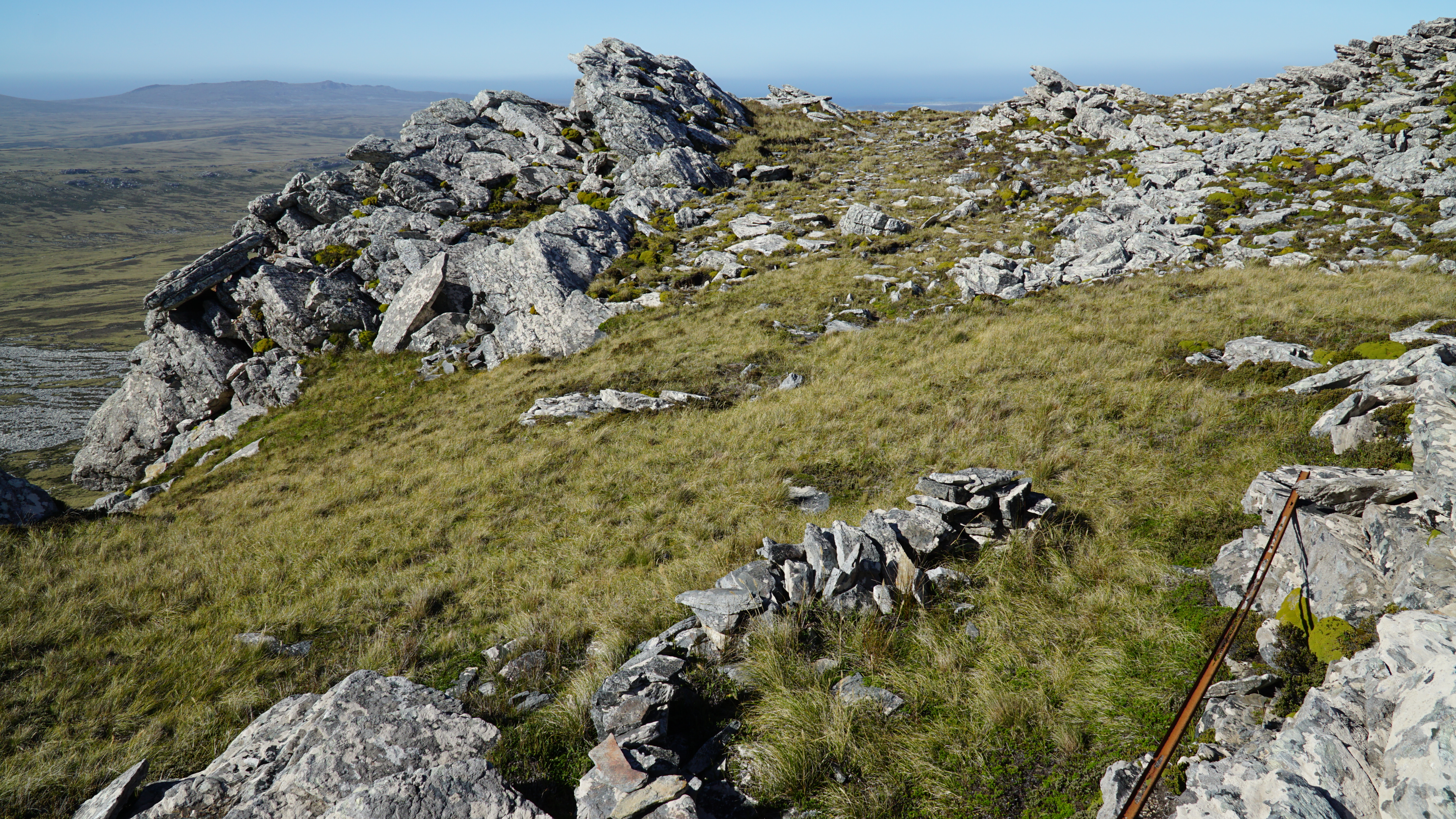
The position has been constructed against a rocky crag using local rock to build a wall front and sides, and steel rails that are likely to have come from the narrow gauge railway between Camber Point fuel depot and Moody Brook radio station. Corrugated iron sheet nearby suggests this was also used to weatherproof the shelter. I have called this a command post because of the large size and both the effort and materials that have been used to construct it. It could also have served as an observation post due to the commanding views over the ground to its front.

The position has been constructed against a rocky crag using local rock to build a wall front and sides, and steel rails that are likely to have come from the narrow gauge railway between Camber Point fuel depot and Moody Brook radio station. Corrugated iron sheet nearby suggests this was also used to weatherproof the shelter. I have called this a command post because of the large size and both the effort and materials that have been used to construct it. It could also have served as an observation post due to the commanding views over the ground to its front.

The decaying remains of a 1982 Argentine field kitchen on the eastern approach to Mount Tumbledown that would once have provided hot foot and drink to the soldiers dug in to defend the mountain and the approach to Stanley.

The decaying remains of a 1982 Argentine field kitchen on the eastern approach to Mount Tumbledown that would once have provided hot foot and drink to the soldiers dug in to defend the mountain and the approach to Stanley.

The decaying remains of a 1982 Argentine field kitchen on the eastern approach to Mount Tumbledown that would once have provided hot foot and drink to the soldiers dug in to defend the mountain and the approach to Stanley.

The decaying remains of a 1982 Argentine field kitchen on the eastern approach to Mount Tumbledown that would once have provided hot foot and drink to the soldiers dug in to defend the mountain and the approach to Stanley.

The decaying remains of a 1982 Argentine field kitchen on the eastern approach to Mount Tumbledown that would once have provided hot foot and drink to the soldiers dug in to defend the mountain and the approach to Stanley.

The decaying remains of a 1982 Argentine field kitchen on the eastern approach to Mount Tumbledown that would once have provided hot foot and drink to the soldiers dug in to defend the mountain and the approach to Stanley.

The decaying remains of a 1982 Argentine field kitchen on the eastern approach to Mount Tumbledown that would once have provided hot foot and drink to the soldiers dug in to defend the mountain and the approach to Stanley.

An infantry position, possibly for a machine gun given the commanding view across the east approach to Mount Tumbledown. It is facing west, the direction of likely British advance and covers the Argentine access to the mountain.

An infantry position, possibly for a machine gun given the commanding view across the east approach to Mount Tumbledown. It is facing west, the direction of likely British advance and covers the Argentine access to the mountain.
Historical Overview
Mount Tumbledown, Mount William, and Sapper Hill are located to the west of Port Stanley, the capital of the Falkland Islands. Due to their proximity to the capital, these positions held strategic importance during the 1982 Falklands War. On the night of 13–14 June, British forces launched an offensive against Mount Tumbledown and the surrounding high ground. The operation was successful, forcing the retreat of the Argentine force. This engagement, one of several night battles during the British advance toward Stanley, allowed British troops to secure a dominant position over the town, leading to the fall of Stanley and the surrender of Argentine forces on the islands.
Quick Facts
UK (Scots Guards)
- Commander: Mike Scott
- Strength: ca. 500 Mann
- Casualties: 10
Argentina
- Commander: Carlos Robacio
- Strength: ca. 450 Mann
- Casualties: 33
Strategic Context
Breaking final resistance before Stanley.
Related Literature


Der Eiserne Vorhang: Die Unterdrückung Osteuropas 1944–1956

Die Kubakrise 1962

Mao und seine verlorenen Kinder: Chinas Kulturrevolution

Maos Großer Hunger: Massenmord und Menschenexperiment in China
Historical Locations
Interactive map requires third-party cookie consent.