Battle of Tanga

Germans on the left, British on the right
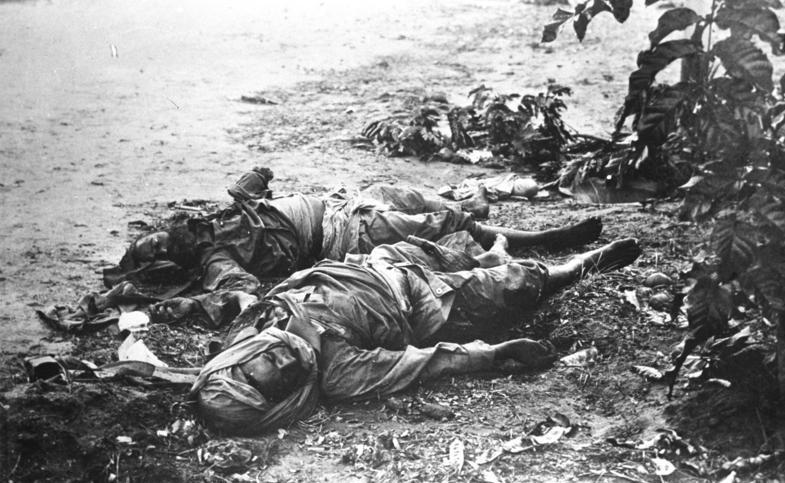
For documentary purposes the German Federal Archive often retained the original image captions, which may be erroneous, biased, obsolete or politically extreme. Englische Landung bei Tanga, 2. bis 4. November 1914: Indische Gefallene des Landungskorps.

Der Krieg 1914-19 in Wort und Bild, published 1919.
Historical Overview
The Battle of Tanga, also known as the Battle of the Bees, was an unsuccessful invasion of the Port of Tanga in German East Africa by the British Indian Expeditionary Force "B" on 3–5 November 1914 during World War I. Under the command of the Major-General Arthur Aitken, British forces attacked Tanga in concert with Indian Expeditionary Force "C", which concomitantly attempted to capture Longido. The battle was the first major engagement of the East African campaign and saw Aitken's troops defeated by a smaller force of German Schutztruppen under Paul von Lettow-Vorbeck and forced to retreat. Lettow-Vorbeck's men captured weapons, medical supplies, tents, blankets, rations and several Maxim guns after the battle, which played a major role in allowing his troops to resist the Allies for the rest of the world conflict.
Quick Facts
Schutztruppe
- Commander: Lettow-Vorbeck
- Strength: ca. 1.100
- Casualties: ca. 150
British India
- Commander: Arthur Aitken
- Strength: ca. 8.000
- Casualties: ca. 1.000
Strategic Context
Attempt to capture German East Africa via landing at a main hub.
Related Literature


Frühling der Revolution: Europa 1848/49 und der Kampf für eine neue Welt
Christopher Clark

Risorgimento! Italiens Kampf um die Einheit im 19. Jahrhundert
Historical Locations
Interactive map requires third-party cookie consent.