Battle of Taierzhuang

Chinese soldiers in house-to-house fighting in the Battle of Tai'erzhuang

1938年,中国军队攻入台儿庄,与日军展开巷战。

Brick wall with bullet holes left during Battle of Taierzhuang displayed at the National Museum of China.
![A Chinese infantry soldier during the Battle of Taierzhuang putting on a explosive suicide vest made out of Model 24 hand grenades to use in a suicide bombing against a Japanese tank.
Due to lack of anti-armor weaponry, Suicide bombing was also used against the Japanese. Chinese troops strapped explosives like grenade packs or dynamite to their bodies and threw themselves under Japanese tanks to blow them up.[1] Dynamite and grenades were strapped on by Chinese troops who rushed at Japanese tanks and blew themselves up.[2][3][4][5][6] During one incident at Taierzhuang, Chinese suicide bombers obliterated four Japanese tanks with grenade bundles.[7][8]](https://upload.wikimedia.org/wikipedia/commons/0/0b/Chinese_infantry_soldier_preparing_a_suicide_vest_of_Model_24_hand_grenades_at_the_Battle_of_Taierzhuang_against_Japanese_Tanks.jpg)
A Chinese infantry soldier during the Battle of Taierzhuang putting on a explosive suicide vest made out of Model 24 hand grenades to use in a suicide bombing against a Japanese tank. Due to lack of anti-armor weaponry, Suicide bombing was also used against the Japanese. Chinese troops strapped explosives like grenade packs or dynamite to their bodies and threw themselves under Japanese tanks to blow them up.[1] Dynamite and grenades were strapped on by Chinese troops who rushed at Japanese tanks and blew themselves up.[2][3][4][5][6] During one incident at Taierzhuang, Chinese suicide bombers obliterated four Japanese tanks with grenade bundles.[7][8]
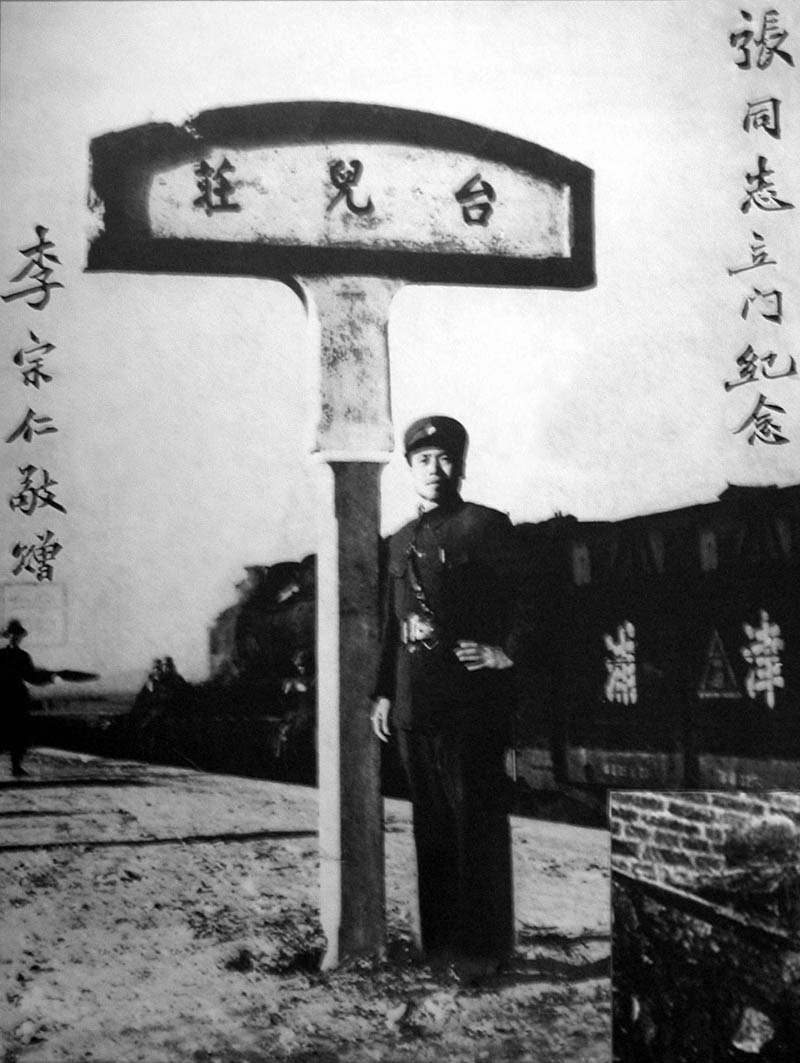
General Li Zongren/Li Tsung-jen at Tai'erzhuang/Taierhchwang

Chinese soldiers charge against enemy emplacements in the Battle of Tai'erzhuang

Chinese soldiers take cover near wrecked Japanese trucks near Taierzhuang, a dead horse is visible in the foreground.

台儿庄会战形势图
Historical Overview
The Battle of Taierzhuang took place during the Second Sino-Japanese War in 1938. It was fought between the armies of the Republic of China and the Empire of Japan at the peak of the Xuzhou Campaign. The battle was the war's first major Chinese victory. The battle was a setback for the Japanese military and its reputation as an invincible force. For Chinese forces, it was a tremendous morale boost.
Quick Facts
Rep. of China
- Commander: Li Zongren
- Strength: ca. 100.000
- Casualties: ca. 13.000
Empire of Japan
- Commander: Rensuke Isogai
- Strength: ca. 30.000
- Casualties: ca. 8.000
Strategic Context
Breaking the myth of Jap. invincibility.
Related Literature


Der Gulag

Die Schlacht um Berlin und das Ende des Dritten Reichs 1945

Hunde, wollt ihr ewig leben: ein Stalingrad-Roman

Roter Hunger: Stalins Krieg gegen die Ukraine

So weit die Füße tragen

Söldner ohne Sold: Die deutschen Freikorps 1918–1923

Vom Massensturm zur Stoßtrupptaktik: Die deutsche Landkriegtaktik im Spiegel von Dienstvorschriften und Publizistik 1906 bis 1918

Wir Wehr-Wölfe: Erinnerungen eines Freikorps-Führers

Zweiter Weltkrieg Erlebnisbericht Apokalypse Stalingrad: Untergang der 6. Armee 1942-1943
Walter Mönch
Rise And Fall Of The Third Reich
William Shirer
Historical Locations
Exact location not recorded in historical records