All Battles

Battle of Cannae

-216 Apulien Feldschlacht

Battle of Cannae, in Catalan

Battle of Cannae, in Catalan

Author: File:Battle cannae destruction.gif: Frank Martini. Cartographer, Department of History, United States Military Academy. File:Battle cannae destruction.-fr.svg: User:Mr H. translation: SMP (talk page)License:PD
Source
Hannibal Barca at the battle of Cannae (216 BC)

Hannibal Barca at the battle of Cannae (216 BC)

Author: Heinrich Leutemann (1824-1905)License:PD
Source
IdentificatieTitel(s): Dood van Lucius Aemilius Paulus IPaolo Emilio moribondo alla Battaglia di Canne, ricusa il cavallo che gli offre il Tribuno Lentulo, volendo morire frà la strage de' suoi Romani (titel op object). Geschiedenis van het Romeinse Rijk (serietitel). Frontespizio della Istoria Romana (serietitel)Objecttype: prent Serienummer: 57/101Objectnummer: RP-P-1929-223Catalogusreferentie: Marini&Fagiolo 57Opschriften / Merken: verzamelaarsmerk, verso, gestempeld: Lugt 2228; opschrift, recto midden onder, handgeschreven in inkt: ‘Paulus Aemilius weigert in den slag van Canna, stervend het paard dat de Tribuun Lentulus hem aanbiedt, daar hij ster-/ ven wil, temidden der slachting onder zijne Romeinen’Omschrijving: De gewonde Lucius Aemilius Paulus I weigert een paard aan te nemen van de tribuun Lentulus. Lucius Aemilius Paulus I kiest ervoor te sterven te midden van zijn soldaten tijdens de Slag bij Cannae.VervaardigingVervaardiger: prentmaker: Bartolomeo Pinelli (vermeld op object), naar eigen ontwerp van: Bartolomeo Pinelli (vermeld op object)Plaats vervaardiging: RomeDatering: 1817Fysieke kenmerken: etsMateriaal: papier Techniek: etsenAfmetingen: plaatrand: h 315 mm × b 425 mmToelichtingDeze prent maakt deel uit van een reeks van 101 prenten over de geschiedenis van Rome.OnderwerpWat: (story of) Lucius Aemilius Paul(l), us - death of person from classical historyVerwerving en rechtenCredit line: Schenking van J.J. de Man, EdeVerwerving: schenking 1929Copyright: Publiek domein

IdentificatieTitel(s): Dood van Lucius Aemilius Paulus IPaolo Emilio moribondo alla Battaglia di Canne, ricusa il cavallo che gli offre il Tribuno Lentulo, volendo morire frà la strage de' suoi Romani (titel op object). Geschiedenis van het Romeinse Rijk (serietitel). Frontespizio della Istoria Romana (serietitel)Objecttype: prent Serienummer: 57/101Objectnummer: RP-P-1929-223Catalogusreferentie: Marini&Fagiolo 57Opschriften / Merken: verzamelaarsmerk, verso, gestempeld: Lugt 2228; opschrift, recto midden onder, handgeschreven in inkt: ‘Paulus Aemilius weigert in den slag van Canna, stervend het paard dat de Tribuun Lentulus hem aanbiedt, daar hij ster-/ ven wil, temidden der slachting onder zijne Romeinen’Omschrijving: De gewonde Lucius Aemilius Paulus I weigert een paard aan te nemen van de tribuun Lentulus. Lucius Aemilius Paulus I kiest ervoor te sterven te midden van zijn soldaten tijdens de Slag bij Cannae.VervaardigingVervaardiger: prentmaker: Bartolomeo Pinelli (vermeld op object), naar eigen ontwerp van: Bartolomeo Pinelli (vermeld op object)Plaats vervaardiging: RomeDatering: 1817Fysieke kenmerken: etsMateriaal: papier Techniek: etsenAfmetingen: plaatrand: h 315 mm × b 425 mmToelichtingDeze prent maakt deel uit van een reeks van 101 prenten over de geschiedenis van Rome.OnderwerpWat: (story of) Lucius Aemilius Paul(l), us - death of person from classical historyVerwerving en rechtenCredit line: Schenking van J.J. de Man, EdeVerwerving: schenking 1929Copyright: Publiek domein

Author: RijksmuseumLicense:CC0
Source
Il fiume Fortore della battaglia di Canne nella zona comune delle fonti antiche

Il fiume Fortore della battaglia di Canne nella zona comune delle fonti antiche

Author: WikidemarcoLicense:CC-BY-SA-4.0
Source
Lodovico Pogliaghi - Roman women in the temple of Mars after Cannae, 215 BC

Lodovico Pogliaghi - Roman women in the temple of Mars after Cannae, 215 BC

Author: Lodovico PogliaghiLicense:PD
Source
Punti storici d’Italia: campo della battaglia di Canne.

Punti storici d’Italia: campo della battaglia di Canne.

Author: Gustav Adolf ClossLicense:PD
Source
Placchette rinascimentali

Placchette rinascimentali

Author: SailkoLicense:CC-BY-4.0
Source
Il moderno, battaglia di canne, 1503-1504

Il moderno, battaglia di canne, 1503-1504

Author: sailkoLicense:CC-BY-SA-4.0
Source
Picture from a bird's eye view of a roman maniple. Image was created in Autodesk 3DS Max with extracted models of Legio XX Roman Legionaries from the Roma Surrectum II mod for Rome Total War.

Picture from a bird's eye view of a roman maniple. Image was created in Autodesk 3DS Max with extracted models of Legio XX Roman Legionaries from the Roma Surrectum II mod for Rome Total War.

Author: Strikerg13License:CC-BY-SA-4.0
Source
Romuleon-BnF365-fol. 89, Bataille de Tarente

Romuleon-BnF365-fol. 89, Bataille de Tarente

Author: Jean Colombe et son Atelier (XVe siècle)License:PD
Source
Schieramento iniziale battaglia di Canne

Schieramento iniziale battaglia di Canne

Author: WikidemarcoLicense:CC-BY-SA-4.0
Source
Livy, Histoire romaine. Translation from the Latin by Pierre Bersuire: The battle of Cannae
Place of origin, date: Paris, follower of the Luçon Master, First Master of the Grande Bible Historiale Complétée of Jean, Duc de Berry (Paris, BNF, fr. 159) or Ravenelle Master (illuminators); c. 1390-1400
Material: Vellum, ff. 228+196+160 (3 vols.), 415x303 (279x188) mm, 52 lines, littera textualis, Bindings: 18th-century brown leather; gilt
Decoration: Vol. I: 1 two-column miniature (145x185 mm); 9 column miniatures (80/70x85/80 mm); 2 illustrations in the margin (emblems); decorated initials with border decoration (ff. 9r, 12v, 19r, 23v, 26v, etc.); penwork initials throughout. Vol. II: 1 two-column miniature(154x185 mm); 9 column miniatures (100/80x105/80 mm); 2 illustrations in the margin (emblems); decorated initials with border decoration (ff. 5r, 8r, 25r, 46r, 64r, etc.); penwork initials throughout. Vol. III: 1 two-column miniature (140x188 mm); 8 column miniatures (85/70x90/80mm); 2 illustrations in the margin (emblems); decorated initials with border decoration (ff. 5r, 10r, 22v, 36r, 55r, etc.); penwork initials throughout. Added: coats of arms, emblems and motto of Philip of Cleves on the opening pages of all three volumes
Provenance: possibly made for Bertrando de Rossi, Count of San Secundo (emblem). Louis de Luxembourg, connétable de France (d. 1475; signature); by descent to his granddaughter Françoise de Luxembourg and her husband Philip of Cleves (d. 1528; coats of arms, emblems, motto;signature); purchased in 1531 from Philip's estate by Henry III, Count of Nassau (d. 1538); by descent to the Princes of Orange-Nassau, the later Stadholders, at The Hague; carried off in 1795 to Paris by the French and restituted to the Koninklijke Bibliotheek in 1816
Livy, Histoire romaine. Translation from the Latin by Pierre Bersuire: The battle of Cannae Place of origin, date: Paris, follower of the Luçon Master, First Master of the Grande Bible Historiale Complétée of Jean, Duc de Berry (Paris, BNF, fr. 159) or Ravenelle Master (illuminators); c. 1390-1400 Material: Vellum, ff. 228+196+160 (3 vols.), 415x303 (279x188) mm, 52 lines, littera textualis, Bindings: 18th-century brown leather; gilt Decoration: Vol. I: 1 two-column miniature (145x185 mm); 9 column miniatures (80/70x85/80 mm); 2 illustrations in the margin (emblems); decorated initials with border decoration (ff. 9r, 12v, 19r, 23v, 26v, etc.); penwork initials throughout. Vol. II: 1 two-column miniature(154x185 mm); 9 column miniatures (100/80x105/80 mm); 2 illustrations in the margin (emblems); decorated initials with border decoration (ff. 5r, 8r, 25r, 46r, 64r, etc.); penwork initials throughout. Vol. III: 1 two-column miniature (140x188 mm); 8 column miniatures (85/70x90/80mm); 2 illustrations in the margin (emblems); decorated initials with border decoration (ff. 5r, 10r, 22v, 36r, 55r, etc.); penwork initials throughout. Added: coats of arms, emblems and motto of Philip of Cleves on the opening pages of all three volumes Provenance: possibly made for Bertrando de Rossi, Count of San Secundo (emblem). Louis de Luxembourg, connétable de France (d. 1475; signature); by descent to his granddaughter Françoise de Luxembourg and her husband Philip of Cleves (d. 1528; coats of arms, emblems, motto;signature); purchased in 1531 from Philip's estate by Henry III, Count of Nassau (d. 1538); by descent to the Princes of Orange-Nassau, the later Stadholders, at The Hague; carried off in 1795 to Paris by the French and restituted to the Koninklijke Bibliotheek in 1816

Author: follower of the Luçon Master, First Master of the Grande Bible Historiale Complétée of Jean, Duc de Berry (Paris, BNF, fr. 159) or Ravenelle Master (illuminators)License:PD
Source
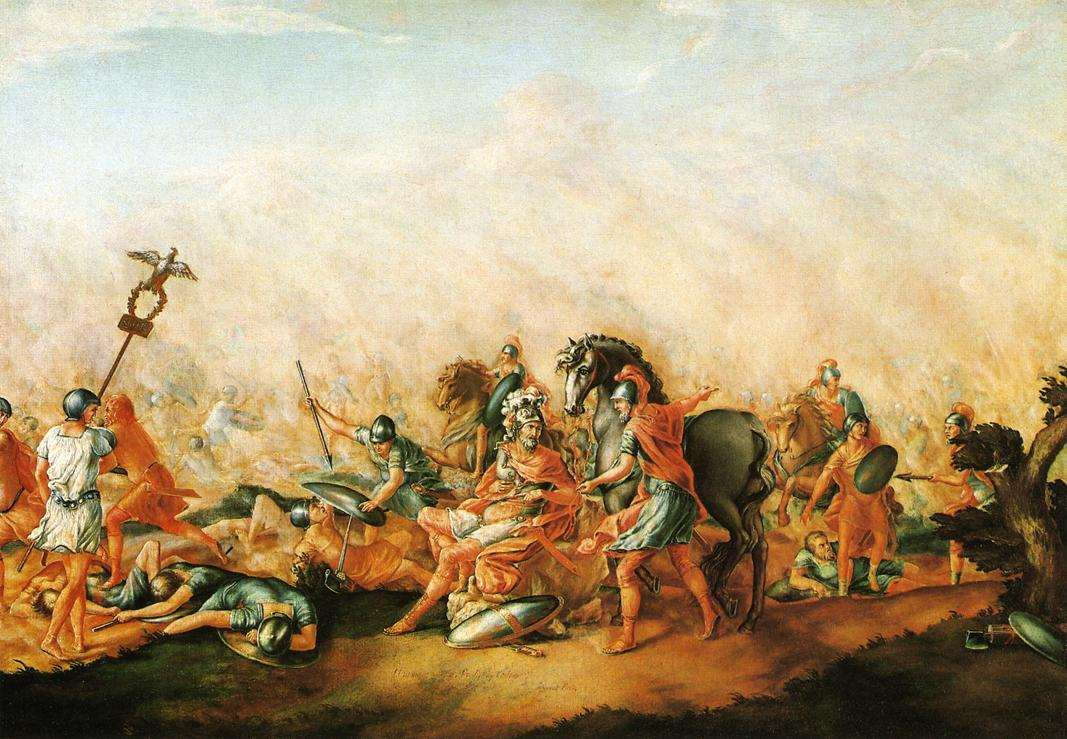
The Death of Aemilius Paulus

The Death of Aemilius Paulus

Author: John TrumbullLicense:PD
Source
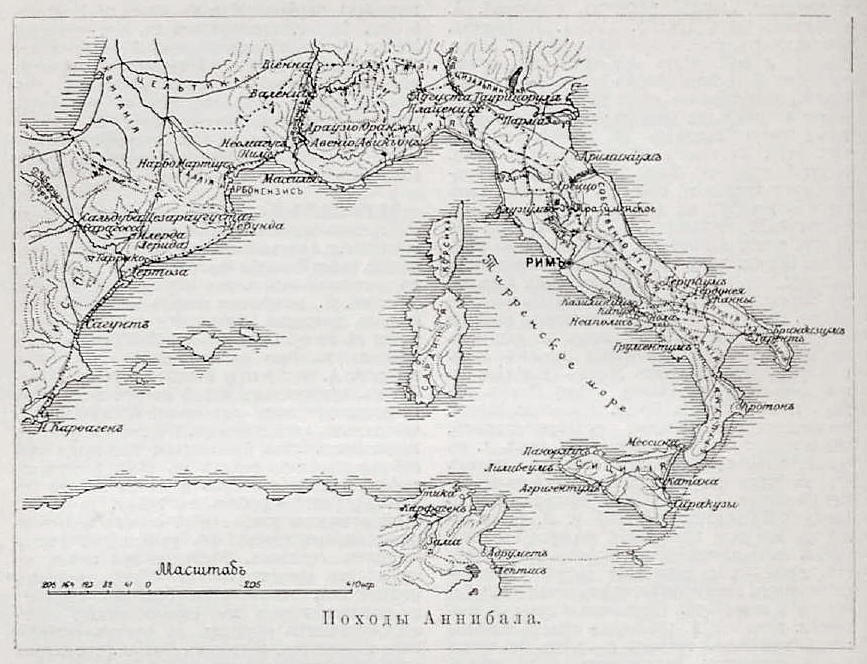
Данное изображение было использовано в статье «Аннибал» опубликованной во втором томе «Военной энциклопедии», который был издан книгоиздательским товариществом Ивана Дмитриевича Сытина в 1911 году в столице Российской империи городе Санкт-Петербурге.

Данное изображение было использовано в статье «Аннибал» опубликованной во втором томе «Военной энциклопедии», который был издан книгоиздательским товариществом Ивана Дмитриевича Сытина в 1911 году в столице Российской империи городе Санкт-Петербурге.

Author: «Военная энциклопедия И. Д. Сытина». Том 2 (Санкт-Петербург; 1911).License:PD
Source
The sumptuous illustration on this volume was attributed to Bartolomeo della Gatta (1448-1502). Framed by allegorical figure, there is a tableau showing eight dignitaries, and a standing character, illustrating the passage in which Mango Barca (243-203 B.C.) arrived in Carthage announcing the victory in Cannae (Punic War Ⅱ, 216 B.C.).

The sumptuous illustration on this volume was attributed to Bartolomeo della Gatta (1448-1502). Framed by allegorical figure, there is a tableau showing eight dignitaries, and a standing character, illustrating the passage in which Mango Barca (243-203 B.C.) arrived in Carthage announcing the victory in Cannae (Punic War Ⅱ, 216 B.C.).

Author: 氏子License:CC-BY-SA-4.0
Source

Historical Overview

Hannibal's masterpiece. Through a double envelopment, he encircled and almost completely destroyed the numerically superior Roman army.

Quick Facts

Outcome:Decisive Carthaginian victory; heaviest defeat in Rome's history.

Carthage

  • Commander: Hannibal Barkas
  • Strength: ca. 50.000 Mann
  • Casualties: ca. 6.000 - 8.000

Roman Republic

  • Commander: Terentius Varro
  • Strength: ca. 80.000 Mann
  • Casualties: ca. 50.000 - 70.000

Strategic Context

Hannibal's attempt to force Rome into surrender by a crushing defeat on its own soil and to lure away its allies.

Conflict / War

Punic Wars

Decisive Roman victory; Rome's rise as a naval power.

Related Literature

Cover of GOLDSWORTHY:ROMAN ARMY AT WAR 100BC-AD200

GOLDSWORTHY:ROMAN ARMY AT WAR 100BC-AD200

Non-fictionAncient RomeMilitärgeschichte

English
Classical Antiquity
Cover of Auf dem Weg zum Imperium: Eine Geschichte der römischen Armee

Auf dem Weg zum Imperium: Eine Geschichte der römischen Armee

Non-fictionAncient RomeMilitärgeschichte

German
Classical Antiquity
Cover of Aufstieg und Fall des Alten Ägypten: Die Geschichte einer geheimnisvollen Zivilisation vom 5. Jahrtausend v. Chr. bis Kleopatra

Aufstieg und Fall des Alten Ägypten: Die Geschichte einer geheimnisvollen Zivilisation vom 5. Jahrtausend v. Chr. bis Kleopatra

Non-fictionAncient WorldAltes Ägypten

German
Classical Antiquity
Cover of Caesar lässt grüßen: Die Geschichte der Römer

Caesar lässt grüßen: Die Geschichte der Römer

Non-fictionAncient Rome

German
Classical Antiquity
Cover of Das alte Griechenland: Die visuelle Geschichte. Hochwertiger Bildband mit über 850 Fotos

Das alte Griechenland: Die visuelle Geschichte. Hochwertiger Bildband mit über 850 Fotos

Illustrated BookAncient GreeceAncient World

German
Classical Antiquity
Cover of Das frühe Persien: Geschichte eines antiken Weltreichs

Das frühe Persien: Geschichte eines antiken Weltreichs

Non-fictionPersian HistoryAncient World

German
Classical Antiquity
Cover of Die verdammt blutige Geschichte der Antike: ohne den ganzen langweiligen Kram

Die verdammt blutige Geschichte der Antike: ohne den ganzen langweiligen Kram

Ancient WorldErzählendes Sachbuch

German
Classical Antiquity
Cover of Eine unerzählte Geschichte der Antike: Auf den Spuren vergessener Orte – von Britannia bis Vietnam

Eine unerzählte Geschichte der Antike: Auf den Spuren vergessener Orte – von Britannia bis Vietnam

Non-fictionAncient World

German
Classical Antiquity
Cover of Feldherren, Krieger und Strategen: Krieg in der Antike von Achill bis Attila

Feldherren, Krieger und Strategen: Krieg in der Antike von Achill bis Attila

Non-fictionAncient WorldMilitärstrategie

German
Classical Antiquity
Cover of Geschichte der römischen Kaiserzeit: Von Augustus bis zu Konstantin

Geschichte der römischen Kaiserzeit: Von Augustus bis zu Konstantin

Non-fictionAncient RomeGerman Empire

German
Classical Antiquity
Cover of Geschichte der römischen Republik: Von den Anfängen bis Augustus

Geschichte der römischen Republik: Von den Anfängen bis Augustus

Non-fictionAncient RomeRepublikc

German
Classical Antiquity
Cover of Gladius: Roms Legionen in Germanien

Gladius: Roms Legionen in Germanien

Non-fictionGerman HistoryAncient Rome

German
Classical Antiquity
Cover of Krise und Untergang der römischen Republik

Krise und Untergang der römischen Republik

Non-fictionAncient Rome

German
Classical Antiquity
Cover of Römische Geschichte

Römische Geschichte

Non-fictionAncient Rome

German
Classical Antiquity
Cover of Römische Geschichte: 5 Bände im Schuber

Römische Geschichte: 5 Bände im Schuber

Non-fictionAncient Rome

German
Classical Antiquity
Cover of Römische Geschichte: Von den Anfängen bis zum Untergang

Römische Geschichte: Von den Anfängen bis zum Untergang

Non-fictionAncient Rome

German
Classical Antiquity
Cover of Über die Germanen: Tacitus – antike Geschichtsschreibung über die Bewohner Germaniens

Über die Germanen: Tacitus – antike Geschichtsschreibung über die Bewohner Germaniens

ReportGerman HistoryAncient Rome

German
Classical Antiquity

Historical Locations

Interactive map requires third-party cookie consent.