Battle of the Catalaunian Plains

Battaglia dei Campi Catalaunici

An historical map showing the Hun invasion of Gaul in 451 CE (AD), leading to the Battle of Chalons. The generally accepted routes are shown, along with the larger cities threatened or sacked by the Huns.

A hunok Galliában 451-ben

An historical map showing the Hun invasion of Gaul in 451 CE (AD), leading to the Battle of Chalons. The generally accepted routes are shown, along with the larger cities threatened or sacked by the Huns. Various sources give conflicting information on whether some cities were sacked, in particular Trier. Man says "no", while Ferrill says "yes". Most other sources agree with Ferrill. There are also several cities southeast of Troyes which were said to have been sacked, including Auxerre, Besancon, and Langres.

De veldtochten van Attila in Gallië in 451

Поход гуннов в Галлию (451 год)

匈人入侵高卢,最终发生了沙隆战役。图中展示了普遍认同的双方进军路线,并标记了受到威胁或遭到劫掠的较大城市。

An historical map showing the Hun invasion of Gaul in 451 CE (AD), leading to the Battle of Chalons. The generally accepted routes are shown, along with the larger cities threatened or sacked by the Huns.

Diagramação da Batalha dos Campos Cataláunicos
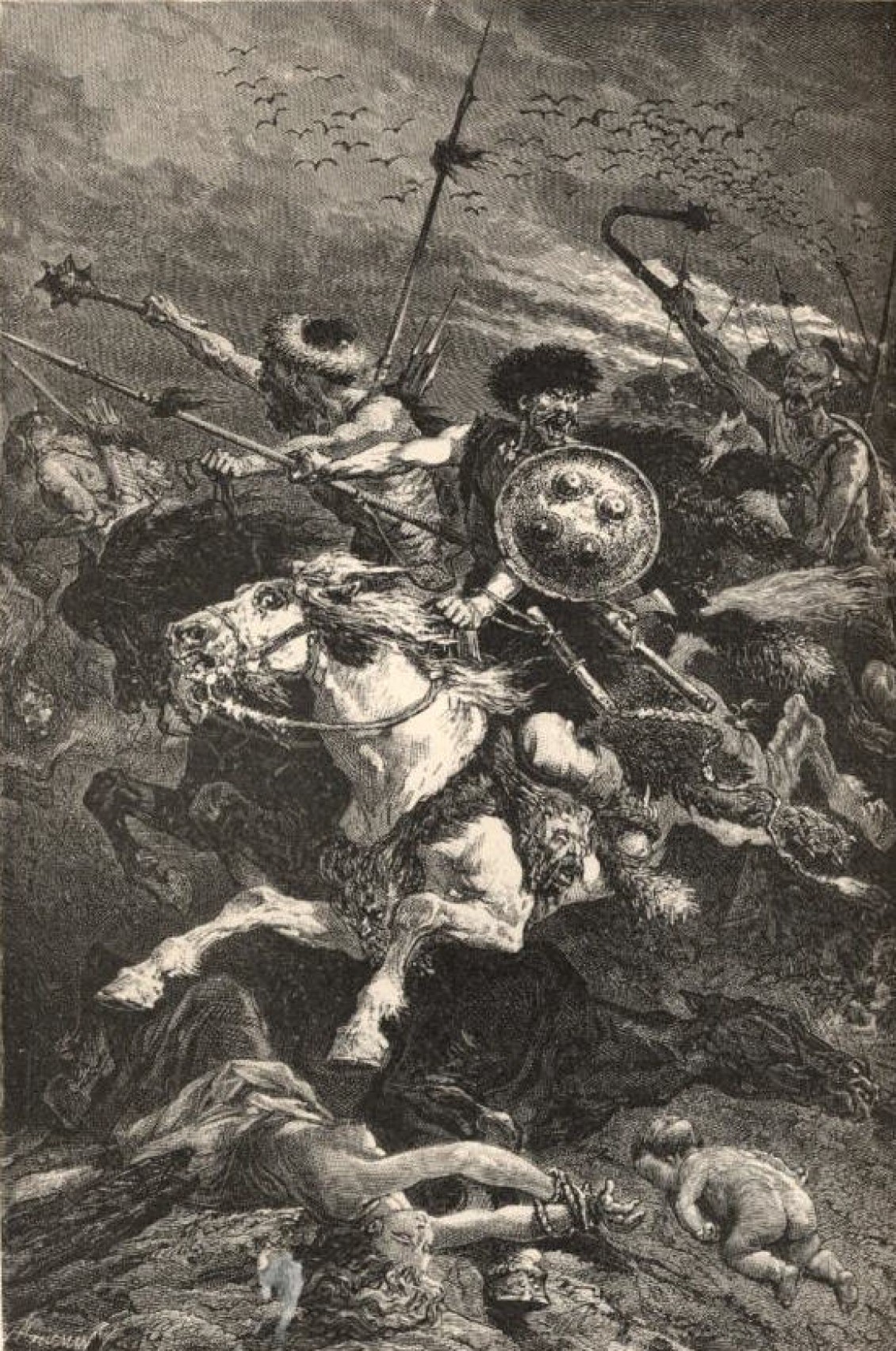
"The Huns at the Battle of Chalons" from page 135 of A Popular History of France From The Earliest Times Volume I of VI (en:Project Gutenberg e-text). Illustration by A. De Neuville (1836-1885)

Battle of the Catalaunian plains, between Attila, Aetius, Meroveus and Theodoric I; from Jacob van Maerlant's Spieghel Historiael (KB KA 20, fol. 146v)

Body of Theodoric is carried from the battlefield

Bataille des champs Catalauniques (451)

Huns by Rochegrosse 1910

Roman villa in Gaul sacked by the hordes of Attila the Hun. Signed 'GRochegrosse' (lower right).

Saint Aignan church of Orléans (Loiret, France) : Arrival of Aetius' army

Silvered bronze mount of an armoire depicting the victory of Merovingian King Merovech over the armies of Attila the Hun in 451. By Emmanuel Fremiet, 1867. In the collection of the Metropolitan Museum of Art.
![Roman villa in Gaul sacked by the hordes of Attila the Hun. Illustration from a book:Georges Rochegrosse, sa vie, son oeuvre [par J. Valmy-Baysse] Nombreuses reproductions ([1910])](https://upload.wikimedia.org/wikipedia/commons/9/99/Huns_by_Rochegrosse.jpg)
Roman villa in Gaul sacked by the hordes of Attila the Hun. Illustration from a book:Georges Rochegrosse, sa vie, son oeuvre [par J. Valmy-Baysse] Nombreuses reproductions ([1910])
Historical Overview
The Battle of the Catalaunian Plains, also called the Battle of the Campus Mauriacus, Battle of Châlons, Battle of Troyes or the Battle of Maurica, took place on 20 June 451 AD, between a coalition, led by the Roman general Flavius Aetius and the Visigothic king Theodoric I, against the Huns and their vassals, commanded by their king, Attila. It proved to be one of the last major military operations of the Western Roman Empire, although Germanic foederati composed the majority of the coalition army. The exact strategic significance is disputed. Historians generally agree that the siege of Aurelianum was the decisive moment in the campaign and stopped the Huns' attempt to advance any further into Roman territory or establish vassals in Roman Gaul. However, the Huns looted and pillaged much of Gaul and crippled the military capacity of the Romans and Visigoths. Attila died only two years later, in 453. After the Battle of Nedao in 454, the coalition of the Huns and the incorporated Germanic vassals gradually disintegrated.
Quick Facts
Roman-Gothic Alliance
- Commander: Flavius Aetius / Theoderich I. †
- Strength: ca. 50.000 Mann
- Casualties: ca. 10.000 - 15.000
Huns & Vassals
- Commander: Attila
- Strength: ca. 50.000 - 60.000 Mann
- Casualties: ca. 20.000
Strategic Context
Defending against the massive Hunnic invasion of Gaul, which would have meant the collapse of the Western Roman Empire.
Conflict / War
Hunnic Invasions
Related Literature

Geschichte der Spätantike: Das Römische Reich von Diocletian bis Justinian 284-565 n. Chr.
Historical Locations
Interactive map requires third-party cookie consent.