Battle of Bussaco

These two faces of the basis read : Roliça 17 - VIII - 1808 Buçaco 27 - IX - 1810

No.2 Battle of Sierra de Basaco above St. Antonio de Cantaro title QS:P1476,en:"No.2 Battle of Sierra de Basaco above St. Antonio de Cantaro "label QS:Len,"No.2 Battle of Sierra de Basaco above St. Antonio de Cantaro "

Detail of the Tiles depicting the Batalha of Buçaco, victoriously fought on September 27, 1810. Memorial at Buçaco : https://commons.wikimedia.org/wiki/File:Bussaco_1810.JPG Location : Inner court of the Museum, northernmost corner.

Tiles depicting the Batalha of Buçaco, victoriously fought on September 27, 1810 by the Anglo-Portuguese Army against the napoléonic invader. Tiles created around 1900. At Buçaco, a commemorative obelisk has been erected in 1873 : https://commons.wikimedia.org/wiki/File:Bussaco_1810.JPG.
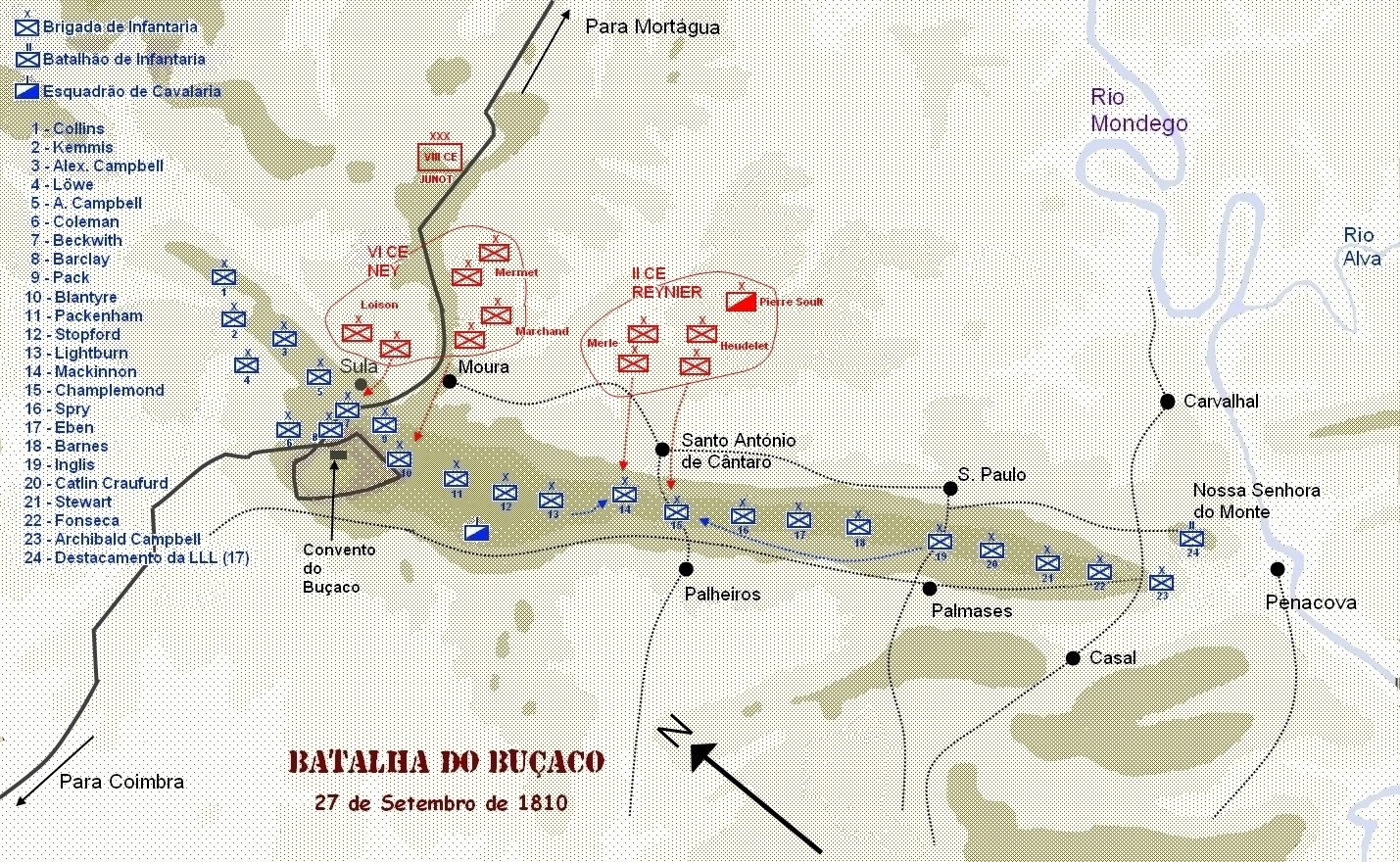
Map showing the locations of the units at the start of the Battle of Buçaco.

Bataille de Buçaco, 27 septembre 1810. Les 43e et 52e régiments d'infanterie légère britanniques attaquent les soldats français de la division Loison.

"The First French Invasion", by Roque Gameiro, in Quadros da História de Portugal ("Pictures of the History of Portugal", 1917).

Engraving representing the Battle of Buçaco - September 27, 1810 - published in London on June 1, 1815, by J. Jenkins, 48 Strand. There is in the Military Historical Archives, Lisbon, Portugal, and is identified with the code EN-AHM-FE-10-A7-MD-12.A

Charles Turner - No.2 Battle of Sierra de Basaco above St. Antonio de Cantaro - B1978.43.1025 - Yale Center for British Art (cropped)

British infantry deployed in line on the ridge at Bussaco during the Peninsular War. Successive campaigns in the Iberian Peninsula led to a continuous drain on French manpower.
Historical Overview
The Battle of Buçaco or Bussaco was fought on 27 September 1810 during the Peninsular War in the Portuguese mountain range of Serra do Buçaco, resulting in the defeat of French forces by Lord Wellington's Anglo-Portuguese Army. Having occupied the heights of Bussaco with a total of 26,843 British and 25,429 Portuguese troops, Wellington was attacked five times successively by invasion force of 65,050 French under Marshal André Masséna. Masséna was uncertain as to the disposition and strength of the opposing forces because Wellington had deployed them on the reverse slope of the ridge, where they could neither be easily seen nor easily softened up with artillery.
Quick Facts
British & Portuguese
- Commander: Lord Wellington
- Strength: ca. 52.000
- Casualties: ca. 1.250
Kingdom of France
- Commander: André Masséna
- Strength: ca. 65.000
- Casualties: ca. 4.500
Strategic Context
Delaying the French advance on Lisbon.
Related Literature


Die Schlacht: Waterloo 1815
Historical Locations
Interactive map requires third-party cookie consent.