Battle of Saipan

Marine PFC code talker Cecil G. Trosip of Oraibi, Arizona at communication system on Saipan

4th Marine Division. Saipan. In a burned out cane field, near a former Japanese observation post, a Marine patrol, which has been scouting the eastern coast of Saipan, listens to its squad leader as he reads the day's news from the daily mimeographed newspaper printed on Saipan by the Marines. The paper is distributed by the same trucks which bring supplies to Marines at front line positions

4th Marine Division Marines advance on a Japanese occupied cave
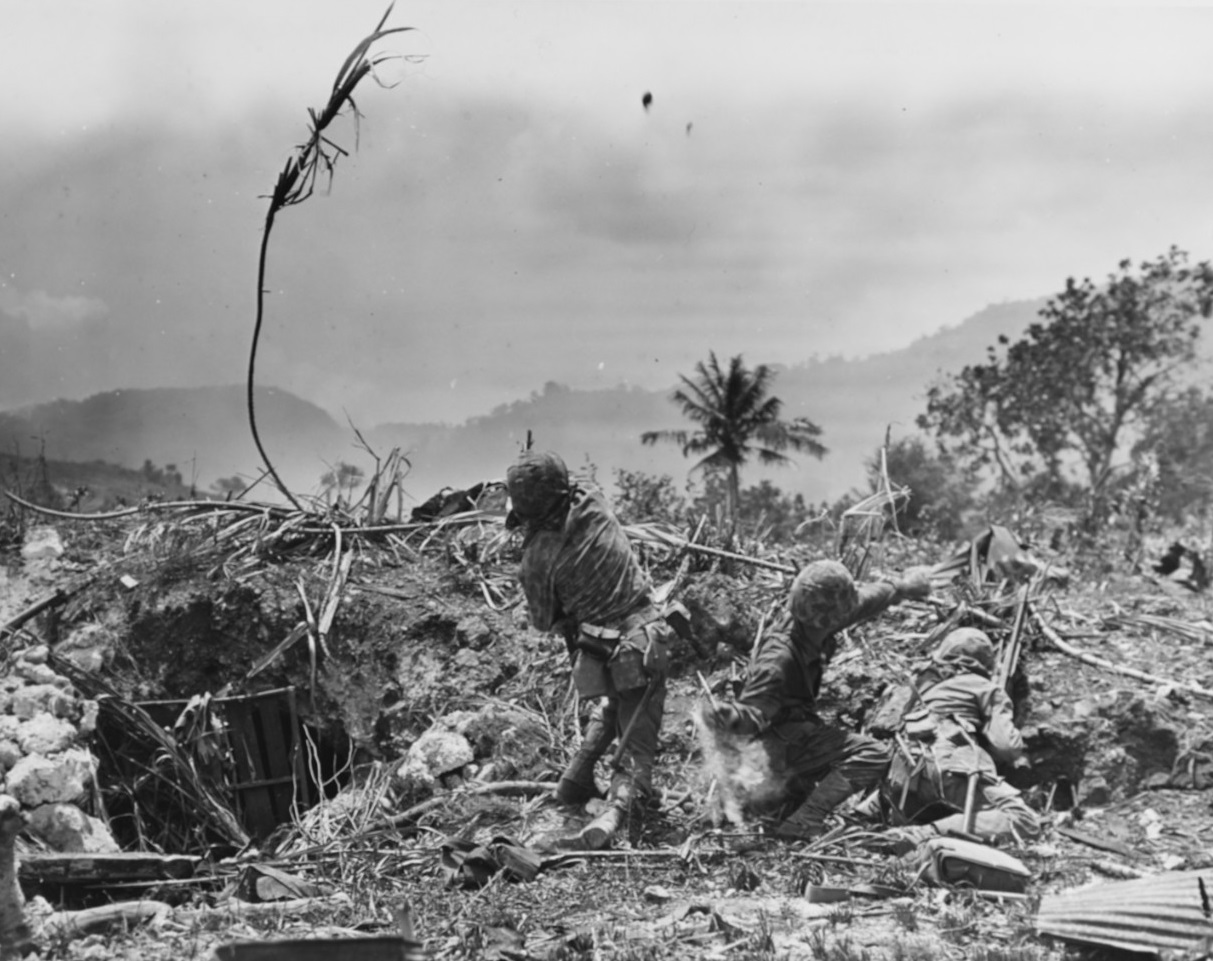
A marine throws a hand grenade at an enemy position on Saipan. A second marine is about to throw his grenade which is smoking from its burning fuse

WorldWarII SaipanandTinian1

"After the Marines captured this mountain gun from the Japs at Saipan, they put it into use during the attack on Garapan, administrative center of the island."

"Marine Sgt. F. Smit...and Cpl. S. Brown...open a coconut to get a cool drink on Saipan."

"Negro assault troops await orders D-day to attack enemy shortly after they had come ashore at Saipan in the Marianas."
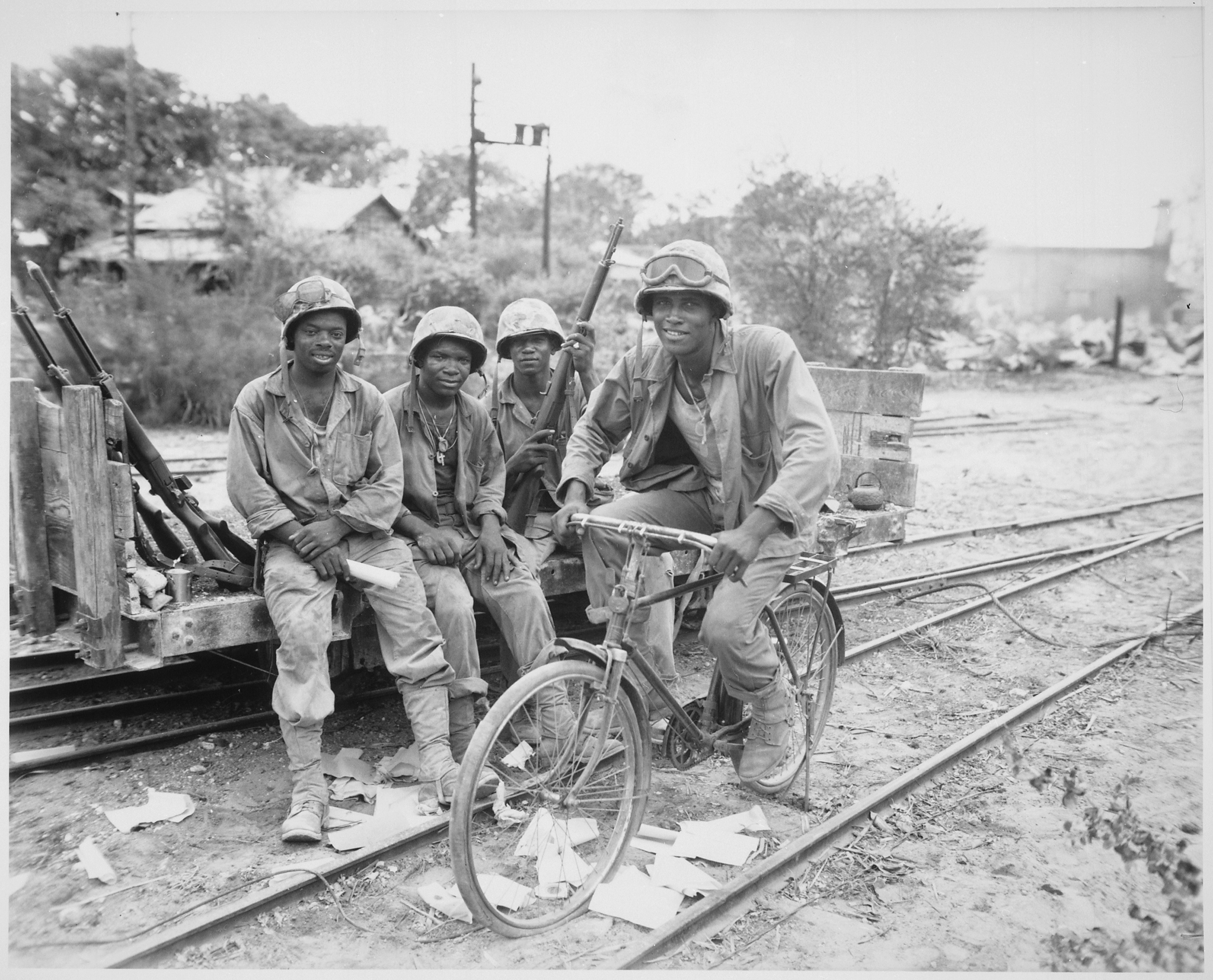
"Negro Marines, attached to the Third Ammunition Company, take time out from supplying ammunition to the front line on Saipan. Riding captured...bicycle is Pfc. Horace Boykin; and left to right, Cpl. Willis T. Anthony, Pfc. Emmitt Shackelford, and Pfc. Eugene Purdy."

The above photo of a Tenth Marines howitzer section in action during the campaign for Saipan shows how crew drill was used in combat.

Four 4th Marine Division Marines take cover behind trees as they mop-up Japanese in a canefield. Mount Tapochau is in the background
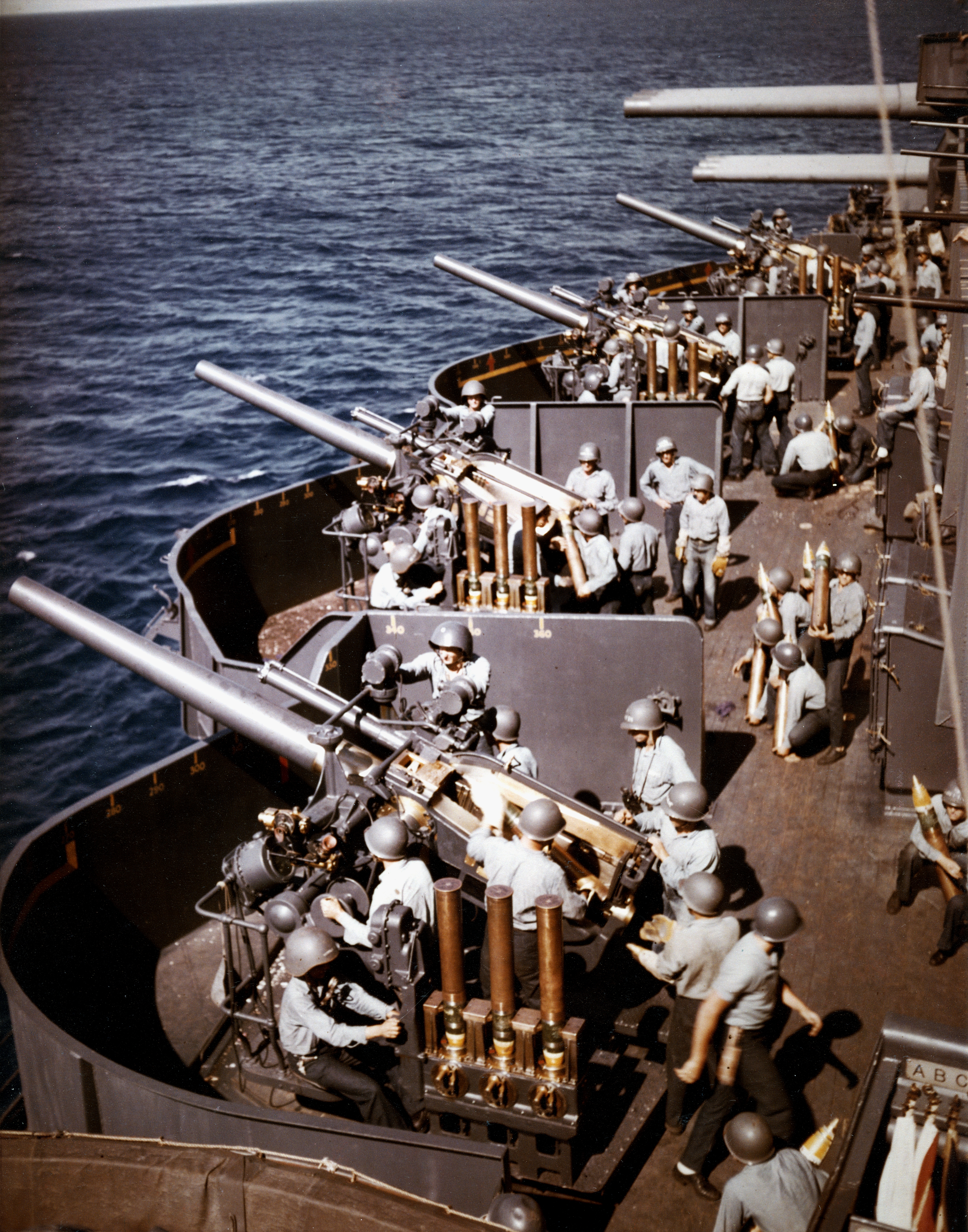
The 5"/25 (127 mm) battery aboard the U.S. Navy battleship USS New Mexico (BB-40) prepares to fire during the bombardment of Saipan, 15 June 1944. Note the time-fuze setters on the left side of each gun mount, each holding three "fixed" rounds of ammunition; the barrels of 20 mm machine guns at the extreme right; and triple the 14"/50 (34.5 cm) guns in the background.

Map of Allied amphibious landings in the 1941-1944 Pacific War with information about Saipan marked in blue.

Members of the 1st JASCO operating an SCR 284 radio during the battle of Saipan, 1944

2d Marine Division Troops on Tanapag plain after Gyokusai attack, Saipan July 1944
![7/14 Saipan. Lieutenant General Robert G. Richardson, Jr., Commanding General, CPA (Central Pacific Area) passes huge stores of captured foodstuffs now used to feed civilian internees on Saipan. Laudansky [photographer?]. 10/01/1944. (ref:W-CPA-44-6953)](https://upload.wikimedia.org/wikipedia/commons/9/96/3365882431_e146a4947e_oSaipan.jpg)
7/14 Saipan. Lieutenant General Robert G. Richardson, Jr., Commanding General, CPA (Central Pacific Area) passes huge stores of captured foodstuffs now used to feed civilian internees on Saipan. Laudansky [photographer?]. 10/01/1944. (ref:W-CPA-44-6953)
![Saipan. Jap civilians in temporary internment camp under USMC guard. Combat scenes, Signal Corps. 10/01/1944. World War 2. W-CPA-44-5881. 6/17 Gurtcheff [photographer?].Note: the caption was transcribed from the original WW2 record.](https://upload.wikimedia.org/wikipedia/commons/a/a6/3403070618_ab9425d1c4_oSaipan.jpg)
Saipan. Jap civilians in temporary internment camp under USMC guard. Combat scenes, Signal Corps. 10/01/1944. World War 2. W-CPA-44-5881. 6/17 Gurtcheff [photographer?].Note: the caption was transcribed from the original WW2 record.
![Saipan. Aerial view of Garapan, largest Jap city on Saipan, showing effects of bombing and naval fire. It is referred to as the "Casino of the Pacific" because of the bitter street fighting which took place there. July Laudansky [photographer?]. 10/01/194World War 2. W-CPA-44-6737 (ref:E44-78-31) ; the caption was transcribed from the original WW2 record.](https://upload.wikimedia.org/wikipedia/commons/4/49/3403070894_ac0308be6d_oSaipan.jpg)
Saipan. Aerial view of Garapan, largest Jap city on Saipan, showing effects of bombing and naval fire. It is referred to as the "Casino of the Pacific" because of the bitter street fighting which took place there. July Laudansky [photographer?]. 10/01/194World War 2. W-CPA-44-6737 (ref:E44-78-31) ; the caption was transcribed from the original WW2 record.

37mm gun crew in battle lg

Fires rage at a fuel dump (left center) and the Charan-Kanoa sugar refinery (right) during strikes on Saipan at the time of the invasion in center is the Aslito Airfield
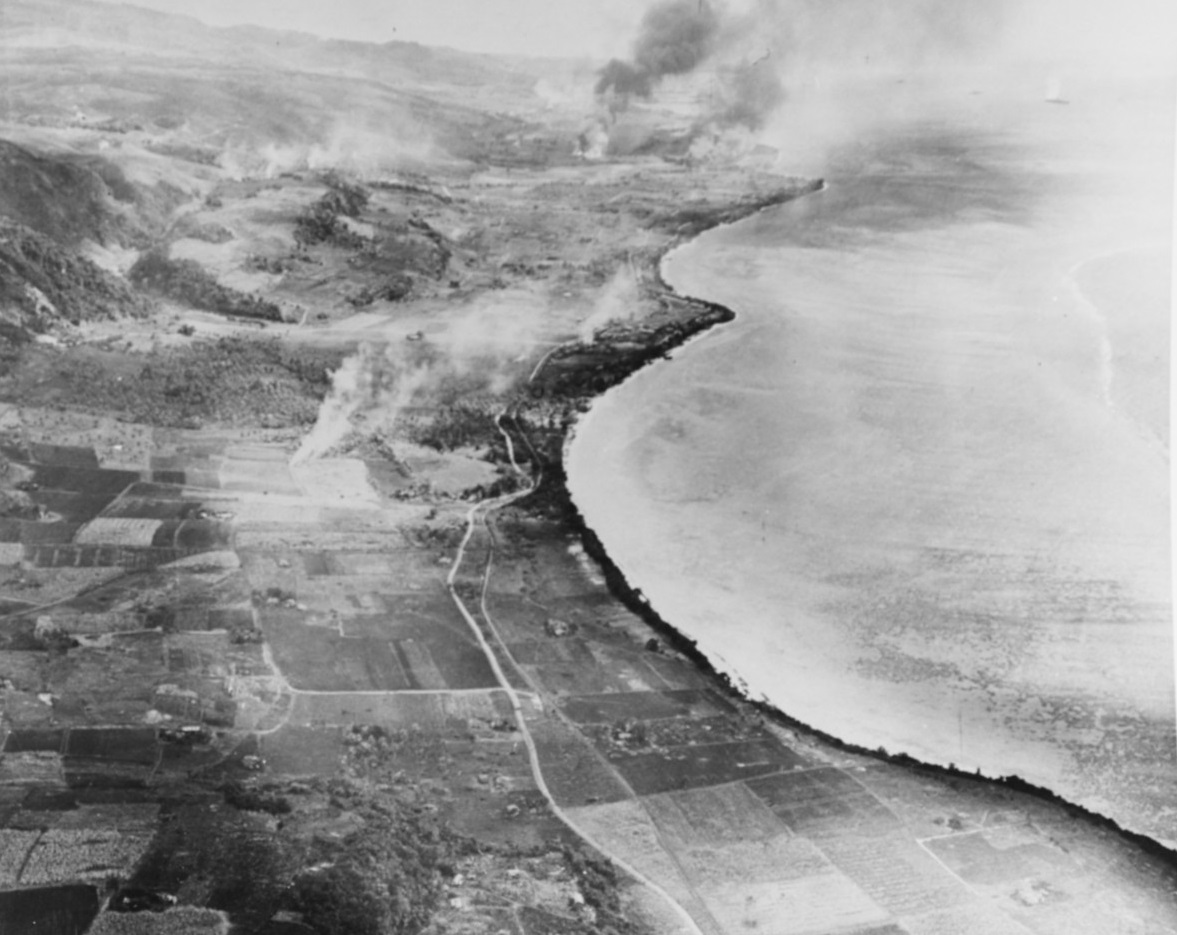
Naval bombardment in support of Marine operations ashore, during June-July 1944

Pilots of the 73rd Fighter Squadron, 7th USAAF, receive briefing on the flight deck of USS Manila Bay (CVE-61) prior to take off for Saipan, where they will be based. Planes are P-47s.
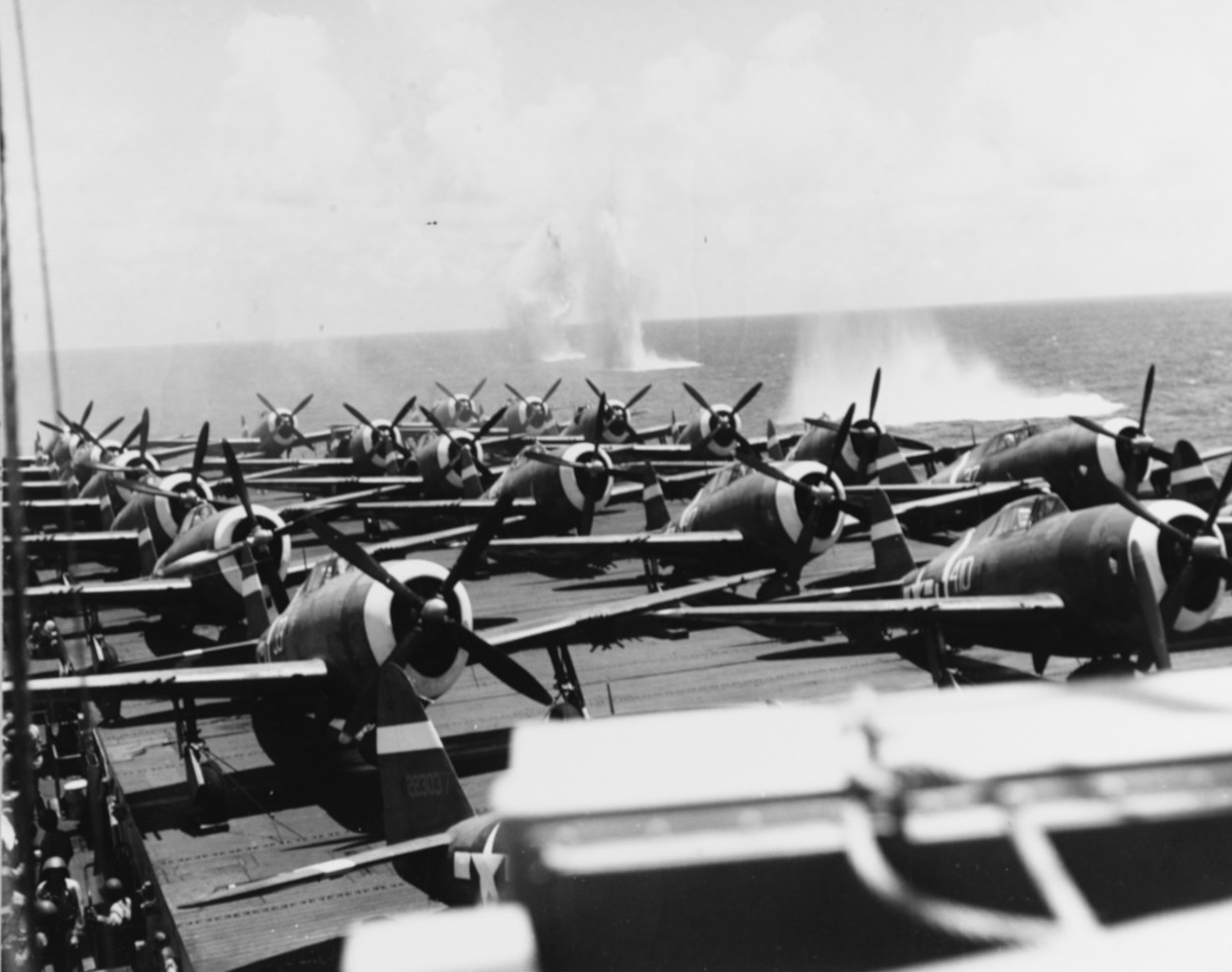
USS Manila Bay (CVE-61) under bombing attack by four Japanese "Zeke" aircraft, off Saipan, at 12:05 on 23 June 1944. Note USAAF P-47 fighters on deck, for delivery to Saipan airfields.
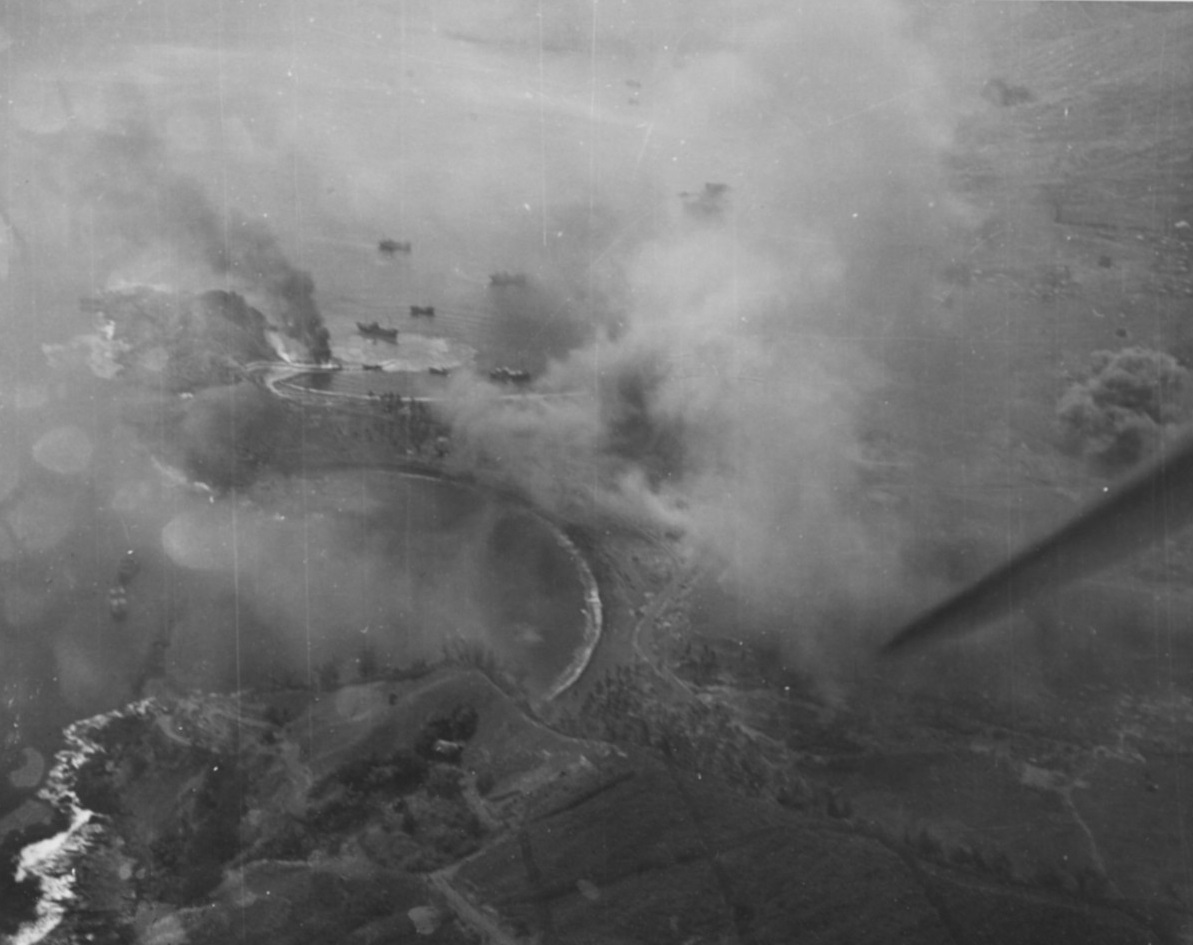
Navy planes strike coastal shipping and other targets on Pagan Island, 23 June 1944

TF-58 planes raid Pagan Island, 23 June 1944. Note SB2C "Helldiver" in distance
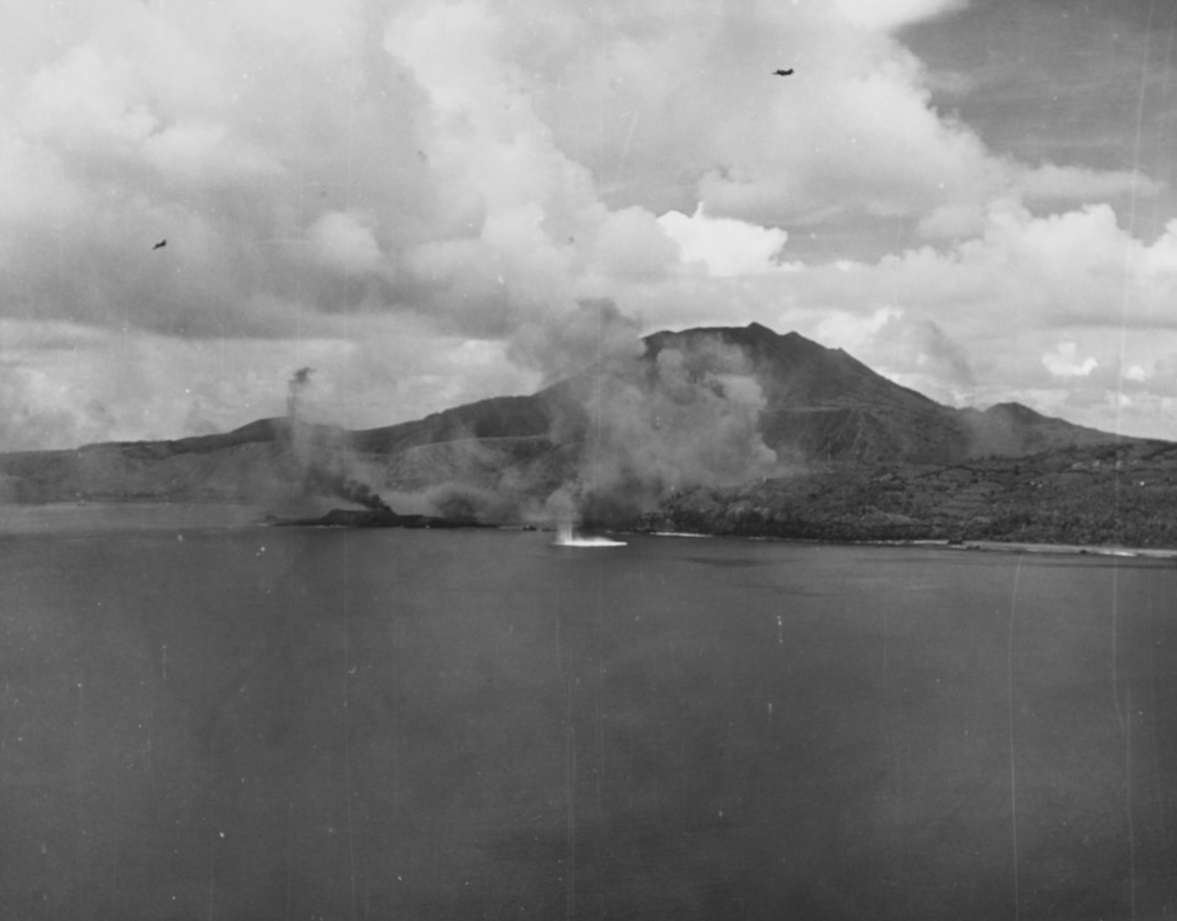
TF-58 planes raid Pagan Island, 23 June 1944. Note two SB2C Helldivers
Historical Overview
The Battle of Saipan was an amphibious assault launched by the United States against the Empire of Japan during the Pacific campaign of World War II between 15 June and 9 July 1944. The initial invasion triggered the Battle of the Philippine Sea, which effectively destroyed Japanese carrier-based airpower, and the battle resulted in the American capture of the island. Its occupation put the major cities of the Japanese home islands within the range of B-29 bombers, making them vulnerable to strategic bombing by the United States Army Air Forces. It also precipitated the resignation of Hideki Tōjō, the prime minister of Japan.
Quick Facts
US Marine Corps
- Commander: Holland Smith
- Strength: 71000
- Casualties: 3426
Empire of Japan
- Commander: Yoshitsugu Saitō †
- Strength: 31000
- Casualties: 29000
Strategic Context
Japan comes within range of American B-29 bombers.
Related Literature


Der Gulag

Die Schlacht um Berlin und das Ende des Dritten Reichs 1945

Hunde, wollt ihr ewig leben: ein Stalingrad-Roman

Roter Hunger: Stalins Krieg gegen die Ukraine

So weit die Füße tragen

Söldner ohne Sold: Die deutschen Freikorps 1918–1923

Vom Massensturm zur Stoßtrupptaktik: Die deutsche Landkriegtaktik im Spiegel von Dienstvorschriften und Publizistik 1906 bis 1918

Wir Wehr-Wölfe: Erinnerungen eines Freikorps-Führers

Zweiter Weltkrieg Erlebnisbericht Apokalypse Stalingrad: Untergang der 6. Armee 1942-1943
Walter Mönch
Rise And Fall Of The Third Reich
William Shirer
Historical Locations
Interactive map requires third-party cookie consent.