All Battles

Ruhr Pocket

1945 Ruhrgebiet Kesselschlacht

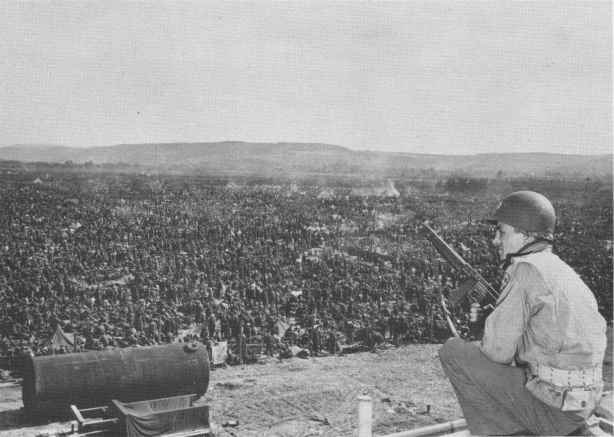
At a prisoner-of-war enclosure near Remagen, Germany, one of the Rheinwiesenlager, a U.S. soldier takes part in keeping guard over thousands of German soldiers captured in the Ruhr area.

At a prisoner-of-war enclosure near Remagen, Germany, one of the Rheinwiesenlager, a U.S. soldier takes part in keeping guard over thousands of German soldiers captured in the Ruhr area.

Author: Unknown authorUnknown authorLicense:PD
Source
General notes:  Use War and Conflict Number 1093 when ordering a reproduction or requesting information about this image.

General notes: Use War and Conflict Number 1093 when ordering a reproduction or requesting information about this image.

Author: Unknown authorUnknown author or not providedLicense:PD
Source
Churchill tanks of 6th Guards Tank Brigade carrying paratroopers from the American 17th Airborne Division pass through Dorsten in Germany, while an Achilles tank destroyer waits, 29 March 1945.
Churchill tanks of 6th Guards Tank Brigade carrying paratroopers from the American 17th Airborne Division pass through Dorsten, 29 March 1945. On the right is an Achilles 17-pdr tank destroyer.

Churchill tanks of 6th Guards Tank Brigade carrying paratroopers from the American 17th Airborne Division pass through Dorsten in Germany, while an Achilles tank destroyer waits, 29 March 1945. Churchill tanks of 6th Guards Tank Brigade carrying paratroopers from the American 17th Airborne Division pass through Dorsten, 29 March 1945. On the right is an Achilles 17-pdr tank destroyer.

Author: No 5 Army Film & Photographic Unit, Midgley (Sgt)License:PD
Source
Churchill tanks of 6th Guards Tank Brigade carrying paratroopers of the 17th US Airborne Division, Germany, 29 March 1945.

Churchill tanks of 6th Guards Tank Brigade carrying paratroopers of the 17th US Airborne Division, Germany, 29 March 1945. Churchill tanks of 6th Guards Tank Brigade carrying paratroopers of the 17th US Airborne Division, Germany, 29 March 1945.

Author: No 5 Army Film & Photographic Unit, Norris (Sgt)License:PD
Source
Crossing of the Rhine

Crossing of the Rhine

Author: UnknownLicense:PD
Source
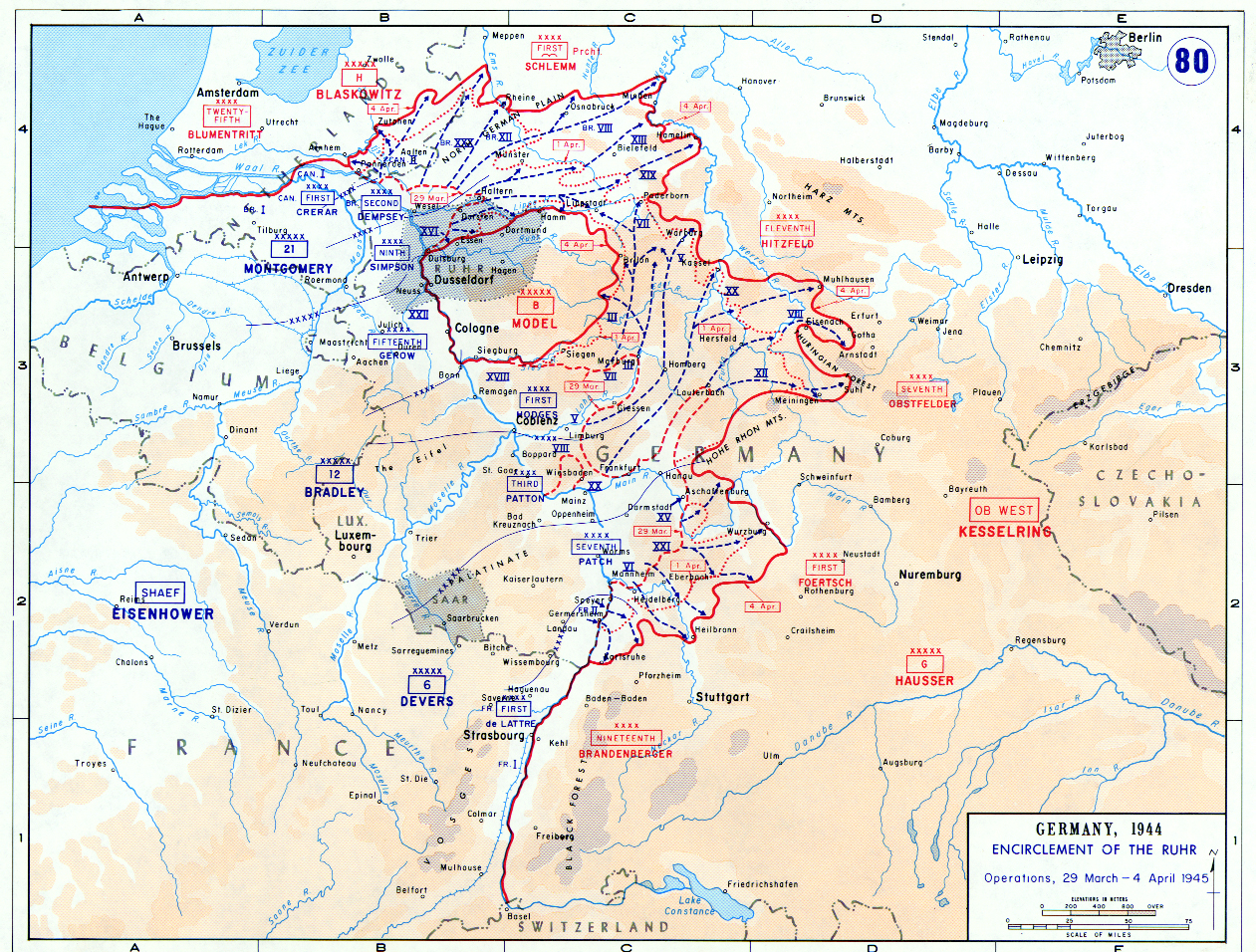
Encirclement of the Ruhr

Encirclement of the Ruhr

Author: UnknownLicense:PD
Source
Gedenktafel "Zur Mahnung" am Polizeipräsidium Düsseldorf: 
In diesem Hause der Polizei waren 1933–1945 "zur Verfügung der GESTAPO" (Geheime Staatspolizei im SS-Staat) für Stunden oder Wochen insgesamt 7101 Männer und 851 Frauen eingesperrt. Viele wurden von hier aus in "Konzentrationslager" gebracht, andere töteten sich selbst, weil sie die Folterungen nicht ertragen konnten. Todesnot litten sie alle. 
Auch der Kommandeur der Schutzpolizei, Oberstleutnant Franz Jürgens und die Bürger Knab, Kleppe, Weill und Andreesen waren hier am 16. April 1945 inhaftiert, weil sie versucht hatten, die Stadt Düsseldorf kampflos an die Alliierten Befreier zu übergeben, um Tod und Zerstörung Einhalt zu gebieten. Nach einem standgerichtlichen Mordurteil in der Nacht zum 17. April 1945 wurde Jürgens mit seinen Getreuen im Hof der Berufsschule an der Färberstraße erschossen und verscharrt. Ein Düsseldorfer Schwurgericht erklärte 1949 jenes Mordurteil für rechtens. Dem hat sich 1952 der Bundesgerichtshof angeschlossen.

 "Der Tod ist ein Meister aus Deutschland" (Paul Celan)

Gedenktafel "Zur Mahnung" am Polizeipräsidium Düsseldorf: In diesem Hause der Polizei waren 1933–1945 "zur Verfügung der GESTAPO" (Geheime Staatspolizei im SS-Staat) für Stunden oder Wochen insgesamt 7101 Männer und 851 Frauen eingesperrt. Viele wurden von hier aus in "Konzentrationslager" gebracht, andere töteten sich selbst, weil sie die Folterungen nicht ertragen konnten. Todesnot litten sie alle. Auch der Kommandeur der Schutzpolizei, Oberstleutnant Franz Jürgens und die Bürger Knab, Kleppe, Weill und Andreesen waren hier am 16. April 1945 inhaftiert, weil sie versucht hatten, die Stadt Düsseldorf kampflos an die Alliierten Befreier zu übergeben, um Tod und Zerstörung Einhalt zu gebieten. Nach einem standgerichtlichen Mordurteil in der Nacht zum 17. April 1945 wurde Jürgens mit seinen Getreuen im Hof der Berufsschule an der Färberstraße erschossen und verscharrt. Ein Düsseldorfer Schwurgericht erklärte 1949 jenes Mordurteil für rechtens. Dem hat sich 1952 der Bundesgerichtshof angeschlossen. "Der Tod ist ein Meister aus Deutschland" (Paul Celan)

Author: Jula2812License:CC-BY-SA-4.0
Source
Julius Nierstenhöfer (Jg. 1886), Hohenlimburg, Oegerstr. 79, war Sozialdemokrat und kandidierte bei der Stadtverordnetenwahl im März 1933 auf der Liste der Hohenlimburger SPD. Wegen Tätigkeit in einer kommunistischen Widerstandsgruppe wurde er 1936 zu vier Jahren Zuchthaus verurteilt. Denunziert und verhaftet am 9.2.1945. Ermordet im April 1945 im Rombergpark/Dortmund. Verlegter Stolperstein Oeger Straße 79 nicht mehr vorhanden.

Julius Nierstenhöfer (Jg. 1886), Hohenlimburg, Oegerstr. 79, war Sozialdemokrat und kandidierte bei der Stadtverordnetenwahl im März 1933 auf der Liste der Hohenlimburger SPD. Wegen Tätigkeit in einer kommunistischen Widerstandsgruppe wurde er 1936 zu vier Jahren Zuchthaus verurteilt. Denunziert und verhaftet am 9.2.1945. Ermordet im April 1945 im Rombergpark/Dortmund. Verlegter Stolperstein Oeger Straße 79 nicht mehr vorhanden.

Author: Unknown photographerLicense:CC-BY-SA-4.0
Source
Am 30. Mai 2015 enthüllte Plastik Friedensstele 70 Jahre Frieden in Letmathe seit dem 16. April 1945 (Cortenstahl, 55 cm x 30 cm x 220 cm) im Park von Haus Letmathe in Iserlohn-Letmathe, Hagener Straße 62.  Künstler: Frank Haase aus Hemer.

Am 30. Mai 2015 enthüllte Plastik Friedensstele 70 Jahre Frieden in Letmathe seit dem 16. April 1945 (Cortenstahl, 55 cm x 30 cm x 220 cm) im Park von Haus Letmathe in Iserlohn-Letmathe, Hagener Straße 62. Künstler: Frank Haase aus Hemer.

Author: Asio otusLicense:CC-BY-SA-4.0
Source
Photo of Major General Maurice Rose, scanned from Post WWII 3rd Armored division government publication "Spearhead in the West", published by the Division in occupied Germany.
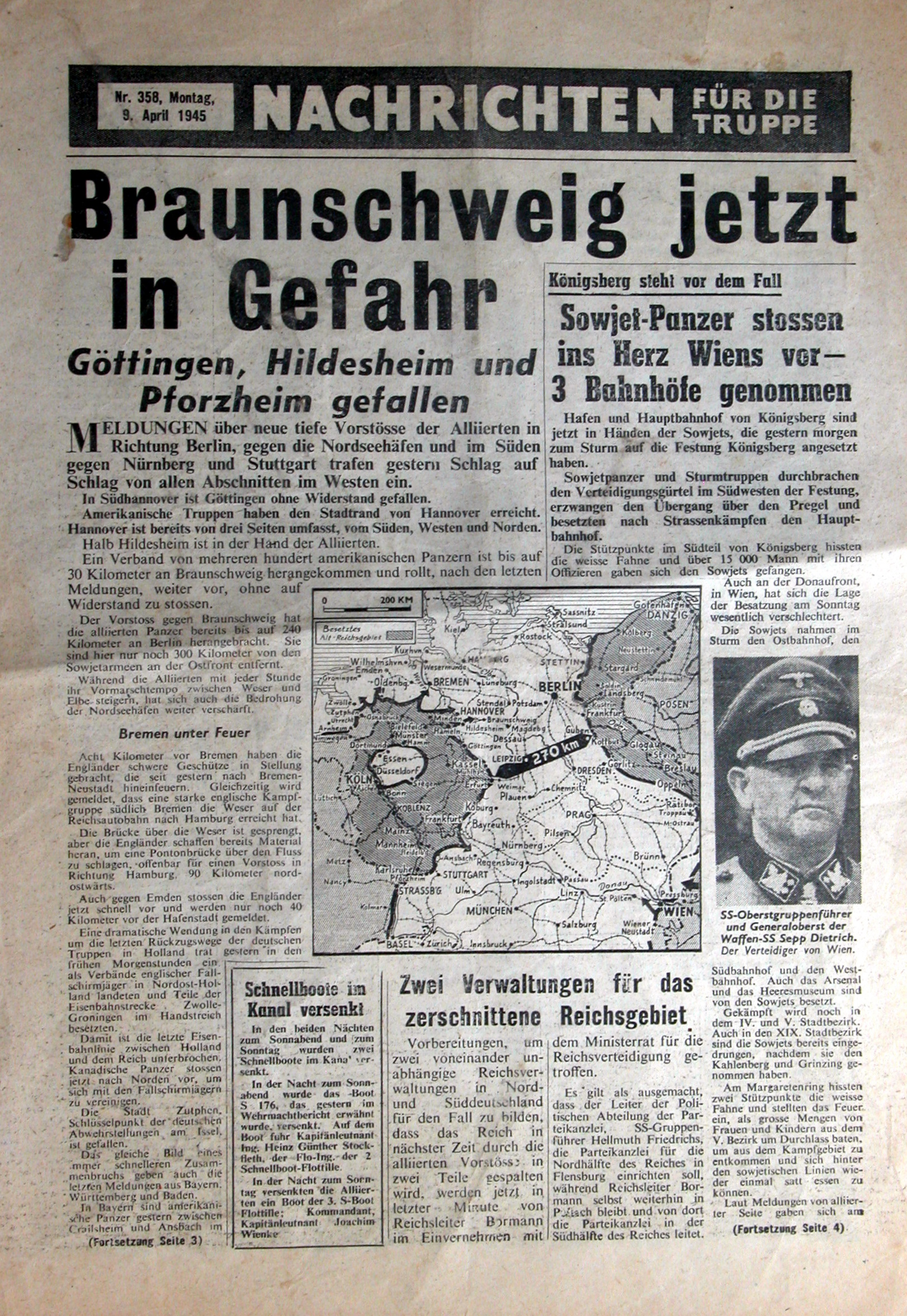
Photo of Major General Maurice Rose, scanned from Post WWII 3rd Armored division government publication "Spearhead in the West", published by the Division in occupied Germany.

Author: en:MatthewdkaufmanLicense:PD
Source
Nachrichten für die Truppe, Nr. 358, Montag, 9. April 1945 (alliiertes Propagandamaterial)

Nachrichten für die Truppe, Nr. 358, Montag, 9. April 1945 (alliiertes Propagandamaterial)

Author: Political Intelligence Department (PID) und Office of Strategic Services (OSS) für Psychological Warfare Division (PWD) und Supreme Headquarters Allied Expeditionary Force (SHAEF)License:PD
Source
Map of the reduction of the Ruhr Pocket, 4–14 April, 1945

Map of the reduction of the Ruhr Pocket, 4–14 April, 1945

Author: Roger D. ClintonLicense:PD
Source
Map of the Ruhr Pocket

Map of the Ruhr Pocket

Author: Kernec at German WikipediaLicense:CC-BY-SA-4.0
Source
Company K, 2nd Infantry Regiment, 5th Infantry Division.

Photographer: Pfc. Jerome P. Musae, 166th Signal Photo Co.

Company K, 2nd Infantry Regiment, 5th Infantry Division. Photographer: Pfc. Jerome P. Musae, 166th Signal Photo Co.

Author: Signal Corps Archive from United StatesLicense:PD
Source
737th Tank Battalion and Company K, 2nd Infantry Regiment, 5th Infantry Division.

Photographer: Pfc. J. P. Musae, 166th Signal Photo Co.

737th Tank Battalion and Company K, 2nd Infantry Regiment, 5th Infantry Division. Photographer: Pfc. J. P. Musae, 166th Signal Photo Co.

Author: Signal Corps Archive from United StatesLicense:PD
Source
11 March, 1945.
3rd Battalion, 2nd Infantry Regiment, 5th Infantry Division. 

Photographer: Pvt. Keen, 165th Signal Photo Co.

11 March, 1945. 3rd Battalion, 2nd Infantry Regiment, 5th Infantry Division. Photographer: Pvt. Keen, 165th Signal Photo Co.

Author: Signal Corps Archive from United StatesLicense:PD
Source
12 April, 1945.
5th Infantry Division.
Photographer: Pvt. Joseph A. Jones, 165th Signal Photo Co.

Photo Source: U.S. National Archives. Digitized by Signal Corps Archive.

12 April, 1945. 5th Infantry Division. Photographer: Pvt. Joseph A. Jones, 165th Signal Photo Co. Photo Source: U.S. National Archives. Digitized by Signal Corps Archive.

Author: Signal Corps Archive from United StatesLicense:PD
Source
8th Infantry Division.

Photographer: T/5 Ernest Braun, 165th Signal Photo Co.

8th Infantry Division. Photographer: T/5 Ernest Braun, 165th Signal Photo Co.

Author: Signal Corps Archive from United StatesLicense:PD
Source
... the Germans bring entire mass of equipment to a plaza in Sehrlohn, Germany. 16 April, 1945.
7th Armored Division.
The Germans are of the 512. Schwere Panzerjäger-Abteilung.

Photographer: Pvt. Charles Herr, Jr., 165th Signal Photo Co.

... the Germans bring entire mass of equipment to a plaza in Sehrlohn, Germany. 16 April, 1945. 7th Armored Division. The Germans are of the 512. Schwere Panzerjäger-Abteilung. Photographer: Pvt. Charles Herr, Jr., 165th Signal Photo Co.

Author: Signal Corps Archive from United StatesLicense:PD
Source
95th Infantry Division.
Photographer: Pick.

Photo Source: U.S. National Archives. Digitized by Signal Corps Archive.

95th Infantry Division. Photographer: Pick. Photo Source: U.S. National Archives. Digitized by Signal Corps Archive.

Author: Signal Corps Archive from United StatesLicense:PD
Source
German nurse assists a Ninth U.S. Army medic treat a wounded German SS trooper, [sic] captured during the battle for Unna, Germany. Unna is located in the industrial Ruhr valley pocket and was defended by a large number of German SS troops before its capture by 9th U.S. Army troops. 11 April, 1945.

Note: The German soldier in the photo appears to be a member of the Heer, not the SS as the original caption states.

German nurse assists a Ninth U.S. Army medic treat a wounded German SS trooper, [sic] captured during the battle for Unna, Germany. Unna is located in the industrial Ruhr valley pocket and was defended by a large number of German SS troops before its capture by 9th U.S. Army troops. 11 April, 1945. Note: The German soldier in the photo appears to be a member of the Heer, not the SS as the original caption states.

Author: Signal Corps Archive from Ireland and United StatesLicense:PD
Source
Left to right: Private First Class Stanley Barhok (Astobula, Ohio); Staff Sergeant Mivhael Kollin (715 E. 99th St., Cleveland, Ohio); Private First Class James M. McGoldrick (West Plains, MS); and Pfc. Norman Dwelle (209 4th Ave. SW Jamestown, ND). HQ Co., 3rd Battalion, 194th Glider Infantry, 17th Airborne Division, First Allied Airborne Army.

Photographer: Tec 4 C.M. Pletcher.

Left to right: Private First Class Stanley Barhok (Astobula, Ohio); Staff Sergeant Mivhael Kollin (715 E. 99th St., Cleveland, Ohio); Private First Class James M. McGoldrick (West Plains, MS); and Pfc. Norman Dwelle (209 4th Ave. SW Jamestown, ND). HQ Co., 3rd Battalion, 194th Glider Infantry, 17th Airborne Division, First Allied Airborne Army. Photographer: Tec 4 C.M. Pletcher.

Author: Signal Corps Archive from Ireland and United StatesLicense:PD
Source
City of Siegen (Westphalia, Germany): Educational signage about the mining adit Hainer Stollen, located in the east side of the Siegberg mountain. During late WWII, this centuries-old iron ore mine was specially prepared in a secret operation of the national socialist regime. In 1944, it was used to host important cultural artifacts and pieces of art of Westphalian churches and museums as a protection from air raid damage. Among these items were the Aachen Cathedral Treasury (Aachener Domschatz) and the casket with the remains of Charlemagne (Karlsschrein). In April 1945, the treasury in the adit was detected by U.S. troops who returned the contents to their original places in May 1945.

City of Siegen (Westphalia, Germany): Educational signage about the mining adit Hainer Stollen, located in the east side of the Siegberg mountain. During late WWII, this centuries-old iron ore mine was specially prepared in a secret operation of the national socialist regime. In 1944, it was used to host important cultural artifacts and pieces of art of Westphalian churches and museums as a protection from air raid damage. Among these items were the Aachen Cathedral Treasury (Aachener Domschatz) and the casket with the remains of Charlemagne (Karlsschrein). In April 1945, the treasury in the adit was detected by U.S. troops who returned the contents to their original places in May 1945.

Author: Frank BehnsenLicense:CC-BY-4.0
Source
This   file was uploaded  with Commonist.
Hier wohnte Ferdinand Jahny, Jg. 1903, KPD-Mitglied, verhaftet 1935, ermordet 13. April 1945

This file was uploaded with Commonist. Hier wohnte Ferdinand Jahny, Jg. 1903, KPD-Mitglied, verhaftet 1935, ermordet 13. April 1945

Author: Harald Malte SchwarzLicense:CC0
Source
Ehrenmal Vellinghausen-Eilmsen, Soldatengräber

Ehrenmal Vellinghausen-Eilmsen, Soldatengräber

Author: AthLicense:CC0
Source

Historical Overview

Encirclement and destruction of Army Group B.

Quick Facts

Outcome:Allied victory.

US 5th Army

  • Commander: Omar Bradley
  • Strength: ca. 1.000.000
  • Casualties: ca. 10.000

German Army

  • Commander: Walter Model †
  • Strength: ca. 430.000
  • Casualties: ca. 317.000

Strategic Context

Strategic destruction of the industrial heartland.

Related Literature

Cover of Berlin: The Downfall 1945

Berlin: The Downfall 1945

Antony Beevor

Non-fictionWW2WW2 Eastern Front

English
World Wars Era
Cover of Gulag: A History

Gulag: A History

Non-fiction20th CenturySoviet Union

English
World Wars Era
Cover of Red Famine: Stalin's War on Ukraine

Red Famine: Stalin's War on Ukraine

Non-fiction20th CenturySoviet Union

English
World Wars Era
Cover of Stalingrad

Stalingrad

Antony Beevor

WW2ReportWW2 Eastern Front

English
World Wars Era
Cover of The Gulag Archipelago

The Gulag Archipelago

Non-fiction20th CenturySoviet Union

English
World Wars Era
Cover of Der Gulag

Der Gulag

Non-fiction20th CenturySoviet Union

German
World Wars Era
Cover of Die Schlacht um Berlin und das Ende des Dritten Reichs 1945

Die Schlacht um Berlin und das Ende des Dritten Reichs 1945

Non-fictionWW2WW2 Eastern Front

German
World Wars Era
Cover of Hunde, wollt ihr ewig leben: ein Stalingrad-Roman

Hunde, wollt ihr ewig leben: ein Stalingrad-Roman

WW2WW2 Eastern FrontHistorical Noval

German
World Wars Era
Cover of Roter Hunger: Stalins Krieg gegen die Ukraine

Roter Hunger: Stalins Krieg gegen die Ukraine

Non-fiction20th CenturySoviet Union

German
World Wars Era
Cover of So weit die Füße tragen

So weit die Füße tragen

20th CenturySoviet UnionGulag

German
World Wars Era
Cover of Söldner ohne Sold: Die deutschen Freikorps 1918–1923

Söldner ohne Sold: Die deutschen Freikorps 1918–1923

Report20th CenturyGerman History

German
World Wars Era
Cover of Vom Massensturm zur Stoßtrupptaktik: Die deutsche Landkriegtaktik im Spiegel von Dienstvorschriften und Publizistik 1906 bis 1918

Vom Massensturm zur Stoßtrupptaktik: Die deutsche Landkriegtaktik im Spiegel von Dienstvorschriften und Publizistik 1906 bis 1918

Non-fiction20th CenturyGerman History

German
World Wars Era
Cover of Wir Wehr-Wölfe: Erinnerungen eines Freikorps-Führers

Wir Wehr-Wölfe: Erinnerungen eines Freikorps-Führers

Report20th CenturyGerman History

German
World Wars Era
Cover of Zweiter Weltkrieg Erlebnisbericht Apokalypse Stalingrad: Untergang der 6. Armee 1942-1943

Zweiter Weltkrieg Erlebnisbericht Apokalypse Stalingrad: Untergang der 6. Armee 1942-1943

Walter Mönch

Non-fictionWW2WW2 Eastern Front

German
World Wars Era
Rise And Fall Of The Third Reich

Rise And Fall Of The Third Reich

William Shirer

20th CenturyGerman HistoryNational Socialism

World Wars Era

Historical Locations

Interactive map requires third-party cookie consent.