Siege of Przemysl
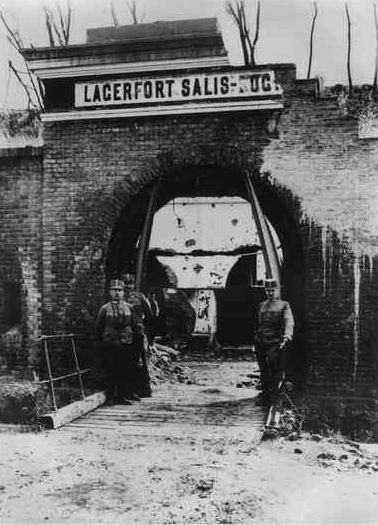
Salissoglio1915

Hermann Kusmanek von Burgneustädten

Przemyśl fortress

Erzherzog Friedrich in Sanok beim wiedereroberten Przemyśl, im Auto zusammen mit Feldzeugmeister Paul Freiherr Puhallo von Brlog am 6. Juni 1915.

Przemyśl fortress
![Подпись: "Перемышль. Форт, в котором был в апреле Государь [Николай II]. На куполе [уцелевшей] башни виден след нашего снаряда". Май 1915.](https://upload.wikimedia.org/wikipedia/commons/7/7b/1915_%D0%9F%D0%B5%D1%80%D0%B5%D0%BC%D1%8B%D1%88%D0%BB%D1%8C_%D0%B2%D0%B7%D1%8F%D1%82_%D0%BE%D0%B1%D1%80%D0%B0%D1%82%D0%BD%D0%BE.jpg)
Подпись: "Перемышль. Форт, в котором был в апреле Государь [Николай II]. На куполе [уцелевшей] башни виден след нашего снаряда". Май 1915.
Russia. Anonymous artist. Европейская Война. Осада Перемышля. (The European war. The Siege of Przemyśl). 1915. 57 x 80 cm. (Slg.Nr. 803) On this poster by Lubok tradition, the siege of the largest Austro-Hungarian fortress Przemyśl is shown. The garrison of 110,000 men had to surrender in March 1915, after 133 days of siege. The Russian army was just ahead of Krakow. In June 1915, Przemyśl was conquered back in the wake of a large German-Austrian offensive.
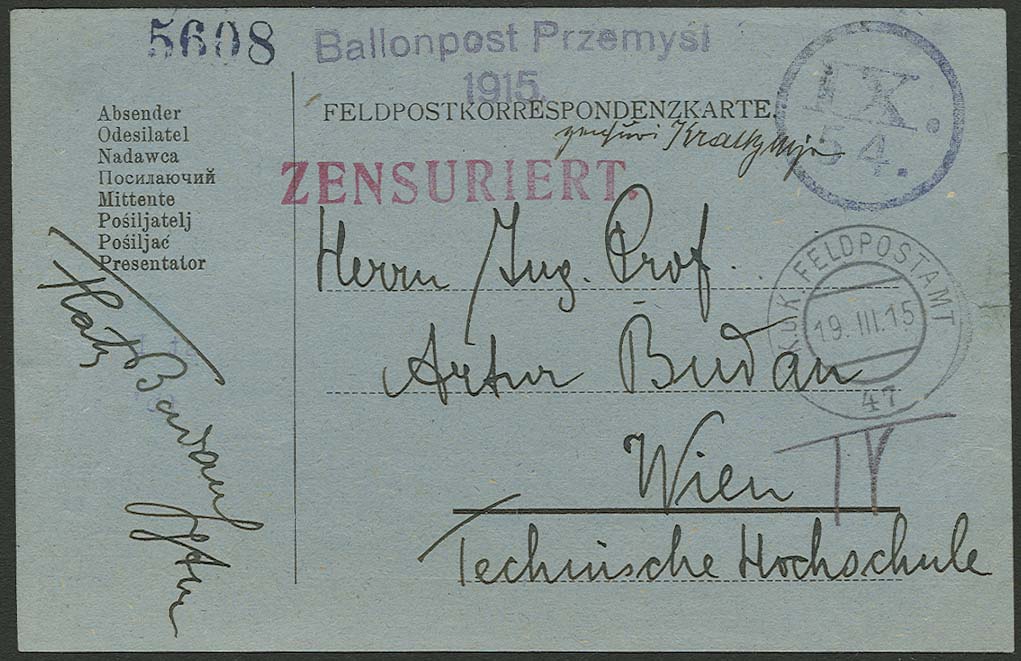
ÖSTERREICH 1915, Ballonpost Przemysl, blaue Feldpostkarte Nr. 5608 mit Grußtext geschrieben 23.1., violetter L2 "Ballonpost Przemysl 1915" und L1 "Zensuriert", Transit. Adressiert an: Herrn Ing. Prof. Artur Budan, Wien IV, Technische Hochschule.

Der Krieg 1914-19 in Wort und Bild, published 1919.

Der Beobachtungsballon der Festung Przemyśl
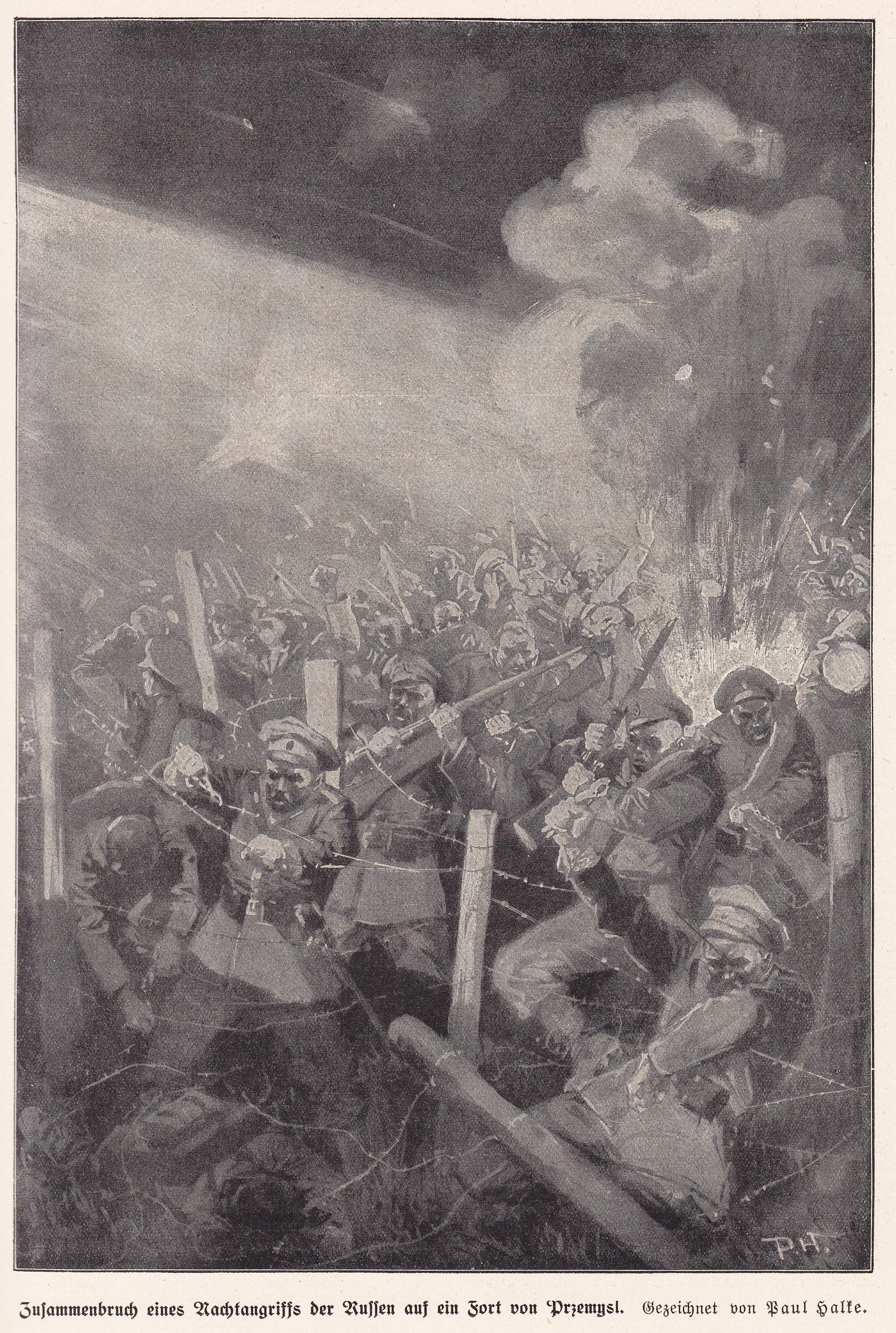
Der Krieg 1914-19 in Wort und Bild, published 1919.
![Omschrijving: Festungen und Ihre Bezwinger. De Poolse vestingstad Przemysl en een portret met oorlogssymboliek van Generaal Paul von Kneussl. Polen, Przemysl, datum Unknown. [1914-1918].](https://upload.wikimedia.org/wikipedia/commons/f/f8/Festungen_und_Ihre_Bezwinger%2C_SFA002026440.jpg)
Omschrijving: Festungen und Ihre Bezwinger. De Poolse vestingstad Przemysl en een portret met oorlogssymboliek van Generaal Paul von Kneussl. Polen, Przemysl, datum Unknown. [1914-1918].

Festungskommandant Hermann von Kusmanek mit seinem Stab in Przemyśl 1914, unten, 4. von links

Field Marshal Friedrich Archduke of Austria, Duke of Teschen (1856-1936), supreme commander of Austria-Hungarian Armed Forces in WW1, visiting the Przemyśl fortress (today in South-Eastern Poland) after recapture in June 1915

Mikolaj II w Twierdzy Przemysl

Der Krieg 1914-19 in Wort und Bild, published 1919,

How the Przemysl Forts were wrecked.
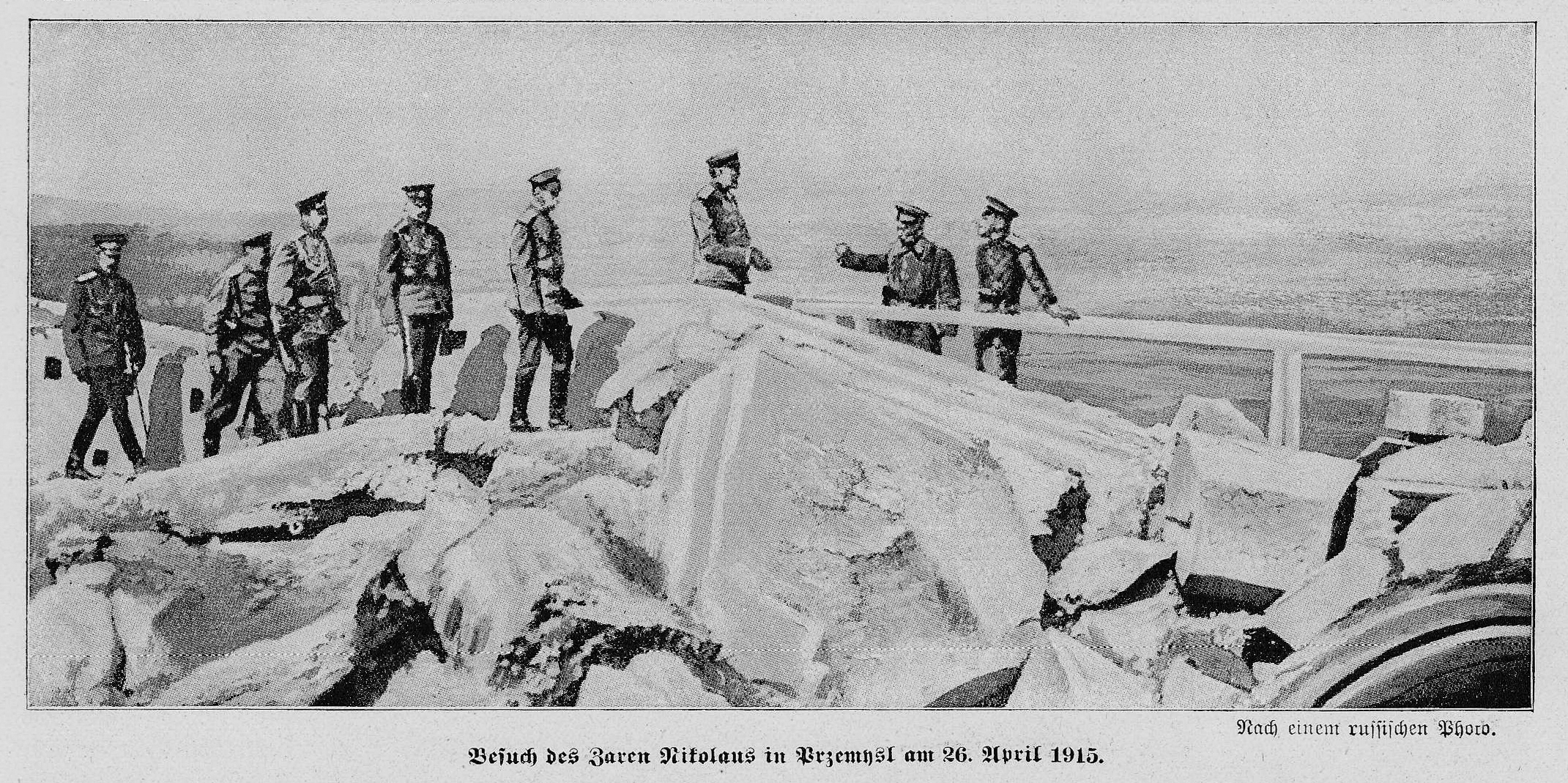
Der Krieg 1914-19 in Wort und Bild, published 1919,

Der Krieg 1914-19 in Wort und Bild, published 1919.

Russia. Anonymous artist. Европейская Война. Осада Перемышля. (The European war. The Siege of Przemyśl). 1915. 57 x 80 cm. (Slg.Nr. 803) On this poster by Lubok tradition, the siege of the largest Austro-Hungarian fortress Przemyśl is shown. The garrison of 110,000 men had to surrender in March 1915, after 133 days of siege. The Russian army was just ahead of Krakow. In June 1915, Przemyśl was conquered back in the wake of a large German-Austrian offensive.
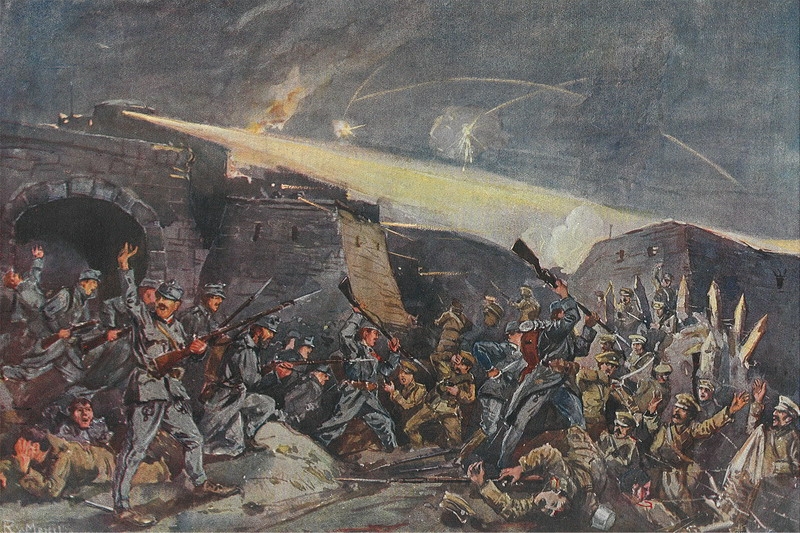
Storming Fort Siedlicka, the fortress of Przemysl by K.U.K. infantry

Feldzeugmeister Árpád TAMÁSY (or TAMÁSSY) von Fogaras, 1861-1939 hung. division commander in WW1, adjoint commander of The Fortress of Przemyśl, in 1918. Corps Commander

1 repr. (pocztówka) : dr. ; 13x9 cm

Wycięty las przed fortami.

Zniszczona wieża artyleryjska w forcie.
Historical Overview
The Siege of Przemyśl was the longest siege in Europe during the First World War, and the second-longest in the entire conflict, after the Siege of Medina. The siege was a crushing defeat of the Austro-Hungarian Army by the Russian Army. Przemyśl was a fortress-town and stronghold on the River San in southeastern Poland. The investment of Przemyśl began on 16 September 1914 and was briefly suspended on 11 October, due to an Austro-Hungarian offensive. The siege resumed on 9 November and the Austro-Hungarian garrison surrendered on 22 March 1915, after holding out for a total of 133 days. The siege has been referred to as "Austria-Hungary's Stalingrad".
Quick Facts
Russian Empire
- Commander: Radko Dimitriew
- Strength: ca. 280.000
- Casualties: ca. 40.000
Austria-Hungary
- Commander: Hermann Kusmanek
- Strength: ca. 130.000
- Casualties: ca. 117.000
Strategic Context
Defense of the strategic railway hub of Galicia.
Related Literature


Frühling der Revolution: Europa 1848/49 und der Kampf für eine neue Welt
Christopher Clark

Risorgimento! Italiens Kampf um die Einheit im 19. Jahrhundert
Historical Locations
Interactive map requires third-party cookie consent.