Battle of Osan

Battle of Osan Map

Task Force Smith near Osan, 5 July 1950
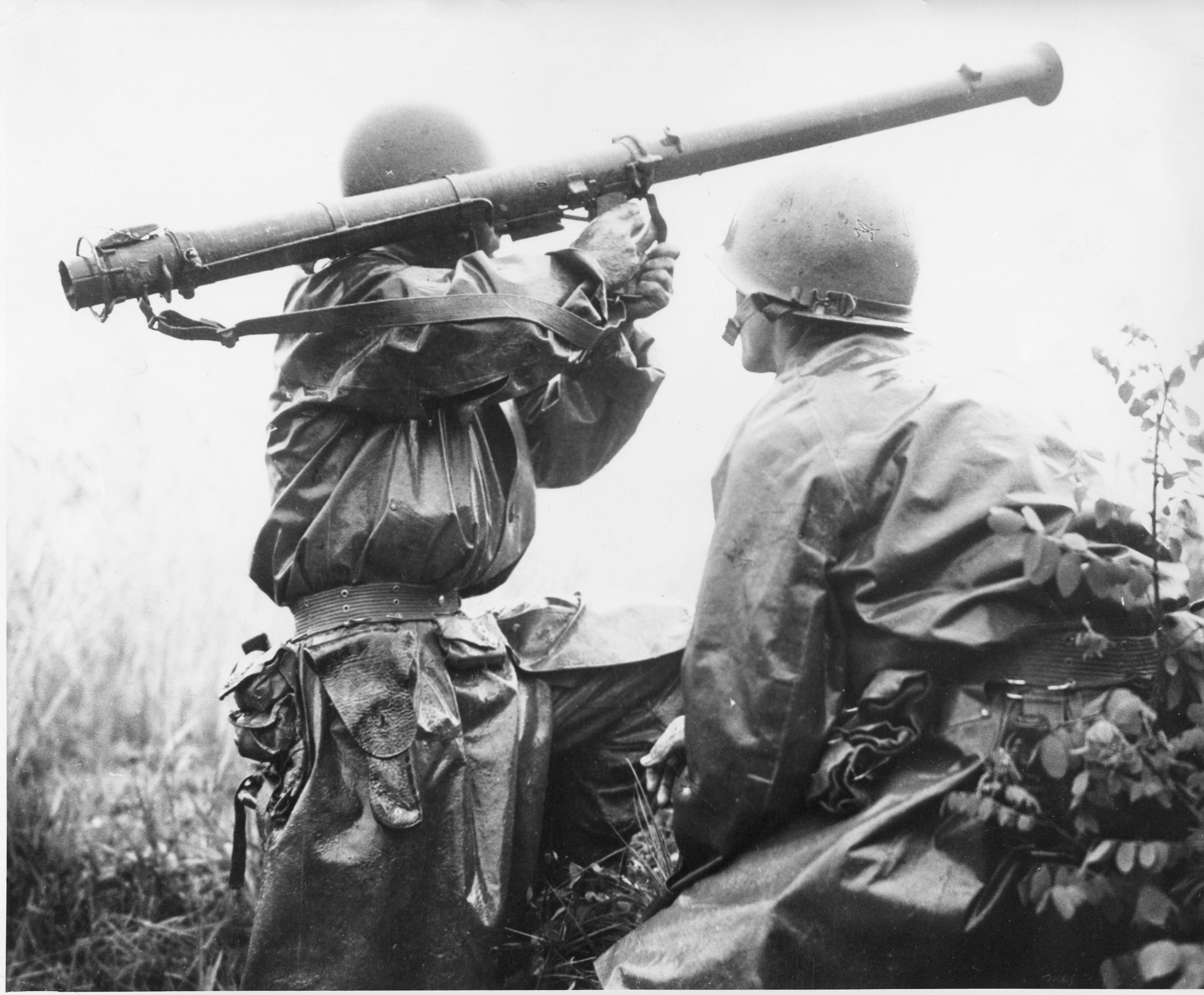
A team mans a Bazooka at the Battle of Osan. Members of the 24th Infantry Division, first United States ground units to reach the front, go into action against North Korean forces at the village of Sojong-Ni, near Osan. At right is Private First Class Kenneth Shadrick, who was killed by enemy fire a few moments after this photo was made, thus becoming the first United States soldier to die in the Korean campaign.
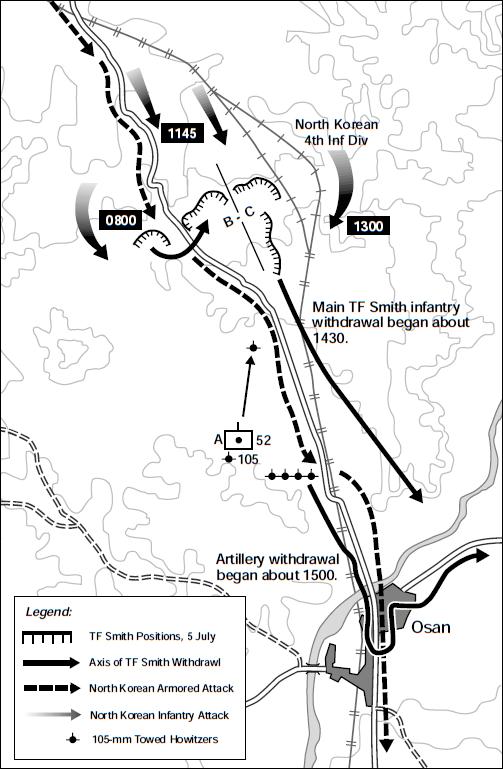
Task Force Smith near Osan, 5 July 1950

Task Force Smith near Osan, 5 July 1950

A commemorative ceremony is held at the Task Force Smith Memorial in honor of the men who fell near this spot on July 5, 1950. From left to right are Lieutenant Colonel Tilden Ried, Commander, 1st Battalion, 21 Infantry; Major General Alexander M. Weyand, Commander, 25th Infantry Division, and General Park Noh Young of the South Korean army.

Map of the Battle of Osan.
Historical Overview
The Battle of Osan was the first engagement between the United States and North Korea during the Korean War. On July 5, 1950, Task Force Smith, an American task force of 540 infantry supported by an artillery battery, was moved to Osan, south of Seoul, the capital of South Korea, and was ordered to fight as a rearguard to delay the advancing North Korean forces while more US troops arrived to form a stronger defensive line to the south. The task force lacked both anti-tank guns and effective infantry anti-tank weapons and had been equipped with obsolete rocket launchers and a few 57 mm recoilless rifles. Aside from a limited number of HEAT shells for the unit's 105 mm howitzers, crew-served weapons that could defeat T-34/85 tanks from the Soviet Union had not yet been distributed to the US Army forces in South Korea.
Quick Facts
North Korea
- Commander: Choi Yong-kun
- Strength: 2 Regimenter, 36 Pz
- Casualties: gering
USA
- Commander: Charles B. Smith
- Strength: 540 Mann
- Casualties: 150
Strategic Context
Attempt to prevent a North Korean lightning victory.
Related Literature


Der Eiserne Vorhang: Die Unterdrückung Osteuropas 1944–1956

Die Kubakrise 1962

Mao und seine verlorenen Kinder: Chinas Kulturrevolution

Maos Großer Hunger: Massenmord und Menschenexperiment in China
Historical Locations
Exact location not recorded in historical records