Operation Nordlicht
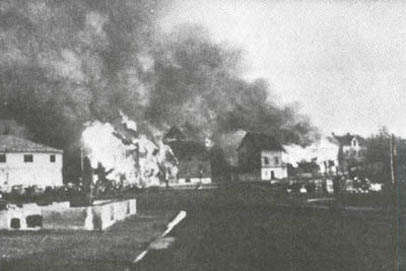
Norwegian town of Kirkenes burning after withdrawal of German forces.

A Norwegian guard watching the movements of the Germans.It was reported to Norwegian Headquarters in eastern Finnmark that the civilian population on the island of Sørøya in Western Finnmark was living under very difficult conditions due to the complete destruction by the Germans of everything on the Island. An expedition was set to the island and Norwegian forces evacuated a number of civilians eastwards and took care of the population until the evacuation could take place. In the middle of the February four British destroyers arrived at the island and evacuated the rest of the civilian population.

In November 1944, Nazi Germany forcibly removed civilians from Indre Finnmark and burnt down their houses as part of their scorched-earth policy. A good number of people managed to escape the forced relocations and flee into the fjells where they encountered major difficulties. On the Swedish side of the border, large quantities of clothes and food were collected for the people in Finnmark. The boy in the photograph has just received rolled oatmeal and peas as part of that collection.

Etter at russerne hadde rykket inn i Kirkenes og Øst-Finnmark kom i begynnelsen av november Den norske militærkommisjonen under ledelse av oberst A.D. Dahl og de første norske troppestyrker fra Storbritannia, for sammen med Den russiske ishavsarme å føre kampen videre mot tyskerne i Nord-Norge. Bildet er tatt under et besøk som representanter for Misjonen avla i Vadsø kort etter ankomsten til Norge. En ser oberst Dahl i samtale med den nyutnevnte fylkesmann, redaktør Peder Holt. London, 29.12.1944
Historical Overview
Operation Northern Light was a German operation in October 1944, towards the end of the Second World War. After Finland had made peace with the USSR, the Germans planned to fall back to defense lines across Finnish Lapland. During the operation, Oberkommando der Wehrmacht gave an order to change from Operation Birke to Operation Nordlicht on 4 October 1944. Instead of evacuating everything and then fortifying the strong defensive positions, the German 20th Mountain Army was to retreat according to a set timetable to a new defense line in Lyngen Municipality in Troms county, Norway. The Germans retreated using scorched-earth tactics and destroyed almost all buildings and all boats in Finnmark, thus denying the enemy any facilities in the area. The same tactics had already been used in Finnish Lapland. The retreat ended on 20 January 1945. A detailed account of 'the Nazis' scorched earth campaign in Norway' by Vincent Hunt includes statements by eyewitnesses, photographs taken at the time and a map of locations and prisoner of war camps.
Quick Facts
German Army
- Commander: Lothar Rendulic
- Strength: 200000
- Casualties: -
Finland
- Commander: Hjalmar Siilasvuo
- Strength: 60000
- Casualties: -
Strategic Context
Complete evacuation of Finland by German forces.
Related Literature


Der Gulag

Die Schlacht um Berlin und das Ende des Dritten Reichs 1945

Hunde, wollt ihr ewig leben: ein Stalingrad-Roman

Roter Hunger: Stalins Krieg gegen die Ukraine

So weit die Füße tragen

Söldner ohne Sold: Die deutschen Freikorps 1918–1923

Vom Massensturm zur Stoßtrupptaktik: Die deutsche Landkriegtaktik im Spiegel von Dienstvorschriften und Publizistik 1906 bis 1918

Wir Wehr-Wölfe: Erinnerungen eines Freikorps-Führers

Zweiter Weltkrieg Erlebnisbericht Apokalypse Stalingrad: Untergang der 6. Armee 1942-1943
Walter Mönch
Rise And Fall Of The Third Reich
William Shirer
Historical Locations
Interactive map requires third-party cookie consent.