Battle of Manila

The Manila post office building under attack by U.S. troops, 26 February 1945. When photo was taken, the American soldiers were rushing Japanese positions in the post office. Note extensive fire damage to buildings in the area, and wrecked bridges.

Filipino survivors of the assault on the walled city area, after their liberation by U.S. troops, 23 February 1945

Stretcher party brings out a wounded U.S. soldier, following an attack by U.S. troops to liberate Filipino prisoners in the walled city, 23 February 1945. Note wrecked buildings.

Destruction at the Walled City (Intramuros district) of old Manila in May 1945 — after the Battle of Manila.
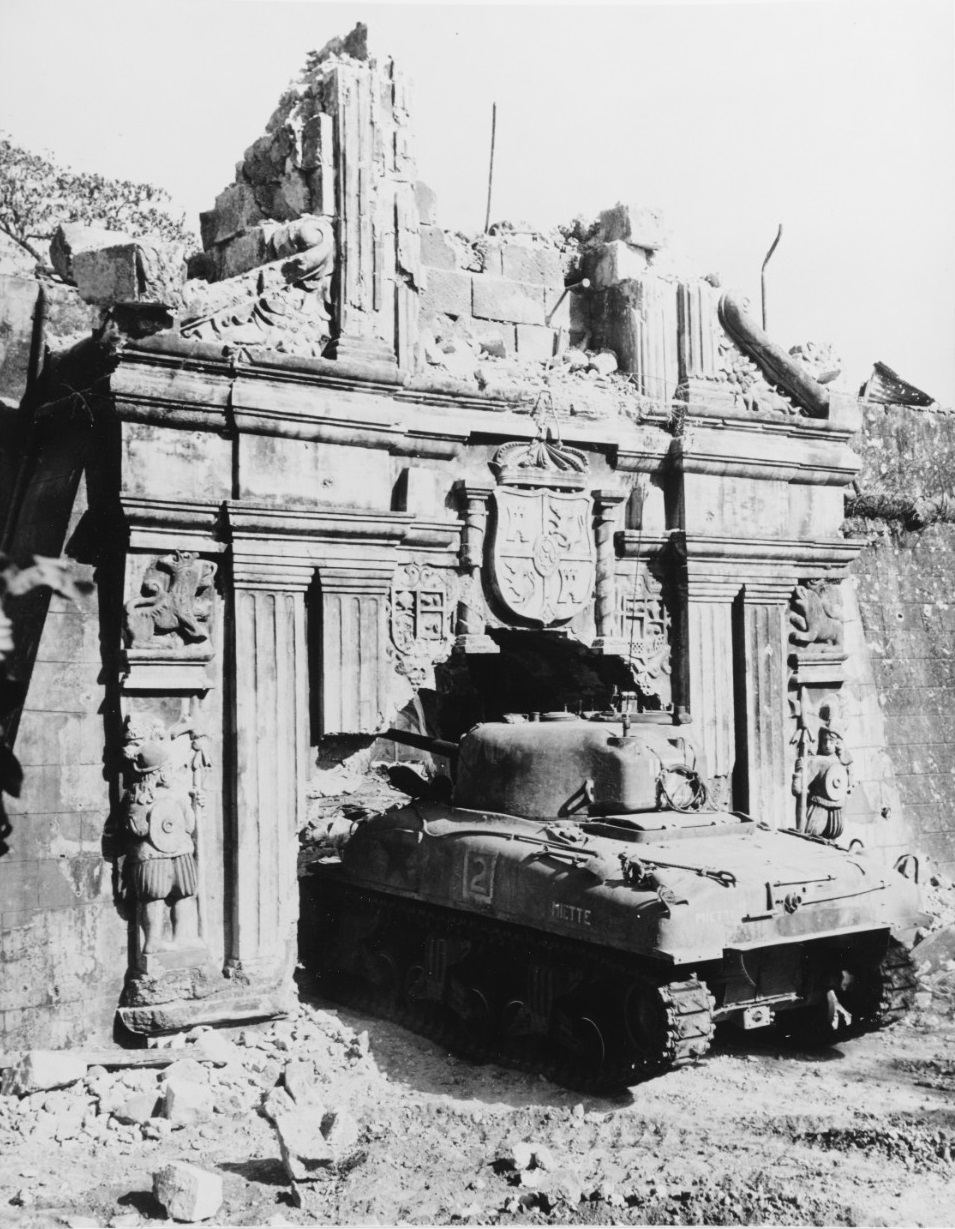
Battle of Manila a U.S. Army M4 Sherman tank enters old Fort Santiago through a somewhat enlarged gate, 26 February 1945. Note crest carved over the gate, and extensive damage.

U.S. infantrymen make a house to house search for Japanese inside the ruins of the walled city, from which they had liberated hundreds of Filipino prisoners, 23 February 1945.

Classic pincer movement with the Sixth Army advancing from the north, and Eighth Army from the south to capture Manila.

Battle of Manila (1945) map at the Manila American Cemetery and Memorial

Battle of Manila Historical Marker installed in Freedom Triangle Plaza, Manila City Hall

Scope and content: Complete demolition of the Legislature Building in Manila, P.I. One of the finest government buildings in the Far East, it was the pride of the Philippine Government. Filipino citizens pass the building and look in abject wonderment at the results of total war.

Damage to the Manila Post Office 1945
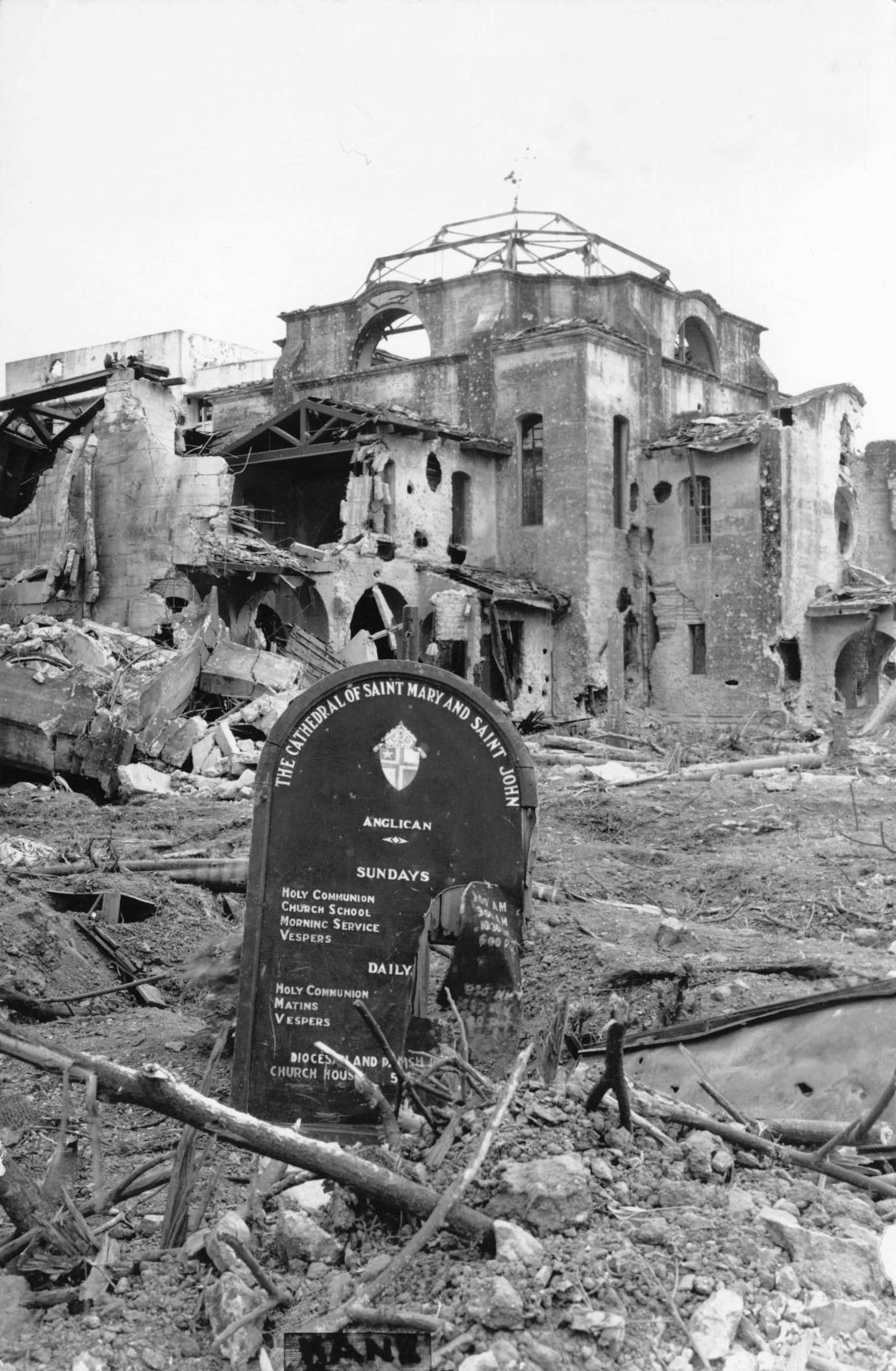
Destroyed during the Battle of Manila of 1945. Photo taken from archived of F.K. Ellington, Army Photographer during WWII, serving in the Pacific Theatre for 15 months. He was discharged from Camp Atterbury, Indiana December 28, 1945

Damage to the Manila Post Office 1945
![Injured POWs (MAMAS D45-457-90), National Museum of Health and Medicine
Description: Two injured POWs [prisoners of war] near hte Bilibid Prison Camp. Manila, Philippine Islands.
During Japanese occupation, Bilibid Prison was used as a camp, hospital, and transit center for POWs. Many of the thousands of POWs processed here throughout the war were American. It was liberated during battle in February 1945 and 1,200 internees were freed. It now serves as a penitentiary.
Date: circa 1945
Photo ID: MAMAS D45-457-90
Source collection: OHA 220.1: Museum and Medical Arts Service (MAMAS) Photographs
Repository: National Museum of Health and Medicine, Otis Historical Archives
Rights: No known restrictions upon publication, physical copy retained by National Museum of Health and Medicine. Publication and high resolution image requests should be directed to the NMHM (http://www.medicalmuseum.mil/" rel="nofollow">www.medicalmuseum.mil/)](https://upload.wikimedia.org/wikipedia/commons/2/2e/Injured_POWs_%28MAMAS_D45-457-90%29%2C_National_Museum_of_Health_and_Medicine_%283390876128%29.jpg)
Injured POWs (MAMAS D45-457-90), National Museum of Health and Medicine Description: Two injured POWs [prisoners of war] near hte Bilibid Prison Camp. Manila, Philippine Islands. During Japanese occupation, Bilibid Prison was used as a camp, hospital, and transit center for POWs. Many of the thousands of POWs processed here throughout the war were American. It was liberated during battle in February 1945 and 1,200 internees were freed. It now serves as a penitentiary. Date: circa 1945 Photo ID: MAMAS D45-457-90 Source collection: OHA 220.1: Museum and Medical Arts Service (MAMAS) Photographs Repository: National Museum of Health and Medicine, Otis Historical Archives Rights: No known restrictions upon publication, physical copy retained by National Museum of Health and Medicine. Publication and high resolution image requests should be directed to the NMHM (http://www.medicalmuseum.mil/" rel="nofollow">www.medicalmuseum.mil/)

Japanese Imperial forces wounded surrender to US and Filipino soldiers under the United States Army and Philippine Commonwealth Army in unidentified city in Manila, May 1945. Note the American troops on the right foreground carrying two M1 Garand rifles.

L5-B air evacuation (MAMAS D45-416-24K), National Museum of Health and Medicine Description: Patient in a cast being loaded onto L-5B for evacuation by air. On nose of plane: "Angel of Mercy sponsored by the students of Keating School, Detroit, Michigan." 98th Evacuation Hospital, Manila, Philippine Islands. Date: February 1945 Photo ID: MAMAS D45-416-24K Source collection: OHA 220.1: Museum and Medical Arts Service (MAMAS) Photographs Repository: National Museum of Health and Medicine, Otis Historical Archives Rights: No known restrictions upon publication, physical copy retained by National Museum of Health and Medicine. Publication and high resolution image requests should be directed to the NMHM (http://www.medicalmuseum.mil/" rel="nofollow">www.medicalmuseum.mil/)
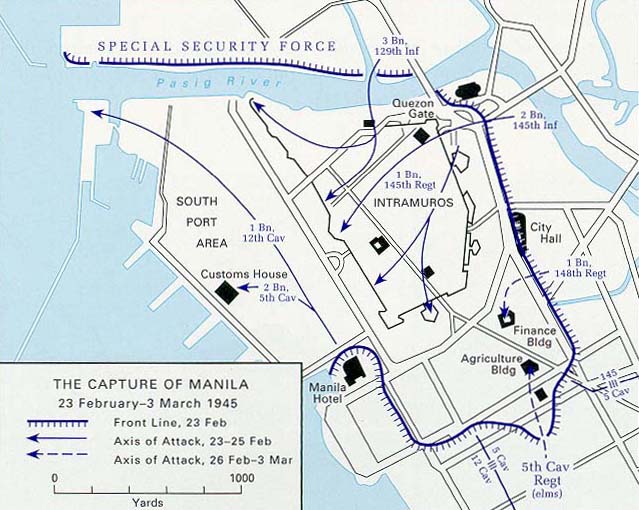
Map for the Capture of Manila

U.S. troops at the Rizal Baseball Stadium, Manila
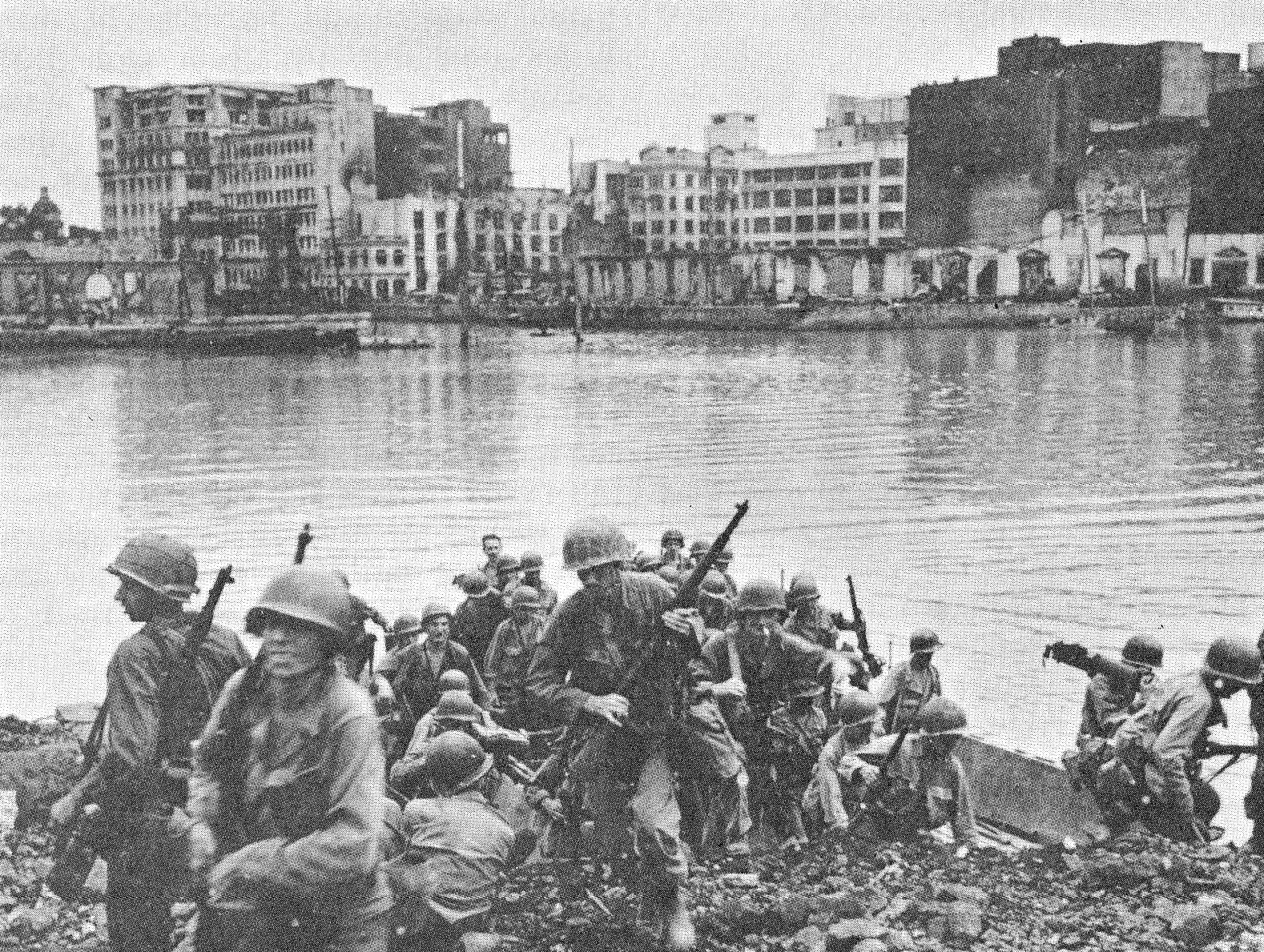
U.S. troops entering Walled City, Manila

Destroyed Legislature Building, Manila

Aerial view of Manila: Bilibid Prizon at lower left; note roadblock on Quezon Boulevard, left center

Citizens of Manila run for safety from suburbs burned by Japanese soldiers

U.S. troops fighting in the Walled City, Manila

Scope and content: Complete demolition of the Legislature Building in Manila, P.I. One of the finest government buildings in the Far East, it was the pride of the Philippine Government. Filipino citizens pass the building and look in abject wonderment at the results of total war.
Scope and content: Complete demolition of the Legislature Building in Manila, P.I. One of the finest government buildings in the Far East, it was the pride of the Philippine Government. Filipino citizens pass the building and look in abject wonderment at the results of total war.
Historical Overview
The Battle of Manila was a major battle during the Philippine campaign of 1944–45, during the Second World War. It was fought by forces from both the United States and the Philippines against Japanese troops in Manila, the capital city of the Philippines. The month-long battle, which resulted in the death of at least 100,000 civilians and the complete devastation of the city, was the scene of the worst urban fighting fought by American forces in the Pacific theater. During the battle, Japanese forces committed mass murder against Filipino civilians, while American firepower also killed many people. The fierce resistance of Japanese troops entrenched in many of the city's landmarks, along with the usage of massed artillery barrages by American forces to dislodge them, destroyed much of Manila's architectural and cultural heritage dating back to the city's founding. Often referred to as "the Stalingrad of Asia", the battle is widely considered to be one of the most destructive urban battles ever fought, as well as the single largest urban battle ever fought by American forces.
Quick Facts
USA/Philippines
- Commander: Douglas MacArthur
- Strength: 35000
- Casualties: 1010
Japanese Navy
- Commander: Sanji Iwabuchi †
- Strength: 17000
- Casualties: 16000
Strategic Context
Liberation of the Philippines from Japanese occupation.
Related Literature


Der Gulag

Die Schlacht um Berlin und das Ende des Dritten Reichs 1945

Hunde, wollt ihr ewig leben: ein Stalingrad-Roman

Roter Hunger: Stalins Krieg gegen die Ukraine

So weit die Füße tragen

Söldner ohne Sold: Die deutschen Freikorps 1918–1923

Vom Massensturm zur Stoßtrupptaktik: Die deutsche Landkriegtaktik im Spiegel von Dienstvorschriften und Publizistik 1906 bis 1918

Wir Wehr-Wölfe: Erinnerungen eines Freikorps-Führers

Zweiter Weltkrieg Erlebnisbericht Apokalypse Stalingrad: Untergang der 6. Armee 1942-1943
Walter Mönch
Rise And Fall Of The Third Reich
William Shirer
Historical Locations
Interactive map requires third-party cookie consent.