Battle of Crete
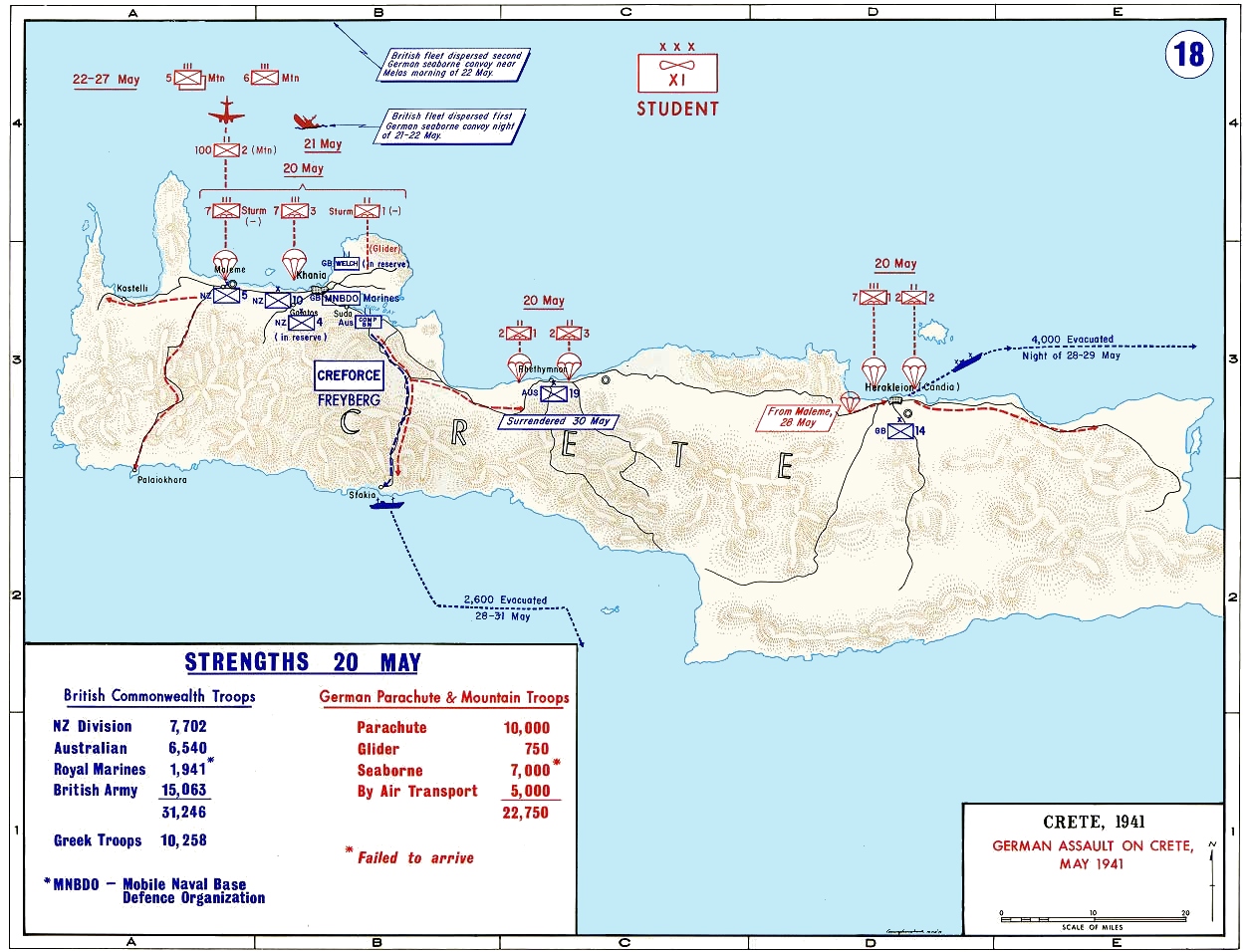
German assault on Crete - May 1941

Memorial at Maleme Airfield, Tavronitis, Crete, to members of 30 and 33 Squadrons RAF who were killed in the Battle of Crete, 1941.

190520-N-AZ866-0018 CHANIA, Greece (May 20, 2019) Capt. Ryan T. Tewell, commanding officer, Naval Support Activity Souda Bay, renders a salute during the countries national anthems during the opening flag raise ceremony for the Battle of Crete at the Firka Fortress in Chania, Greece, May 20, 2019. Tewell attended and/or participated in several ceremonial events held in the Souda Bay and Maleme areas of Greece on the island of Crete. But it was not the U.S. military of World War II that was center stage. This year marked the 78th anniversary of the Battle of Crete that began the morning of May 20, 1941, when Nazi Germany launched an airborne invasion of Crete under the code-name Unternehmen Merker (Operation Mercury). The Allied Forces comprised of service members from Britain, New Zealand and Australia were joined with local villagers, most armed with farm tools or kitchen items, to resist the invasion. A long hard battle was fought for almost a week, but eventually the Allied forces had no choice but to evacuate. Cretan civilians took great risk to offer aid and shelter to those who remained and wanted to avoid capture by Nazi troops. Tewell attended the opening flag raising ceremony held at Firka Fortress in Chania, a wreath laying ceremony at the Souda Bay Allied War Cemetery and another at the German War Cemetery in Maleme, May 20. (U.S. Navy photo by MC2 Kelly M. Agee/Released)

190520-N-AZ866-0073 MALEME, Greece (May 20, 2019) The German War Cemetery in Maleme, Greece, May 20, 2019. This year marked the 78th anniversary of the Battle of Crete that began the morning of May 20, 1941, when Nazi Germany launched an airborne invasion of Crete under the code-name Unternehmen Merker (Operation Mercury). The Allied Forces comprised of service members from Britain, New Zealand and Australia were joined with local villagers, most armed with farm tools or kitchen items, to resist the invasion. A long hard battle was fought for almost a week, but eventually the Allied forces had no choice but to evacuate. Cretan civilians took great risk to offer aid and shelter to those who remained and wanted to avoid capture by Nazi troops. Tewell attended the opening flag raising ceremony held at Firka Fortress in Chania, a wreath laying ceremony at the Souda Bay Allied War Cemetery and another at the German War Cemetery in Maleme, May 20. (U.S. Navy photo by MC2 Kelly M. Agee/Released)

190520-N-AZ866-0152 MALEME, Greece (May 20, 2019) Capt. Ryan T. Tewell, commanding officer, Naval Support Activity Souda Bay, attends a Battle of Crete Commemoration Ceremony at the German War Cemetery in Maleme, Greece, May 20, 2019. Tewell attended and/or participated in several ceremonial events held in the Souda Bay and Maleme areas of Greece on the island of Crete. But it was not the U.S. military of World War II that was center stage. This year marked the 78th anniversary of the Battle of Crete that began the morning of May 20, 1941, when Nazi Germany launched an airborne invasion of Crete under the code-name Unternehmen Merker (Operation Mercury). The Allied Forces comprised of service members from Britain, New Zealand and Australia were joined with local villagers, most armed with farm tools or kitchen items, to resist the invasion. A long hard battle was fought for almost a week, but eventually the Allied forces had no choice but to evacuate. Cretan civilians took great risk to offer aid and shelter to those who remained and wanted to avoid capture by Nazi troops. Tewell attended the opening flag raising ceremony held at Firka Fortress in Chania, a wreath laying ceremony at the Souda Bay Allied War Cemetery and another at the German War Cemetery in Maleme, May 20. (U.S. Navy photo by MC2 Kelly M. Agee/Released)

190520-N-AZ866-0252 MALEME, Greece (May 20, 2019) Capt. Ryan T. Tewell, commanding officer, Naval Support Activity Souda Bay, renders a salute after laying a wreath on behalf of the U.S. Navy at a commemoration ceremony held in Maleme, Greece, at the German War Cemetery, May 20, 2019. Tewell attended and/or participated in several ceremonial events held in the Souda Bay and Maleme areas of Greece on the island of Crete. But it was not the U.S. military of World War II that was center stage. This year marked the 78th anniversary of the Battle of Crete that began the morning of May 20, 1941, when Nazi Germany launched an airborne invasion of Crete under the code-name Unternehmen Merker (Operation Mercury). The Allied Forces comprised of service members from Britain, New Zealand and Australia were joined with local villagers, most armed with farm tools or kitchen items, to resist the invasion. A long hard battle was fought for almost a week, but eventually the Allied forces had no choice but to evacuate. Cretan civilians took great risk to offer aid and shelter to those who remained and wanted to avoid capture by Nazi troops. Tewell attended the opening flag raising ceremony held at Firka Fortress in Chania, a wreath laying ceremony at the Souda Bay Allied War Cemetery and another at the German War Cemetery in Maleme, May 20. (U.S. Navy photo by MC2 Kelly M. Agee/Released)

190520-N-AZ866-0314 MALEME, Greece (May 20, 2019) Capt. Ryan T. Tewell, commanding officer, Naval Support Activity Souda Bay, renders a salute during a commemoration ceremony held in Maleme, Greece, at the German War Cemetery, May 20, 2019. Tewell attended and/or participated in several ceremonial events held in the Souda Bay and Maleme areas of Greece on the island of Crete. But it was not the U.S. military of World War II that was center stage. This year marked the 78th anniversary of the Battle of Crete that began the morning of May 20, 1941, when Nazi Germany launched an airborne invasion of Crete under the code-name Unternehmen Merker (Operation Mercury). The Allied Forces comprised of service members from Britain, New Zealand and Australia were joined with local villagers, most armed with farm tools or kitchen items, to resist the invasion. A long hard battle was fought for almost a week, but eventually the Allied forces had no choice but to evacuate. Cretan civilians took great risk to offer aid and shelter to those who remained and wanted to avoid capture by Nazi troops. Tewell attended the opening flag raising ceremony held at Firka Fortress in Chania, a wreath laying ceremony at the Souda Bay Allied War Cemetery and another at the German War Cemetery in Maleme, May 20. (U.S. Navy photo by MC2 Kelly M. Agee/Released)

190520-N-AZ866-0347 SOUDA BAY, Greece (May 20, 2019) Service members and civilians from the United States, Britain, New Zealand, Germany, Australia and Greece attend a Battle of Crete Commemoration Ceremony at the Souda Bay Allied War Cemetary in Souda Bay, Greece, May 20, 2019. Tewell attended and/or participated in several ceremonial events held in the Souda Bay and Maleme areas of Greece on the island of Crete. But it was not the U.S. military of World War II that was center stage. This year marked the 78th anniversary of the Battle of Crete that began the morning of May 20, 1941, when Nazi Germany launched an airborne invasion of Crete under the code-name Unternehmen Merker (Operation Mercury). The Allied Forces comprised of service members from Britain, New Zealand and Australia were joined with local villagers, most armed with farm tools or kitchen items, to resist the invasion. A long hard battle was fought for almost a week, but eventually the Allied forces had no choice but to evacuate. Cretan civilians took great risk to offer aid and shelter to those who remained and wanted to avoid capture by Nazi troops. Tewell attended the opening flag raising ceremony held at Firka Fortress in Chania, a wreath laying ceremony at the Souda Bay Allied War Cemetery and another at the German War Cemetery in Maleme, May 20. (U.S. Navy photo by MC2 Kelly M. Agee/Released)

190520-N-AZ866-0427 SOUDA BAY, Greece (May 20, 2019) Capt. Ryan T. Tewell, commanding officer, Naval Support Activity Souda Bay renders a salute after laying a wreath at the Allied War Cemetery at Souda Bay during a ceremony commemorating the 78th anniversary of the Battle of Crete, May 20,2019. Tewell attended and/or participated in several ceremonial events held in the Souda Bay and Maleme areas of Greece on the island of Crete. But it was not the U.S. military of World War II that was center stage. This year marked the 78th anniversary of the Battle of Crete that began the morning of May 20, 1941, when Nazi Germany launched an airborne invasion of Crete under the code-name Unternehmen Merker (Operation Mercury). The Allied Forces comprised of service members from Britain, New Zealand and Australia were joined with local villagers, most armed with farm tools or kitchen items, to resist the invasion. A long hard battle was fought for almost a week, but eventually the Allied forces had no choice but to evacuate. Cretan civilians took great risk to offer aid and shelter to those who remained and wanted to avoid capture by Nazi troops. Tewell attended the opening flag raising ceremony held at Firka Fortress in Chania, a wreath laying ceremony at the Souda Bay Allied War Cemetery and another at the German War Cemetery in Maleme, May 20. (U.S. Navy photo by MC2 Kelly M. Agee/Released)

World War II weapons and military equipment of Nazi Germany (The Third Reich) on display in the Athens War Museum in Athens, Greece: M40 German armed forces (Wehrmacht) tropical field cap (German: Feldmütze) from the Battle of Crete

190520-N-AZ866-0314 SOUDA BAY, Greece (May 20, 2019) Service members and civilians from the United States, Britain, New Zealand, Germany, Australia and Greece attend a Battle of Crete Commemoration Ceremony at the Souda Bay Allied War Cemetary in Souda Bay, Greece, May 20, 2019. Tewell attended and/or participated in several ceremonial events held in the Souda Bay and Maleme areas of Greece on the island of Crete. But it was not the U.S. military of World War II that was center stage. This year marked the 78th anniversary of the Battle of Crete that began the morning of May 20, 1941, when Nazi Germany launched an airborne invasion of Crete under the code-name Unternehmen Merker (Operation Mercury). The Allied Forces comprised of service members from Britain, New Zealand and Australia were joined with local villagers, most armed with farm tools or kitchen items, to resist the invasion. A long hard battle was fought for almost a week, but eventually the Allied forces had no choice but to evacuate. Cretan civilians took great risk to offer aid and shelter to those who remained and wanted to avoid capture by Nazi troops. Tewell attended the opening flag raising ceremony held at Firka Fortress in Chania, a wreath laying ceremony at the Souda Bay Allied War Cemetery and another at the German War Cemetery in Maleme, May 20. (U.S. Navy photo by MC2 Kelly M. Agee/Released)

210521-N-AZ966-0081 NAVAL SUPPORT ACTIVITY SOUDA BAY, Greece (May 21, 2021) Navy Capt. Rafael C. Facundo, commanding officer, Naval Support Activity Souda Bay, renders a salute during a Battle of Crete ceremony held at the Firka Fortress in Chania, Greece, May 21, 2021. This year marked the 80th anniversary of the Battle of Crete, which began the morning of May 20, 1941, when Nazi Germany launched an airborne invasion of Crete under the code name Unternehmen Merker (Operation Mercury). NSA Souda Bay is an operational ashore base that enables U.S., allied, and partner nation forces to be where they are needed when they are needed to ensure security and stability in Europe, Africa, and Southwest Asia. (U.S. Navy photo by Mass Communication Specialist 2nd Class Kelly M. Agee/Released)

210523-N-AZ966-0182 NAVAL SUPPORT ACTIVITY SOUDA BAY, (May 23, 2021) – Navy Capt. Rafael C. Facundo, commanding officer, Naval Support Activity Souda Bay, lays a wreath during a Battle of Crete commemoration ceremony held at the German War Cemetery in Maleme, Greece, May 23, 2021. This year marked the 80th anniversary of the Battle of Crete, which began the morning of May 20, 1941, when Nazi Germany launched an airborne invasion of Crete under the code name Unternehmen Merker (Operation Mercury). NSA Souda Bay is an operational ashore base that enables U.S., allied, and partner nation forces to be where they are needed when they are needed to ensure security and stability in Europe, Africa, and Southwest Asia. (U.S. Navy photo by Mass Communication Specialist 2nd Class Kelly M. Agee/Released)

210523-N-AZ966-0186 NAVAL SUPPORT ACTIVITY SOUDA BAY, (May 23, 2021) – Navy Capt. Rafael C. Facundo, commanding officer, Naval Support Activity Souda Bay, salutes during a Battle of Crete commemoration ceremony held at the German War Cemetery in Maleme, Greece, May 23, 2021. This year marked the 80th anniversary of the Battle of Crete, which began the morning of May 20, 1941, when Nazi Germany launched an airborne invasion of Crete under the code name Unternehmen Merker (Operation Mercury). NSA Souda Bay is an operational ashore base that enables U.S., allied, and partner nation forces to be where they are needed when they are needed to ensure security and stability in Europe, Africa, and Southwest Asia. (U.S. Navy photo by Mass Communication Specialist 2nd Class Kelly M. Agee/Released)

210523-N-AZ966-0461 NAVAL SUPPORT ACTIVITY SOUDA BAY, (May 23, 2021) – Navy Capt. Rafael C. Facundo, commanding officer, Naval Support Activity Souda Bay, places a wreath during a Battle of Crete commemoration ceremony held at the Battle of Crete Memorial at the Malame Airport, May 23, 2021. This year marked the 80th anniversary of the Battle of Crete, which began the morning of May 20, 1941, when Nazi Germany launched an airborne invasion of Crete under the code name Unternehmen Merker (Operation Mercury). NSA Souda Bay is an operational ashore base that enables U.S., allied, and partner nation forces to be where they are needed when they are needed to ensure security and stability in Europe, Africa, and Southwest Asia. (U.S. Navy photo by Mass Communication Specilist 2nd Class Kelly M. Agee/Released)

220521-N-YD328-0417 NAVAL SUPPORT ACTIVITY SOUDA BAY, Greece (May 21, 2022) Cmdr. Michael Mosi, executive officer, Naval Support Activity Souda Bay, renders a salute at the Allied War Cemetery at Souda Bay, Greece, during a ceremony commemorating the Battle of Crete. This year marked the 81st anniversary of the Battle of Crete, which began the morning of May 20, 1941, when Nazi Germany launched an airborne invasion of Crete under the code name Unternehmen Merker (Operation Mercury). Naval Support Activity Souda Bay is an operational ashore base that enables U.S., allied, and partner nation forces to be where they are needed when they are needed to ensure security and stability in the European, African, and Central Command areas of responsibility. (U.S. Navy photo by Nicholas S. Tenorio/Released)

220521-N-YD328-0436 NAVAL SUPPORT ACTIVITY SOUDA BAY, Greece (May 21, 2022) Attendees gather at the Allied War Cemetery at Souda Bay, Greece, during a ceremony commemorating the Battle of Crete. This year marked the 81st anniversary of the Battle of Crete, which began the morning of May 20, 1941, when Nazi Germany launched an airborne invasion of Crete under the code name Unternehmen Merker (Operation Mercury). Naval Support Activity Souda Bay is an operational ashore base that enables U.S., allied, and partner nation forces to be where they are needed when they are needed to ensure security and stability in the European, African, and Central Command areas of responsibility. (U.S. Navy photo by Nicholas S. Tenorio/Released)

220522-N-YD328-0159 NAVAL SUPPORT ACTIVITY SOUDA BAY, Greece (May 22, 2022) Attendees at a Battle of Crete commemoration ceremony observe a flyover by the Hellenic air force at the Battle of Crete Memorial at the Malame Airport, May 22, 2022. This year marked the 81st anniversary of the Battle of Crete, which began the morning of May 20, 1941, when Nazi Germany launched an airborne invasion of Crete under the code name Unternehmen Merker (Operation Mercury). Naval Support Activity Souda Bay is an operational ashore base that enables U.S., allied, and partner nation forces to be where they are needed when they are needed to ensure security and stability in the European, African, and Central Command areas of responsibility. (U.S. Navy photo by Nicholas S. Tenorio/Released)
Luftlandung auf Kreta

World War II weapons and military equipment of Nazi Germany (The Third Reich) on display in the Athens War Museum in Athens, Greece: "The Battle of Crete 20-31 May, 1941", painting by C. Kontopanos Mauser Karabiner 98k rifle used by the German armed forces (Wehrmacht) and their allies Crete Cuff Title (Crete Cuff Band, German: Ärmelband Kreta) awarded to all German soldiers participating in the invasion of Crete Iron Cross military decoration German gas mask canister Nazi swastika flags (Reichskriegsflagge and national flag of The Third Reich)

AWM description: The Forty-Second Street sign, naming a lane in Crete where a small Allied force repelled advancing Germans. On 27 May 1941, 42nd Street was the site of a battle between the German 141st Mountain Regiment and two companies of the 2/7 Battalion, joined by New Zealanders of the 28th (Maori) Battalion, stopping the Germans for the rest of the day. The name '42nd Street', a humorous appellation inspired by the musical of the same name, was given by a small group of sappers from the 42nd Field Company, Royal Engineers who had bivouacked beside the dirt lane after being sent to garrison Crete late in 1940. The name was recorded on British maps and passed into common use. With German advances into Crete, allied troops joined together, withdrawing towards Canea and by 27th May occupied a line including 42nd Street, from Suda Bay to the Malaxa escarpment. This was the rearguard of the Commonwealth force retreating southward to Sfakia, site of evacuations.
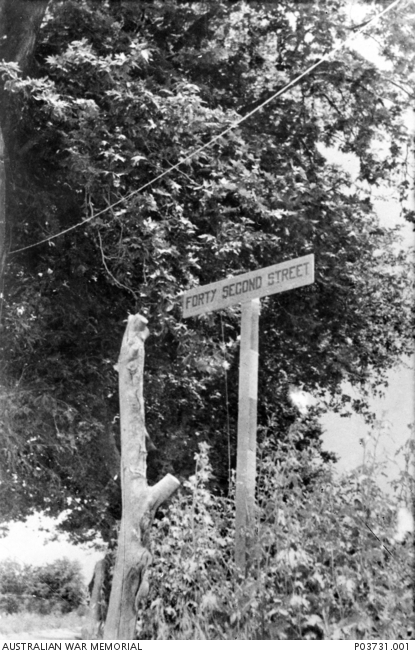
AWM description: The Forty-Second Street sign, naming a lane in Crete where a small Allied force repelled advancing Germans. On 27 May 1941, 42nd Street was the site of a battle between the German 141st Mountain Regiment and two companies of the 2/7 Battalion, joined by New Zealanders of the 28th (Maori) Battalion, stopping the Germans for the rest of the day. The name '42nd Street', a humorous appellation inspired by the musical of the same name, was given by a small group of sappers from the 42nd Field Company, Royal Engineers who had bivouacked beside the dirt lane after being sent to garrison Crete late in 1940. The name was recorded on British maps and passed into common use. With German advances into Crete, allied troops joined together, withdrawing towards Canea and by 27th May occupied a line including 42nd Street, from Suda Bay to the Malaxa escarpment. This was the rearguard of the Commonwealth force retreating southward to Sfakia, site of evacuations.
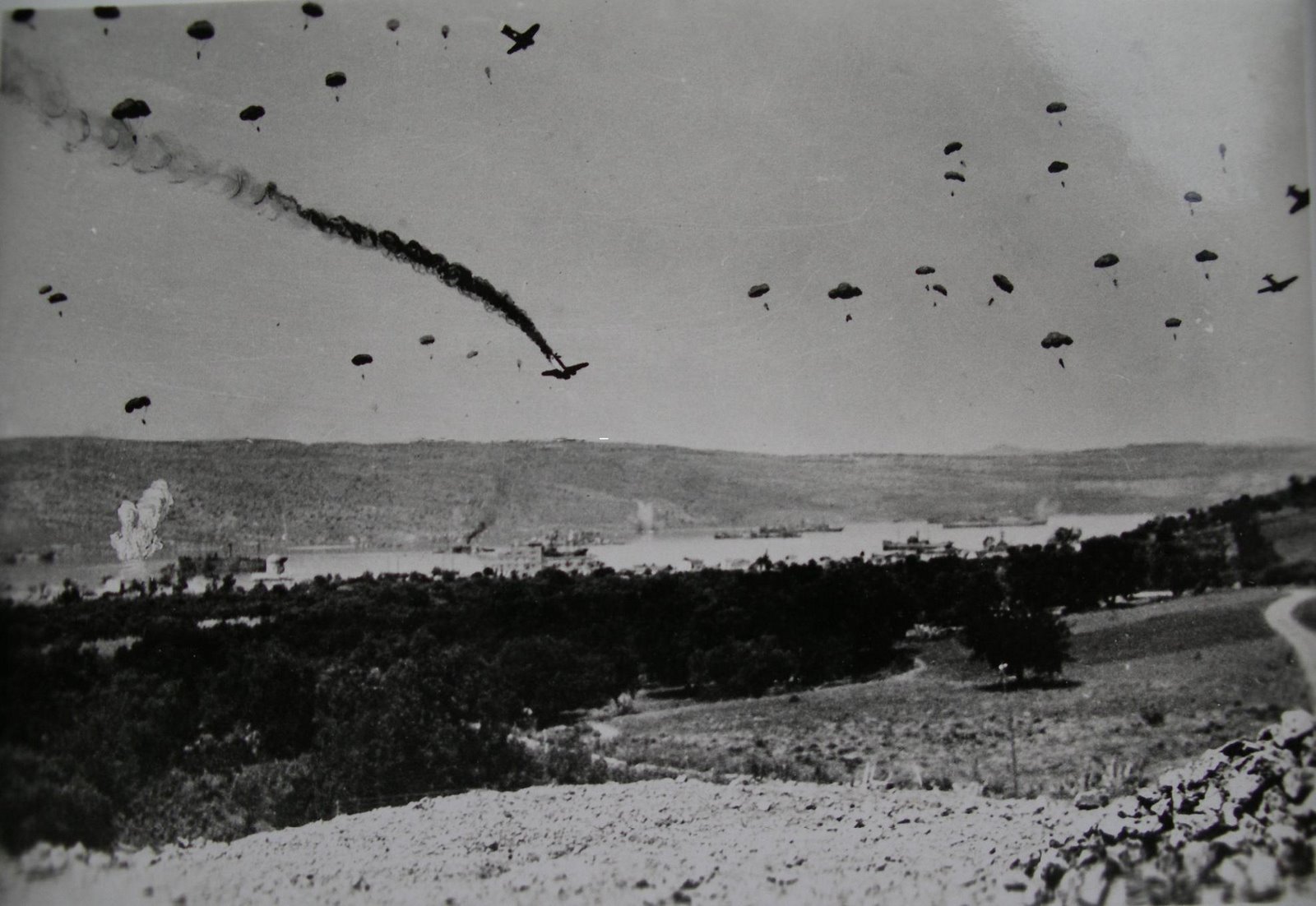
Ataque de paracaidistas alemanes sobre los aeródromos de Ypenburg, Ockenburg y Valkenburg
![On 1 June 1941 The Battle for Crete ended.
According to NZHistory.govt.nz, The Battle for Crete was one of the most dramatic battles of the Second World War. For 12 days, a mixed force of New Zealanders, British, Australian and Greek troops desperately tried to fight off a huge German airborne assault, ultimately without success.
More than 1700 British, Commonwealth and Greek soldiers were killed and 15,000 captured during the battle. There were 671 New Zealanders among the dead, and 2180 Kiwi prisoners of war. More than 6000 Germans were killed or wounded. The Luftwaffe lost more than 350 aircraft.
The image above shows a book cover featuring artwork by official war artist Peter McIntyre. It is part of a digitised record titled ‘Crete Personal Stories and other unofficial material.- [letters and other personal papers collected by Arthur Kidson, relating mainly to the battle for Crete. Research papers for the official history of the Petrol Company 2 NZEF [New Zealand Expeditionary Force]].’The full record can be viewed online here: https://ndhadeliver.natlib.govt.nz/delivery/DeliveryManagerServlet?dps_pid=IE41212861" rel="noreferrer nofollow">ndhadeliver.natlib.govt.nz/delivery/DeliveryManagerServle...
Caption information from https://nzhistory.govt.nz/war/the-battle-for-crete" rel="noreferrer nofollow">nzhistory.govt.nz/war/the-battle-for-crete
Archives New Zealand reference: AABK W4471 Box 1 part 2
https://www.archway.archives.govt.nz/ViewFullItem.do?code=123401" rel="noreferrer nofollow">www.archway.archives.govt.nz/ViewFullItem.do?code=123401
For updates on our On This Day series and news from Archives New Zealand, follow us on Twitter https://www.twitter.com/ArchivesNZ" rel="noreferrer nofollow">www.twitter.com/ArchivesNZ
Material from Archives New Zealand Te Rua Mahara o te Kāwanatanga](https://upload.wikimedia.org/wikipedia/commons/d/d7/Battle_for_Crete_%2849891372983%29.jpg)
On 1 June 1941 The Battle for Crete ended. According to NZHistory.govt.nz, The Battle for Crete was one of the most dramatic battles of the Second World War. For 12 days, a mixed force of New Zealanders, British, Australian and Greek troops desperately tried to fight off a huge German airborne assault, ultimately without success. More than 1700 British, Commonwealth and Greek soldiers were killed and 15,000 captured during the battle. There were 671 New Zealanders among the dead, and 2180 Kiwi prisoners of war. More than 6000 Germans were killed or wounded. The Luftwaffe lost more than 350 aircraft. The image above shows a book cover featuring artwork by official war artist Peter McIntyre. It is part of a digitised record titled ‘Crete Personal Stories and other unofficial material.- [letters and other personal papers collected by Arthur Kidson, relating mainly to the battle for Crete. Research papers for the official history of the Petrol Company 2 NZEF [New Zealand Expeditionary Force]].’The full record can be viewed online here: https://ndhadeliver.natlib.govt.nz/delivery/DeliveryManagerServlet?dps_pid=IE41212861" rel="noreferrer nofollow">ndhadeliver.natlib.govt.nz/delivery/DeliveryManagerServle... Caption information from https://nzhistory.govt.nz/war/the-battle-for-crete" rel="noreferrer nofollow">nzhistory.govt.nz/war/the-battle-for-crete Archives New Zealand reference: AABK W4471 Box 1 part 2 https://www.archway.archives.govt.nz/ViewFullItem.do?code=123401" rel="noreferrer nofollow">www.archway.archives.govt.nz/ViewFullItem.do?code=123401 For updates on our On This Day series and news from Archives New Zealand, follow us on Twitter https://www.twitter.com/ArchivesNZ" rel="noreferrer nofollow">www.twitter.com/ArchivesNZ Material from Archives New Zealand Te Rua Mahara o te Kāwanatanga

The Battle for Crete began just after dawn on 20 May 1941. Many of the 7700 New Zealand soldiers stationed on Crete were finishing breakfast when hundreds of German transport aircraft – some towing gliders – rumbled in over the Mediterranean island. The air above was suddenly filled with parachutes as thousands of elite German paratroops began to descend from the sky. For 12 dramatic days New Zealanders, British, Australian and Greek troops, assisted by Cretan civilians, tried to repel a huge airborne assault by the Germans. The airborne element in the German attack was a major factor of the Battle, and began earlier. This is a translation of a situation report issued by the Luftwaffe Fuhrungsstab IC, detailing the reconnaissance they made on 19 May. It outlines the position and type of ships: some having already been attacked. Then in the morning between 5.15 and 7.00am, twelve German dive-bombers attacked ships in Suda Bay and destroyed three Hurricane fighter planes at Maleme airfield. The scene was set for the massive launch of paratroopers for the following morning. The report itself dates from 19 May – 3 June 1941 and was translated by the Air Ministry in August 1952. It is a fascinating insight into the German side of the Battle for Crete. Archives Reference: WAII2 Box 11/14 VII/117 archway.archives.govt.nz/ViewFullItem.do?code=20591316 For updates on our On This Day series and news from Archives New Zealand, follow us on Twitter www.twitter.com/ArchivesNZ Material from Archives New Zealand Caption information from www.nzhistory.net.nz/war/the-battle-for-crete

Leaflet of the Supreme Command of the German Army (Wehrmacht), with threats of reprisals against Cretan civilians fighting the Germans. May 1941.31 cm x 22 cm. In private collection.
Historical Overview
The Battle of Crete, codenamed Operation Mercury, was a major Axis airborne and amphibious operation during World War II to capture the island of Crete. It began on the morning of 20 May 1941, with multiple German airborne landings on Crete. Greek and other Allied forces, along with Cretan civilians, defended the island. After the first day of fighting, the Germans had suffered heavy casualties and the Allied troops were confident that they would defeat the invasion. The next day, through communication failures, Allied tactical hesitation, and German offensive operations, Maleme Airfield in western Crete fell, enabling the Germans to land reinforcements and overwhelm the defensive positions on the north of the island. Allied forces withdrew to the south coast. More than half were evacuated by the British Royal Navy and the remainder surrendered or joined the Cretan resistance. The defence of Crete evolved into a costly naval engagement; by the end of the campaign the Royal Navy's eastern Mediterranean strength had been reduced to only two battleships and three cruisers.
Quick Facts
German Paratroopers
- Commander: Kurt Student
- Strength: 22000
- Casualties: 6500
Allies (Multi)
- Commander: B. Freyberg
- Strength: 40000
- Casualties: 15000
Strategic Context
Strategic base in the Mediterranean.
Related Literature


Der Gulag

Die Schlacht um Berlin und das Ende des Dritten Reichs 1945

Hunde, wollt ihr ewig leben: ein Stalingrad-Roman

Roter Hunger: Stalins Krieg gegen die Ukraine

So weit die Füße tragen

Söldner ohne Sold: Die deutschen Freikorps 1918–1923

Vom Massensturm zur Stoßtrupptaktik: Die deutsche Landkriegtaktik im Spiegel von Dienstvorschriften und Publizistik 1906 bis 1918

Wir Wehr-Wölfe: Erinnerungen eines Freikorps-Führers

Zweiter Weltkrieg Erlebnisbericht Apokalypse Stalingrad: Untergang der 6. Armee 1942-1943
Walter Mönch
Rise And Fall Of The Third Reich
William Shirer
Historical Locations
Interactive map requires third-party cookie consent.