Atomic bombings of Hiroshima and Nagasaki

Original Caption: Dwelling destroyed by blast. No fire.

Original Caption: 4600 feet southwest of GZ. Dwellings destroyed by blast and fire.
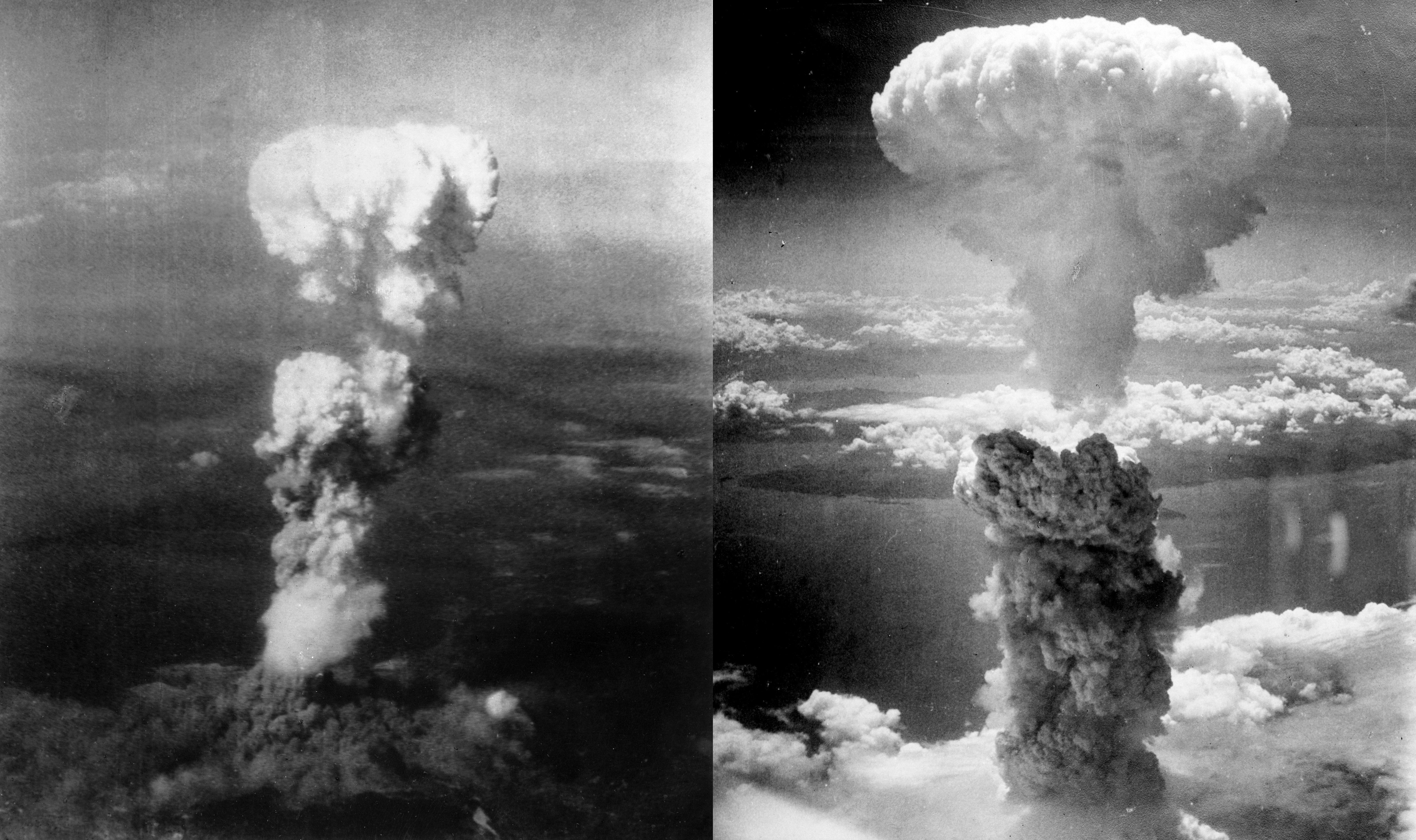
Left picture : At the time this photo was made, smoke billowed 20,000 feet above Hiroshima while smoke from the burst of the first atomic bomb had spread over 10,000 feet on the target at the base of the rising column. Six planes of the 509th Composite Group participated in this mission: one to carry the bomb (Enola Gay), one to take scientific measurements of the blast (The Great Artiste), the third to take photographs (Necessary Evil), while the others flew approximately an hour ahead to act as weather scouts (08/06/1945). Bad weather would disqualify a target as the scientists insisted on a visual delivery. The primary target was Hiroshima, the secondary was Kokura, and the tertiary was Nagasaki.Right picture : Atomic bombing of Nagasaki on August 9, 1945, taken by Charles Levy.

Flugblatt gegen Atomkraft der "aktion pro vita Stuttgart" in den 1970er Jahren Aufschrift: So sieht unsere „strahlende“ Zukunft aus! Deshalb: heute aktiv - sonst morgen radioaktiv! Ein Kind aus Hiroshima Fruchtschäden (Injury of fetus = Verletzung des Fötus) Die geplanten Atomkraftwerke und Wiederaufbereitungsanlagen in der Bundesrepublik. Quelle: Studie 1220 - Juli 1975, Kernforschungsanlage Jülich im Auftrage des Bundesinnenministeriums und Entwicklungsplan "Kraftwerkstandorte" Baden-Württemberg. .

Leaflet dropped on Japan in the bombings of Hiroshima and Nagasaki urging quick surrender.

Amid the wreckage of a prison in Nagasaki, three Manhattan Project specialists use Geiger counters to measure residual radioactivity. They are, from left to right: Captain Henry Barnett, author of the April 1946 medical report, Robert Serber, and Captain Harry O. Whipple. All three had been working at Los Alamos.

Original Caption: Assembly area for dead, pending identification and disposal. Photo from Japanese Newspaper files.
The Atomic Bomb, by Rebecca Pate and Evan Mickey.

A leaflet dropped from a B-29 on Japan after the bombing of Hiroshima. Translation: Notice to the Japanese People! Evacuate the city immediately. What this leaflet contains is extremely important, so please read carefully. The Japanese people are facing an extremely important autumn. Your military leaders were presented with thirteen articles for surrender by our three-country alliance to put an end to this unprofitable war. This proposal was ignored by your army leaders. Because of this the Soviet Republic intervened. In addition, the United States has developed an atom bomb, which had not been done by any nation before. It has been determined to employ this frightening bomb. One atom bomb has the destructive power of 2000 B-29s. This frightening fact should be understood by you by observing what kind of situation was caused when only one was dropped on Hiroshima.

Painting in the street celebrating the 40th anniversary of Independence Day

Una stima dei danni provocati dai bombardamenti atomici su Hiroshima e Nagasaki nel 1945.

चित्र ११.२ परमाणु बम

First leaflet which was dropped on Japanese cities in conjunction with the Atomic Bomb. Text: TO THE JAPANESE PEOPLE: America asks that you take immediate heed of what we say on this leaflet. We are in possession of the most destructive explosive ever devised by man. A single one of our newly developed atomic bombs is actually the equivalent in explosive power to what 2000 of our giant B-29's can carry on a single mission. This awful fact is one for you to ponder and we solemnly assure you it is grimly accurate. We have just begun to use this weapon against your homeland. If you still have any doubt, make inquiry as to what happened to Hiroshima when just one atomic bomb fell on that city. Before using this bomb to destroy every resource of the military by which they are prolonging this useless war, we ask that you now petition the Emperor to end the war. Our President has outlined for you the thirteen consequences of an honorable surrender: We urge that you accept these consequences and begin the work of building a new, better, and peace-loving Japan. You should take steps now to cease military resistance. Otherwise, we shall resolutely employ this bomb and all our other superior weapons to promptly and forcefully end the war. EVACUATE YOUR CITIES
The General Effects of the Atomic Bombs on Hiroshima and Nagasaki. Describes effects and provides analysis of effects on various types of structures.

Letter received from General Thomas Handy to General Carl Spaatz, authorizing the dropping of the first atomic bomb.

The Knoxville News-Sentinel headlines, August 6, 1945.
75 ans après les bombardements d’Hiroshima et de Nagasaki, l’ombre d’une guerre nucléaire plane toujours sur nos têtes, malgré les horreurs subies par ces villes. Encore aujourd’hui, aucune ville n’est préparée aux conséquences de l’explosion d’une bombe atomique, et aucune nation ne pourrait y faire face efficacement. Des milliers, voire des millions de civils seraient tués et blessés sans que personne ne puisse leur porter secours.

Poster of atomic bombs the United States dropped on the Japanese cities of Hiroshima and Nagasaki on August 6 and 9, 1945.

Operations Order No. 35, issued by the 509th Composite Group on August 5, 1945, for the atomic bombing mission on Hiroshima, Japan, signed by Major James I. Hopkins, Jr.

On display in the War Memorial museum, Canberra, Australia. The hands apparently show the time of the explosion. The infocard described the glass face as being melted by the blast (you can see it dripping at the bottom), and said the clock was found near the centre of the explosion. It did not specify Hiroshima or Nagasaki.
Scope and content: In this letter (which was not sent) to Chicago newspaper columnist Irv Kupcinet, former President Truman defends his decision to use the atomic bomb against Japan in World War II. Asserting that use of the bomb saved American and Japanese lives by ending the war, Mr. Truman observes that the attack on Pearl Harbor occurred while the United States was at peace with Japan, and resulted in the deaths of thousands of American servicemen.
Order from General Thomas Handy to General Carl Spaatz authorizing the dropping of the first atomic bomb
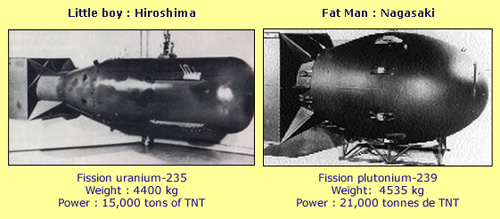
The Little boy and Fat man bombs dropped on Japan

Original Caption: 14750 feet southeast of GZ. Occasional minor blast damage to buildings.

NEWSMAP For the Armed Forces. V-E Day + 15 Weeks - 192nd Week of U.S. Participation in the War.

nihonnogenbakubungaku
Historical Overview
On 6 and 9 August 1945, the United States detonated two atomic bombs over the Japanese cities of Hiroshima and Nagasaki, respectively, during the final days of World War II. The aerial bombings killed 150,000 to 246,000 people, most of whom were civilians, and remain the first and only uses of nuclear weapons in an armed conflict. In the final year of World War II, the Allies prepared for a costly invasion of the Japanese mainland. This undertaking was preceded by a conventional bombing and firebombing campaign that devastated 64 Japanese cities, including an operation on Tokyo. The war in Europe concluded when Germany surrendered on 8 May 1945, and the Allies turned their full attention to the Pacific War. By July 1945, the Allies' Manhattan Project had produced two types of atomic bombs: "Little Boy", an enriched uranium gun-type fission weapon, and "Fat Man", a plutonium implosion-type nuclear weapon. The 509th Composite Group of the U.S. Army Air Forces was trained and equipped with the specialized Silverplate version of the Boeing B-29 Superfortress, and deployed to Tinian in the Mariana Islands. The Allies called for the unconditional surrender of the Imperial Japanese Armed Forces in the Potsdam Declaration on 26 July 1945, the alternative being "prompt and utter destruction". The Japanese government ignored the ultimatum. Japan announced its surrender to the Allies on 15 August, six days after the bombing of Nagasaki and the Soviet Union's declaration of war against Japan and invasion of Manchuria. The Japanese government signed an instrument of surrender on 2 September, ending the war.
Quick Facts
US Army Air Forces
- Commander: Paul Tibbets
- Strength: 1 B-29
- Casualties: 0
Japan (Civilian)
- Commander: -
- Strength: -
- Casualties: 140000
Strategic Context
Forcing immediate surrender without an invasion.
Related Literature


Der Gulag

Die Schlacht um Berlin und das Ende des Dritten Reichs 1945

Hunde, wollt ihr ewig leben: ein Stalingrad-Roman

Roter Hunger: Stalins Krieg gegen die Ukraine

So weit die Füße tragen

Söldner ohne Sold: Die deutschen Freikorps 1918–1923

Vom Massensturm zur Stoßtrupptaktik: Die deutsche Landkriegtaktik im Spiegel von Dienstvorschriften und Publizistik 1906 bis 1918

Wir Wehr-Wölfe: Erinnerungen eines Freikorps-Führers

Zweiter Weltkrieg Erlebnisbericht Apokalypse Stalingrad: Untergang der 6. Armee 1942-1943
Walter Mönch
Rise And Fall Of The Third Reich
William Shirer
Historical Locations
Interactive map requires third-party cookie consent.