Battle of Heligoland Bight

British sketch of the movements of SMS "Stettin", "Frauenlob" und "V 187" (0730 – 0900 GMT)

Sinking of the German cruiser Mainz in the Battle of Heligoland. The photograph, taken from the deck of a British warship, shows the cruiser in flames and settling in the water.
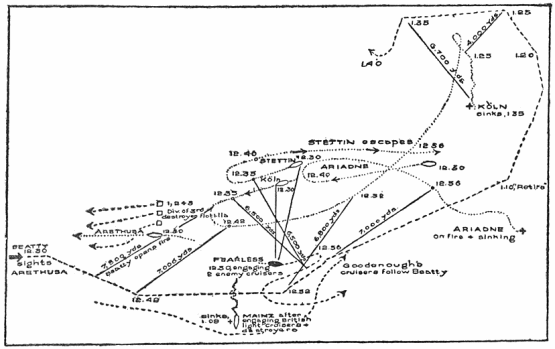
Map showing British and German ships and movements at the Battle of Heligoland Bightl, Final Phase, 28 August November 1914.

Map showing British and German ships and movements at the Battle of Heligoland Bight, First Phase, 28 August 1914.
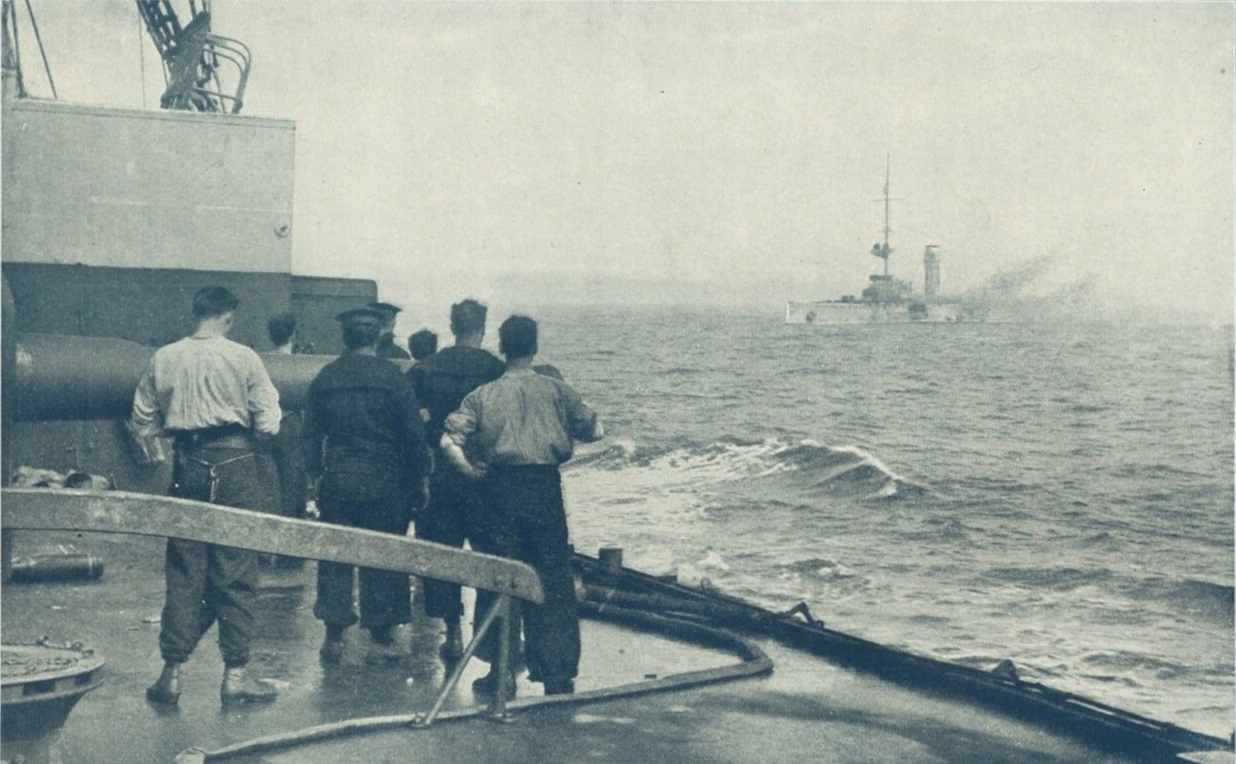
Titleː A Remarkable Camera Record of the Sinking of the German Cruiser Mainz off Heligoland August 28th 1914. A photograph taken from the deck of a British cruiser just before the Mainz sank, In the foreground British sailors watch the Mainz on fire. The text indicates the photo was taken from the deck of one of the British cruisers present, and shows a British gun crew standing by their 6 inch gun. The Mainz is seen on fire, minus two after funnels and a mast, shortly before heeling over and sinking.
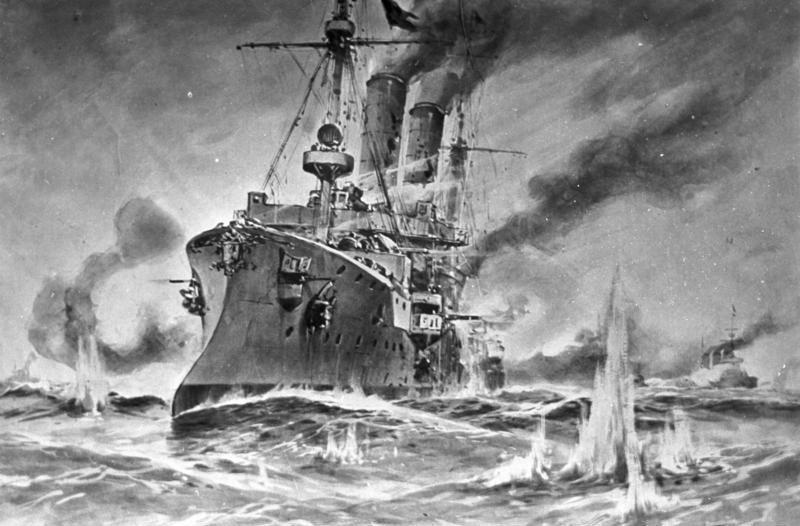
For documentary purposes the German Federal Archive often retained the original image captions, which may be erroneous, biased, obsolete or politically extreme. Kleiner Kreuzer "SMS Ariadne" im Gefecht Kleiner Kreuzer "S.M.S. Ariadne" der Gazellen-Klasse im Gefecht.- Gemälde von Willy Stöwer (1864-1931)

Helgoland - German Patrols
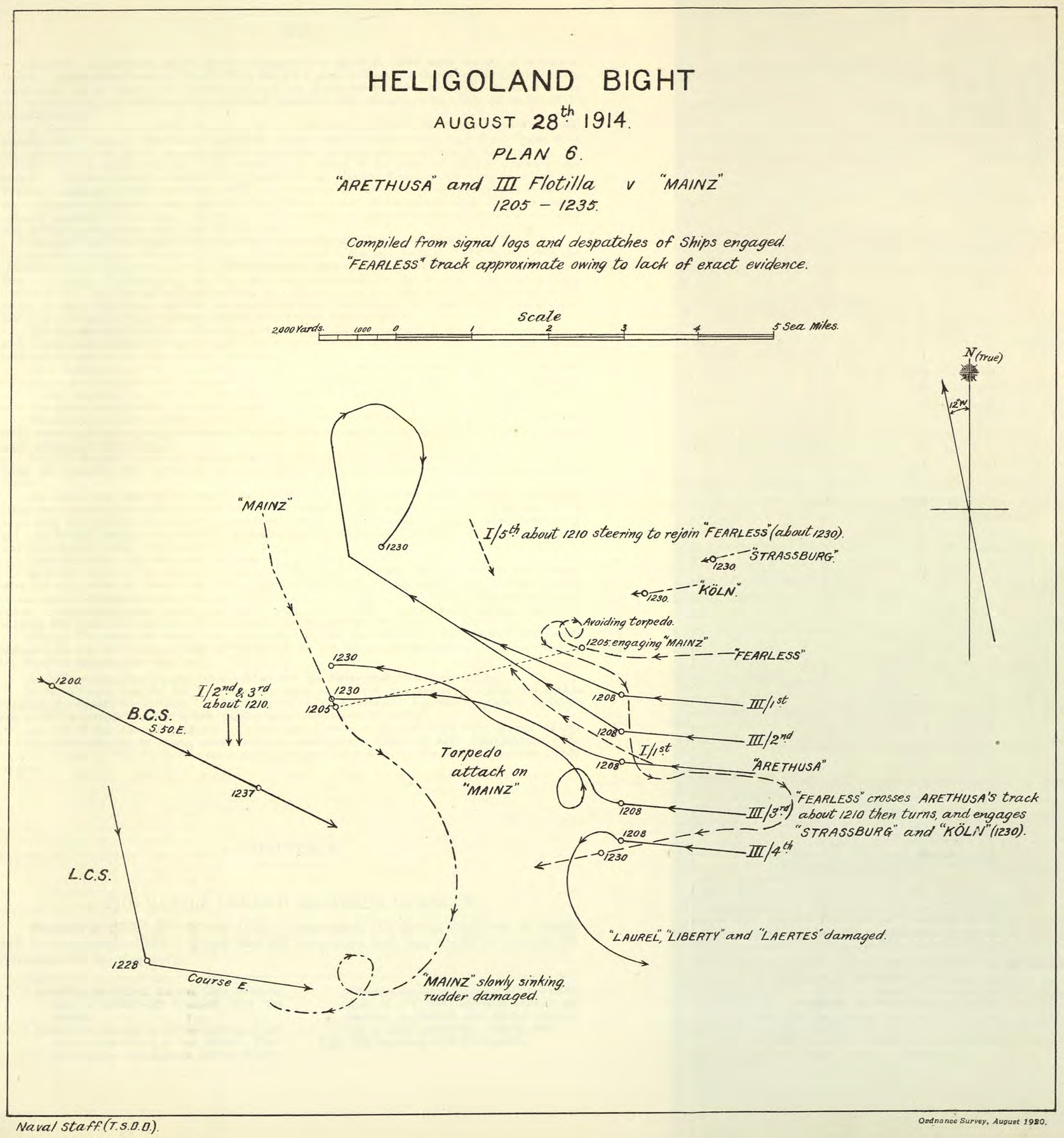
British sketch of the movements of "Arethusa" and III Flotilla v "Mainz" in the engagement in Heligoland Bight

Battle of the Bight - British sketch of operational plan

Helgoland - British sketch of the movements of light cruisers (HMS "Arethusa", "Fearless" v SMS "Straßburg", "Cöln"(1046 – 1105 GMT)

British sketch of the movements of SMS "Straßburg" against British Flottillas (1116 – 1143 GMT)

British sketch of the movements of SMS "Straßburg" against British Flottillas (1116 – 1143 GMT)

British sketch of the movements of "Arethusa" and III Flotilla v "Mainz" in the engagement in Heligoland Bight - Part 1

British sketch of the sinking of SMS "Cöln" and "Ariadne"

Sketch of the fighting of "Straßburg" (11:27-12:04 GMT)
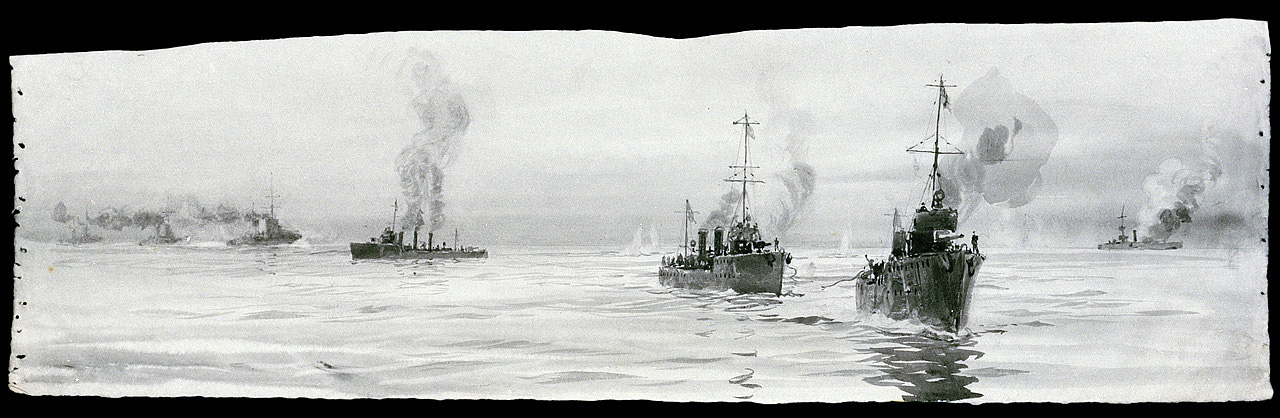
L-class destroyers and the battlecruisers 'Lion', 'Queen Mary', and 'Princess Royal', with the 'Mainz', at the Battle of the Heligoland Bight, 28 August 1914 Commodore Reginald Tyrwhitt, commander of the Harwich Force, in the light cruiser 'Arethusa' with 16 destroyers of the 3rd Destroyer Flotilla, and Captain Blunt in the scout cruiser 'Fearless' with 15 destroyers of the 1st Destroyer Flotilla, steamed into the Heligoland Bight to attack German patrol lines shortly before 07.00 on 28 August 1914. They were supported by Commodore Goodenough with the six cruisers of the 1st Light Cruiser Squadron, who was in turn covered by the five battlecruisers of Vice-Admiral Beatty. In the ensuing confused action three German cruisers and one torpedo boat were sunk and other cruisers damaged, with over 1000 German officers and men being lost. On the British side, the 'Arethusa' and the destroyers 'Laertes', 'Laurel' and 'Liberty' were damaged and casualties were 59 dead and 43 wounded. This drawing shows destroyers of the 3rd Destroyer Flotilla after their action with the German cruiser 'Mainz' (1909) which is seen on fire on the right. The destroyer in the right foreground is taking the badly damaged 'Laurel' (1913), the one behind, in tow. Two of the destroyers are shown with the letter L painted on the hull but this should have been painted out on the outbreak of war. The battlecruisers 'Lion' (1910), 'Queen Mary' (1912) and 'Princess Royal' (1911) are coming into action in the left distance. Wyllie produced a variant of this composition in watercolour for his and M.F. Wren's 'Sea Fights of the Great War' (f. p.24) in which tye positions of the destroyers and' 'Mainz' is almost the same, but the ' Lion' much more prominent in the centre. See also PAF1232.
![L-class destroyers under fire from the 'Mainz' at the Battle of the Heligoland Bight, 28 August 1914
Inscribed along the bottom by the artist to identify the ships, from far left to right: 'Maintz' [sic] (German cruiser), 'Liberty', 'Lysander', 'Laurel' and 'Laertes'. Commodore Reginald Tyrwhitt, commander of the Harwich Force, in the light cruiser 'Arethusa' with 16 destroyers of the 3rd Destroyer Flotilla, and Captain Blunt in the scout cruiser 'Fearless' with 15 destroyers of the 1st Destroyer Flotilla, steamed into the Heligoland Bight to attack German patrol lines shortly before 07.00 on 28 August 1914. They were supported by Commodore Goodenough with the six cruisers of the 1st Light Cruiser Squadron, who was in turn covered by the five battlecruisers of Vice-Admiral Beatty. In the ensuing confused action three German cruisers and one torpedo boat were sunk and other cruisers damaged, with over 1000 German officers and men being lost. On the British side, the 'Arethusa' and the destroyers 'Laertes', 'Laurel' and 'Liberty' were damaged and casualties were 59 dead and 43 wounded. This drawing shows the four named L-class destroyers of the 3rd Destroyer Flotilla under fire from the 'Mainz' (1909) at about 11.45. 'Laurel' still has the letter L on her hull but this should have been painted out on the outbreak of war and maya be an error by Wyllie. See also PAF1231.](https://upload.wikimedia.org/wikipedia/commons/6/6d/L-class_destroyers_under_fire_from_the_%27Mainz%27_at_the_Battle_of_the_Heligoland_Bight%2C_28_August_1914_RMG_PW1232.jpg)
L-class destroyers under fire from the 'Mainz' at the Battle of the Heligoland Bight, 28 August 1914 Inscribed along the bottom by the artist to identify the ships, from far left to right: 'Maintz' [sic] (German cruiser), 'Liberty', 'Lysander', 'Laurel' and 'Laertes'. Commodore Reginald Tyrwhitt, commander of the Harwich Force, in the light cruiser 'Arethusa' with 16 destroyers of the 3rd Destroyer Flotilla, and Captain Blunt in the scout cruiser 'Fearless' with 15 destroyers of the 1st Destroyer Flotilla, steamed into the Heligoland Bight to attack German patrol lines shortly before 07.00 on 28 August 1914. They were supported by Commodore Goodenough with the six cruisers of the 1st Light Cruiser Squadron, who was in turn covered by the five battlecruisers of Vice-Admiral Beatty. In the ensuing confused action three German cruisers and one torpedo boat were sunk and other cruisers damaged, with over 1000 German officers and men being lost. On the British side, the 'Arethusa' and the destroyers 'Laertes', 'Laurel' and 'Liberty' were damaged and casualties were 59 dead and 43 wounded. This drawing shows the four named L-class destroyers of the 3rd Destroyer Flotilla under fire from the 'Mainz' (1909) at about 11.45. 'Laurel' still has the letter L on her hull but this should have been painted out on the outbreak of war and maya be an error by Wyllie. See also PAF1231.

The battlecruiser HMS NEW ZEALAND steaming into action at the Battle of Heligoland Bight.
![Rescuing the crew of the German light cruiser 'Mainz' at the Battle of the Heligoland Bight, 28 August 1914 (sketch)
Inscribed by the artist, below image, 'Com Keys' and 'Mintz sinking' [sic]. This preliminary pencil sketch shows the destroyer 'Lurcher' (1912), flagship of Commodore Roger Keyes, alongside the disabled German light cruiser 'Mainz' (1909) at about 12.25 during the Battle of the Heligoland Bight on 28 August 1914. The 'Mainz' had been in action with the light cruiser 'Arethusa', the destroyers of the 3rd Flotilla and the ships of Commodore Goodenough's 1st Light Cruiser Squadron. Completely disabled by shells and a torpedo, and with her captain killed, she was ordered to be abandoned and scuttled. The 'Lurcher' came alongside and rescued the wounded crewmen while other ships rescued men from the sea. A total of 348 of the crew of the 'Mainz' were saved and she eventually sank at 13.08. For a more developed wash version, see PAE3448.](https://upload.wikimedia.org/wikipedia/commons/e/ee/Rescuing_the_crew_of_the_German_light_cruiser_%27Mainz%27_at_the_Battle_of_the_Heligoland_Bight%2C_28_August_1914_%28sketch%29_RMG_PV1043.jpg)
Rescuing the crew of the German light cruiser 'Mainz' at the Battle of the Heligoland Bight, 28 August 1914 (sketch) Inscribed by the artist, below image, 'Com Keys' and 'Mintz sinking' [sic]. This preliminary pencil sketch shows the destroyer 'Lurcher' (1912), flagship of Commodore Roger Keyes, alongside the disabled German light cruiser 'Mainz' (1909) at about 12.25 during the Battle of the Heligoland Bight on 28 August 1914. The 'Mainz' had been in action with the light cruiser 'Arethusa', the destroyers of the 3rd Flotilla and the ships of Commodore Goodenough's 1st Light Cruiser Squadron. Completely disabled by shells and a torpedo, and with her captain killed, she was ordered to be abandoned and scuttled. The 'Lurcher' came alongside and rescued the wounded crewmen while other ships rescued men from the sea. A total of 348 of the crew of the 'Mainz' were saved and she eventually sank at 13.08. For a more developed wash version, see PAE3448.

Rescuing the crew of the German light cruiser 'Mainz' at the Battle of the Heligoland Bight, 28 August 1914 This drawing quite accurately depicts the rescue of most of the 346 survivors from the German light cruiser 'Mainz' (1909), the large ship on the right, which was heavily damaged by the gunfire of British cruisers and battle-cruisers at the Battle of the Heligoland Bight on 28 August 1914. Two of her three funnels and her mainmast went by the board before she surrendered. The destroyer 'Lurcher' (1912, shown ), flagship of Commodore Roger Keyes, went alongside to take off survivors while boats from other destroyers assisted in the work. The abandoned 'Mainz' then sank. Wyllie has written 'mast more upright' at the bottom, presumably referring to that of the 'Lurcher'. For a preliminary pencil sketch of this subject see PAE1043.

+Siegel der Kaiserliche Marine - Amt fürdie Truppen in Helgoland

SMS Ariadne

The German light cruiser SMS Mainz sinking at the battle of Heligoland bight on August 28 1914.

SMS V 187
Historical Overview
The Battle of Heligoland Bight was the first Anglo-German naval battle of the First World War, fought on 28 August 1914, between ships of the United Kingdom and Germany. The battle took place in the south-eastern North Sea, when the British attacked German patrols off the north-west German coast. The German High Seas Fleet was in harbour on the north German coast while the British Grand Fleet was out in the northern North Sea. Both sides engaged in long-distance sorties with cruisers and battlecruisers, with close reconnaissance of the area of sea near the German coast—the Heligoland Bight—by destroyer.
Quick Facts
Royal Navy
- Commander: David Beatty
- Strength: 5 Schlachtkreuzer
- Casualties: 35 Tote
Imperial German Navy
- Commander: Leberecht Maass †
- Strength: 6 Kreuzer
- Casualties: 712 Tote
Strategic Context
British raid on German patrol lines.
Related Literature


Frühling der Revolution: Europa 1848/49 und der Kampf für eine neue Welt
Christopher Clark

Risorgimento! Italiens Kampf um die Einheit im 19. Jahrhundert
Historical Locations
Interactive map requires third-party cookie consent.