Bombing of Guernica
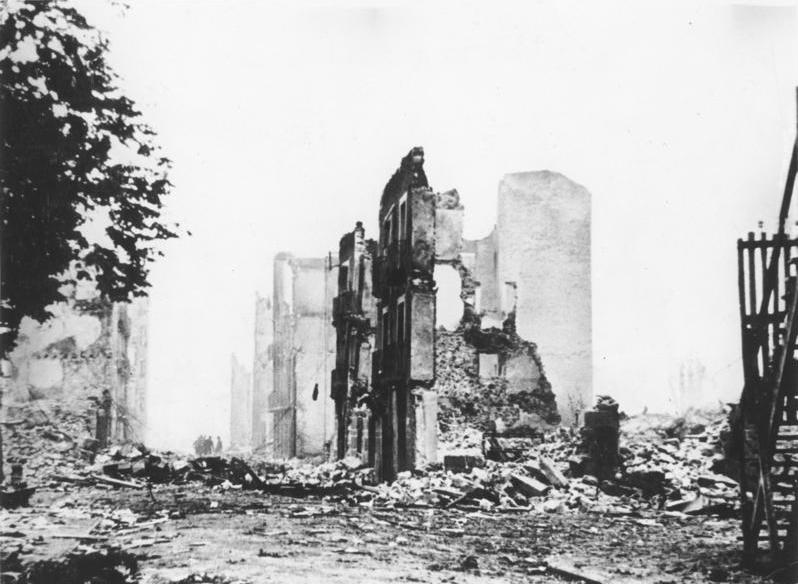
For documentary purposes the German Federal Archive often retained the original image captions, which may be erroneous, biased, obsolete or politically extreme. Die Ruinen von Guernica 5603/37

Noticia sobre el bombardeo de Guernica

Euskariana artxiboaren arabera, beharbada Durangoko bonbardaketako irudia, baina ez da, Gernikakoa da, San Juan Ibarra eliza da

El pueblo de Gernika en ruinas tras el bombardeo.

Paragraph from George L. Steer Report in New York Times on Destruction of City - Museum of Peace - Gernika (Guernica) - Bascay - Spain

After the Battle of Guadalajara, the Nationalist troops gave up in the attack to Madrid. In the meantime, the North, Asturias, Cantabria, and Bilbao, in the Basque Country, one of the most industrialized and modern regions of the country, had prepared an impregnable line of defence so that the coup forces could not occupy it. On 26 April 1937, several planes from the Nazi Germany ‘Condor Legion’ dropped thousands of incendiary bombs over the unoccupied city of Guernica uninterruptedly for three hours, killing up to 1,500 civilians in what is believed to be the first air attack targeting only civilians. The operation was totally acknowledged by Franco and the Nationalists, who later led a propaganda campaign to appease the international media claiming they didn’t know nothing. And then, Alejandro Goicoechea deserted. Goicoechea was the engineer who had planned the whole defence of the North. With this information in the hands of the Nationalist, the line was useless. To distract the enemy, the Government led the Battle of Brunete, which ended with an indecisive result, with higher casualties in the Republican side. Then, the Nationalists attacked further North, occupying Zaragoza in the East -approaching Catalonia-, being eventually stopped in the city of Belchite, which was destroyed to the grounds. By the end of 1937, the North was practically conquered. With the occupation of Northern Valencia in the first half of 1938, only Madrid, Catalonia, La Mancha, the island of Menorca, and the Eastern regions were still controlled by the Republicans. The Spanish colonies had also been defeated and were now in Nationalist hands. Without foreign reinforcements, and with the professional troops used by the Rebels, the war would end very soon. Caption: The ruins of the destroyed city of Guernica, 1937. Bodies can be seen. #historiansunion #colored #colorized #colourised #colorization #colourisation #color #colour #history #military #ww1 #wwi #worldwarone #greatwar #thegreatwar #ww2 #wwii #worldwartwo #military #war #warfare #allies #axis #spanishcivilwar #guerracivilespañola #franco #franciscofranco #cassowaryscw

Chronicle of the bombing of Guernica made the day after the bombing and published in "The Times".
Historical Overview
On 26 April 1937, the Basque town of Guernica was aerially bombed during the Spanish Civil War. It was carried out at the behest of Francisco Franco's rebel Nationalist faction by its allies, the Nazi German Luftwaffe's Condor Legion and the Fascist Italian Aviazione Legionaria, under the code name Operation Rügen. The town was being used as a communications centre by Republican forces just behind the front line, and the raid was intended to destroy bridges and roads. The operation opened the way to Franco's capture of Bilbao and his victory in northern Spain.
Quick Facts
Legion Condor
- Commander: Wolfram v. Richthofen
- Strength: 43 Flugzeuge
- Casualties: 0
Civilians
- Commander: -
- Strength: -
- Casualties: ca. 150–800
Strategic Context
Terror raid to break Basque resistance.
Related Literature


Der Gulag

Die Schlacht um Berlin und das Ende des Dritten Reichs 1945

Hunde, wollt ihr ewig leben: ein Stalingrad-Roman

Roter Hunger: Stalins Krieg gegen die Ukraine

So weit die Füße tragen

Söldner ohne Sold: Die deutschen Freikorps 1918–1923

Vom Massensturm zur Stoßtrupptaktik: Die deutsche Landkriegtaktik im Spiegel von Dienstvorschriften und Publizistik 1906 bis 1918

Wir Wehr-Wölfe: Erinnerungen eines Freikorps-Führers

Zweiter Weltkrieg Erlebnisbericht Apokalypse Stalingrad: Untergang der 6. Armee 1942-1943
Walter Mönch
Rise And Fall Of The Third Reich
William Shirer
Historical Locations
Interactive map requires third-party cookie consent.