Battle of the Ebro
Batalla del Ebre, espai de memoria

Batalla del Ebre, espai de memoria

битва на эбро
Página 59 del libro "Las Brigadas Internacionales", de Víctor Hurtado y José Luis Martín Ramos (DAU, 2013). El texto y el mapa explican el ataque republicano con el que dio comienzo la batalla del Ebro, en julio de 1938.

Página 59 del libro "Las Brigadas Internacionales", de Víctor Hurtado y José Luis Martín Ramos (DAU, 2013). El texto y el mapa explican el ataque republicano con el que dio comienzo la batalla del Ebro, en julio de 1938.

Batalla Ebro

Búnker de la Batalla del Ebro en Corbera d'Ebre. Concentración republicana de EUiA en 2006.
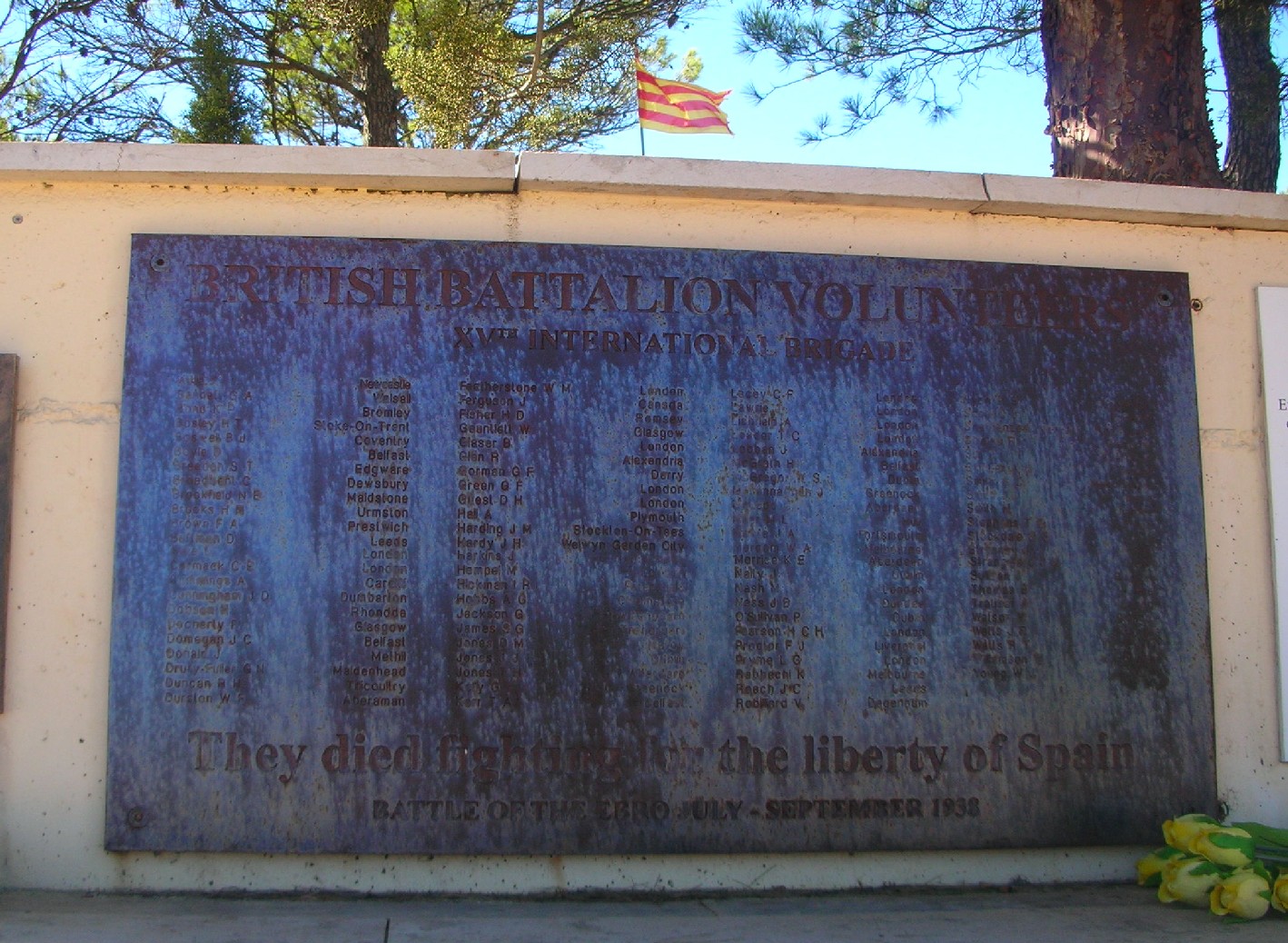
Plaque honoring the fallen British volonteer soldiers who died in the Ebro Battle defending the Spanish Republic at the monument on cota 705, Serra de Pàndols

Batalla del Ebre, espai de memoria

Centro de Interpretación "les Veus del Front", audiovisual sobre la Batalla del Ebro en Pinell de Bray

Corbera d'Ebre amb el Poble Vell a dalt

Cruce del Ebro
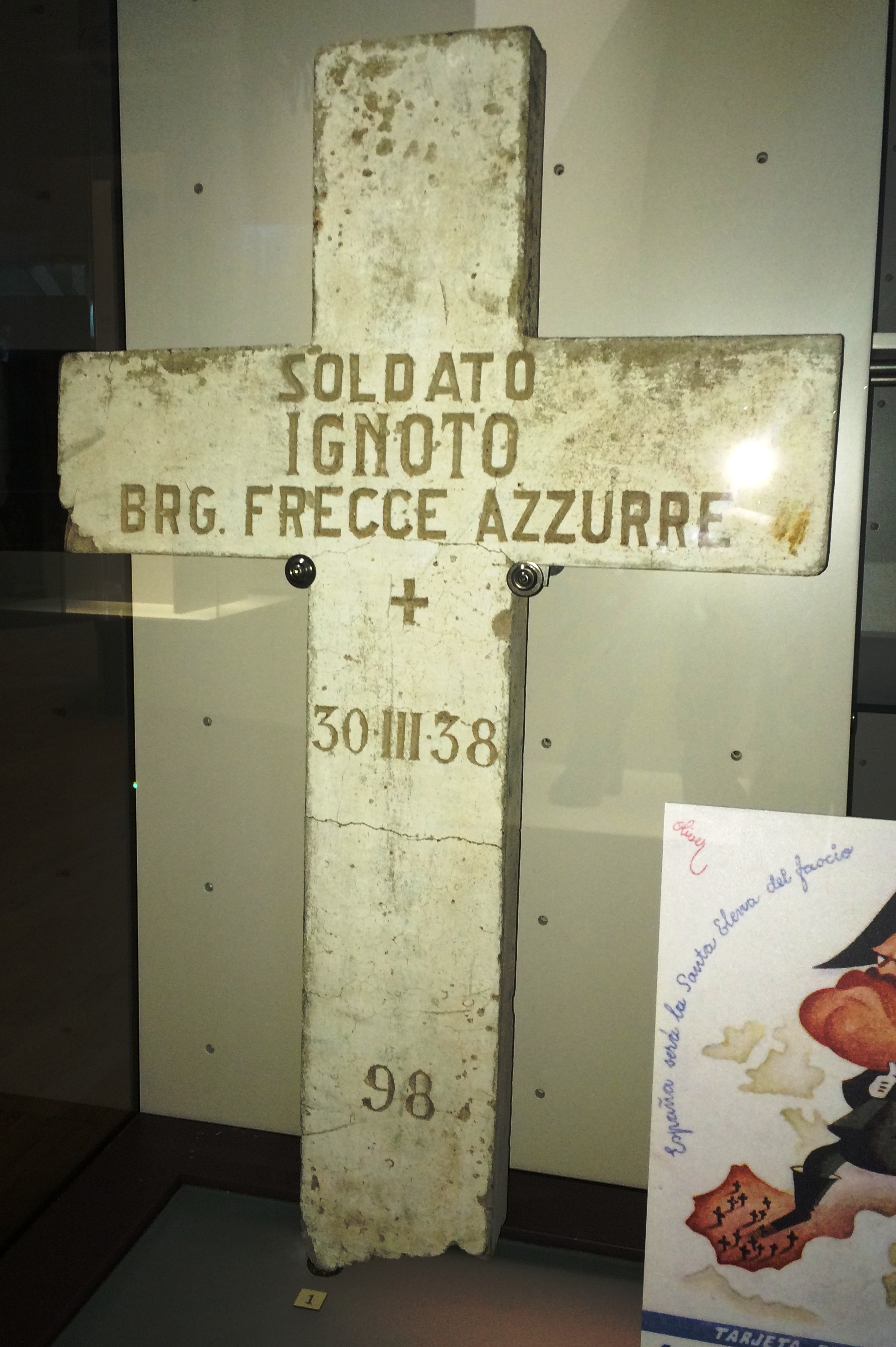
Cross that marked the tomb of an unknown Italian soldier of the Brigata Frecce Azzurre, dead on 30 March 1938 in the Battle of the Ebro. Photo taken at the Royal Military Museum, Brussels.

Movimientos de tropas en el inicio de la batalla del Ebro.
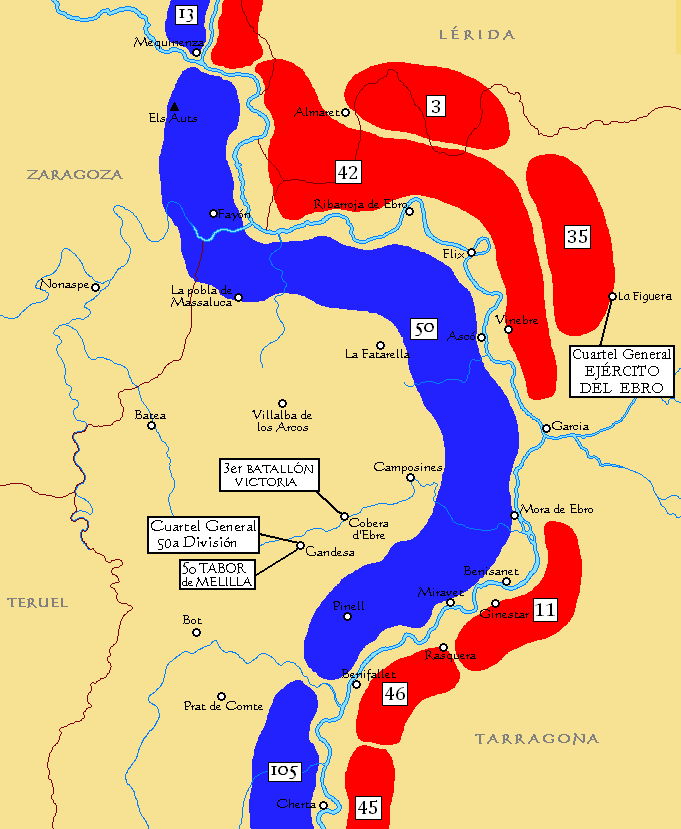
Mapa con la distribución de fuerzas durante la Batalla del Ebro. Las bolsas de color rojo equivalen a divisiones del Ejército Popular con su denominación oficial. Las bolsas de color azul equivalen a las divisiones del Ejército Franquista con su denominación. Los cuadros que aparecen se refieren o bien a presencia de un Estado Mayor o de una unidad militar independiente.
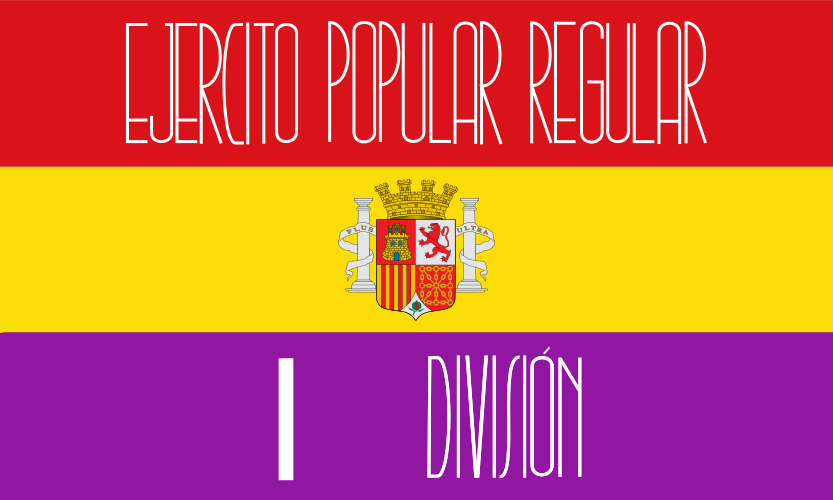
Reproducción de la bandera de la 11 División del Ejército Popular de la II República Española, conservada en el Museo de Tabar (Navarra). Esta unidad fue creada en mayo de 1937 y combatió en los frentes de Belchite, Aragón, Ebro y Cataluña. Fuente: Juan Manuel Peña López, José Luis Alonso González, La Guerra Civil y sus banderas 1936-1939, Aldaba Ed. Madrid 2004, ISBN 849508872X

Fuerzas del gobierno español cruzando el Ebro Forces of the Spanish Government Crossing the Ebrotitle QS:P1476,en:"Forces of the Spanish Government Crossing the Ebro"label QS:Len,"Forces of the Spanish Government Crossing the Ebro"

Spanish Civil War - Czechoslovak Gottwald artillery batteries

Members of the XV International Brigade, possibly the British Battalion, being farewelled during the Battle of the Ebro in the football field of Marçà

Peace monument (Monument a la Pau) on cota 705, Serra de Pàndols

Batalla del Ebre, espai de memoria

Batalla del Ebre, espai de memoria

Batalla del Ebre, espai de memoria

Batalla del Ebre, espai de memoria

Bomba (inert) de morter MLIC Valero mod. 1932, reformada monobloc, de 50 mm. Fabricació republicana (Stoker catalana). Recuperada del fang de la riba sud del riu Ebre, a uns 100 mts del pont de ferrocarril de Garcia.

Julio Alvarez del Vayo y Olloqui treats cigars to soldiers who distinguished themselves in the Battle of the Ebro.
Historical Overview
The Battle of the Ebro was the longest and largest battle of the Spanish Civil War and the greatest, in terms of manpower, logistics and material ever fought on Spanish soil. It took place between July and November 1938, with fighting mainly concentrated in two areas on the lower course of the Ebro River, the Terra Alta comarca of Catalonia, and the Auts area close to Fayón in the lower Matarranya, Eastern Lower Aragon. These sparsely populated areas saw the largest array of armies in the war. The battle was a massive blow to the Second Spanish Republic, with tens of thousands left dead or wounded and little effect on the advance of the Nationalists.
Quick Facts
Nationalists
- Commander: Francisco Franco
- Strength: ca. 100.000
- Casualties: ca. 6.500
Republicans
- Commander: Juan Modesto
- Strength: ca. 80.000
- Casualties: ca. 10.000
Strategic Context
Last desperate attempt by the Republic to reunite its territories.
Related Literature


Der Gulag

Die Schlacht um Berlin und das Ende des Dritten Reichs 1945

Hunde, wollt ihr ewig leben: ein Stalingrad-Roman

Roter Hunger: Stalins Krieg gegen die Ukraine

So weit die Füße tragen

Söldner ohne Sold: Die deutschen Freikorps 1918–1923

Vom Massensturm zur Stoßtrupptaktik: Die deutsche Landkriegtaktik im Spiegel von Dienstvorschriften und Publizistik 1906 bis 1918

Wir Wehr-Wölfe: Erinnerungen eines Freikorps-Führers

Zweiter Weltkrieg Erlebnisbericht Apokalypse Stalingrad: Untergang der 6. Armee 1942-1943
Walter Mönch
Rise And Fall Of The Third Reich
William Shirer
Historical Locations
Interactive map requires third-party cookie consent.