Chosin Reservoir

First Division Leathernecks counter fire with fire when attacked by well entrenched Chinese Reds during the Division's heroic breakout from Chosin

Exhausted Leathernecks of the 1st Marine Division stop for a brief rest during the bitter fighting at the Chosin Reservoir in Korea, December 1950.

A column of troops and armor of the 1st Marine Division move through communist Chinese lines during their successful breakout from the Chosin Reservoir in North Korea. The Marines were besieged when the Chinese entered the Korean War November 27, 1950, by sending 200,000 shock troops against Allied forces.

Marines at Hagaru perimeter watch Corsairs drop napalm on Chinese as Item Company 31/7 moves around high ground at left to attack enemy position.

With the repaired bridge in the background, Marines resume their march south toward Hungnam. By evening on 9 December the Treadway bridge was in place and men and vehicles could move unimpeded down the main supply route through Funchilin Pass. From here on enemy resistance was limited to small-scale firefights and ambushes. The most sizable resistance would come near Sudong.

Seventh Marine Regiment, wearing and carrying cold weather equipment, presses into Communist territory of Chosin Reservoir

First Marine Division infantry take to a rugged hillside in wiping out enemy troops who have set up a roadblock against their retreat
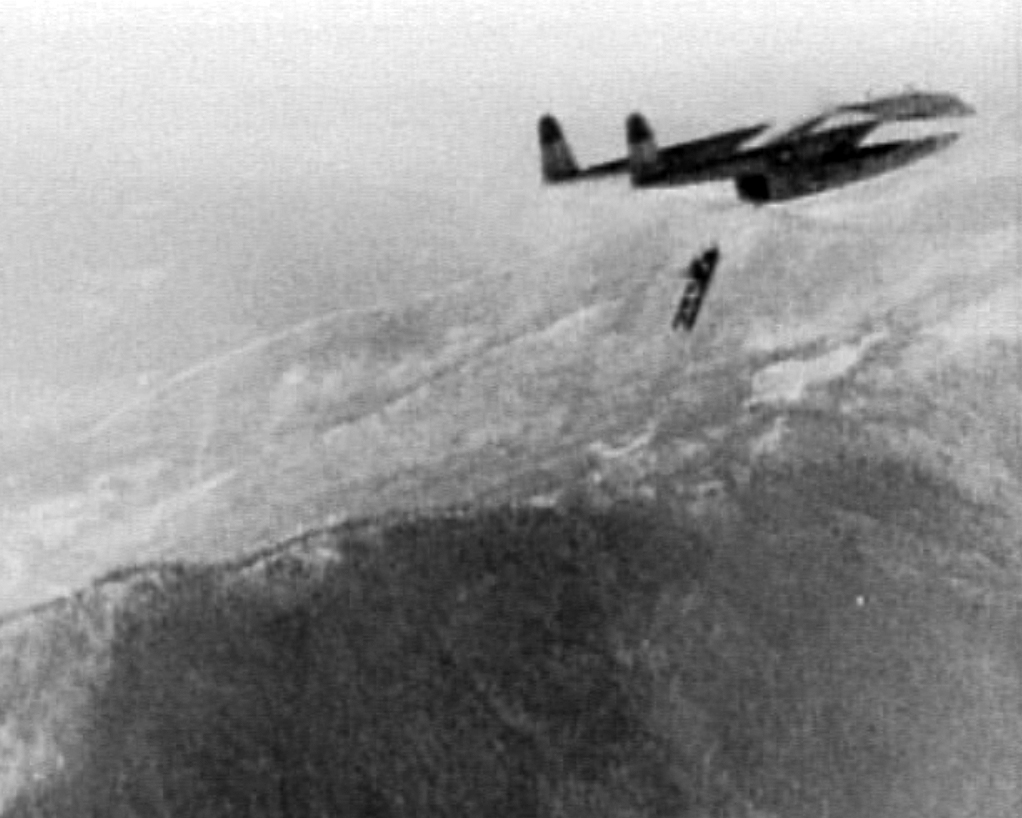
An M-2 Treadway Bridge section is dropped from the door of a C-119 assigned to the 314th Troop Carrier Group, 61st Troop Carrier Squadron over Koto-ri, North Korea Dec. 7, 1950. Rear clamshell doors of the C-119 were removed to accommodate the outsize bridge sections.

Elements of 1st Marine Division advance after successfully overcoming an enemy ambush.
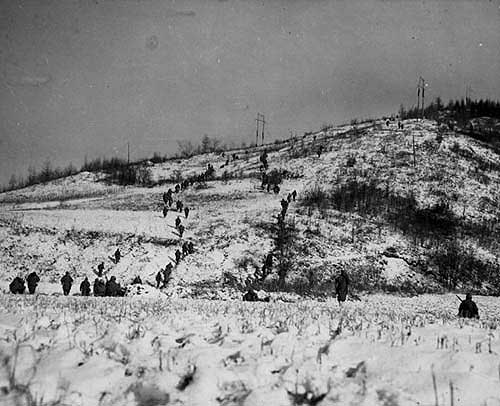
1st Marine Regiment, on supply and withdrawal route of 5th and 7th Marines, had to repel repeated attacks by Chinese communists.

Marines of 1st Marine Division pay respects to fallen buddies during memorial services at Hungnam.

More than 250 veterans gathered here Nov. 10 to mark the 60th anniversary of the pivotal Jangjin “Chosin” Reservoir battle where U.S. Soldiers and Marines defeated a much larger enemy force during a strategic retreat through bitterly cold and fiercely contested mountainous terrain. Photos by SPC Francisco Alejandro.

More than 250 veterans gathered here Nov. 10 to mark the 60th anniversary of the pivotal Jangjin “Chosin” Reservoir battle where U.S. Soldiers and Marines defeated a much larger enemy force during a strategic retreat through bitterly cold and fiercely contested mountainous terrain. Photos by SPC Francisco Alejandro.

More than 250 veterans gathered here Nov. 10 to mark the 60th anniversary of the pivotal Jangjin “Chosin” Reservoir battle where U.S. Soldiers and Marines defeated a much larger enemy force during a strategic retreat through bitterly cold and fiercely contested mountainous terrain. Photos by SPC Francisco Alejandro.

More than 250 veterans gathered here Nov. 10 to mark the 60th anniversary of the pivotal Jangjin “Chosin” Reservoir battle where U.S. Soldiers and Marines defeated a much larger enemy force during a strategic retreat through bitterly cold and fiercely contested mountainous terrain. Photos by SPC Francisco Alejandro.

More than 250 veterans gathered here Nov. 10 to mark the 60th anniversary of the pivotal Jangjin “Chosin” Reservoir battle where U.S. Soldiers and Marines defeated a much larger enemy force during a strategic retreat through bitterly cold and fiercely contested mountainous terrain. Photos by SPC Francisco Alejandro.

More than 250 veterans gathered here Nov. 10 to mark the 60th anniversary of the pivotal Jangjin “Chosin” Reservoir battle where U.S. Soldiers and Marines defeated a much larger enemy force during a strategic retreat through bitterly cold and fiercely contested mountainous terrain. Photos by SPC Francisco Alejandro.

2nd Battalion, 5th Marines set up a command post near the Chosin Reservoir NARA 127-N-A4560

330-PS-971 (A-5439): Photograph shows the close coordination of U.S. Marine Air and Ground units during recent fighting with Chinese Communists in Korea. U.S. Marines move forward after effective close support of their air units have flushed the enemy from their hillside entrenchments. Billows of smoke rise skyward from this target area. Photograph released January 6, 1951. (7/8/2015).
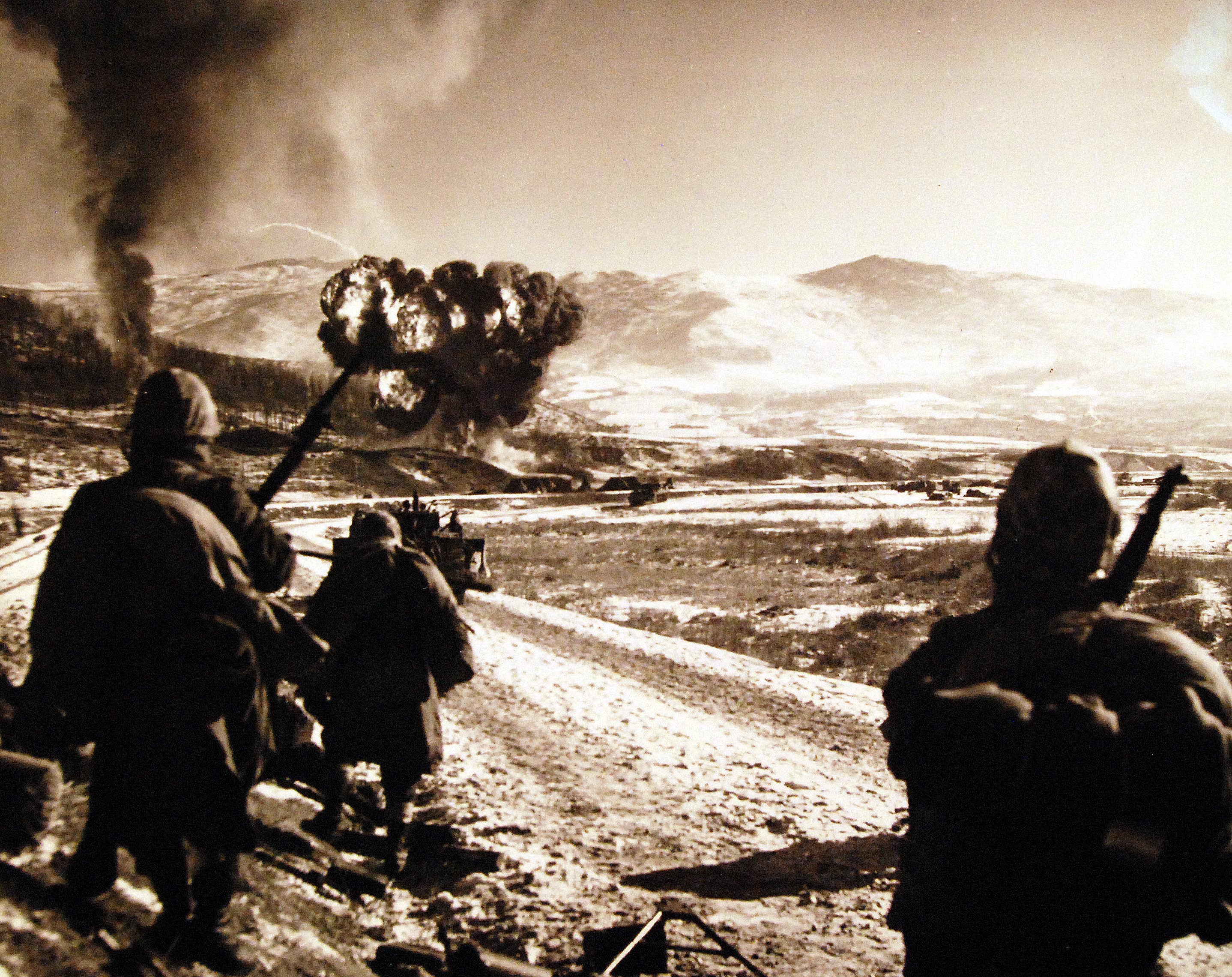
330-PS-971 (A-5464): Photograph shows the close coordination of U.S. Marine Air and Ground units during recent fighting with Chinese Communists in Korea. A Marine Corsair offers close support to ground units brought in close contact with the enemy. The plane zooms skyward through the smoke after dropping napalm on a Red concentration. Note sheet of flame at base of the hill below plane. Photograph released January 6, 1951. (7/8/2015).

330-PS-971 (A-5469): Bomb Break. Elements of the First Marine Division rest on a snow-covered Korean roadside after successfully overcoming an enemy ambush. Photograph released January 5, 1951. Photographed by Sergeant F.C. Kerr, USMC. (7/8/2015).

Marines of Dog Company, 7th Marines, warm their rations and themselves beside a fire before advancing west of Chosin Reservoir.
眼前这位须眉皓然的老人,名叫张崇岫。92岁的他回忆起71年前那段战火纷飞的岁月,依然历历在目。张崇岫1942年秋参加新四军,担任战士和文化教员。1950年加入抗美援朝战争,担任中国人民志愿军第九兵团政治部摄影组长。作为一名战地记者,他曾用相机镜头真实记录下长津湖战役。近日,在张崇岫安徽合肥的家中,他一边翻开战争摄影图集,一边向记者讲述镜头背后的故事。

A row of dead Chinese frozen in grotesque positions, on the high ground overlooking a command post of the 5th Marines at Yudam-ni, mark the line of their farthest advance. The burden of the Chinese attack was borne chiefly by isolated Marine rifle companies holding ridgeline positions.

Astonished Marines of the 5th and 7th Regiments, who hurled back a surprise onslaught by three Chinese communist divisions, hear that they are to withdraw! Ca. December 1950. Sgt. Frank C. Kerr. (Marine Corps) Exact Date Shot Unknown NARA FILE #: 127-N-A4852 WAR & CONFLICT BOOK #: 1392
General notes: Use War and Conflict Number 1392 when ordering a reproduction or requesting information about this image.
Scope and content: BITTER COLD, BITTER FIGHT. While units of the U.S. Far East Air Forces Combat Cargo Command made an all-out effort to aid embattled units of the First Marine Division and Seventh Infantry Division, the men fighting in Korea were trying desperately to link up in their battle for survival. This marine is shown just as he reached the crest of the ridge at the link-up point. Wet, stinging snow and ice made the operation the most difficult sort, as unleashed hordes of communist troops charge again and again into the United Nations forces.
Historical Overview
The Battle of Chosin Reservoir, also known as the Chosin Reservoir Campaign or the Battle of Lake Changjin, was a battle in the Korean War. The name "Chosin" is derived from the Japanese pronunciation "Chōshin", instead of the Korean pronunciation.
Quick Facts
PR China (PVA)
- Commander: Song Shilun
- Strength: 120000
- Casualties: 40000
UN Forces
- Commander: Edward Almond
- Strength: 30000
- Casualties: 15000
Strategic Context
Defending against Chinese intervention.
Related Literature


Der Eiserne Vorhang: Die Unterdrückung Osteuropas 1944–1956

Die Kubakrise 1962

Mao und seine verlorenen Kinder: Chinas Kulturrevolution

Maos Großer Hunger: Massenmord und Menschenexperiment in China
Historical Locations
Exact location not recorded in historical records