Battle of Caen

Deux chars britannique avec leurs équipages à l'aube.

British Sherman tanks and a 6-pdr anti-tank gun in the centre of Caen, Normandy, 10 July 1944. Sherman tanks and 6-pdr anti-tank gun in the centre of Caen, 10 July 1944.

A captured Panzergrenadier of the Hitlerjugend taken by a Canadian Intelligence Unit during the fighting for Caen. The official Public Archives of Canada caption for this photo taken a month after the activities in question, contains no information about the prisoner other than his division. Note: both allied soldiers are wearing the British P-1944 "Turtle" Mk III steel helmet, which was introduced shortly before D-Day. The Mk III helmet was much superior to the conventional "Brodie" helmet normally worn by British & Commonwealth soldiers. The soldier nearest the camera is holding a .303" Lee Enfield rifle in his right hand. A caption of this picture at https://flashbak.com/d-day-the-germans-story-in-43-haunting-photos-394/ reads - A wounded German prisoner, wearing a camouflages uniform, is escorted to an allied first aid station in France on June 21, 1944, by Pvt. Gaston Daisneault, Chateauguay, Quebec, (left) and Pvt. Robert Bonneau (center, background), of Lyster, Quebec.

IWM caption : THE BRITISH ARMY IN THE NORMANDY CAMPAIGN 1944. Lance Corporals A.Burton and L.Barnett of 6th Airborne Division guarding a road junction near Ranville, 7 June 1944. Each is armed with a Mk V Sten submachine gun. Horsa gliders can be seen in the background.

Unidentified soldiers from the 9th Canadian Infantery Brigade in a destroyed church in Carpiquet near Caen, France.
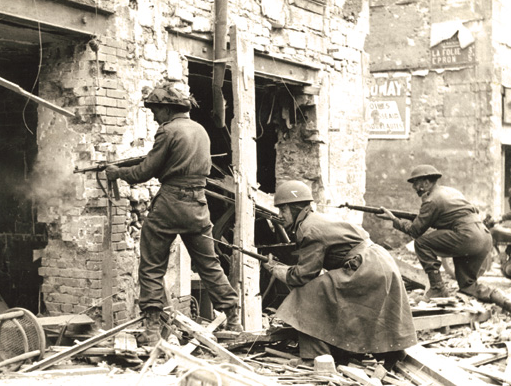
A Canadian soldier fires on the enemy in a house in Caen, July 10, 1944. Photo by Ken Bell.

Allied Campaign in North West Europe the Battle For Caen June 1944 Rifleman Reg. Oates of Walthamstow and Sergeant James Woodward of Tottenham take up a position with a Piat mortar in a cornfield near Caen.

fronts successifs lors de la bataille de Caen
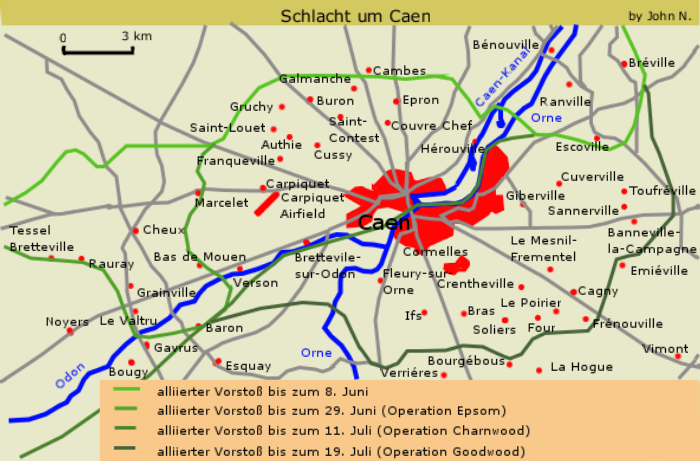
Map, showing the w:Battle for Caen.
![Map, showing the Battle for Caen
Made by Wikipedia use John N. under the Creative Commons 2.0 Germany license (http://en.wikipedia.org/wiki/Image:Battleforcaenmap.png) and translated into English by myself (rwhealey) on 8/21/06.
Verified source: Max Hastings, Overlord: D-Day and the Battle for Normandy, Vintage Books USA; (2006) [1985], ISBN 0-30727-571-X, pages 137–239.](https://upload.wikimedia.org/wikipedia/commons/b/ba/Battleforceanmapenglish.png)
Map, showing the Battle for Caen Made by Wikipedia use John N. under the Creative Commons 2.0 Germany license (http://en.wikipedia.org/wiki/Image:Battleforcaenmap.png) and translated into English by myself (rwhealey) on 8/21/06. Verified source: Max Hastings, Overlord: D-Day and the Battle for Normandy, Vintage Books USA; (2006) [1985], ISBN 0-30727-571-X, pages 137–239.

Map, showing the Battle for Caen

Map, showing the Battle for Caen with French caption and title

A rocket fired from a Typhoon of No 181 Squadron, Royal Air Force, on its way towards buildings at Carpiquet airfield during the battle for Normandy. The Canadian 3rd Division took Carpiquet to the west of Caen on 4 July.
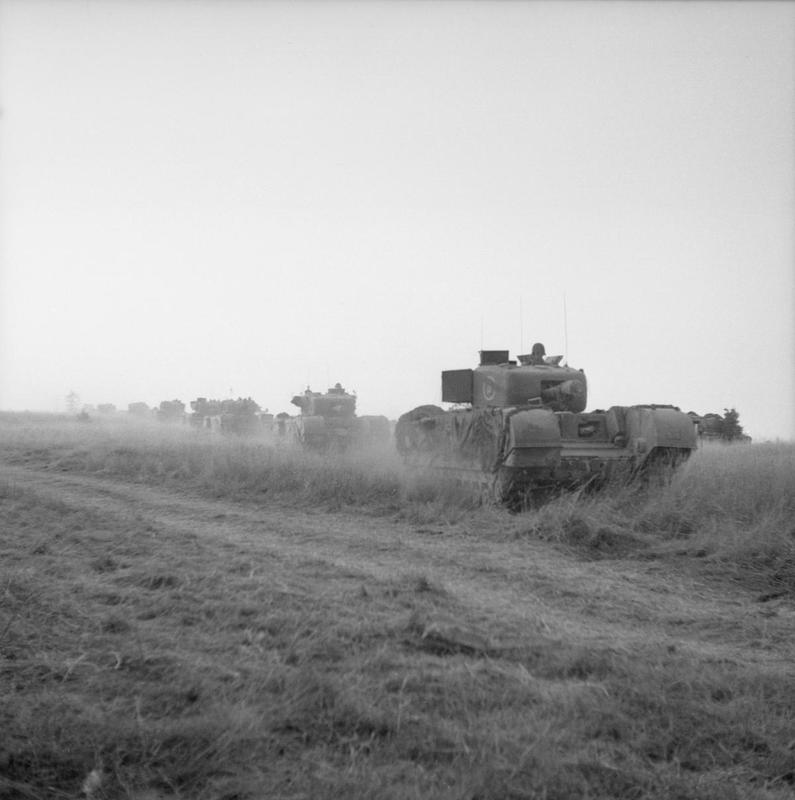
British Tanks Nw Europe 1944-45 Churchill tanks assembled for an attack towards Evrecy in the Odon Valley, Normandy, 16 July 1944.

British Tanks Nw Europe 1944-45 A Churchill tank moves up in preparation for an attack towards Evrecy in the Odon Valley, Normandy, 16 July 1944.

British Tanks Nw Europe 1944-45 A Churchill tank of 'B' Squadron, 107th Regiment Royal Armoured Corps, 34th Tank Brigade, Odon Valley, Normandy, 17 July 1944.
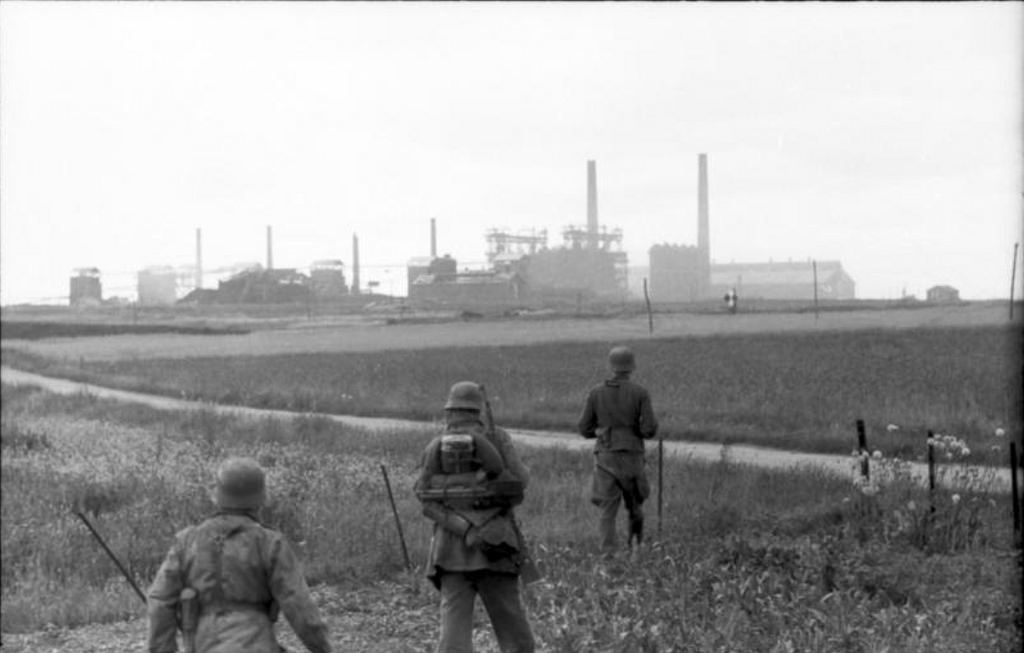
Collombelles, Soldaten auf Feld vor Fabrik

Frankreich, Zivilisten in Ortschaft

Frankreich, Zivilisten, Feuerwehr in Ortschaft

Frankreich, Schäden an Gebäude
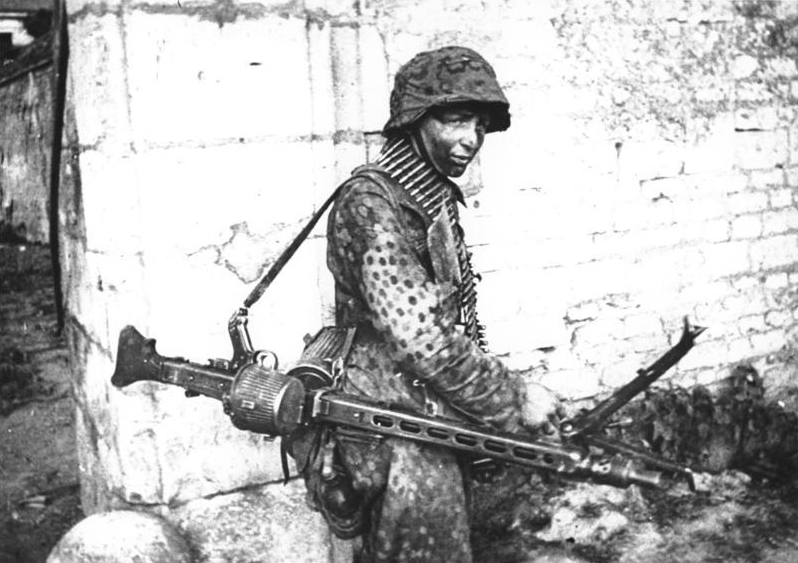
Frankreich, MG-Schütze

unidentified infantrymen resting in a damaged streetcar, Caen.

Après la libération de la rive gauche de la ville, de la nourriture est apportée sur un chariot tiré par un cheval aux civils s'étant réfugiés dans l'église Saint-Étienne.

Vue aérienne des bombardement sur la région de Caen.

An unidentified Canadian soldier guarding a captured German officer.

Les hommes du régiment Stormont Dundas et Glengarry Highlanders prennent un repas à l'extérieur de la gare de Caen.
Historical Overview
The Battle for Caen was a military engagement between the British Second Army and the German Panzergruppe West in the Second World War for control of the city of Caen and its vicinity during the Battle of Normandy. Caen is about 9 mi (14 km) inland from the Calvados coast astride the Orne River and Caen Canal, at the junction of several roads and railways. The communication links made it an important operational objective for both sides. Caen and the area to its south are flatter and more open when compared to the bocage country of western Normandy, and Allied air force commanders wanted the area captured quickly in order to construct airfields to base more aircraft in France proper.
Quick Facts
UK / Canada
- Commander: B. Montgomery
- Strength: 115000
- Casualties: 30000
German Army
- Commander: Erwin Rommel
- Strength: 80000
- Casualties: 20000
Strategic Context
British-Canadian attempt to force a breakout.
Related Literature


Der Gulag

Die Schlacht um Berlin und das Ende des Dritten Reichs 1945

Hunde, wollt ihr ewig leben: ein Stalingrad-Roman

Roter Hunger: Stalins Krieg gegen die Ukraine

So weit die Füße tragen

Söldner ohne Sold: Die deutschen Freikorps 1918–1923

Vom Massensturm zur Stoßtrupptaktik: Die deutsche Landkriegtaktik im Spiegel von Dienstvorschriften und Publizistik 1906 bis 1918

Wir Wehr-Wölfe: Erinnerungen eines Freikorps-Führers

Zweiter Weltkrieg Erlebnisbericht Apokalypse Stalingrad: Untergang der 6. Armee 1942-1943
Walter Mönch
Rise And Fall Of The Third Reich
William Shirer
Historical Locations
Interactive map requires third-party cookie consent.