Brusilov Offensive

Eastern Front prior to the Brusilov Offensive

Offensive of the Russian South-Western front (Brusilov offensive), 1916, with starting positions on 4 June (thick solid line), initial advances on 16 June (thinner jagged line), and final positions on 20 September (dotted line). Arrows show the direction of attacks of the 3rd, 8th, 11th, 7th and 9th armies (the last unlabeled). The offensive's original objective, Lemburg, would be near the left edge of the map in the center.

Brusilov Offensive

Plan de la Ofensiva Brusílov, con sus objetivos y las direcciones de ataque principales y secundarias.

Brusilov Offensive

Map of Eastern Front 1916 based on File:EasternFront1916a.jpg

From the fighting in Bukovina - Russian assault after preparatory barrage, 11 July 1916

From the fighting of the Russian offensive in the Buchach area, 1916
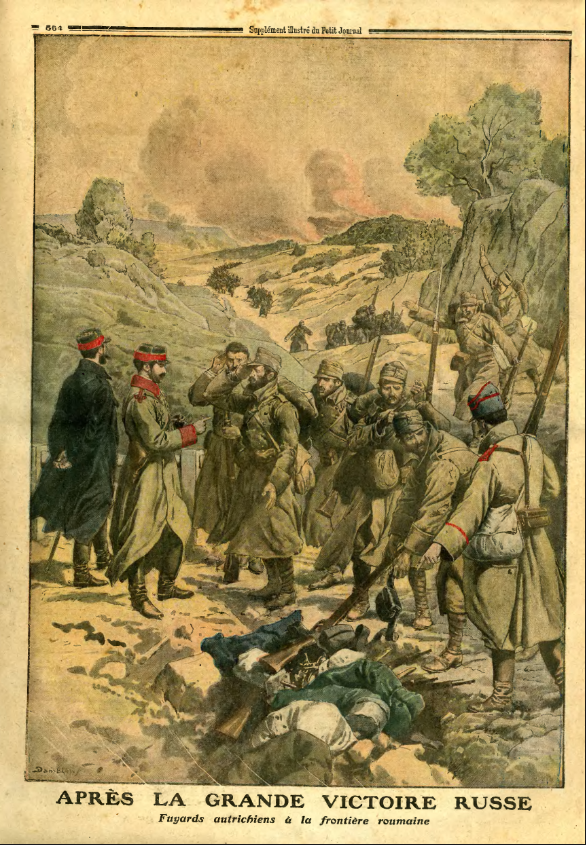
Image form Le Petit Journal. Austria-Hungarian POWs on roumanian frontier after Brusilov Offensive.

Sujet : Brusilov, Aleksej Alekseevič (1853-1926) -- Portraits Guerre mondiale (1914-1918) Généraux -- Russie Russie. Armée Décorations d'honneur -- Russie Photographie de presse -- 1900-1945 Référence bibliographique : Rol, 42791 Appartient à l’ensemble documentaire : Pho20Rol Couverture : .. octobre 1914 Langue : français
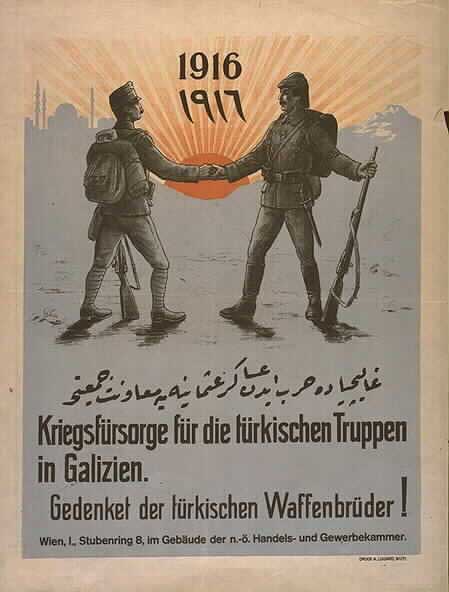
War Welfare for the Turkish Troops in Galicia.

carte_de_l'offensive_Broussilov à partir de celles publiées par Le Pays de france.

Kaiser Wilhelm II inspecting Turkish troops of the 15th Corps in East Galicia, Poland. Prince Leopold of Bavaria, the Supreme Commander of the German Army on the Eastern Front, is second from the left.

Panorama with Anastasia Nikolaevna Romanova and her family in Sebastopol, 27 May 1916 (14 May 1916, in the eastern Old System). Celebrations of the 20th anniversary of the beginning of Nicholas II kingdom and in order to prepare the en:Brusilov offensive.

The History of World War I (the ongoing series, issue I). Battles of World War I. The Brusilov Offensive. June — August 1916. The map of the battle; Aleksei Brusilov with staff officers.The stamp of Russia, 20.00 ₽, 31 July 2014, PTC Marka Catalogue No. 1856, Michel No. 2062. Coated paper. Offset printing. Perforation: comb 12:12. Size of the stamp: 50×37 mm. Print run: 363,000.

Russian mass attack supported by armored cars near Okna, June 5 1916

Turkish troops in Galicia repel a Russian attack at Zolota Lipa on August 17, 1916

Летом 1916 года в ходе знаменитого Брусиловского прорыва дивизия генерала Гильчевского захватила 22 тыс. пленных

Трофеи русской армии после Брусиловского прорыва
Historical Overview
The Brusilov offensive, also known as the June advance, or Battle of Galicia-Volhynia, of June to September 1916 was the Russian Empire's greatest feat of arms during World War I and among the most lethal offensives in world history. The historian Graydon Tunstall called the Brusilov offensive the worst crisis of World War I for Austria-Hungary and the Triple Entente's greatest victory, but it came at a tremendous loss of life. The victory contributed to a morale upsurge among the Russian troops. The offensive's success led Russia's allies to reconsider their positions on postwar territorial concessions, including the status of Anatolia and the Bosphorus Strait.
Quick Facts
Russian Empire
- Commander: Alexei Brusilow
- Strength: ca. 600.000
- Casualties: ca. 500.000
Austria-Hungary
- Commander: Erzh. Friedrich
- Strength: ca. 500.000
- Casualties: ca. 600.000
Strategic Context
Attempt to knock Austria-Hungary out of the war.
Related Literature


Der Gulag

Die Schlacht um Berlin und das Ende des Dritten Reichs 1945

Hunde, wollt ihr ewig leben: ein Stalingrad-Roman

Roter Hunger: Stalins Krieg gegen die Ukraine

So weit die Füße tragen

Söldner ohne Sold: Die deutschen Freikorps 1918–1923

Vom Massensturm zur Stoßtrupptaktik: Die deutsche Landkriegtaktik im Spiegel von Dienstvorschriften und Publizistik 1906 bis 1918

Wir Wehr-Wölfe: Erinnerungen eines Freikorps-Führers

Zweiter Weltkrieg Erlebnisbericht Apokalypse Stalingrad: Untergang der 6. Armee 1942-1943
Walter Mönch
Rise And Fall Of The Third Reich
William Shirer
Historical Locations
Interactive map requires third-party cookie consent.