Siege of Carthage

No description

Vue d'artiste de l'assaut final sur Carthage en 146 avant J.-C. Troisième Guerre punique.

Langue : français Éditeur : Se trouve, A Paris, chez le citoyen Mirys, rue de la Vieille-Estrapade, n°1007...

Richard Henry Brockː The siege of Carthage 146 BC - Roman soldiers entering Carthage

Живописное обозрение стран света : иллюстрированный журнал путешествий, исследований и проч.; художественно-литературный журнал; иллюстрированный журнал; ... / Ред. Н. И. Зуев, Н. И. Шульгин, П. Н. Полевой, С. Е. Добродеев, А. П. Нестор, И. Н. Потапенко, П. В. Быков, А. К. Шеллер, К. С. Баранцевич. — Спб.: типография Спб. акц. общ. «Слово», 1872—1905. — полные годовые подшивки, еженед.

Живописное обозрение стран света : иллюстрированный журнал путешествий, исследований и проч.; художественно-литературный журнал; иллюстрированный журнал; ... / Ред. Н. И. Зуев, Н. И. Шульгин, П. Н. Полевой, С. Е. Добродеев, А. П. Нестор, И. Н. Потапенко, П. В. Быков, А. К. Шеллер, К. С. Баранцевич. — Спб.: типография Спб. акц. общ. «Слово», 1872—1905. — полные годовые подшивки, еженед.
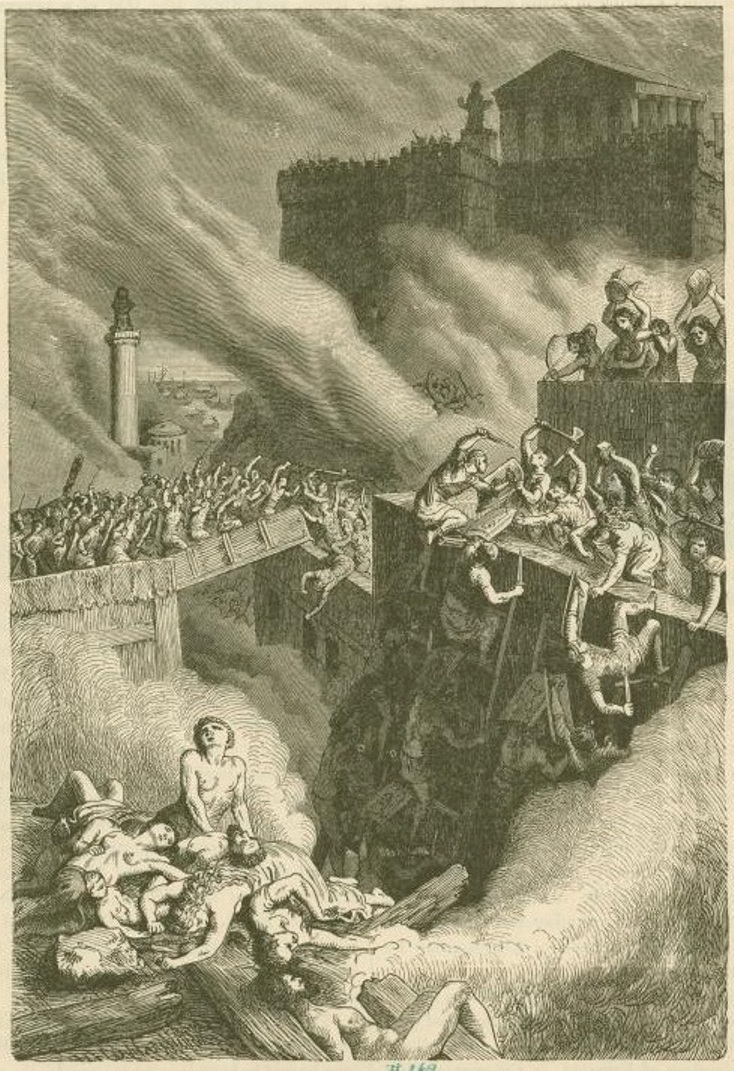
Final assault on Cartage. Third Punic War. 146 BC. Imaginary representation in 1885.

In 1868 Poynter produced another of his most celebrated Roman spectaculars, The Catapult. This shows Roman soldiers manning a siege engine for an attack on the walls of Carthage, during the siege which ended in the destruction of Carthage in 146 BC. The famous command of Cato the Elder, "Delenda est Carthago" (quoted in Plutarch's "Life of Cato") is carved in the wood of the huge catapult. The picture was a great success.
Historical Overview
The siege of Carthage was the main engagement of the Third Punic War fought between Carthage and Rome. It consisted of the nearly three-year siege of the Carthaginian capital, Carthage. In 149 BC, a large Roman army landed at Utica in North Africa. The Carthaginians hoped to appease the Romans, but despite the Carthaginians surrendering all of their weapons, the Romans pressed on to besiege the city. The Roman campaign suffered repeated setbacks through 149 BC, only alleviated by Scipio Aemilianus, a middle-ranking officer, distinguishing himself several times. A new Roman commander took over in 148 BC, and fared equally badly. At the annual election of Roman magistrates in early 147 BC, the public support for Scipio was so great that the usual age restrictions were lifted to allow him to be appointed commander in Africa.
Quick Facts
Roman Republic
- Commander: Scipio Aemilianus
- Strength: ca. 40.000 - 80.000 Mann
- Casualties: Moderat
Carthage
- Commander: Hasdrubal der Böotarche
- Strength: ca. 30.000 Soldaten / 200.000 Zivilisten
- Casualties: Fast 100% (Tod oder Sklaverei)
Strategic Context
The final implementation of the Roman dogma "Ceterum censeo Carthaginem esse delendam" (Furthermore, I am of the opinion that Carthage must be destroyed).
Conflict / War
Punic Wars
Related Literature


Auf dem Weg zum Imperium: Eine Geschichte der römischen Armee

Aufstieg und Fall des Alten Ägypten: Die Geschichte einer geheimnisvollen Zivilisation vom 5. Jahrtausend v. Chr. bis Kleopatra

Caesar lässt grüßen: Die Geschichte der Römer

Das alte Griechenland: Die visuelle Geschichte. Hochwertiger Bildband mit über 850 Fotos

Das frühe Persien: Geschichte eines antiken Weltreichs

Die verdammt blutige Geschichte der Antike: ohne den ganzen langweiligen Kram

Eine unerzählte Geschichte der Antike: Auf den Spuren vergessener Orte – von Britannia bis Vietnam

Feldherren, Krieger und Strategen: Krieg in der Antike von Achill bis Attila

Geschichte der römischen Kaiserzeit: Von Augustus bis zu Konstantin

Geschichte der römischen Republik: Von den Anfängen bis Augustus

Gladius: Roms Legionen in Germanien

Krise und Untergang der römischen Republik

Römische Geschichte

Römische Geschichte: 5 Bände im Schuber

Römische Geschichte: Von den Anfängen bis zum Untergang

Über die Germanen: Tacitus – antike Geschichtsschreibung über die Bewohner Germaniens
Historical Locations
Interactive map requires third-party cookie consent.