All Battles

Siege of Kars

1855 Ostanatolien Belagerung

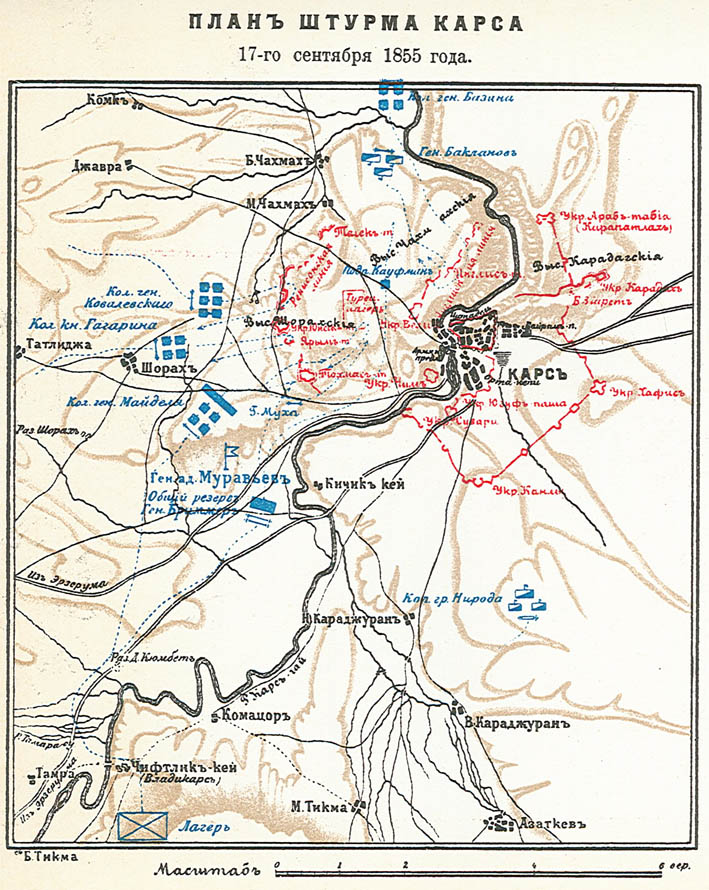
The plan of the Russian assault on Kars on September 17, 1855

The plan of the Russian assault on Kars on September 17, 1855

Author: Unknown authorUnknown authorLicense:PD
Source
The siege план of Kars bя Russian forces, 1855

The siege план of Kars bя Russian forces, 1855

Author: www.armenica.orgLicense:CC-BY-SA-4.0
Source
Siege of Kars (1828). Russo-Turkish War (1828–1829)

Siege of Kars (1828). Russo-Turkish War (1828–1829)

Author: January SuchodolskiLicense:PD
Source
Pictorial history of the Russian war 1854-5-6: with maps, plans, and wood engravings

Pictorial history of the Russian war 1854-5-6: with maps, plans, and wood engravings

Author: George DoddLicense:PD
Source
Map of a fortress of Kars and vicinities during the Crimean War, 1853-1855

Map of a fortress of Kars and vicinities during the Crimean War, 1853-1855

Author: Богданович, Модест Иванович (1805-1882).License:PD
Source
Pictorial history of the Russian war 1854-5-6: with maps, plans, and wood engravings

Pictorial history of the Russian war 1854-5-6: with maps, plans, and wood engravings

Author: George Dodd (1808–1881)License:PD
Source
In June 1855, during the Crimean War (1854–1856), Kars, a city in north-eastern Turkey, was besieged by a Russian army of 25,000 men. Demoralised by their defeats at the hands of the Russians, the Turks left the defence of Kars to Brevet Colonel (later General Sir) William Fenwick Williams who was the British commissioner with the Ottoman Army in Anatolia. Through his brilliant organisation, the garrison was able to repulse three major Russian attacks, but eventually cold, famine and an outbreak of cholera forced it to surrender on 26 November 1855. 
In the foreground, the commander of the garrison of Kars, the british  brevet colonel William Fenwick Williams.
In the background, the governor of the Caucasus and the commander-in-chief of the Caucasian army (from the end of 1854), the russian general of the infantry N.N. Muravyov, accepting the capitulation of Kars.

In June 1855, during the Crimean War (1854–1856), Kars, a city in north-eastern Turkey, was besieged by a Russian army of 25,000 men. Demoralised by their defeats at the hands of the Russians, the Turks left the defence of Kars to Brevet Colonel (later General Sir) William Fenwick Williams who was the British commissioner with the Ottoman Army in Anatolia. Through his brilliant organisation, the garrison was able to repulse three major Russian attacks, but eventually cold, famine and an outbreak of cholera forced it to surrender on 26 November 1855. In the foreground, the commander of the garrison of Kars, the british brevet colonel William Fenwick Williams. In the background, the governor of the Caucasus and the commander-in-chief of the Caucasian army (from the end of 1854), the russian general of the infantry N.N. Muravyov, accepting the capitulation of Kars.

Author: Thomas Jones BarkerLicense:PD
Source

Historical Overview

Russian success on the Caucasus front against the Ottomans.

Quick Facts

Outcome:Russian victory.

Tsardom of Russia

  • Commander: Nikolai Murawjow
  • Strength: ca. 25.000
  • Casualties: ca. 2.500

Ottoman Empire

  • Commander: Williams (brit. Berater)
  • Strength: ca. 17.000
  • Casualties: ca. 6.500

Strategic Context

Struggle for dominance in the Caucasus region.

Related Literature

Cover of Revolutionary Spring: Fighting for a New World 1848-1849

Revolutionary Spring: Fighting for a New World 1848-1849

Christopher Clark

Revolution19th CenturyEuropäische Geschichte

English
Industrial Era & Imperialism
Cover of Spanish-American War: A Captivating Guide to the War Between the United States of America and Spain along with The Philippine–American War that Followed

Spanish-American War: A Captivating Guide to the War Between the United States of America and Spain along with The Philippine–American War that Followed

American HistorySpanish History

English
Industrial Era & Imperialism
Cover of The Philippine–American War

The Philippine–American War

American HistoryPhilippine History20th Century

English
Industrial Era & Imperialism
Cover of Frühling der Revolution: Europa 1848/49 und der Kampf für eine neue Welt

Frühling der Revolution: Europa 1848/49 und der Kampf für eine neue Welt

Christopher Clark

Revolution19th CenturyEuropäische Geschichte

German
Industrial Era & Imperialism
Cover of Risorgimento! Italiens Kampf um die Einheit im 19. Jahrhundert

Risorgimento! Italiens Kampf um die Einheit im 19. Jahrhundert

Italian HistoryNon-fiction19th Century

German
Industrial Era & Imperialism

Historical Locations

Interactive map requires third-party cookie consent.