Schlacht von Waterloo
Historische Übersicht
Die Schlacht von Waterloo besiegelte das endgültige Ende der Herrschaft Napoleons und den Abschluss der Napoleonischen Kriege. Nahe dem heutigen belgischen Ort Waterloo gelang es den alliierten Truppen unter dem britischen Feldmarschall Wellington und den preußischen Kräften unter Generalfeldmarschall Blücher, die französische Armee vernichtend zu schlagen. Die Niederlage zwang Napoleon zur endgültigen Abdankung und führte zu einer jahrzehntelangen Phase des Friedens und der Restauration in Europa.

No description
pronunciation recording

The painting "Wartime Suffering" symbolizes and recalls the suffering that war brings. J.J. Eeckhout painted it in 1826. It is a classical, romanticized depiction in which the suffering of war is personified in a market woman. She mourns her fallen husband who lies at her feet. This soldier is a flanker from a Battalion of Infantry of Line of the Dutch force, which took part in the battle of Waterloo (1815). The drama is heightened by their child and by her skyward gaze. Her suffering is said to be based on the diary of one sergeant Jan Willem van Wetering who fought at Waterloo. It tells of a market girl who, shortly after giving birth to her child, searches desperately and in vain for her husband. According to his captain, he was still alive, but she did not believe him and insisted that her husband had perished. This motif can be found, either centrally or as a detail, in the romanticized pictorial expressions of Napoleonic battles in the first half of the 19th century.
digitized The online edition of this book in the public domain, i.e., not protected by copyright, has been produced by the Emory University Digital library Publications Program A novel Subjects:

Excerpts from Translator's Preface, dated from Brussels, 17th March, 1817. The unparalleled consequences of the Battle of Waterloo have induced me to offer to the Public, a Translation of CRAAN's Account of it. (...) I have undertaken this Narrative (...) to give publicity to every circumstance connected with that glorious campaign, which, after so many years of bloodshed, has given Peace and Tranquility to Europe ! ► More about former Mont-Saint-Jean Farm, used as Field Hospital in June 1815, now converted into a Museum (and recreational activities) : (File:18 June 1815 – Waterloo – Mont-Saint-Jean, Museum.jpg)
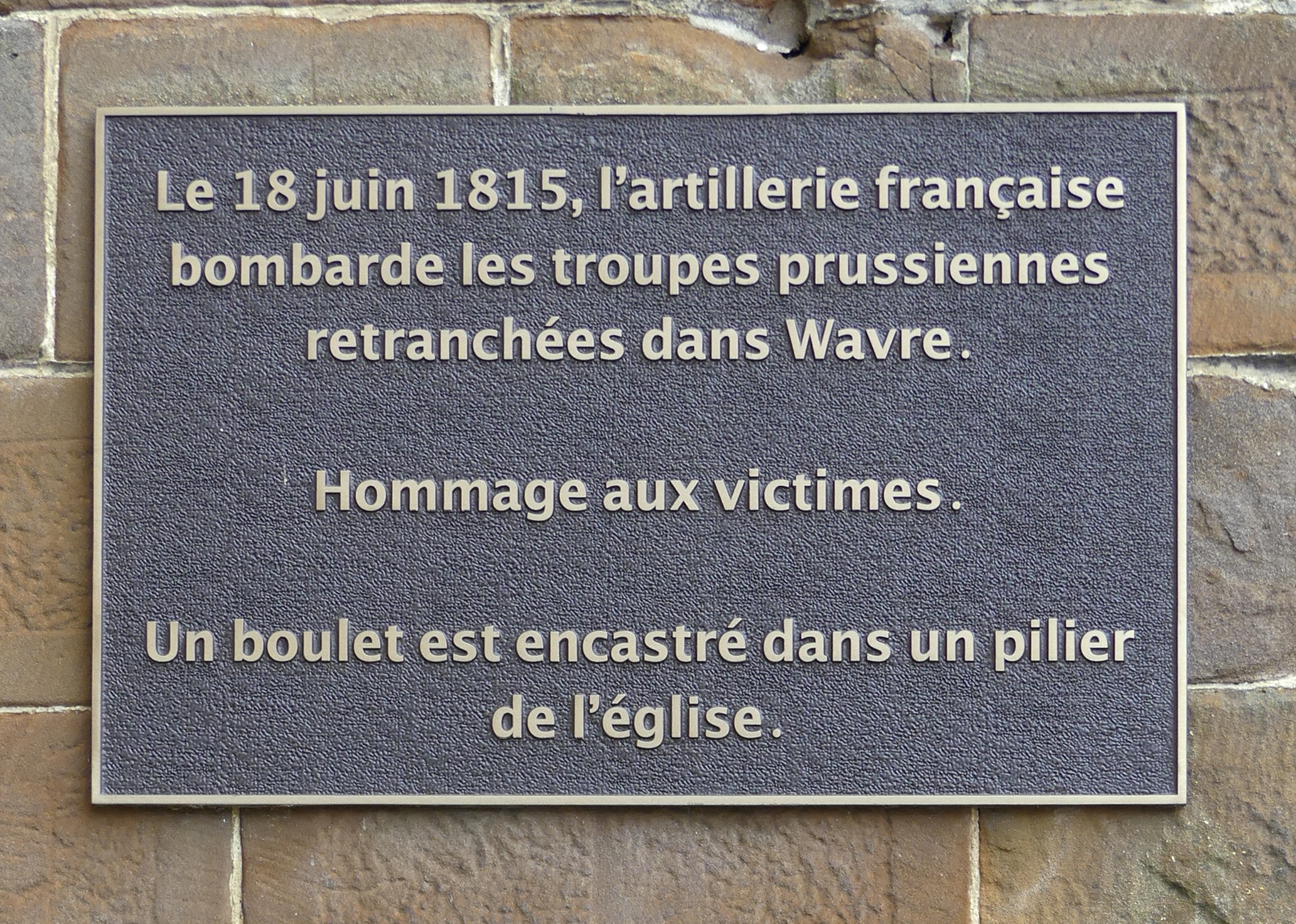
Plaque affixed on the façade of Saint-Jean-Baptiste's church of Wavre, Belgium, on the right of the entrance. The plaque reads : Le 18 juin 1815, l'artillerie française bombarde les troupes prussiennes retranchées dans Wavre. Hommage aux victimes. Un boulet est encastré dans un pilier de l'église. Translation On June 18, 1815, the French artillery bombarded the Prussian troops entrenched in Wavre. Tribute to the victims. A ball is embedded in a pillar of the church. Although Napoleone Buonaparte had already fled the main battlefield before dark on that memorable 18 June 1815, without bothering to concede defeat for fear of the treatment he knew he would receive from Feldmarschall Blücher, the fight went on to the South and East of Waterloo, like here in and around Wavre where the Prussian army was stationned since their arrival by mid-June. The remains of the French army still in fighting order bombarded the town and its inhabitants, before being repelled by Lieutenant-General Johann von Thielmann (1765-1824) and driven back to France. Rare are the thoughts spared for the civilian victims of the napoléonic régime, all over Europe. Equally rare are the thoughts spared for the helpless troops too commonly used as ammunition.

Plaque affixed at the entrance of the parish church of Braine-l'Alleud. (FR) Cette église servit d'hopital au lendemain de la bataille du 18 juin 1815. Charitablement les Brainois vinrent en aide aux blessés. (EN) This church served as a hospital the day after the battle of June 18, 1815. Charitably, the people of Braine-l'Alleud came to the aid of the wounded. (DE) Diese Kirche diente am Tag nach der Schlacht vom 18. Juni 1815 als Krankenhaus. Wohltätig kam das Volk von Braine-l'Alleud den Verwundeten zu Hilfe. Excerpt of Cotton, Edward, A Voice from Waterloo (...), 5th edit., 1854, Chapter IX, 137. The field of battle, after the victory, presented a frightful and most distressing spectacle. (...) Solicitude for the wounded prompted the Duke to ride back to Brussels immediately after the sanguinary contest. The assistance of the town authorities was requested, in collecting and removing the wounded from the field, burying the dead, etc., as well as to restore confidence amongst the population, and allay the extreme excitement which prevailed throughout Belgium. Right nobly did the inhabitants of Brussels repond to his appeal. The clergy, as might have been expected, were foremost in their exertions to relieve the dreadful agonies of so many gallant and innocent sufferers : the highest in rank rivalled the hardier classes in performing the most trying offices for the mangled heroes that filled the hospitals, and encumbered even many private dwellings. (...)
![From 1890 to 1894, seventeen Fighters were re-buried in the Crypt of the British Waterloo Campaign Memorial, from various cemeteries around the Battlefield of Waterloo and from Brussels : ►([1]).
Close-up on the tablet : ►(File:18 June 1815 – Victory at Waterloo – British Waterloo Campaign Memorial, crypt, tablet.jpg).
Napoleonic Wars casualties : ►([2])](https://upload.wikimedia.org/wikipedia/commons/d/d7/18_June_1815_%E2%80%93_Victory_at_Waterloo_%E2%80%93_British_Waterloo_Campaign_Memorial%2C_crypt.jpg)
From 1890 to 1894, seventeen Fighters were re-buried in the Crypt of the British Waterloo Campaign Memorial, from various cemeteries around the Battlefield of Waterloo and from Brussels : ►([1]). Close-up on the tablet : ►(File:18 June 1815 – Victory at Waterloo – British Waterloo Campaign Memorial, crypt, tablet.jpg). Napoleonic Wars casualties : ►([2])

Tablet erected above the entrance to the Crypt, gold-plated during the restorations for the bicentennial commemorations of the Battle of Waterloo. Front view of the monument : ►(File:18_June_1815_–_Victory_at_Waterloo_–_British_Waterloo_Campaign_Memorial,_front_view.jpg).

Plaque affixed at the entrance of the Wellington Museum, Waterloo, reading : Translation : During the Battle of Waterloo, this inn, built in 1705, housed the Headquarters of the Duke of Wellington, where he spent the nights of June 17 and 18, 1815. Here he wrote the first part of the dispatch announcing the Allied Victory. Le Comité de Waterloo – The Waterloo Commitee placed this plaque in 1996 About the museum : File:18_June_1815_–_Victory_at_Waterloo_–_Duke_of_Wellington's_Headquarter.jpg

Tablet dated 1858 affixed in the Rotunda (Chapel) of Saint Joseph's church of Waterloo, after its renovation that year. The bust of Lord Wellington ►(File:18_June_1815_–_Victory_at_Waterloo_–_Lord_Wellington's_Bust,_St_Joseph's_Church.jpg), dated 1855, was placed in front of the tablet on that occasion ►(File:18_June_1815_–_Victory_at_Waterloo_–_The_Duke.jpg). The tablet reads : In Honored Memory of // All British Officers // Non Commissioned Officers and Soldiers // Who fell in Battle // Upon the 16th 17th and 18th of June 1815, // This Tablet was erected // By a few Brothers in arms and Countrymen // A. D. MDCCCLVIII Glory encircles with the same noble diadem // the humble as well as the exalted
![In Memoriam Sgt.-Maj. Edward Cotton (1792 ? – 24 June 1849), author of A voice from Waterloo.
Edw. Cotton served in the British Army for several years, took part to the Battle of Waterloo and retired thereafter : the definitive collapse of the napoléonic régime allowed Europe to live in peace. He settled at Mont-Saint-Jean and made a living from his services as guide to visitors (pilgrims) of the battlefield. He went on buying a house (or had it built) at the foot of the Lion's Mound (built 1826), large enough to serve as a hotel – also as museum where memorabilia found on the battlefield were exhibited : ►([1]).
At the end of his life, Edward Cotton put his own memories of the battle into writing, minutely documented and expanded thank to the information and documents he had collected over thirty years. It was self-published in 1846 at Mont-Saint-Jean under the title A Voice from Waterloo. A second, enlarged edition, was similarly published in 1847.
Luckily for posterity, Cotton still had time to prepare a third edition, revised and considerably enlarged, prefaced in February 1849. He presumably saw the first copies published by Benjamin L. Green, London, an edition that reached a large audience and served as reference for many years (a facsimile was issued in 1974). Meanwhile, several other reprints have been made (fourth in 1852 ; fifth in 1854 ; sixth in 1862 ; etc.).
Pr. Gustave Sluse translated the sixth edition (1862) in French : Une voix de Waterloo, Brussels, 1874. That translation, reprinted by Jourdan, Brussels, is set to be republished on June 17, 2021.
Also, Karin C. Röhrs gave a German translation, Eine Stimme aus Waterloo (August 2013), to coincide with the bicentennial of the October 1813 victorious Völkerschlacht (Battle of Leipzig, 16 to 18 October 1813).
In 1849, Edward Cotton was interred in the orchard of Hougoumont Farm (shown) : the smaller slab was his ; in the foreground, Capt. John Lucie Blackman's. A photo from ca. 1912 : ►([2]).
When the British memorial was build in the Cemetery of Brussels (►(File:18 June 1815 – Victory at Waterloo – British Waterloo Campaign Memorial, front view.jpg), his remains were translated to its crypt (►([]).](https://upload.wikimedia.org/wikipedia/commons/e/ee/18_June_1815_%E2%80%93_Victory_at_Waterloo_%E2%80%93_In_Memoriam_Sgt_Edward_Cotton%2C_%22A_Voice_from_Waterloo%22.jpg)
In Memoriam Sgt.-Maj. Edward Cotton (1792 ? – 24 June 1849), author of A voice from Waterloo. Edw. Cotton served in the British Army for several years, took part to the Battle of Waterloo and retired thereafter : the definitive collapse of the napoléonic régime allowed Europe to live in peace. He settled at Mont-Saint-Jean and made a living from his services as guide to visitors (pilgrims) of the battlefield. He went on buying a house (or had it built) at the foot of the Lion's Mound (built 1826), large enough to serve as a hotel – also as museum where memorabilia found on the battlefield were exhibited : ►([1]). At the end of his life, Edward Cotton put his own memories of the battle into writing, minutely documented and expanded thank to the information and documents he had collected over thirty years. It was self-published in 1846 at Mont-Saint-Jean under the title A Voice from Waterloo. A second, enlarged edition, was similarly published in 1847. Luckily for posterity, Cotton still had time to prepare a third edition, revised and considerably enlarged, prefaced in February 1849. He presumably saw the first copies published by Benjamin L. Green, London, an edition that reached a large audience and served as reference for many years (a facsimile was issued in 1974). Meanwhile, several other reprints have been made (fourth in 1852 ; fifth in 1854 ; sixth in 1862 ; etc.). Pr. Gustave Sluse translated the sixth edition (1862) in French : Une voix de Waterloo, Brussels, 1874. That translation, reprinted by Jourdan, Brussels, is set to be republished on June 17, 2021. Also, Karin C. Röhrs gave a German translation, Eine Stimme aus Waterloo (August 2013), to coincide with the bicentennial of the October 1813 victorious Völkerschlacht (Battle of Leipzig, 16 to 18 October 1813). In 1849, Edward Cotton was interred in the orchard of Hougoumont Farm (shown) : the smaller slab was his ; in the foreground, Capt. John Lucie Blackman's. A photo from ca. 1912 : ►([2]). When the British memorial was build in the Cemetery of Brussels (►(File:18 June 1815 – Victory at Waterloo – British Waterloo Campaign Memorial, front view.jpg), his remains were translated to its crypt (►([]).

Plaque related to the Dutch Memorial to the Victims of Napoleone Buonaparte fallen at the Battle of Waterloo on 18 June 1815 erected in the Rotunda of Saint Joseph's of Waterloo, which reads : Auspice Illustrissimo Principe // FREDERICO NASSOVIO // In Perpetuam Memoriam // Insignis Victoriæ // Anno MDCCCXV Die Juni XVIII // Relatæ // Waterl. Sodal. Ære Et Cura // Hoc Monumentum Est Erectum Translation : “Under the patronage of the illustrious Prince Frederic of Nassau, in eternal memory of the glorious victory achieved at Waterloo on June 18th 1815, this monument was erected and funded by his companions-in-arms”.

Plaque imbedded in 1847 in the eastern gable of the La Haye Sainte main building, overlooking the road N.5, replacing a previous marble tablet presumably affixed in 1818, along with the construction of the monument to the K.G.L. : ►(File:18 June 1815 – Victory at Waterloo – Hanoverian Monument, The South Face.jpg). About the plaque. En mémoire de la défense de la Haie-Sainte, le corps des officiers Anglo-Hanovriens du deuxième bataillon léger de la légion royale allemande fit encastrer, dans le pignon de la ferme vers la route, une plaque de marbre blanc, où on rappelait la mort glorieuse de plusieurs officiers de ce bataillon ; en 1847, le prince George, actuellement roi de Hanovre, l'a fait remplacer par une plaque de fer carrée et posée en losange. On y lit, en lettres saillantes et dorées : (...). La ferme a été rebâtie et est, comme jadis, bornée au sud par un verger. Les champs voisins, où le carnage a été affreux, constituent en réalité une immense nécropole. Une seule fosse, pratiquée dans la vallon, vers l'est, a reçu les corps de 4,000 soldats et d'un grand nombre de chevaux. Tarlier, Charles ; Wauters, Alphonse, Géographie et histoire des communes belges, vol. 1, Novembre 1869, 78. TRANSLATION In memory of the defense of La Haie-Sainte, the corps of Anglo-Hanoverian officers of the second light battalion of the royal German legion had a white marble tablet embedded in the gable of the farm towards the road, where the glorious death of several officers of this battalion was recalled; in 1847, the prince George, currently King of Hanover, had it replaced by a square iron plate laid in a diamond pattern. It reads, in protruding and gilded letters: (...). The farm has been rebuilt and is, as in the past, bounded to the south by an orchard. The neighbouring fields, where the carnage was horrendous, are in reality a huge necropolis. A single pit, made in the valley to the east, received the bodies of 4,000 soldiers and a large number of horses.
![Plaque affixed on the pinion of the main building, overlooking the road N.5.
Overall view of the farm : File:18 June 1815 – Victory at Waterloo – La Haye Sainte.jpg
More information : [1].](https://upload.wikimedia.org/wikipedia/commons/7/7a/18_June_1815_%E2%80%93_Victory_at_Waterloo_%E2%80%93_La_Haye_Sainte._To_Major_Baring._To_Colonel_von_Ompteda.jpg)
Plaque affixed on the pinion of the main building, overlooking the road N.5. Overall view of the farm : File:18 June 1815 – Victory at Waterloo – La Haye Sainte.jpg More information : [1].

Although the Lion's Mound (File:18_June_1815_–_Victory_at_Waterloo,_memorial.jpg) is undisputedly built on the territory of Braine-l'Alleud, it is irrevocably linked to the neighbour city of Waterloo). So resounding was the 18th of June 1815 Victory of Waterloo, which put an end to the napoléonic régime and its never ending cortège of wars and deaths and ruins and lootings and misery all over Europe, that the name of Waterloo, along with the even more famous name of Wellington, has been perpetuated all over the world, from Canada to New Zealand, by being given to towns, large and small, and to villages and hamlets, to hills, bays, lakes, and also to streets, boulevards, avenues, squares, bridges, towers, &c., and coins and medals, and also to a train station in London, an obelisk in Wiesbaden, a gate in Osnabrück, and also one in Vienna, a quay in Berlin, a column in Hannover, ..., &c. – to which a few more "Belle-Alliance" should be added. Today, the silhouette of the Lion's Mound has become the trademark of the city of Waterloo, Belgium. It welcomes visitors along the incoming roads.

18 June 1815, late evening. And suddenly broke out news of victorious fights at hardly known places the day before, like : La Haye Sainte, Belle-Alliance, Goumont (Hougoumont)..., – as the daily L'Oracle enthusiastically reported from Brussels : "Partout la haine contre l'usurpateur a éclaté de la manière la plus énergique ; hier, au moment de la bataille, la crainte glaçait toutes les âmes ; aujourd'hui la joie la plus vive est peinte sur toutes les figures. (...)" – (L'Oracle, 19 June 1815.) TRANSLATION – Everywhere hatred against the usurper has burst forth in the most energetic manner; yesterday, at the time of the battle, fear froze all souls; today the liveliest joy is painted on all faces. (...) Mont-Saint-Jean Museum : ►(File:18 June 1815 – Waterloo – Mont-Saint-Jean, Museum.jpg).

Epitaph. Die gefallenen Helden ehrt dankbar König und Vaterland. Sie ruhn in Frieden. Belle-Alliance den 18. Juni 1815.
![The commemorative plaque reads :
Aan den jongen held Willem F.G.L. Pr. v. Oranje en alle zijne brave wapen broederen van 1815 toegew[ijd].
(Translation) : "Dedicated to the young hero Willem F.G.L. Pr. v. Oranje [Willem Frederik George Lodewijk Prince of Oranje] and all his good brothers-in-arms of 1815.”
For some details about the monument, please see ►
File:18_June_1815_–_Victory_at_Waterloo_–_Velp_Monument.jpg
.](https://upload.wikimedia.org/wikipedia/commons/c/c6/18_June_1815_%E2%80%93_Victory_at_Waterloo_%E2%80%93_Velp_Monument%2C_Commemorative_Plaque.jpg)
The commemorative plaque reads : Aan den jongen held Willem F.G.L. Pr. v. Oranje en alle zijne brave wapen broederen van 1815 toegew[ijd]. (Translation) : "Dedicated to the young hero Willem F.G.L. Pr. v. Oranje [Willem Frederik George Lodewijk Prince of Oranje] and all his good brothers-in-arms of 1815.” For some details about the monument, please see ► File:18_June_1815_–_Victory_at_Waterloo_–_Velp_Monument.jpg .

Eendracht geeft macht The first Dutch national motto was originally expressed in Latin : Concordia res parvae crescunt, and in use from 1588 to 1815. See also "Further information" at the bottom of the page. For some details about the monument, please see ► File:18_June_1815_–_Victory_at_Waterloo_–_Velp_Monument.jpg .

Eendracht de rijke kracht For some details about the monument, please see ► File:18_June_1815_–_Victory_at_Waterloo_–_Velp_Monument.jpg .
![The main inscription reads :
Aan den jongen held Willem F.G.L. Pr. v. Oranje en alle zijne brave wapen broederen van 1815 toegew[ijd]
Translation : "Dedicated to the young hero Willem F.G.L. Pr. v. Oranje [Willem Frederik George Lodewijk Prince of Oranje] and all his good brothers-in-arms of 1815”.
The now restored monument, first erected in 1815, was unveiled anew on September 26th 2015 by Mrs Petra van Wingerden-Boers, Burgemeester (Mayor) of Velp (Gelderland), to commemorate the 200th anniversary of the June 18th, 1815 final Victory of Waterloo by the Allied Europe over the French dictator Napoleone Buonaparte (1769-1821).
Close-ups : Commemorative plaqueːFile:18 June 1815 – Victory at Waterloo – Velp Monument, Commemorative Plaque.jpg, Former Dutch MottoːFile:18 June 1815 – Victory at Waterloo – Velp Monument, former Dutch motto.jpg, Velp Monument MottoːFile:18 June 1815 – Victory at Waterloo – Velp Monument, motto.jpg.](https://upload.wikimedia.org/wikipedia/commons/4/4c/18_June_1815_%E2%80%93_Victory_at_Waterloo_%E2%80%93_Velp_Monument.jpg)
The main inscription reads : Aan den jongen held Willem F.G.L. Pr. v. Oranje en alle zijne brave wapen broederen van 1815 toegew[ijd] Translation : "Dedicated to the young hero Willem F.G.L. Pr. v. Oranje [Willem Frederik George Lodewijk Prince of Oranje] and all his good brothers-in-arms of 1815”. The now restored monument, first erected in 1815, was unveiled anew on September 26th 2015 by Mrs Petra van Wingerden-Boers, Burgemeester (Mayor) of Velp (Gelderland), to commemorate the 200th anniversary of the June 18th, 1815 final Victory of Waterloo by the Allied Europe over the French dictator Napoleone Buonaparte (1769-1821). Close-ups : Commemorative plaqueːFile:18 June 1815 – Victory at Waterloo – Velp Monument, Commemorative Plaque.jpg, Former Dutch MottoːFile:18 June 1815 – Victory at Waterloo – Velp Monument, former Dutch motto.jpg, Velp Monument MottoːFile:18 June 1815 – Victory at Waterloo – Velp Monument, motto.jpg.

Excerpt from Surgeon James's Journal, 1815 (published 1964). More about the context ? ► Mont-Saint-Jean Museum : (File:18 June 1815 – Waterloo – Mont-Saint-Jean, Museum.jpg

Slab, and commemorative plaque unveiled on 18 June 1990, to commemorate the 175th anniversary of the contribution of the 27th Regiment of Foot to the Victory of Waterloo. The plaque reads : In Memory of the Heroic Stand by // the 27th (Inniskilling) Regiment of // Foot at the Battle of Waterloo on // 18th June 1815 when, of the 747 // Officers and Men of the Regiment // Who Joined Battle, 493 Were Killed or // Wounded. A Noble Record of // Stubborn Endurance. Of Them, The Duke of Wellington Said, // 'Ah, They Saved the Centre of my Line' Erected by their Successors The Royal Irish Rangers (27th (Inniskillings) 83rd, 87th) 18 June 1990 Overall view of the stele : File:18_June_1815_–_Waterloo_–_27th_(Inniskilling)_Regiment_of_Foot,_stele.jpg Lamentably, the monument was overthrown in 2010, but soon re-erected, only to be again and similarly vandalized at the end of 2011, but again straightened up early 2012. The stele to Major General Thomas Picton, a few meters away across the street, was similarly overthrown at the beginning of 2011, face against the ground, but duly re-erected a few months later. None suffered any damage. To the eternal shame of the culprits.

Slab, and commemorative plaque unveiled on 18 June 1990, to commemorate the 175th anniversary of the contribution of the 27th Regiment of Foot to the Victory of Waterloo. The plaque reads : In Memory of the Heroic Stand by // the 27th (Inniskilling) Regiment of // Foot at the Battle of Waterloo on // 18th June 1815 when, of the 747 // Officers and Men of the Regiment // Who Joined Battle, 493 Were Killed or // Wounded. A Noble Record of // Stubborn Endurance. Of Them, The Duke of Wellington Said, // 'Ah, They Saved the Centre of my Line' Erected by their Successors The Royal Irish Rangers (27th (Inniskillings) 83rd, 87th 18 June 1990 Close-up on the plaque : ►(File:18 June 1815 – Waterloo – 27th (Inniskilling) Regiment of Foot, plaque.jpg) Overall view on the site : ►(File:18 June 1815 – Waterloo – Remembrance poppies.jpg) Lamentably, the monument was overthrown in 2010, but soon re-erected, only to be again and similarly vandalized at the end of 2011, but again straightened up early 2012. The stele to Lt-General Thomas Picton was similarly overthrown at the beginning of 2011, face against the ground, but duly re-erected a few months later. None suffered any damage. May eternal shame be cast on those culprits.

Model to the farm before the destructions caused by Napoleone Buonaparte (1769-1821) on June 18th, 1815. The north is on the left on this photo. The buildings n° 1, 4 and 5, as well as 9, 16 and 11, have long gone. N°10 was the Chapel, of which a few walls survived, now secured : ►(File:18_June_1815_–_Waterloo_–_Hougoumont._The_chapel.jpg). N°19 is the Northern Gate : ►(File:18_June_1815_–_Waterloo_–_Hougoumont._The_northern_gate,_closed_to_the_assaillant.jpg). N°2 is now a simple wall. N°3, 12 and 18 are now dedicated to exhibitions, among which this model. N°13, 17, 14 and 5 are now in use. Overall view from the end of the orchard : ►(File:18_June_1815_–_Waterloo_–_Hougoumont._To_the_Victims_of_the_napoléonic_régime.jpg).