Schlacht am Little Bighorn
Historische Übersicht
In der Schlacht am Little Bighorn erlag das 7. US-Kavallerieregiment unter Oberstleutnant George A. Custer einer vernichtenden Niederlage gegen eine Allianz aus Lakota-Sioux, Cheyenne und Arapaho unter der Führung von Sitting Bull und Crazy Horse. Das primäre operative Ziel der US-Armee war es, die indigenen Völker gewaltsam aus dem ressourcenreichen Gebiet der Black Hills zu vertreiben und in Reservate zu zwingen. Custers taktische Fehlentscheidung, die gegnerische Streitmacht zu unterschätzen und seine Truppen aufzuteilen, führte zur vollständigen Aufreibung seiner unmittelbaren Abteilung. Der Sieg der amerikanischen Ureinwohner markierte den defensiven Höhepunkt ihres Widerstands, beschleunigte jedoch gleichzeitig die massive Militarisierung der US-Kavallerie im darauffolgenden Feldzug.

Lithograph showing the Battle of Little Bighorn, from the Indian side.

No description
LIBI_00251_07815; A cabinet photograph; 5 3/8" x 4 13/16". This image depicts the group of markers on Last Stand Hill. The iron fence around the Custer Monument is visible in the background. This created with double exposure. There is a faint outline of a figure on a horse near the fence around the Custer monument. There are other faint outlines in the back of the photo. On the verso there is a printed explanation of the image. The image is copyrighted in June of 1879 to Frank Purcell of Billings, Montana. ; photographic; Courtesy of the National Park Service, Little Bighorn Battlefield National Monument, LIBI_00251_07815, Frank Purcell, "'Double Exposure of the Stone Markers on Last Stand Hill," circa June 1879. Keywords: little bighorn battlefield national monument
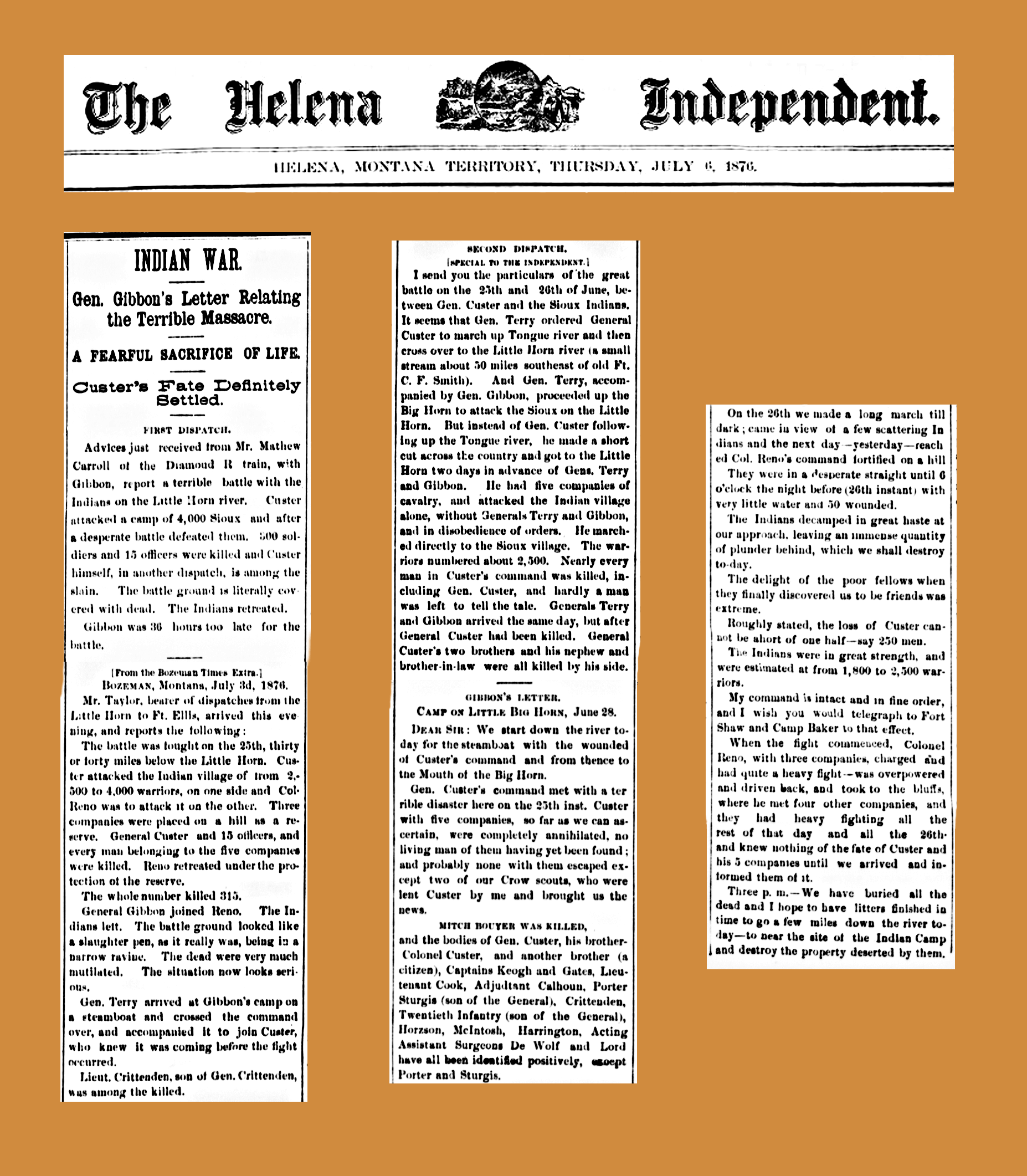
July 6, 1876 newspaper article in The Helena Independent (newspaper in Helena, Montana, U.S.) describing the June 25, 1876 massacre of troops under w:George Armstrong Custer.
![A July 6, 1876 article in The New York Times reporting the massacre of the troops of w:George Armstrong Custer.
Cropping, digital de-speckling, exposure, contrast, and sharpness adjustments were made to make the text more readable.
_ _ _ _ _ _ _ _
The following is the full text of the article:
The New York Times
Thursday July 6, 1876
Massacre of Our Troops.
Five Companies Killed by Indians.
Gen. Custer and Seventeen Commissioned Officers Butchered in a Battle on the Little Horn--Attack on an Overwhelmingly Large Camp of Savages--Three hundred and Fifteen Men Killed and Thirty-One Wounded--Two Brothers, Two Nephews, and a Brother-In-Law of Custer Among the Killed--The Battle-Field Like a Slaughter-Pen
Salt Lake, July 5.--The special correspondent of the Helena (Montana) Herald writes from Stillwater, Montana, under date of July 2, as follows:
Muggins Taylor, a scout for Gen. Gibbon, arrived here last night direct from Little Horn River, and reports that Gen. Custer found the Indian camp of 2,000 lodges on the Little Horn, and immediately attacked it. He charged the thickest portion of the camp with five companies. Nothing is known of the operations of this detachment, except their course as traced by the dead. Major Reno commanded the other seven companies, and attacked the lower portion of the camp. The Indians poured a murderous fire from all directions. Gen. Custer his two brothers, his nephew, and brother-in-law were all killed, and not one of his detachment escaped. Two hundred and seven men were buried in one place. The number of killed is estimated at 300, and the wounded at thirty-one.
The Indians surrounded Major Reno's command and held them one day in the hills cut off from water, until Gibbon's command came in sight, when they broke camp in the night and left. The Seventh fought like tigers, and were overcome by mere brute force.
The Indian loss cannot be estimated as they bore off and cached most of their killed. The remnant of the Seventh Cavalry and Gibbon's command are returning to the mouth of the Little Horn, where a steam-boat lies. The Indians got all the arms of the killed soldiers. There were seventeen commissioned officers killed. The whole Custer family died at the head of their column.
The exact loss is not known as both Adjutants and the Sergeant-major were killed. The Indian camp was from three to four miles long, and was twenty miles up the Little Horn from its mouth.
The Indians actually pulled men off their horses, in some instances.
This report is given as Taylor told it, as he was over the field after the battle. The above is confirmed by other letters, which say Custer has met a fearful disaster.
Another Account
Salt Lake City, July 5.--The Times publishes a dispatch from Boseman, [sic] Montana Territory, dated July 3, 7 P. M.
Mr. Taylor, bearer of dispatches from Little Horn to Fort Ellis, arrived this evening, and reports the following:
The battle was fought on the 25th of June, thirty or forty miles below the Little Horn. Gen. Custer attacked an Indian village of from 2,500 to 4,000 warriors on one side, and Col. Reno was to attack it on the other side. Three companies were placed on a hill as a reserve.
Gen. Custer and fifteen officers and every man belonging to the five companies were killed. Reno retreated under the protection of the reserve. The whole number killed was 315. Gen. Gibbon joined Reno.
When the Indians left, the battle-field looked like a slaughter-pen, as it really was, being in a narrow ravine. The dead were much mutilated.
The situation now looks serious. Gen. Terry arrived at Gibbon's Camp on a steam-boat, and crossed the command over and accompanied it to join Custer, who knew it was coming before the fight occurred. Lieut. Crittenden, son of Gen. Crittenden, was among the killed.
(end)](https://upload.wikimedia.org/wikipedia/commons/f/f1/18760706_Massacre_of_Our_Troops_-_The_New_York_Times.png)
A July 6, 1876 article in The New York Times reporting the massacre of the troops of w:George Armstrong Custer. Cropping, digital de-speckling, exposure, contrast, and sharpness adjustments were made to make the text more readable. _ _ _ _ _ _ _ _ The following is the full text of the article: The New York Times Thursday July 6, 1876 Massacre of Our Troops. Five Companies Killed by Indians. Gen. Custer and Seventeen Commissioned Officers Butchered in a Battle on the Little Horn--Attack on an Overwhelmingly Large Camp of Savages--Three hundred and Fifteen Men Killed and Thirty-One Wounded--Two Brothers, Two Nephews, and a Brother-In-Law of Custer Among the Killed--The Battle-Field Like a Slaughter-Pen Salt Lake, July 5.--The special correspondent of the Helena (Montana) Herald writes from Stillwater, Montana, under date of July 2, as follows: Muggins Taylor, a scout for Gen. Gibbon, arrived here last night direct from Little Horn River, and reports that Gen. Custer found the Indian camp of 2,000 lodges on the Little Horn, and immediately attacked it. He charged the thickest portion of the camp with five companies. Nothing is known of the operations of this detachment, except their course as traced by the dead. Major Reno commanded the other seven companies, and attacked the lower portion of the camp. The Indians poured a murderous fire from all directions. Gen. Custer his two brothers, his nephew, and brother-in-law were all killed, and not one of his detachment escaped. Two hundred and seven men were buried in one place. The number of killed is estimated at 300, and the wounded at thirty-one. The Indians surrounded Major Reno's command and held them one day in the hills cut off from water, until Gibbon's command came in sight, when they broke camp in the night and left. The Seventh fought like tigers, and were overcome by mere brute force. The Indian loss cannot be estimated as they bore off and cached most of their killed. The remnant of the Seventh Cavalry and Gibbon's command are returning to the mouth of the Little Horn, where a steam-boat lies. The Indians got all the arms of the killed soldiers. There were seventeen commissioned officers killed. The whole Custer family died at the head of their column. The exact loss is not known as both Adjutants and the Sergeant-major were killed. The Indian camp was from three to four miles long, and was twenty miles up the Little Horn from its mouth. The Indians actually pulled men off their horses, in some instances. This report is given as Taylor told it, as he was over the field after the battle. The above is confirmed by other letters, which say Custer has met a fearful disaster. Another Account Salt Lake City, July 5.--The Times publishes a dispatch from Boseman, [sic] Montana Territory, dated July 3, 7 P. M. Mr. Taylor, bearer of dispatches from Little Horn to Fort Ellis, arrived this evening, and reports the following: The battle was fought on the 25th of June, thirty or forty miles below the Little Horn. Gen. Custer attacked an Indian village of from 2,500 to 4,000 warriors on one side, and Col. Reno was to attack it on the other side. Three companies were placed on a hill as a reserve. Gen. Custer and fifteen officers and every man belonging to the five companies were killed. Reno retreated under the protection of the reserve. The whole number killed was 315. Gen. Gibbon joined Reno. When the Indians left, the battle-field looked like a slaughter-pen, as it really was, being in a narrow ravine. The dead were much mutilated. The situation now looks serious. Gen. Terry arrived at Gibbon's Camp on a steam-boat, and crossed the command over and accompanied it to join Custer, who knew it was coming before the fight occurred. Lieut. Crittenden, son of Gen. Crittenden, was among the killed. (end)

1886 Card Mount Photograph of Native American Sioux Indians who 10 years earlier had fought in the Battle of the Little Big Horn against George Armstrong Custer and the 7th US Cavalry, performing the Victory Dance Ceremony on the Little Big Horn under the leadership of Chiefs Rain In The Face and John Grass.

Battle of Little Big Horn

Title: Battle of the Big Horn Physical description: 1 print. Notes: This record contains unverified data from PGA shelflist card.; Associated name on shelflist card: Kurz & Allison.

Title: Battle of the Big Horn Physical description: 1 print. Notes: This record contains unverified data from PGA shelflist card.; Associated name on shelflist card: Kurz & Allison.
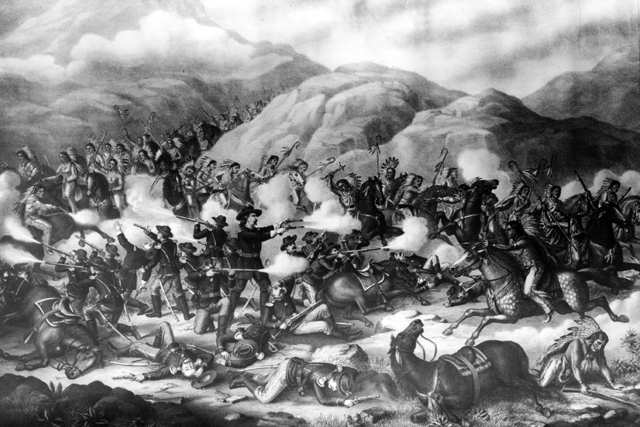
Battle of the Big Horn. Shows the smoking guns of General Custer and his U. S. Army troops being defeated in battle with Native American Lakota Sioux, and Northern Cheyenne, Little Bighorn Battlefield, June 26, 1876 Little Bighorn River, Montana.

No description

Vicinity of the Battle of the Little Bighorn, road map as of 2010. Scale varies due to oblique view. Computer image generated using TruFlite.

The map shows the territory of different plains tribes according to the Fort Laramie Treaty (1851) and many of the battlefields (each marked with a red X) between the Lakotas and the U.S. Army from 1854 to 1890. Also Bozeman Trail and Oregon Trail are shown. Most battles were fought outside the 1851 Lakota territory because the Lakotas had taken treaty defined native territories from the smaller, hostile tribes West and North of them in the years after 1851. By 1862 the Arikara, Hidatsas and Mandans had been forced to live in a village north of the Missouri River, Like A Fishhook Village, completely outside their treaty defined 1851 territory. Foremost the traditional enemies of the Lakotas in the Crow Nation suffered under the persistent Lakota intrusion into areas West of Powder River. (Powder River was the natural line between Lakota and Crow territory as put down in the Fort Laramie treaty.) Thus, Lakota chief Red Cloud fought his war to close Bozeman Trail and the forts built to protect it (Wagon Box Fight and the Fetterman Massacre) in 1851 Crow territory. Later, the Battle of the Rosebud, the Battle of the Little Bighorn River (”the Custer Battle”) and the Battle of Wolf Mountains in Montana were likewise fought in parts of the plains acknowledged as Crow soil by the Lakotas (and Cheyennes and Arapahoes) in 1851. Some of the sources used: Brown, Dee: Bury My Heart at Wounded Knee. Stands In Timber, John and Margot Liberty: Cheyenne Memories. Lincoln. 1972. Page 170, note 13 Meyer, Roy W.: The Village Indians of the Upper Missouri. The Mandans, Hidatsas, and Arikaras. Lincoln and London, 1977. Page 108 Bray, Kingsley M.: ”Crazy Horse and the End of the Great Sioux War.” Nebraska History. Vol. 79, No. 3 (fall 1998). Pp. 94-115. McGinnis, Anthony: Counting Coup and Cutting Horses. Intertribal Warfare on the Northern Plains, 1738-1889. Evergreen, 1990. Page 116. Record of Engagements with Hostile Indians within the Military Division of Missouri, from 1868 to 1882, Lieutenant General P. H. Sheridan, Commanding. Compiled from Official Records. Headquarters Military Division of the Missouri, Chicago, Illinois. 1882. Robertson, Francis B.: ““We Are Going to Have a Big Sioux War”. Colonel David S. Stanley’s Yellowstone Expedition, 1872.” Montana, The Magazine of Western History. Vol. 34, No. 4, Autumn 1984. Pp. 2-15. Hyde, George E.: Life of George Bent. Written From His Letters. Norman, 1987. McCann, Lloyd E.: ”The Grattan Massacre.” Nebraska History. Vol. 37, No. 1 (March, 1956). Pp. 1-26. Bettelyoun, Susan Bordeaux and Josephine Waggoner: ”Three Stories of the Battle of the Blue Water.” With My Own Eyes. A Lakota Woman Tells Her People’s History. Lincoln and London. 1998. NATIONAL HISTORIC LANDMARK NOMINATION. WOLF MOUNTAINS BATTLEFIELD/WHERE BIG CROW WALKED BACK AND FORTH. United States Department of the Interior, National Park Service. Medicine Crow, Joseph: From The Heart Of The Crow Country. The Crow Indians’ Own Stories. New York, 1992. Page 84. The Apsaalooke (Crow Indians) of Montana. A Tribal Histories Teachers's Guide. Compiled and Edited by Phenocia Bauerle, Cindy Bell, Luella Brien, Carrie McCleary, Timothy McCleary and Hubert B. Two Leggings. Little Bighorn College. Crow Agency, Montana. OPI.MT.GOV 2010. Page 6 and 7. Calloway, Colin G.: “The Inter-tribal Balance of Power on the Great Plains, 1760–1850.” Journal of American Studies. Vol. 16, No. 1 (April 1982). Pp. 25-47. White, Richard: ”The Winning of the West: The Expansion of the Western Sioux in the Eighteenth and Nineteenth Centuries.” The Journal of American History. Vol. 65, No. 2 (Sep., 1978). Pp. 319-343. Remele, Larry (Ed.): Fort Buford and the Military Frontier on the Northern Plains. Bismarck, ND. 1987. Hoxie, Frederick E.: Parading Through History. The making of the Crow Nation in America, 1805-1935. Cambridge, 1995. Utley, Robert M.: ”The Bozeman Trail before John Bozeman: A Busy Land.” Montana: The Magazine of Western History. Vol. 53, No. 2 (Summer, 2003). Pp. 20-31.

Gen'l Custer's last stand, looking in the direction of ford and Indian village. Photograph shows pile of bones found at battle site.

7th Calvary 1878 Trumpet in -Fort Camp Verde in Arizona

"The Custer Fight" by Charles Marion Russell. Lithograph. Shows the Battle of Little Bighorn, from the Indian side.

"The Custer Fight" by Charles Marion Russell. Lithograph. Shows the Battle of Little Bighorn, from the Indian side.

"The Custer Fight" by Charles Marion Russell. Lithograph. Shows the Battle of Little Bighorn, from the Indian side.

No description

No description

Former US Army Crow Scouts at the Little Bighorn battlefield in Montana, circa 1913. (Left to right) White Man Runs Him, Hairy Moccasin, Curly and Goes Ahead
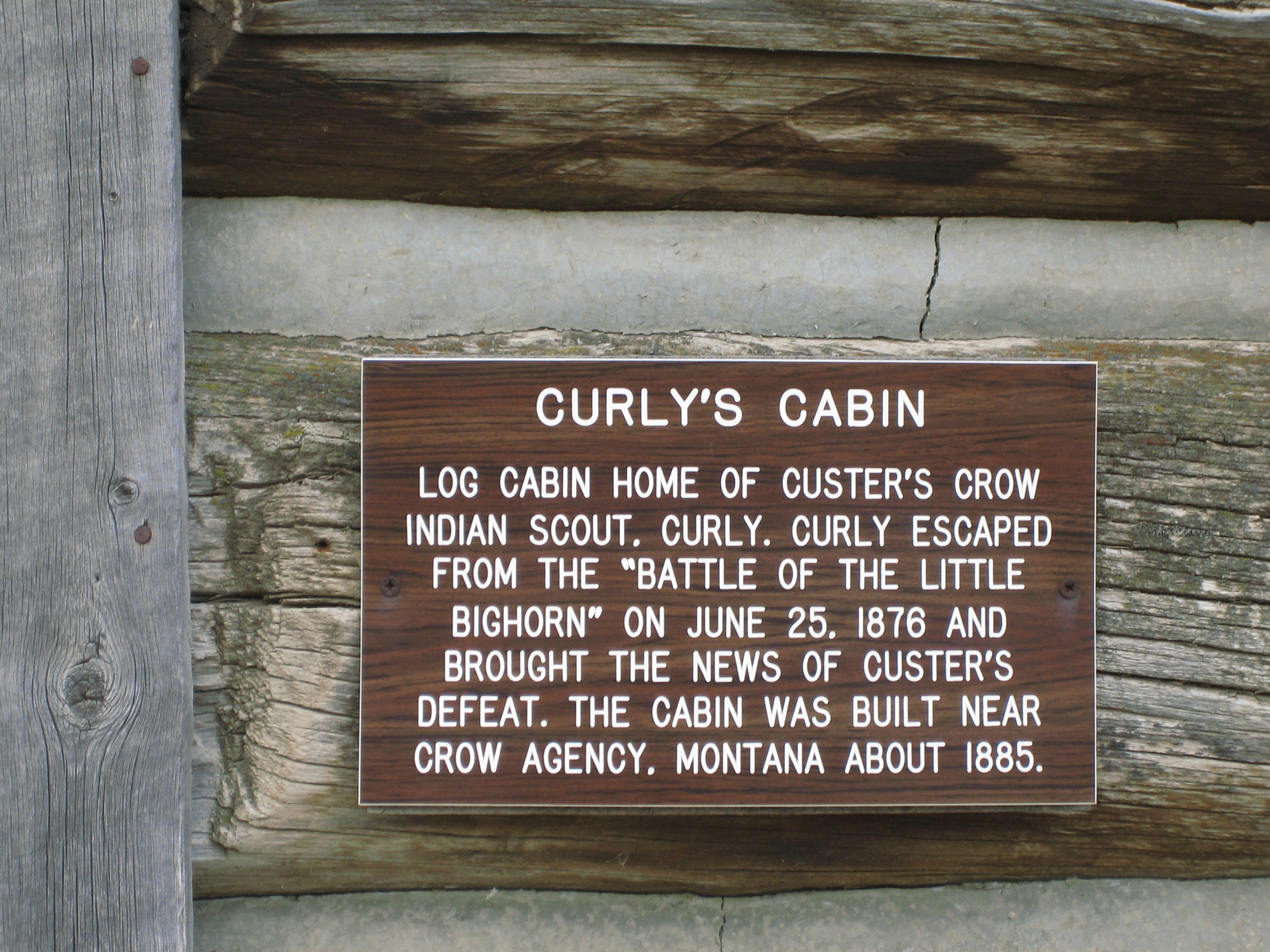
I took photo Aug. 6, 2006.Billy Hathorn (talk) 23:13, 29 June 2008 (UTC)

Custer and the Battle of the Little Big Horn