Schlacht um Villers-Bocage

Villers-Bocage, zerstörte Cromwell-Panzer
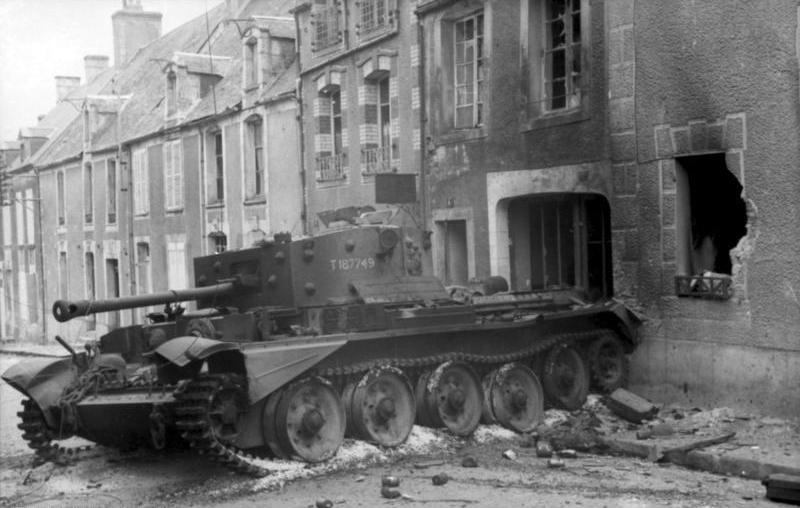
Information added by Wikimedia users. roughly translates as "France, Villers-Bocage.- destroyed British Cruiser Tank VIII Cromwell (Turret number: T 187749) in the village in front of burnt house; PK Signal-Einsatz"

Villers-Bocage, zerstörter Cromwell-Panzer

Villers-Bocage, zerstörte britische Militärfahrzeuge

Probably Borgward B3000 truck

Captain L Cotton MM (left, wearing German Iron Cross!) with his Cromwell VI tank and crew of 4th County of London Yeomanry, 7th Armoured Division, 17 June 1944. Cotton had been promoted to captain following the regiment's action at Villers Bocage.
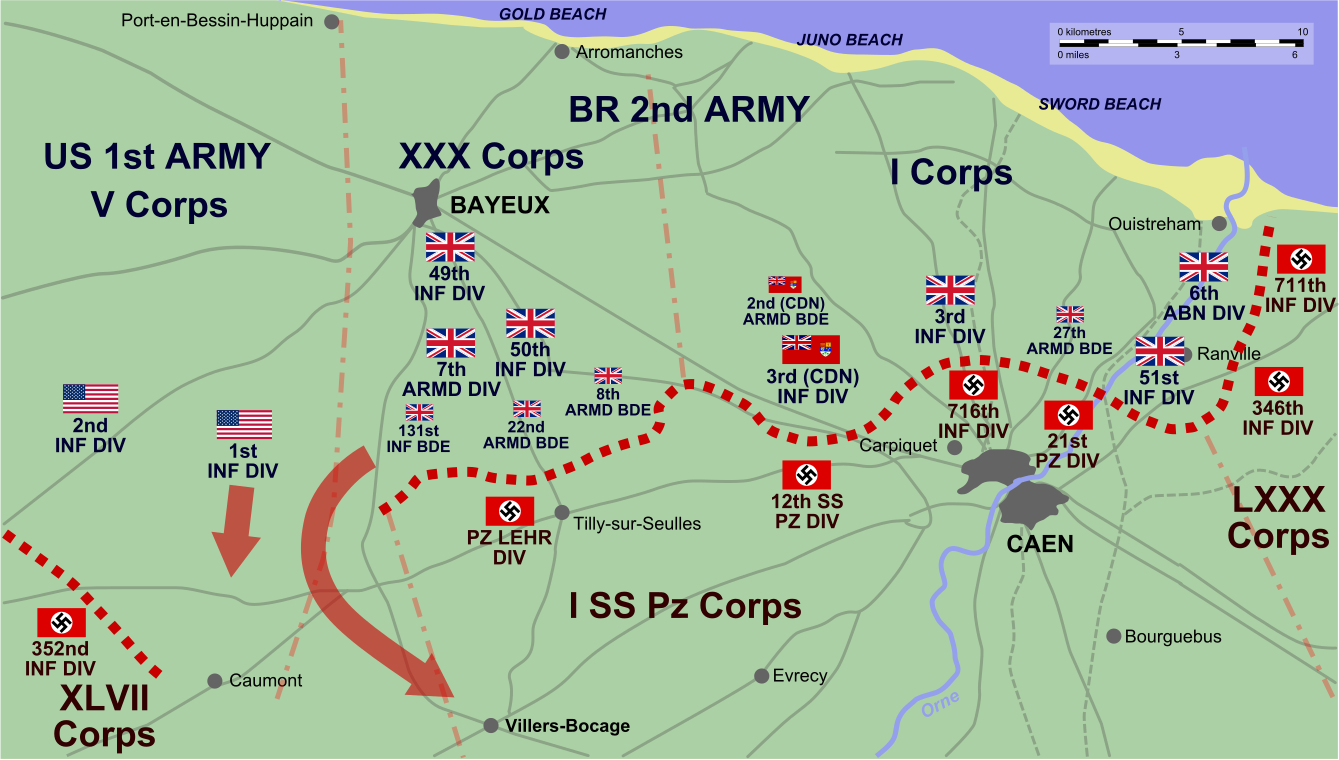
Allied and Axis dispositions on 12 June 1944 before Caen, Normandy. US pressure on the German 352nd Infantry Division forced a withdrawal which opened up a gap in the German line. This was exploited by the British, who attempted to flank the Panzerlehrdivision leading to the Battle of Villers-Bocage.

Royal Air Force Bomber Command, 1942-1945. Avro Lancasters carpet bomb a road junction near Villers Bocage, Normandy, France through which the 2nd and 9th SS Panzer Divisions were expected to move to carry out an attack on the junction of the British and American armies. The daylight attack, by 266 aircraft of Nos. 3, 4 and 8 Groups, was carried out at 4,000 feet to ensure that the target indicators dropped by the Pathfinders were seen and 1,100 tons of bombs were dropped with great accuracy.

Villers-Bocage, zerstörter Sherman-Panzer
![Knocked-out Cromwell observation post tank, commanded by Captain Paddy Victory of 5th Royal Horse Artillery, 7th Armoured Division, in Villers-Bocage, 5 August 1944. Captain Victory had attempted to do a neutral turn to escape more quickly, however a loose large paving slab jammed the track and essentially immobilised the tank.[1]](https://upload.wikimedia.org/wikipedia/commons/3/3d/Cromwellvillersbocage.jpg)
Knocked-out Cromwell observation post tank, commanded by Captain Paddy Victory of 5th Royal Horse Artillery, 7th Armoured Division, in Villers-Bocage, 5 August 1944. Captain Victory had attempted to do a neutral turn to escape more quickly, however a loose large paving slab jammed the track and essentially immobilised the tank.[1]

Villers-Bocage, zerstörter Cromwell-Panzer

Villers-Bocage, zerstörter Cromwell-Panzer

Villers-Bocage, zerstörter Cromwell-Panzer

Villers-Bocage, zerstörter Cromwell-Panzer

Villers-Bocage, zerstörte englische Militärfahrzeuge

Villers-Bocage, zerstörte Cromwell-Panzer

Villers-Bocage, zerstörter Cromwell-Panzer

Villers-Bocage, zerstörter britischer Panzer
![Information added by Wikimedia users.
Pkz IV not a Tiger I/E [it was at Villers-Bocage with the Tigers]](https://upload.wikimedia.org/wikipedia/commons/7/77/Bundesarchiv_Bild_101I-738-0273-01A%2C_Villers-Bocage%2C_zerst%C3%B6rter_Panzer_IV.jpg)
Information added by Wikimedia users. Pkz IV not a Tiger I/E [it was at Villers-Bocage with the Tigers]

Villers-Bocage, zerstörte britische Panzer

Villers-Bocage, zerstörter Sherman-Panzer

Villers-Bocage, zerstörte britische Panzer

Villers-Bocage, Zerstörter M4 Sherman

Map shows the positions of the 4th County of London Yeomanry, A Company, 1st Rifle Brigade and the 1/6 Queen's Regiment prior to the attack launched by Michael Wittmann. The map was possibly created either by The Sharpshooters Yeomanry Association or the late Lieutenant-Colonel Charles Pearce.
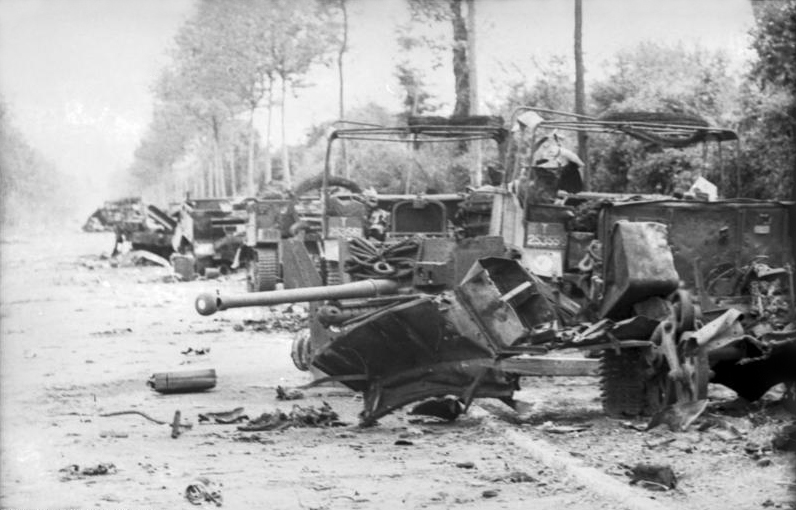
The gun is QF 6-pdr AT-gun, the tractors are most probably Loyd Carriers
Historische Übersicht
Die Schlacht um Villers-Bocage am 13. Juni 1944 war ein Zusammenstoß zwischen deutschen und britischen Panzerstreitkräften während der Schlacht in der Normandie. SS-Hauptsturmführer Michael Wittmann führte eine Einheit von sechs Panzerkampfwagen VI Tiger der Schweren SS-Panzer-Abteilung 101 zur Sicherung der Straße N.175 südlich von Caen bei Villers-Bocage. Die Kampfgruppe kam in der Nacht vom 12. zum 13. Juni an und fuhr in Richtung Nordosten von Villers-Bocage.
Fakten auf einen Blick
Wehrmacht / Waffen-SS
- Befehlshaber: Michael Wittmann
- Truppenstärke: 6 Tiger
- Verluste: gering
Großbritannien
- Befehlshaber: -
- Truppenstärke: 1 Regiment
- Verluste: 200
Strategischer Kontext
Britischer Versuch, Caen von Westen zu umgehen.
Weiterführende Literatur


Red Famine: Stalin's War on Ukraine


Die Schlacht um Berlin und das Ende des Dritten Reichs 1945

Hunde, wollt ihr ewig leben: ein Stalingrad-Roman

Roter Hunger: Stalins Krieg gegen die Ukraine


Söldner ohne Sold: Die deutschen Freikorps 1918–1923

Vom Massensturm zur Stoßtrupptaktik: Die deutsche Landkriegtaktik im Spiegel von Dienstvorschriften und Publizistik 1906 bis 1918

Wir Wehr-Wölfe: Erinnerungen eines Freikorps-Führers

Zweiter Weltkrieg Erlebnisbericht Apokalypse Stalingrad: Untergang der 6. Armee 1942-1943
Walter Mönch
Rise And Fall Of The Third Reich
William Shirer
Historische Orte
Die interaktive Karte erfordert die Zustimmung zu Drittanbieter-Cookies.