Operation Veritable

The British Army in North-west Europe 1944-45 Troops stop for tea in Kranenberg, next to a large circular swastika emblem, 9 February 1945.

The British Army in North-west Europe 1944-45 Troops of the 5/7th Gordon Highlanders in the Reichswald, 9 February 1945.

WWII Rhineland Campaign - 8 Feb - 5 March 1945

A column of Churchill tanks and other vehicles at the start of Operation 'Veritable', NW Europe, 8 February 1945. Churchill tanks and other vehicles at the start of Operation 'Veritable', 8 February 1945.

A soldier standing in the ruins of Kleve, reading a German poster calling for civilians to conserve fuel supplies for the war effort.

British Tanks and Afvs in Nw Europe 1944-45 Churchill tanks supporting infantry of the 2nd Argyll and Sutherland Highlanders during Operation 'Veritable', 8 February 1945.

British Tanks and Afvs in Nw Europe 1944-45 A Churchill tank ploughs along a muddy, heavily rutted forest track in the Reichswald during Operation 'Veritable', 8 February 1945.

Churchill tanks of 107th Regiment RAC (King's Own), 34th Tank Brigade, at the start of the Reichswald battle in Germany, 9 February 1945. Churchill tanks of 107th Regiment RAC (King's Own), 34th Tank Brigade, at the start of the Reichswald battle, 9 February 1945.
Op donderdag 8 februari 2018 vond op de Canadese erebegraafplaats aan de Zevenheuvelenweg in Groesbeek de jaarlijkse herdenking van Operatie Veritable plaats.

Royal Air Force 1939-1945- Bomber Command The German town of Kleve, photographed from a low-flying Auster aircraft, a few days after the major Bomber Command raid on 7-8 February 1945, carried out as a prelude to Operation 'Veritable', the British and Canadian advance across the Rhine.
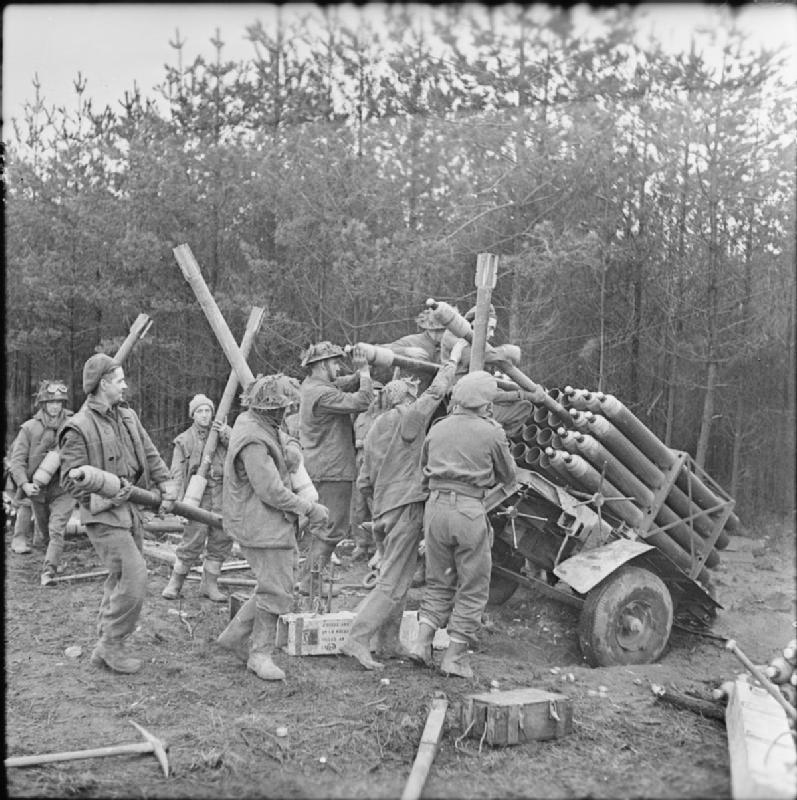
British troops loading rocket projectiles in preparation for the offensive in the Reichswald, Germany.

The Rhineland - Operation Veritable 8-21 February 1945

Ruined Landscape, Reichwald Forest 1945 image: a ruined landscape scarred by war near the Reichswald Forest in Germany. In the foreground various petrol canisters and implements litter a shell hole, with bomb damaged buildings and trees in the background. Military vehicles move along a road on the horizon.

The British Army in North-west Europe 1944-45 A universal carrier of 51st Highland Division ploughing through thick mud during the Reichswald battle, 9 February 1945.

The British Army in North-west Europe 1944-45 An Archer 17-pdr self-propelled gun near Nutterden, 9 February 1945.

The British Army in North-west Europe 1944-45 Men of the 2nd Seaforth Highlanders and Churchill tanks in the Reichswald forest, 10 February 1945.

The British Army in North-west Europe 1944-45 Universal carriers of the 2nd Seaforth Highlanders in the Reichswald forest, 10 February 1945.

The British Army in North-west Europe 1944-45 Infantry of 2nd Argyll and Sutherland Highlanders, 15th (Scottish) Division, dug in outside Kleve in the Reichswald, 10 February 1945.

The British Army in North-west Europe 1944-45 Archer 17-pdr self-propelled gun in the flooded streets of Kranenburg, 11 February 1945.

The British Army in North-west Europe 1944-45 Churchill bridgelayer and fascine carrier in the Reichswald forest, 12 February 1945.

The British Army in North-west Europe 1944-45 The crew of a machine gun carrier of the Middlesex Regiment shelter beneath a tarpaulin erected over their vehicle in the Reichswald, 12 February 1945.

The British Army in North-west Europe 1944-45 Men of the 2nd Gordon Highlanders pose with a captured German swastika flag following the capture of Kleve, 11 February 1945.

The British Army in North-west Europe 1944-45 Churchill tank of 6th Guards Tank Brigade and infantry of the 2nd Gordon Highlanders in Kleve, 11 February 1945.
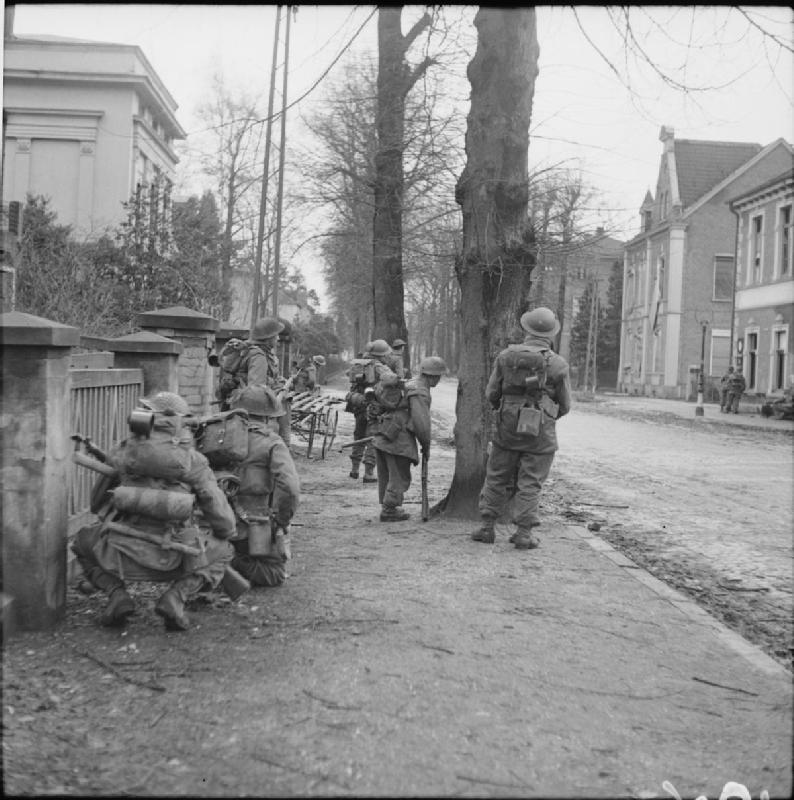
The British Army in North-west Europe 1944-45 Infantry of the 2nd Gordon Highlanders clearing snipers in Kleve, 11 February 1945.

The British Army in North-west Europe 1944-45 Churchill tanks of 6th Guards Tank Brigade and infantry of the 2nd Gordon Highlanders in Kleve, 11 February 1945.

The British Army in North-west Europe 1944-45 Infantry of the 2nd Gordon Highlanders searching German prisoners in Kleve, 11 February 1945.
Historische Übersicht
Die Schlacht im Reichswald fand im Zweiten Weltkrieg zwischen alliierten Expeditionsstreitkräften der britischen 21st Army Group und Verbänden der deutschen 1. Fallschirm-Armee vom 7. bis 22. Februar 1945 im Raum Kleve am Niederrhein statt. Die erbitterten Kämpfe um den Klever Reichswald dauerten zwei Wochen. Über 10.000 alliierte und deutsche Soldaten fielen; auch zahlreiche Zivilisten wurden verwundet oder getötet. Die Schlacht war der Auftakt der Kämpfe, in denen bis zum 10. März 1945 auf der ganzen Länge des westlichen deutschen Rheinufers die deutschen Truppen vertrieben oder aufgerieben wurden. Am 22. Februar 1945 begann die Operation Grenade, am 7. März wurde die Ludendorff-Brücke bei Remagen erobert und ab dem 23. März überquerten westalliierte Truppen bei Rees, Wesel und Dinslaken den Rhein.
Fakten auf einen Blick
UK / Kanada
- Befehlshaber: Harry Crerar
- Truppenstärke: ca. 200.000
- Verluste: ca. 15.000
Wehrmacht
- Befehlshaber: Alfred Schlemm
- Truppenstärke: ca. 50.000
- Verluste: ca. 10.000
Strategischer Kontext
Erreichen des Rheins im Norden.
Weiterführende Literatur


Red Famine: Stalin's War on Ukraine


Die Schlacht um Berlin und das Ende des Dritten Reichs 1945

Hunde, wollt ihr ewig leben: ein Stalingrad-Roman

Roter Hunger: Stalins Krieg gegen die Ukraine


Söldner ohne Sold: Die deutschen Freikorps 1918–1923

Vom Massensturm zur Stoßtrupptaktik: Die deutsche Landkriegtaktik im Spiegel von Dienstvorschriften und Publizistik 1906 bis 1918

Wir Wehr-Wölfe: Erinnerungen eines Freikorps-Führers

Zweiter Weltkrieg Erlebnisbericht Apokalypse Stalingrad: Untergang der 6. Armee 1942-1943
Walter Mönch
Rise And Fall Of The Third Reich
William Shirer
Historische Orte
Die interaktive Karte erfordert die Zustimmung zu Drittanbieter-Cookies.