Alle Schlachten

Schlacht um Tarawa

1943 Gilbertinseln Amphib. Op.

Tarawa

Tarawa

Author: UnknownLicense:PD
Source
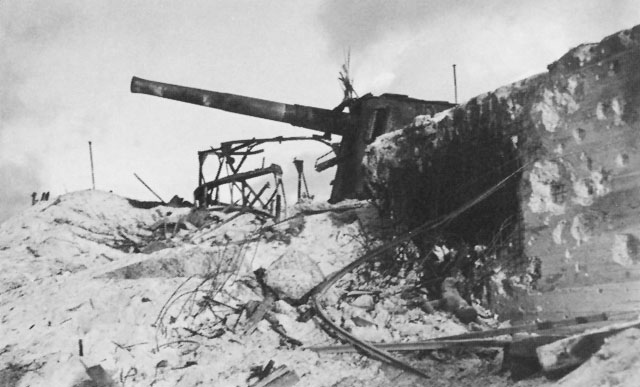
Destruction of one of the four Japanese eight-inch Vickers guns on Betio was caused by naval gunfire and air strikes.

Destruction of one of the four Japanese eight-inch Vickers guns on Betio was caused by naval gunfire and air strikes.

Author: USMCLicense:PD
Source
"Home is Where You Find It-The fighting qualities of the Marines is well known but their sense of humor is running a good second.  Their humor coupled with their adaptability to make the best of an impossible situation is demonstrated by these two Marines on Tarawa who have named their dugout "The Lousy Lousy Lounge.""
From the Julian C. Smith Collection (COLL/202), Marine Corps Archives & Special Collections

OFFICIAL USMC PHOTOGRAPH

"Home is Where You Find It-The fighting qualities of the Marines is well known but their sense of humor is running a good second. Their humor coupled with their adaptability to make the best of an impossible situation is demonstrated by these two Marines on Tarawa who have named their dugout "The Lousy Lousy Lounge."" From the Julian C. Smith Collection (COLL/202), Marine Corps Archives & Special Collections OFFICIAL USMC PHOTOGRAPH

Author: USMC Archives from Quantico, USALicense:CC-BY-4.0
Source
non-original caption.
Original caption: "GROUP OF MARINES"
Photographer not given.
USMC Photo.

127-GR-123-64390

non-original caption. Original caption: "GROUP OF MARINES" Photographer not given. USMC Photo. 127-GR-123-64390

Author: Signal Corps Archive from Ireland and United StatesLicense:PD
Source
Non-original caption.
Photographer not given.
Original caption: South side of concrete command post.

127-GR-125-64397

Non-original caption. Photographer not given. Original caption: South side of concrete command post. 127-GR-125-64397

Author: Signal Corps Archive from Ireland and United StatesLicense:PD
Source
Pack howitzers of the 1st Battalion, Tenth Marines in action on Tarawa.

Pack howitzers of the 1st Battalion, Tenth Marines in action on Tarawa.

Author: USMCLicense:PD
Source
Anthropologist Dr. Gregory Fox  (left) and U.S. Army Staff Sgt. Tyler Green, both of the Joint POW/MIA Accounting Command, Joint Base Pearl Harbor-Hickam, Hawaii, work together to separate various bone fragments into two  different collection compartments while in the village of Betio on Tarawa, Republic of Kiribati, on Aug 12. JPAC is in Tarawa to recover the remains of U. S. Marines from the Battle of Tarawa, which took place during WWII and was the first amphibious assault for the U. S. Marine Corps.

Anthropologist Dr. Gregory Fox (left) and U.S. Army Staff Sgt. Tyler Green, both of the Joint POW/MIA Accounting Command, Joint Base Pearl Harbor-Hickam, Hawaii, work together to separate various bone fragments into two different collection compartments while in the village of Betio on Tarawa, Republic of Kiribati, on Aug 12. JPAC is in Tarawa to recover the remains of U. S. Marines from the Battle of Tarawa, which took place during WWII and was the first amphibious assault for the U. S. Marine Corps.

Author: Master Sgt. Cohen YoungLicense:PD
Source
U.S. Army Mortuary Affairs Specialist, Staff Sgt. Tyler Green of the Joint POW/MIA Accounting Command, Joint Base Pearl Harbor-Hickam, Hawaii digs deeper into a hole in an effort to find remains of a U. S. Marines from the famed WWII battle, The Battle of Tarawa, which are believed to in one of six designated sites in the village of Betio on Tarawa, Republic of Kiribati on Aug 12. Green is a native of East Liverpool, Ohio.

U.S. Army Mortuary Affairs Specialist, Staff Sgt. Tyler Green of the Joint POW/MIA Accounting Command, Joint Base Pearl Harbor-Hickam, Hawaii digs deeper into a hole in an effort to find remains of a U. S. Marines from the famed WWII battle, The Battle of Tarawa, which are believed to in one of six designated sites in the village of Betio on Tarawa, Republic of Kiribati on Aug 12. Green is a native of East Liverpool, Ohio.

Author: Master Sgt. Cohen YoungLicense:PD
Source
U.S. Army Staff Sgt. Tyler Green of the Joint POW/MIA Accounting Command, Joint Base Pearl Harbor-Hickam, Hawaii, shovels dirt into a screen so that the dirt can be broken up in order to find remains of a U. S. Marines from the famed WWII battle, the Battle of Tarawa, which are believed to in one of six designated sites in the village of Betio on Tarawa, Republic of Kiribati on Aug. 9.

U.S. Army Staff Sgt. Tyler Green of the Joint POW/MIA Accounting Command, Joint Base Pearl Harbor-Hickam, Hawaii, shovels dirt into a screen so that the dirt can be broken up in order to find remains of a U. S. Marines from the famed WWII battle, the Battle of Tarawa, which are believed to in one of six designated sites in the village of Betio on Tarawa, Republic of Kiribati on Aug. 9.

Author: Master Sgt. Cohen YoungLicense:PD
Source
Marine Cemetery, Tarawa

Marine Cemetery, Tarawa

Author: LCMDR Charles KerleeLicense:PD
Source
Japanese prisoners of war at Tarawa.  VIRIN: HD-SN-99-02962

Japanese prisoners of war at Tarawa. VIRIN: HD-SN-99-02962

Author: US NavyLicense:PD
Source
This overlay highlights the attack of 3d Battalion 6th Marines on Tarawa.
Map Image 6649 From the World War II: Gilbert Islands Collection (COLL/3653) at the Marine Corps History Division

OFFICIAL USMC PHOTOGRAPH

This overlay highlights the attack of 3d Battalion 6th Marines on Tarawa. Map Image 6649 From the World War II: Gilbert Islands Collection (COLL/3653) at the Marine Corps History Division OFFICIAL USMC PHOTOGRAPH

Author: Archives Branch, USMC History DivisionLicense:CC-BY-4.0
Source
80-G-57356:   Operation Galvanic, Invasion of Tarawa, November 1943.    Japanese pillboxes on Tarawa.  Photographed by CPU-7, November 22, 1943.   (6/2/2015).

80-G-57356: Operation Galvanic, Invasion of Tarawa, November 1943. Japanese pillboxes on Tarawa. Photographed by CPU-7, November 22, 1943. (6/2/2015).

Author: National Museum of the U.S. NavyLicense:PD
Source
80-G-57359:   Operation Galvanic, Invasion of Tarawa, November 1943.    Unloading supplies on seaplane ramp at Tarawa.  Photographed by CPU-7, November 22, 1943.   (6/2/2015).

80-G-57359: Operation Galvanic, Invasion of Tarawa, November 1943. Unloading supplies on seaplane ramp at Tarawa. Photographed by CPU-7, November 22, 1943. (6/2/2015).

Author: National Museum of the U.S. NavyLicense:PD
Source
80-G-57391:   Operation Galvanic, Invasion of Tarawa, November 1943.   Rear Admiral Harry W. Hill, USN, inspects one of the fortress-like bomb-shelters.   Photographed by CPU-7, November 22, 1943.   (6/2/2015).

80-G-57391: Operation Galvanic, Invasion of Tarawa, November 1943. Rear Admiral Harry W. Hill, USN, inspects one of the fortress-like bomb-shelters. Photographed by CPU-7, November 22, 1943. (6/2/2015).

Author: National Museum of the U.S. NavyLicense:PD
Source
80-G-57394:   Operation Galvanic, Invasion of Tarawa, November 1943.   Captain Thomas J. Ryan, USN, examines cans of condensed milk from the Dutch East Indies found in the defenders stores at Tarawa.    Photographed by CPU-7, November 22, 1943.   (6/2/2015).

80-G-57394: Operation Galvanic, Invasion of Tarawa, November 1943. Captain Thomas J. Ryan, USN, examines cans of condensed milk from the Dutch East Indies found in the defenders stores at Tarawa. Photographed by CPU-7, November 22, 1943. (6/2/2015).

Author: National Museum of the U.S. NavyLicense:PD
Source
80-G-57397:   Operation Galvanic, Invasion of Tarawa, November 1943.   Part of the heavy anti-aircraft gun installation beside the body of a dead Japanese soldier.  Photographed by CPU-7, November 22, 1943.   (6/2/2015).

80-G-57397: Operation Galvanic, Invasion of Tarawa, November 1943. Part of the heavy anti-aircraft gun installation beside the body of a dead Japanese soldier. Photographed by CPU-7, November 22, 1943. (6/2/2015).

Author: National Museum of the U.S. NavyLicense:PD
Source
80-G-57405:   Operation Galvanic, Invasion of Tarawa, November 1943.   Sprawled bodies of U.S. Marines on beach of Tarawa, testifying to the ferocity of the struggle for this stretch of sand.  Photographed by CPU-7, November 22, 1943.   (6/2/2015).

80-G-57405: Operation Galvanic, Invasion of Tarawa, November 1943. Sprawled bodies of U.S. Marines on beach of Tarawa, testifying to the ferocity of the struggle for this stretch of sand. Photographed by CPU-7, November 22, 1943. (6/2/2015).

Author: National Museum of the U.S. NavyLicense:PD
Source
80-G-57422:   Operation Galvanic, Invasion of Tarawa, November 1943.   Private First Class “Tex” Rudloff, USMC, in his tank, which was hit several times by cannon fire by Japanese tanks on Tarawa but was undamaged.   Photographed by CPU-7, November 22, 1943.   (6/2/2015).

80-G-57422: Operation Galvanic, Invasion of Tarawa, November 1943. Private First Class “Tex” Rudloff, USMC, in his tank, which was hit several times by cannon fire by Japanese tanks on Tarawa but was undamaged. Photographed by CPU-7, November 22, 1943. (6/2/2015).

Author: National Museum of the U.S. NavyLicense:PD
Source
80-G-57428:   Operation Galvanic, Invasion of Tarawa, November 1943.   Japanese pillboxes on Tarawa made from palm tree trunks.   Photographed by CPU-7, November 22, 1943.   (6/2/2015).

80-G-57428: Operation Galvanic, Invasion of Tarawa, November 1943. Japanese pillboxes on Tarawa made from palm tree trunks. Photographed by CPU-7, November 22, 1943. (6/2/2015).

Author: National Museum of the U.S. NavyLicense:PD
Source
80-G-57431:   Operation Galvanic, Invasion of Tarawa, November 1943.   Lieutenant Commander John W. Heath and Captain Thomas J. Ryan inspect Japanese aerial torpedoes.   Photographed by CPU-7, November 22, 1943.   (6/2/2015).

80-G-57431: Operation Galvanic, Invasion of Tarawa, November 1943. Lieutenant Commander John W. Heath and Captain Thomas J. Ryan inspect Japanese aerial torpedoes. Photographed by CPU-7, November 22, 1943. (6/2/2015).

Author: National Museum of the U.S. NavyLicense:PD
Source
80-G-57433:   Operation Galvanic, Invasion of Tarawa, November 1943.  Japanese pillboxes on Tarawa.  U.S. Marine inspects a reveted Japanese tank used as a pillbox.  In the foreground, a dead Japanese soldier lies grotesquely, frozen by death as he fell.    Photographed by CPU-7, November 22, 1943.   (6/2/2015).

80-G-57433: Operation Galvanic, Invasion of Tarawa, November 1943. Japanese pillboxes on Tarawa. U.S. Marine inspects a reveted Japanese tank used as a pillbox. In the foreground, a dead Japanese soldier lies grotesquely, frozen by death as he fell. Photographed by CPU-7, November 22, 1943. (6/2/2015).

Author: National Museum of the U.S. NavyLicense:PD
Source
80-G-57435:   Operation Galvanic, Invasion of Tarawa, November 1943.  Japanese pillboxes on Tarawa.  Emplaced in a pit behind a barrier on heavy logs, this Japanese tank served as a pillbox.   Photographed by CPU-7, November 22, 1943.   (6/2/2015).

80-G-57435: Operation Galvanic, Invasion of Tarawa, November 1943. Japanese pillboxes on Tarawa. Emplaced in a pit behind a barrier on heavy logs, this Japanese tank served as a pillbox. Photographed by CPU-7, November 22, 1943. (6/2/2015).
Author: National Museum of the U.S. NavyLicense:PD
Source
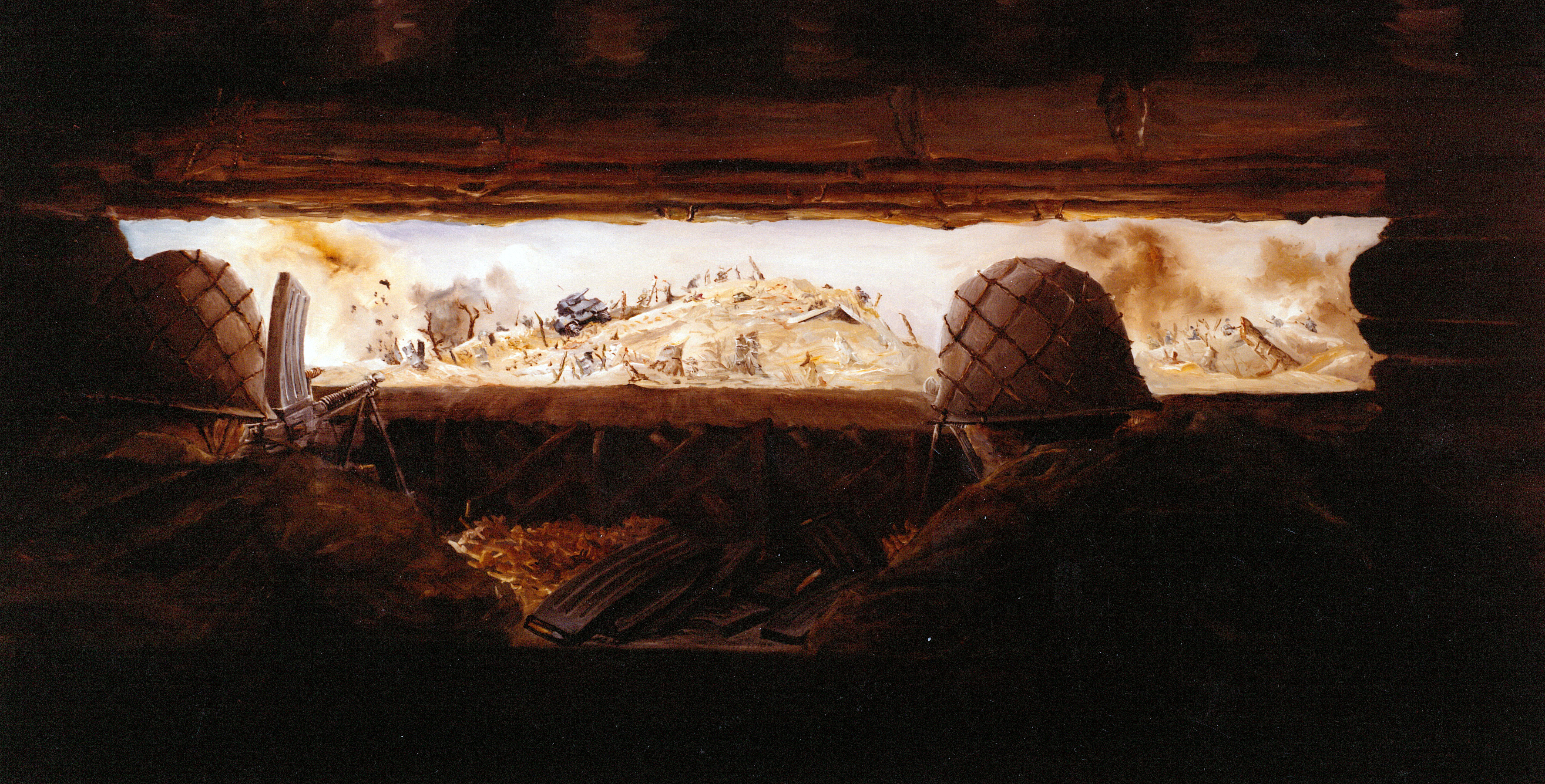
84-28-S:   Operation Galvanic, Invasion of Tarawa, November 1943.   The invasion seen through the mouth of Japanese pillbox, November 1943.       Artwork by John Hamilton from his publication, “War at Sea,” pg. 181.    Courtesy of the U.S. Navy Art Gallery.

84-28-S: Operation Galvanic, Invasion of Tarawa, November 1943. The invasion seen through the mouth of Japanese pillbox, November 1943. Artwork by John Hamilton from his publication, “War at Sea,” pg. 181. Courtesy of the U.S. Navy Art Gallery.

Author: National Museum of the U.S. NavyLicense:PD
Source
M4 Sherman medium tank abandoned after the Battle of Tarawa in the Republic of Kiribati.

M4 Sherman medium tank abandoned after the Battle of Tarawa in the Republic of Kiribati.

Author: Cold Press Publishing from Anchorage, Alaska, USALicense:CC-BY-SA-4.0
Source
Map Image 6560A From the World War II: Gilbert Islands Collection (COLL/3653) at the Marine Corps History Division
OFFICIAL USMC PHOTOGRAPH

Map Image 6560A From the World War II: Gilbert Islands Collection (COLL/3653) at the Marine Corps History Division OFFICIAL USMC PHOTOGRAPH

Author: Archives Branch, USMC History DivisionLicense:CC-BY-4.0
Source

Historische Übersicht

Erste große US-Landung gegen massiven Widerstand.

Fakten auf einen Blick

Ergebnis:US-Sieg.

US Marine Corps

  • Befehlshaber: Julian C. Smith
  • Truppenstärke: 35000
  • Verluste: 1027

Jap. Kaiserreich

  • Befehlshaber: Keiji Shibazaki †
  • Truppenstärke: 4800
  • Verluste: 4690

Strategischer Kontext

Test der amphibischen Doktrin im Zentralpazifik.

Weiterführende Literatur

Cover of Berlin: The Downfall 1945

Berlin: The Downfall 1945

Antony Beevor

SachbuchZweiter WeltkriegWW2-Ostfront

Englisch
Weltkriegs-Ära
Cover of Gulag: A History

Gulag: A History

Sachbuch20. JahrhundertSowjetunion

Englisch
Weltkriegs-Ära
Cover of Red Famine: Stalin's War on Ukraine

Red Famine: Stalin's War on Ukraine

Sachbuch20. JahrhundertSowjetunion

Englisch
Weltkriegs-Ära
Cover of Stalingrad

Stalingrad

Antony Beevor

Zweiter WeltkriegBerichtWW2-Ostfront

Englisch
Weltkriegs-Ära
Cover of The Gulag Archipelago

The Gulag Archipelago

Sachbuch20. JahrhundertSowjetunion

Englisch
Weltkriegs-Ära
Cover of Der Gulag

Der Gulag

Sachbuch20. JahrhundertSowjetunion

Deutsch
Weltkriegs-Ära
Cover of Die Schlacht um Berlin und das Ende des Dritten Reichs 1945

Die Schlacht um Berlin und das Ende des Dritten Reichs 1945

SachbuchZweiter WeltkriegWW2-Ostfront

Deutsch
Weltkriegs-Ära
Cover of Hunde, wollt ihr ewig leben: ein Stalingrad-Roman

Hunde, wollt ihr ewig leben: ein Stalingrad-Roman

Zweiter WeltkriegWW2-OstfrontHistorischer Roman

Deutsch
Weltkriegs-Ära
Cover of Roter Hunger: Stalins Krieg gegen die Ukraine

Roter Hunger: Stalins Krieg gegen die Ukraine

Sachbuch20. JahrhundertSowjetunion

Deutsch
Weltkriegs-Ära
Cover of So weit die Füße tragen

So weit die Füße tragen

20. JahrhundertSowjetunionGulag

Deutsch
Weltkriegs-Ära
Cover of Söldner ohne Sold: Die deutschen Freikorps 1918–1923

Söldner ohne Sold: Die deutschen Freikorps 1918–1923

Bericht20. JahrhundertDeutsche Geschichte

Deutsch
Weltkriegs-Ära
Cover of Vom Massensturm zur Stoßtrupptaktik: Die deutsche Landkriegtaktik im Spiegel von Dienstvorschriften und Publizistik 1906 bis 1918

Vom Massensturm zur Stoßtrupptaktik: Die deutsche Landkriegtaktik im Spiegel von Dienstvorschriften und Publizistik 1906 bis 1918

Sachbuch20. JahrhundertDeutsche Geschichte

Deutsch
Weltkriegs-Ära
Cover of Wir Wehr-Wölfe: Erinnerungen eines Freikorps-Führers

Wir Wehr-Wölfe: Erinnerungen eines Freikorps-Führers

Bericht20. JahrhundertDeutsche Geschichte

Deutsch
Weltkriegs-Ära
Cover of Zweiter Weltkrieg Erlebnisbericht Apokalypse Stalingrad: Untergang der 6. Armee 1942-1943

Zweiter Weltkrieg Erlebnisbericht Apokalypse Stalingrad: Untergang der 6. Armee 1942-1943

Walter Mönch

SachbuchZweiter WeltkriegWW2-Ostfront

Deutsch
Weltkriegs-Ära
Rise And Fall Of The Third Reich

Rise And Fall Of The Third Reich

William Shirer

20. JahrhundertDeutsche GeschichteNationalsozialismus

Weltkriegs-Ära

Historische Orte

Genaue Lage nicht in historischen Quellen überliefert