Schlacht bei Wagram

Gravure représentant l'empereur Napoléon Ier et le colonel Jean Hugues Gambin à la bataille de Wagram
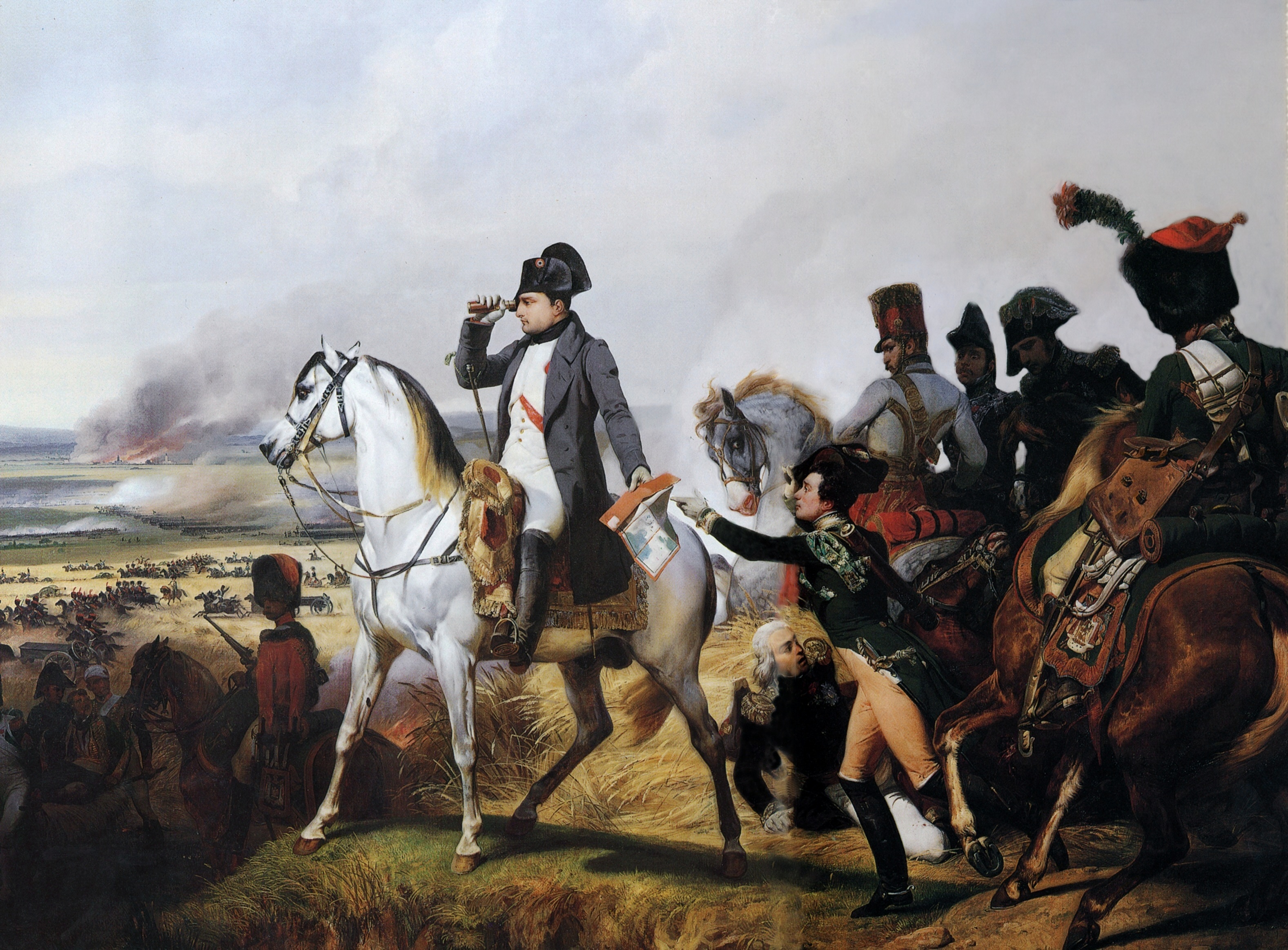
Bataille de Wagram. 6 Juillet 1809.

in the background: Battle of Wagram
L'école d'artillerie (EA) de Draguignan organise les 29 et 30 juin 2011 les commémorations de la bataille de Wagram

A map of the region north of Wien, where the battles of Aspern-Essling (21st-22nd of May) and Wagram (5th-6th of July) took place in 1809 between the Habsburg Austrian Army and the French and German Army of the Napoleon I.

Confrontation between French and Austrians during the Battle of Wagram (engraving on wood)

Auteur(s): Andrieu, Bertrand ou Jean-Bertrand (Bordeaux, 04–11–1761 - Paris, 10–12–1822), graveur en médailles - Médailleur Gallé (Paris - Sèvres), graveur en médailles - Médailleur Date de production: En 1809 Type(s) d'objet(s): Numismatique Dénomination(s): Médaille Lieu(x) d'exécution / réalisation: Paris Date de découverte: En 04–1934 Lieu de découverte: Paris Commentaire sur le lieu de découverte: déposées en 1813 dans la pierre de fondation du Marché des Carmes Dimensions - Oeuvre: Diamètre : 4 cm Poids (type dimension) : 35.21 g Description: Relief, droit, revers. Marques, inscriptions, poinçons: Légende - Au droit circulaire : " NAPOLEON - EMP. ET ROI " ; au revers à l'exergue : " BATAILLE DE WAGRAM. / VI JUILLET MDCCCIX ". Signature - Au droit sur la tranche du buste : " ANDRIEU F." ; au revers à l'exergue à gauche : "DENON D." ; au revers à l'exergue à droite : " GALLE F.". Description iconographique: Droit : buste nu et lauré de Napoléon à droite ; revers : Hercule, portant la léontée, frappant un ennemi au sol et soutenant une victoire tenant une couronne. Mode d'acquisition: Don fouilles Nom du donateur, testateur, vendeur: Commission du Vieux Paris Date d’acquisition: 01–1935 Institution: Musée Carnavalet, Histoire de Paris Numéro d’inventaire: ND3007 IIIF Manifest: https://apicollections.parismusees.paris.fr/iiif/320083711/manifest

Auteur(s): Andrieu, Bertrand ou Jean-Bertrand (Bordeaux, 04–11–1761 - Paris, 10–12–1822), graveur en médailles - Médailleur Gallé (Paris - Sèvres), graveur en médailles - Médailleur Date de production: En 1809 Type(s) d'objet(s): Numismatique Dénomination(s): Médaille Lieu(x) d'exécution / réalisation: Paris Date de découverte: En 04–1934 Lieu de découverte: Paris Commentaire sur le lieu de découverte: déposées en 1813 dans la pierre de fondation du Marché des Carmes Dimensions - Oeuvre: Diamètre : 4 cm Poids (type dimension) : 35.21 g Description: Relief, droit, revers. Marques, inscriptions, poinçons: Légende - Au droit circulaire : " NAPOLEON - EMP. ET ROI " ; au revers à l'exergue : " BATAILLE DE WAGRAM. / VI JUILLET MDCCCIX ". Signature - Au droit sur la tranche du buste : " ANDRIEU F." ; au revers à l'exergue à gauche : "DENON D." ; au revers à l'exergue à droite : " GALLE F.". Description iconographique: Droit : buste nu et lauré de Napoléon à droite ; revers : Hercule, portant la léontée, frappant un ennemi au sol et soutenant une victoire tenant une couronne. Mode d'acquisition: Don fouilles Nom du donateur, testateur, vendeur: Commission du Vieux Paris Date d’acquisition: 01–1935 Institution: Musée Carnavalet, Histoire de Paris Numéro d’inventaire: ND3007 IIIF Manifest: https://apicollections.parismusees.paris.fr/iiif/320083711/manifest
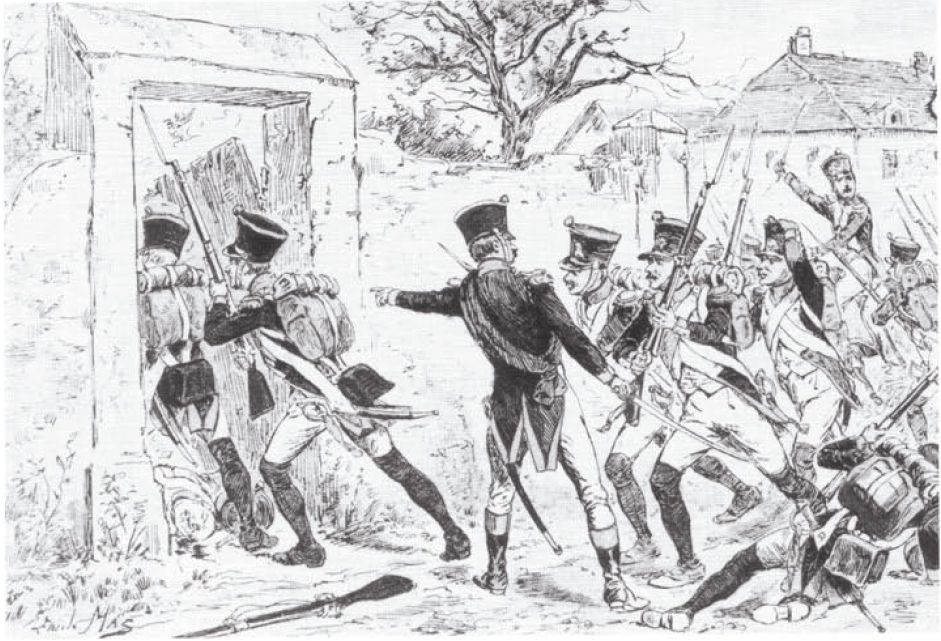
The 4th Line Regiment of Carra Saint-Cyr's division of Marshal Massena's IV Corps storm the village of Aderklaa, a strategic position in the Austrian centre, during the second day of the battle of Wagram. Engraving held at the Musee de l'Armee in Paris.
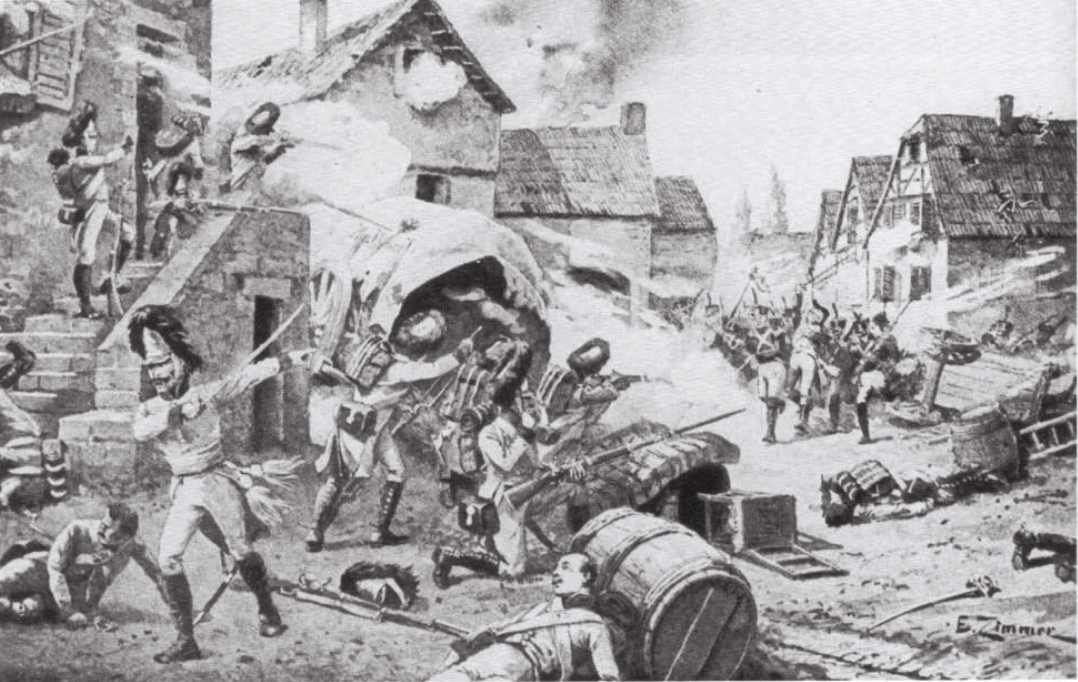
French infantry of Molitor's division (Massena's IV Corps) assault and taken the village of Aderklaa from the Austrian grenadiers (on the left). The Grenadiers and other supportign units needed two full hours before they could retake the position.

Leading his III Corps from the front, Davout has his horse shot under him. He orders his men to continue the assault on Markgrafneusiedl, visible due to its tower in the background. Part of Anne S. K. Brown Collection.

Austrian hussars capture Boudet's guns, not far away from the village of Aspern. Engraving held at the HGM Museum in Vienna.

This medal commemorates Napoleon's victory over the Austrians in the Battle of Wagram. The inscription on the obverse reads "Napoleon the Great, Emperor of the French, King of Italy, Pious, Happy, August, Invincible". The reverse reads "The enemies everywhere dispersed, destroyed, captured" and the date of 1809. The Battle of Wagram (5–6 July 1809) was a military engagement of the Napoleonic Wars that ended in a costly but decisive victory for Emperor Napoleon I's French and allied army against the Austrian army under the command of Archduke Charles of Austria-Teschen. The battle led to the breakup of the Fifth Coalition, the Austrian and British-led alliance against France. With 80,000 casualties, the two-day battle of Wagram was particularly bloody, mainly due to the use of 1,000 artillery pieces and the expenditure of over 180,000 rounds of artillery ammunition on a flat battlefield packed with some 300,000 men. Although Napoleon was the uncontested winner, he failed to secure an overwhelming victory and the Austrian casualties were only slightly greater than those of the French and allies. Nonetheless, the defeat was serious enough to shatter the morale of the Austrians, who could no longer find the will to continue the struggle. The resulting Treaty of Schönbrunn meant the loss of one sixth of the Austrian Empire's subjects, along with some territories, rendering it landlocked until the German Campaign of 1813. From https://en.wikipedia.org/wiki/Battle_of_Wagram" rel="noreferrer nofollow">en.wikipedia.org/wiki/Battle_of_Wagram

The Battle of Wagram (engraving)

Map of the region north of Vienna, site of the battles of Aspern-Essling and Wagram, in 1809.

Tomasz Łubieński pod Wagram w roku 1809; akwarela

"Napoléon pendant la bataille de Wagram" - Napoleon at the battle of Wagram and cuirassiers cheering as they are passing by during a cavalry charge.

French decisive attack at Wagram, on July 6th, at around 13:00 hours. MacDonald's square-shaped attack column is visible in the centre.

Deutsch Wagram Bürgerhaus Quartier von Erzherzog Carl in der Schlacht bei Wagram heute Heimatmuseum

Une des illustrations du tome 1 de l'ouvrage Dictionnaire populaire illustré d'histoire, de géographie, de biographie, de technologie, de mythologie, d'antiquités, des beaux-arts et de littérature, rédigé et édité par Edmond Alonnier & Joseph Décembre
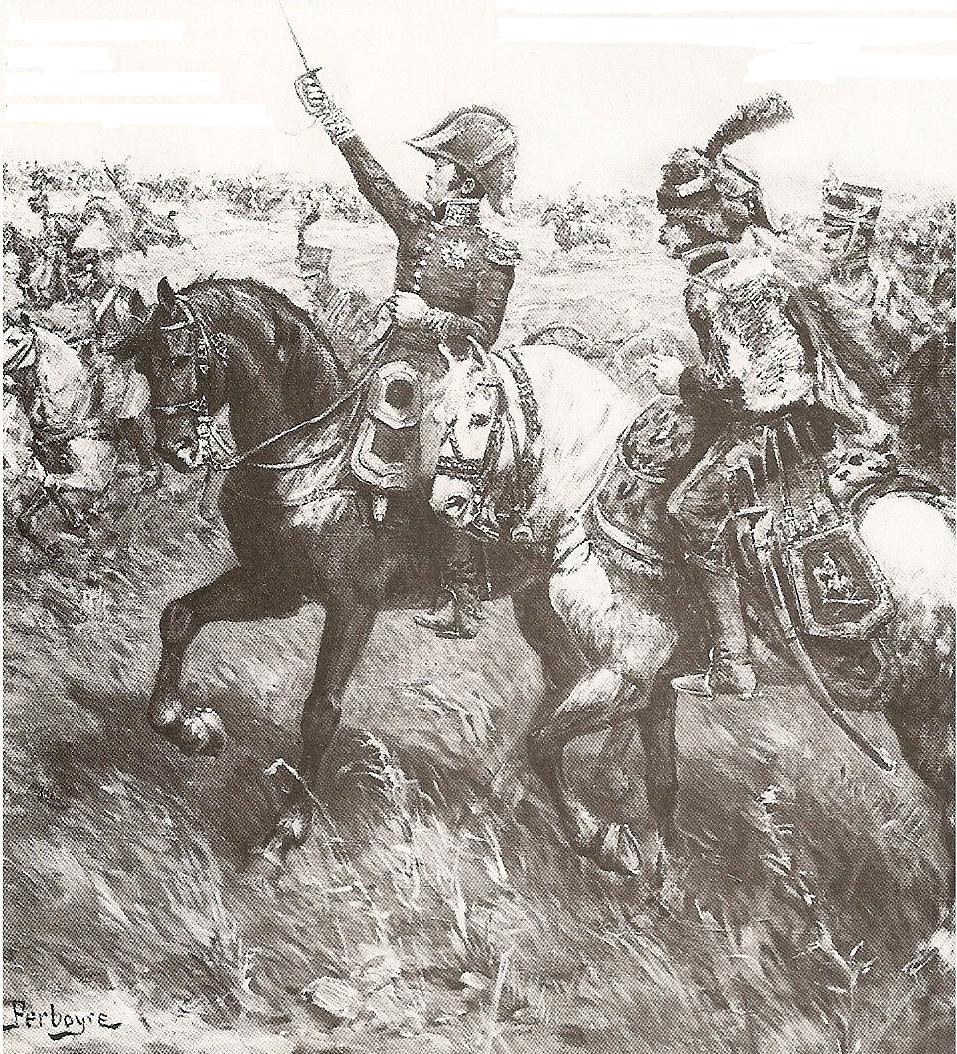
The general Antoine Drouot at the Battle of Wagram

Battle of Wagram
![Sujet : Bataille de Wagram (1809)
Batailles
Deutsch Wagram -- Plans de batailles
Comprend : Bataille de Wagram, première journée, le 5 juillet 1809 à 6 heures du soir ; Wagram, 6 juillet, à 10 heures du matin ; Vue du champ de bataille de Wagram ; Bataille de Wagram, deuxième journée, le 6 juillet 1809 à 1hre après midi
Couverture : Autriche – Basse-Autriche
Langue : français
Éditeur : [s.n.]](https://upload.wikimedia.org/wikipedia/commons/1/19/Ensemble_de_quatre_documents%2C_plans_et_vues%2C_concernant_la_bataille_de_Wagram%2C_5-6_juillet_1809_-_btv1b7200199v_%2801_of_16%29.jpg)
Sujet : Bataille de Wagram (1809) Batailles Deutsch Wagram -- Plans de batailles Comprend : Bataille de Wagram, première journée, le 5 juillet 1809 à 6 heures du soir ; Wagram, 6 juillet, à 10 heures du matin ; Vue du champ de bataille de Wagram ; Bataille de Wagram, deuxième journée, le 6 juillet 1809 à 1hre après midi Couverture : Autriche – Basse-Autriche Langue : français Éditeur : [s.n.]

Erzherzog-Carl-Haus

Gravure représentant l'empereur Napoléon Ier et le colonel Jean Hugues Gambin à la bataille de Wagram
Historische Übersicht
In der Schlacht bei Wagram am 5. und 6. Juli 1809 besiegten Napoleons französische Truppen Erzherzog Karl von Österreichs österreichische Armee in der Nähe von Wien. Dies war gleichzeitig das Ende des Fünften Koalitionskrieges. Die Schlacht wurde auf dem Marchfeld in der Ebene zwischen der Donauauenregion Lobau und der niederösterreichischen Ortschaft Deutsch-Wagram geführt. Maximal 300.000 Soldaten trafen in dieser bis dahin größten Schlacht der napoleonischen Kriege aufeinander, in der die Artillerie eine entscheidende Rolle spielte. Insgesamt beliefen sich die Verluste auf bis zu 78.000 Soldaten, wobei die Österreicher mehr Soldaten verloren als die Franzosen und deren Verbündete.
Fakten auf einen Blick
Grande Armée (FRA)
- Befehlshaber: Napoleon Bonaparte
- Truppenstärke: ca. 170.000
- Verluste: ca. 34.000
Erzherzogtum Österreich
- Befehlshaber: Erzh. Karl
- Truppenstärke: ca. 145.000
- Verluste: ca. 40.000
Strategischer Kontext
Entscheidungsschlacht zur Beendigung des Krieges durch Donauüberquerung.
Weiterführende Literatur

Trafalgar: Great Battles and Sieges

Historische Orte
Die interaktive Karte erfordert die Zustimmung zu Drittanbieter-Cookies.