Schlacht am Signal Hill
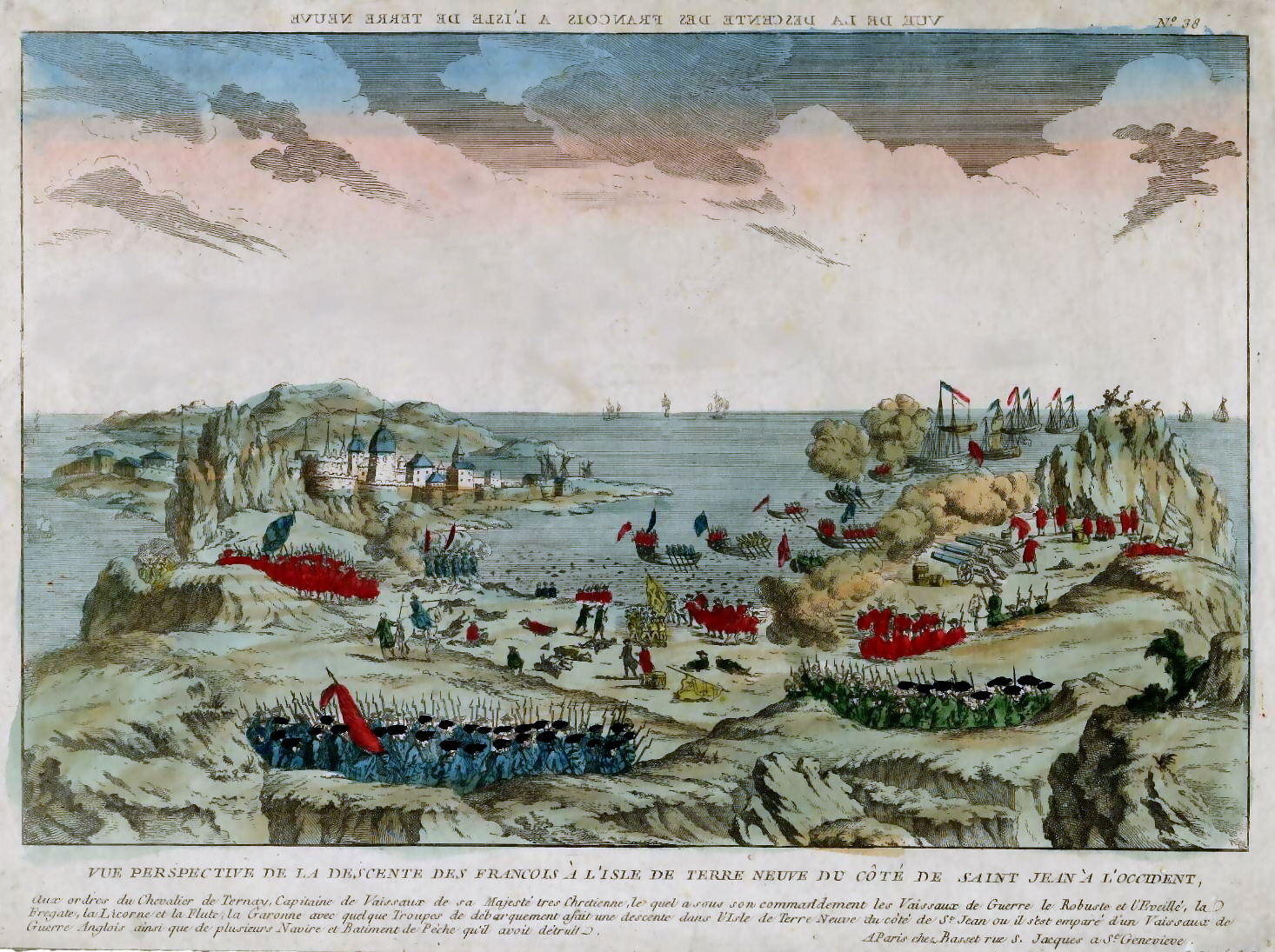
Perspective view of the French attack on Newfoundland near St. John's. Attack under the command of Chevalier de Ternay, (...), with the warships the Robust and the Eveillée, the frigate Licorne and the Flute, the Garonne with some troops landing. He landed in Newfoundland on the side of St. John's where he took an English warships and several ships and fishing vessels that he has destroyed. " These prints were displayed in a box with a mirror (hence the title printed in reverse). The principle of seeing the image without seeing the document directly in the eighteenth century was a curious optical and won a great success.

Plaque in Torbay, Newfoundland which commemorates the landing of British troops on 13 September
Historische Übersicht
Die Schlacht von Signal Hill am 15. September 1762 war die letzte Schlacht im Franzosen- und Indianerkrieg in Nordamerika. Britische Truppen unter Oberstleutnant William Amherst eroberten St. John’s zurück, das die Franzosen Anfang des Jahres in einem Überraschungsangriff eingenommen hatten.
Fakten auf einen Blick
Königreich Großbritannien
- Befehlshaber: William Amherst
- Truppenstärke: ca. 1.900
- Verluste: ca. 30
Königreich Frankreich
- Befehlshaber: d’Haussonville
- Truppenstärke: ca. 1.500
- Verluste: ca. 1.500 (Gefangen)
Strategischer Kontext
Letzter französischer Versuch, Land in Kanada zurückzugewinnen.
Konflikt / Krieg
Siebenjähriger Krieg
Historische Orte
Die interaktive Karte erfordert die Zustimmung zu Drittanbieter-Cookies.