Schlacht von Bussaco

These two faces of the basis read : Roliça 17 - VIII - 1808 Buçaco 27 - IX - 1810

No.2 Battle of Sierra de Basaco above St. Antonio de Cantaro title QS:P1476,en:"No.2 Battle of Sierra de Basaco above St. Antonio de Cantaro "label QS:Len,"No.2 Battle of Sierra de Basaco above St. Antonio de Cantaro "

Detail of the Tiles depicting the Batalha of Buçaco, victoriously fought on September 27, 1810. Memorial at Buçaco : https://commons.wikimedia.org/wiki/File:Bussaco_1810.JPG Location : Inner court of the Museum, northernmost corner.

Tiles depicting the Batalha of Buçaco, victoriously fought on September 27, 1810 by the Anglo-Portuguese Army against the napoléonic invader. Tiles created around 1900. At Buçaco, a commemorative obelisk has been erected in 1873 : https://commons.wikimedia.org/wiki/File:Bussaco_1810.JPG.
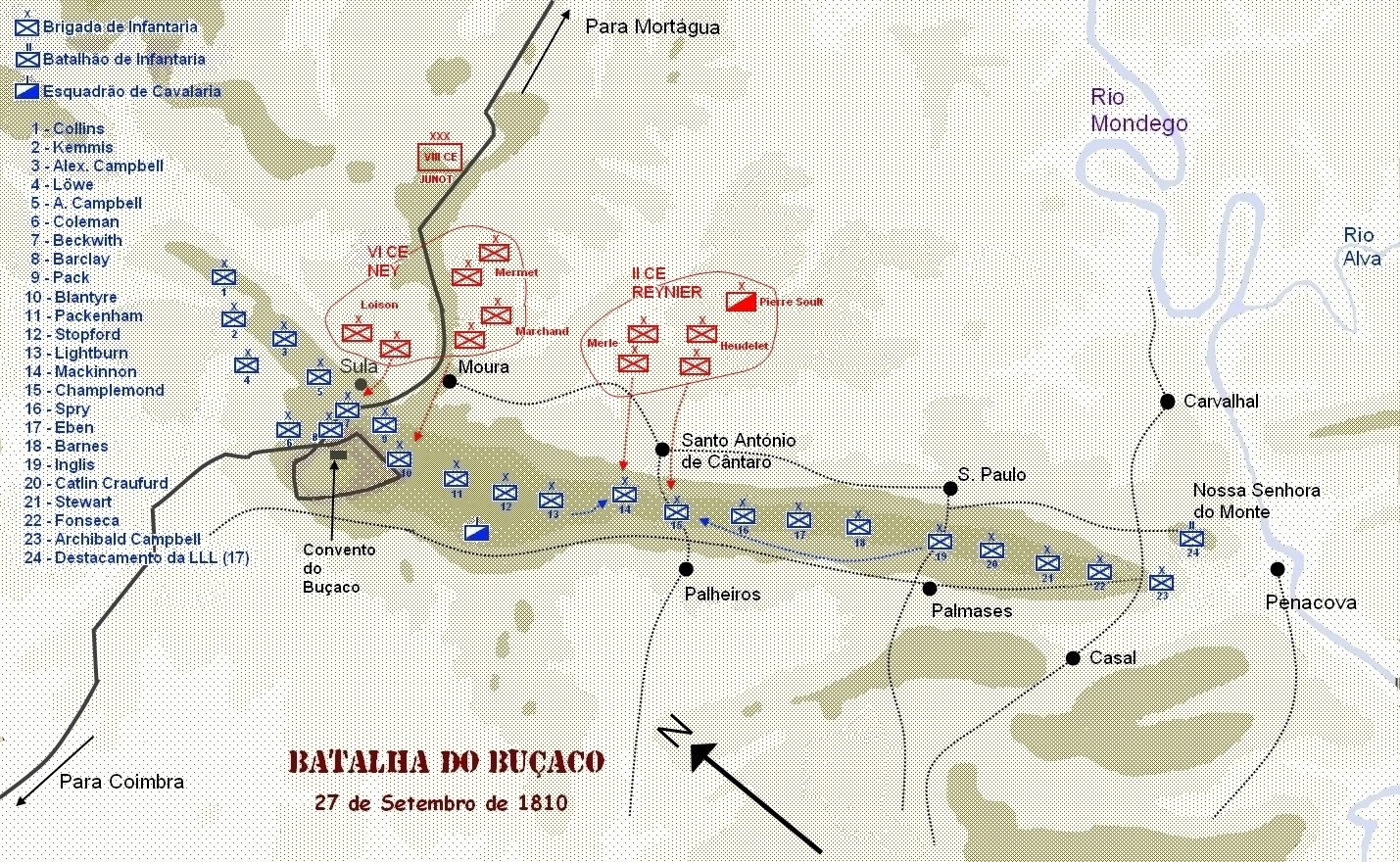
Map showing the locations of the units at the start of the Battle of Buçaco.

Bataille de Buçaco, 27 septembre 1810. Les 43e et 52e régiments d'infanterie légère britanniques attaquent les soldats français de la division Loison.

"The First French Invasion", by Roque Gameiro, in Quadros da História de Portugal ("Pictures of the History of Portugal", 1917).

Engraving representing the Battle of Buçaco - September 27, 1810 - published in London on June 1, 1815, by J. Jenkins, 48 Strand. There is in the Military Historical Archives, Lisbon, Portugal, and is identified with the code EN-AHM-FE-10-A7-MD-12.A

Charles Turner - No.2 Battle of Sierra de Basaco above St. Antonio de Cantaro - B1978.43.1025 - Yale Center for British Art (cropped)

British infantry deployed in line on the ridge at Bussaco during the Peninsular War. Successive campaigns in the Iberian Peninsula led to a continuous drain on French manpower.
Historische Übersicht
In der Schlacht bei Buçaco am 27. September 1810 besiegte ein britisch-portugiesisches Heer unter Wellington eine französische Armee unter Marschall André Masséna, die gekommen war, um Portugal zu erobern.
Fakten auf einen Blick
Briten & Portugiesen
- Befehlshaber: Lord Wellington
- Truppenstärke: ca. 52.000
- Verluste: ca. 1.250
Königreich Frankreich
- Befehlshaber: André Masséna
- Truppenstärke: ca. 65.000
- Verluste: ca. 4.500
Strategischer Kontext
Verzögerung des französischen Vormarsches auf Lissabon.
Weiterführende Literatur

Trafalgar: Great Battles and Sieges

Historische Orte
Die interaktive Karte erfordert die Zustimmung zu Drittanbieter-Cookies.