Operation Rosario

Izado del Pabellón Nacional en Casa de Gobierno de las Islas Malvinas, 1982. Inventario 345426

Izado de la bandera argentina tras el desembarco en las islas Malvinas.

Integrantes de la Infantería de Marina de la Armada Argentina en la Operación Rosario.

Argentine Marines during Operation Rosario. A Sea King can be seen on the background.

Argentine Marines during Operation Rosario. A Sea King can be seen on the background.

An amphibious vehicle patroling Port Stanley 1982

El capellán del Ejército Argentino conversa con un soldado en la entrada de la iglesia católica de la capital de las islas.

Contraalmirante Carlos Büsser; General de División Osvaldo García; Contraalmirante Gualter Allara.

Contraalmirante Carlos Büsser; General de División Osvaldo García; Contraalmirante Gualter Allara.

Contraalmirante Gualter Oscar Allara.

Soldiers from Argentina

Traslado del cuerpo del capitán Giachino.

El cuerpo del capitán Giachino trasladado en un Land Rover confiscado.

LVTP-7 o VAO (Vehículo Anfibio a Oruga) de la Armada Argentina en el desembarco en las islas Malvinas.

Un par de LVTP-7 o VAO (Vehículo Anfibio a Oruga) en el desembarco en las islas Malvinas.

Miembros de la Infantería de Marina de la Armada Argentina en custodia de un sector de Puerto Stanley tras el desembarco en las Malvinas, denominado Operación Rosario.

Tres policías británicos se retiran de sus puestos cuando son relevados por las autoridades argentinas, ante la mirada de los soldados.

El comandante de la Fuerza de Desembarco (GT-40.1), contraalmirante Carlos Büsser, en la ocupación de las Malvinas.

El jefe del Regimiento de Infantería 25, teniente coronel Mohamed Alí Seineldín, en el desembarco en las islas Malvinas.

Mural of 7 images about the Falklands War

National Aeronautics Museum of Argentina, Morón, Buenos Aires Province, Argentina. September 2023.
Operation Azul
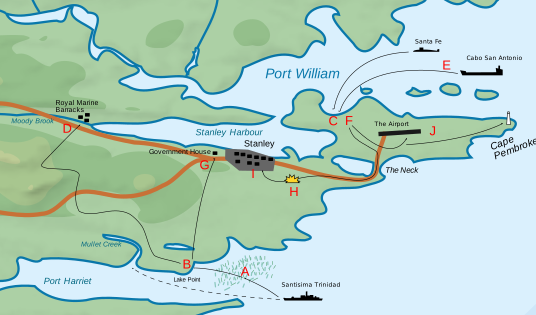
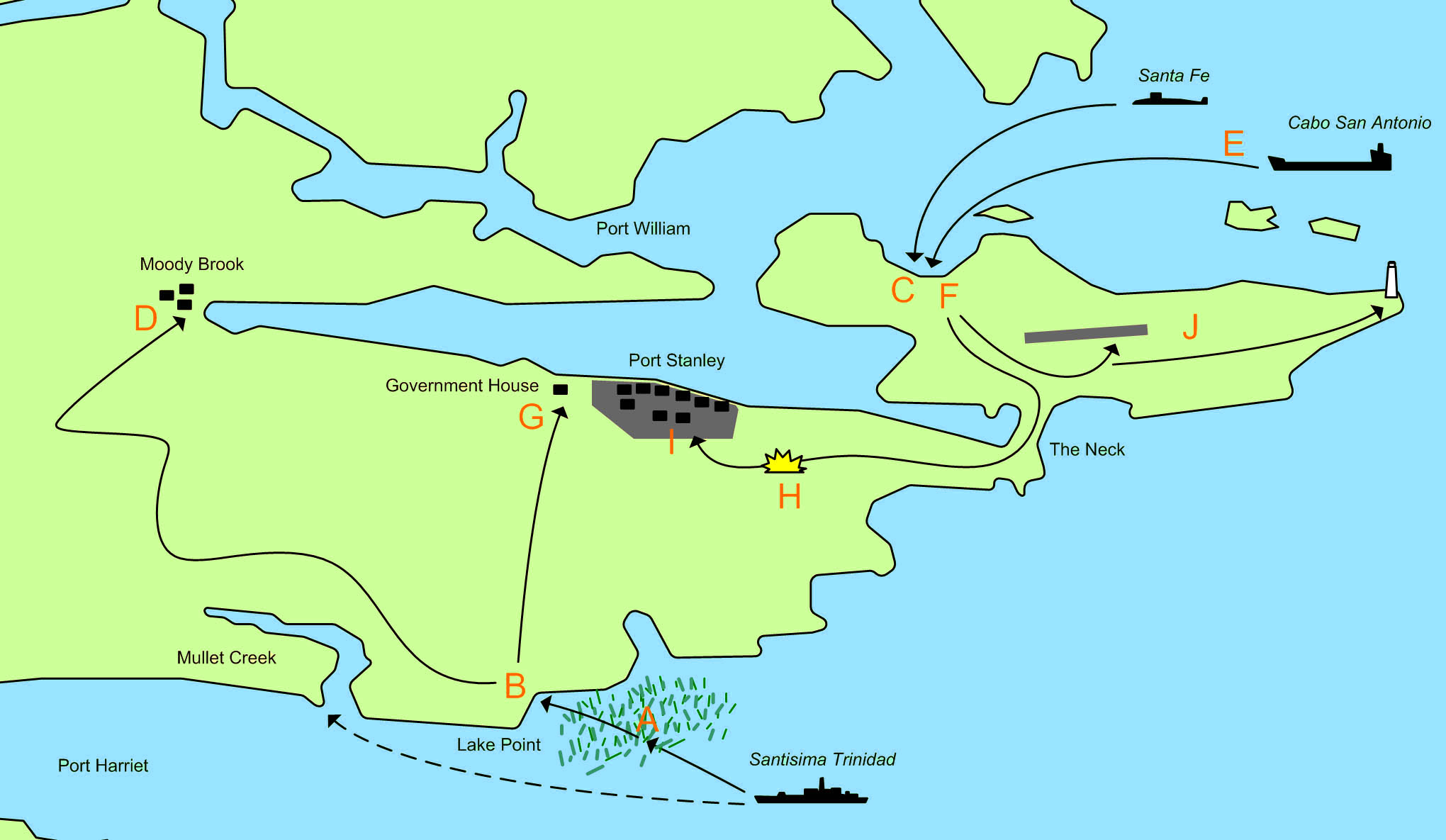
Based on a map in Martin Middlebrook's : The Fight For The Malvinas. The map showing the area of the Falkland Islands around Port Stanley and the actions of 1–2 April 1982 during the Invasion of the Falkland Islands. A. 21:30 1 April - The Type 42 destroyer Santisima Trinidad begins loading marines of the Amphibious Commando Company into 21 small inflatable motor boats. These set out for Mullet Creek at but sail too far north and are caught up in beds of Kelp, which cause problems for the boats. They decide to head for the nearest beach, which is near Lake Point. B. 23:00 1 April - The first group of 91 men lands on an unamed beach at Lake Point. The group splits into a smaller force commanded by Lieutenant-Commander Giachino who head towards Government House, and a larger force commanded by Lieutenant-Commander Sabarots who head towards Moody Brook Barracks. C. 04:30 2 April - A small advanced group from Buzos Tacticos is landed from the Submarine Santa Fe. D. 05:30 2 April - Lieutenant-Commander Sabarots force reaches and surrounds the Barracks. They throw grenades into the buildings and fire machine gun tracer over the buildings. They find the buildings are deserted. E. 06:00 2 April - 20 FMC Amtracs and several LARC 5 stores carrying vehicles are launched from Caba San Antionio. The force splits into 3 groups: A four Amtrac vanguard. Including one carrying the Army Platoon. The main force of 14 Amtracs. The second in command, a recovery Amtrac and LARC vehciles. F. 06:30 2 April - The first Amtracs land and meet no resistance. The Army platoon captures the deserted airport. G. 06:30 2 April - The 5 man Argentine force reaches Government House, where they are stopped by 31 Royal Marines, 11 armed Royal Navy men and 1 locals. Two Argentines are wounded (one would later die), and the remaining 3 are captured. H. 07:15 2 April - Having met no resistance, the Argentine Amtracs advance on Stanley, when they are ambushed from a house about 500 yards from the road. Royal Marines use rockets and machine gun fire. The Royal Marines fall back to Government House. One of the Amtracs is scarred by machine gun fire, and there is one minor injury. I. 08:00 2 April - The Argentine Amtrac force secures Port Stanley. J. The Army platoon begins clearing the runway and seizes the lighthouse.

Recopilación de imágenes durante la Guerra de las Malvinas

Roberto Benito Moya desde el balcón de la Casa Rosada el 2 de abril de 1982
Historische Übersicht
Argentinische Invasion und Besetzung von Stanley.
Fakten auf einen Blick
Argentinien
- Befehlshaber: Carlos Busser
- Truppenstärke: 600 Mann
- Verluste: 1
UK (Royal Marines)
- Befehlshaber: Mike Norman
- Truppenstärke: 68 Mann
- Verluste: 0
Strategischer Kontext
Auslöser des Konflikts durch argentinische Junta.
Weiterführende Literatur

Iron Curtain: The Crushing of Eastern Europe, 1944-1956

Der Eiserne Vorhang: Die Unterdrückung Osteuropas 1944–1956


Mao und seine verlorenen Kinder: Chinas Kulturrevolution

Maos Großer Hunger: Massenmord und Menschenexperiment in China
Historische Orte
Die interaktive Karte erfordert die Zustimmung zu Drittanbieter-Cookies.