Alle Schlachten

Schlacht am Rio de la Plata

1939 Südatlantik Seeschlacht

The German armored cruiser Admiral Graf Spee in flames after being scuttled in the River Plate Estuary off Montevideo, Uruguay.

The German armored cruiser Admiral Graf Spee in flames after being scuttled in the River Plate Estuary off Montevideo, Uruguay.

Author: Orginal link: http://www.iwmcollections.org.uk/media/images/Photographs/Image/A_000002.jpgLicense:PD
Source
Evolución de la batalla del Río de la Plata.

Evolución de la batalla del Río de la Plata.

Author: Battle of Graf Spee.svg: Deep silence derivative work: rowanwindwhistler (talk)License:CC-BY-SA-4.0
Source
Chart of the Battle of the River Plate

Chart of the Battle of the River Plate

Author: Deep silence From this mapLicense:CC-BY-SA-4.0
Source
Map show ship movements during the Battle of the River Plate on 13 December 1939; translated into Japanese by ja:User:Los688.

Map show ship movements during the Battle of the River Plate on 13 December 1939; translated into Japanese by ja:User:Los688.

Author: British GovernmentLicense:PD
Source
Map show ship movements during the Battle of the River Plate on 13 December 1939.
Map show ship movements during the Battle of the River Plate on 13 December 1939.

Author: British GovernmentLicense:PD
Source
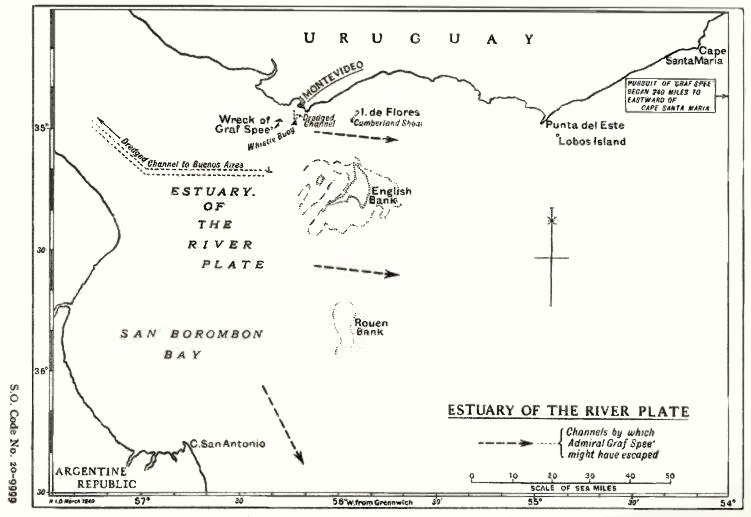
Map of the estuary of the River Plate showing possible exit channels available to the German heavy cruiser Admiral Graf Spee after the Battle of the River Plate in December 1939.

Map of the estuary of the River Plate showing possible exit channels available to the German heavy cruiser Admiral Graf Spee after the Battle of the River Plate in December 1939.

Author: British GovernmentLicense:PD
Source
A monument in honor of Veterans that served in World War II. Unveiled on the 70th anniversary of the Battle of the River Plate

A monument in honor of Veterans that served in World War II. Unveiled on the 70th anniversary of the Battle of the River Plate

Author: Boycie-NLicense:CC-BY-SA-4.0
Source
Omschrijving: Eerste zeeslag Tweede Wereldoorlog: slag bij Montevideo, 1939. Schade die het Duitse pantserschip "Admiral Graf von Spee" opliep, onder meer door het geschut van de Engelse kruiser HMS "Exeter". Granaatinslagen in de boeg.

Omschrijving: Eerste zeeslag Tweede Wereldoorlog: slag bij Montevideo, 1939. Schade die het Duitse pantserschip "Admiral Graf von Spee" opliep, onder meer door het geschut van de Engelse kruiser HMS "Exeter". Granaatinslagen in de boeg.

Author: Unknown authorUnknown authorLicense:PD
Source
Omschrijving: Eerste zeeslag Tweede Wereldoorlog: slag bij Montevideo, 1939. Schade die het Duitse pantserschip "Admiral Graf von Spee" opliep, onder meer door het geschut van de Engelse kruiser HMS "Exeter".

Omschrijving: Eerste zeeslag Tweede Wereldoorlog: slag bij Montevideo, 1939. Schade die het Duitse pantserschip "Admiral Graf von Spee" opliep, onder meer door het geschut van de Engelse kruiser HMS "Exeter".

Author: Unknown authorUnknown authorLicense:PD
Source
Omschrijving: Eerste zeeslag Tweede Wereldoorlog: slag bij Montevideo, 1939. Schade die het Duitse pantserschip "Admiral Graf von Spee" opliep, onder meer door het geschut van de Engelse kruiser HMS "Exeter".

Omschrijving: Eerste zeeslag Tweede Wereldoorlog: slag bij Montevideo, 1939. Schade die het Duitse pantserschip "Admiral Graf von Spee" opliep, onder meer door het geschut van de Engelse kruiser HMS "Exeter".

Author: Unknown authorUnknown authorLicense:PD
Source
Omschrijving: Eerste zeeslag Tweede Wereldoorlog: zeeslag bij Montevideo, 1939. Schade van het Duitse pantserschip "Admiral Graf von Spee", opgelopen door het geschut van de Engelse kruiser "Exeter". Granaatinslagen in de brug.

Omschrijving: Eerste zeeslag Tweede Wereldoorlog: zeeslag bij Montevideo, 1939. Schade van het Duitse pantserschip "Admiral Graf von Spee", opgelopen door het geschut van de Engelse kruiser "Exeter". Granaatinslagen in de brug.

Author: Unknown authorUnknown authorLicense:PD
Source
Omschrijving: Eerste zeeslag Tweede Wereldoorlog: zeeslag bij Montevideo. Kapitein Langsdorff van het Duitse pantserschip "Admiral Graf von Spee" in gesprek met de Duitse gezant Langmann op de kade van Montevideo, 1939.
Omschrijving: Eerste zeeslag Tweede Wereldoorlog: zeeslag bij Montevideo. Kapitein Langsdorff van het Duitse pantserschip "Admiral Graf von Spee" in gesprek met de Duitse gezant Langmann op de kade van Montevideo, 1939.

Author: Unknown authorUnknown authorLicense:PD
Source
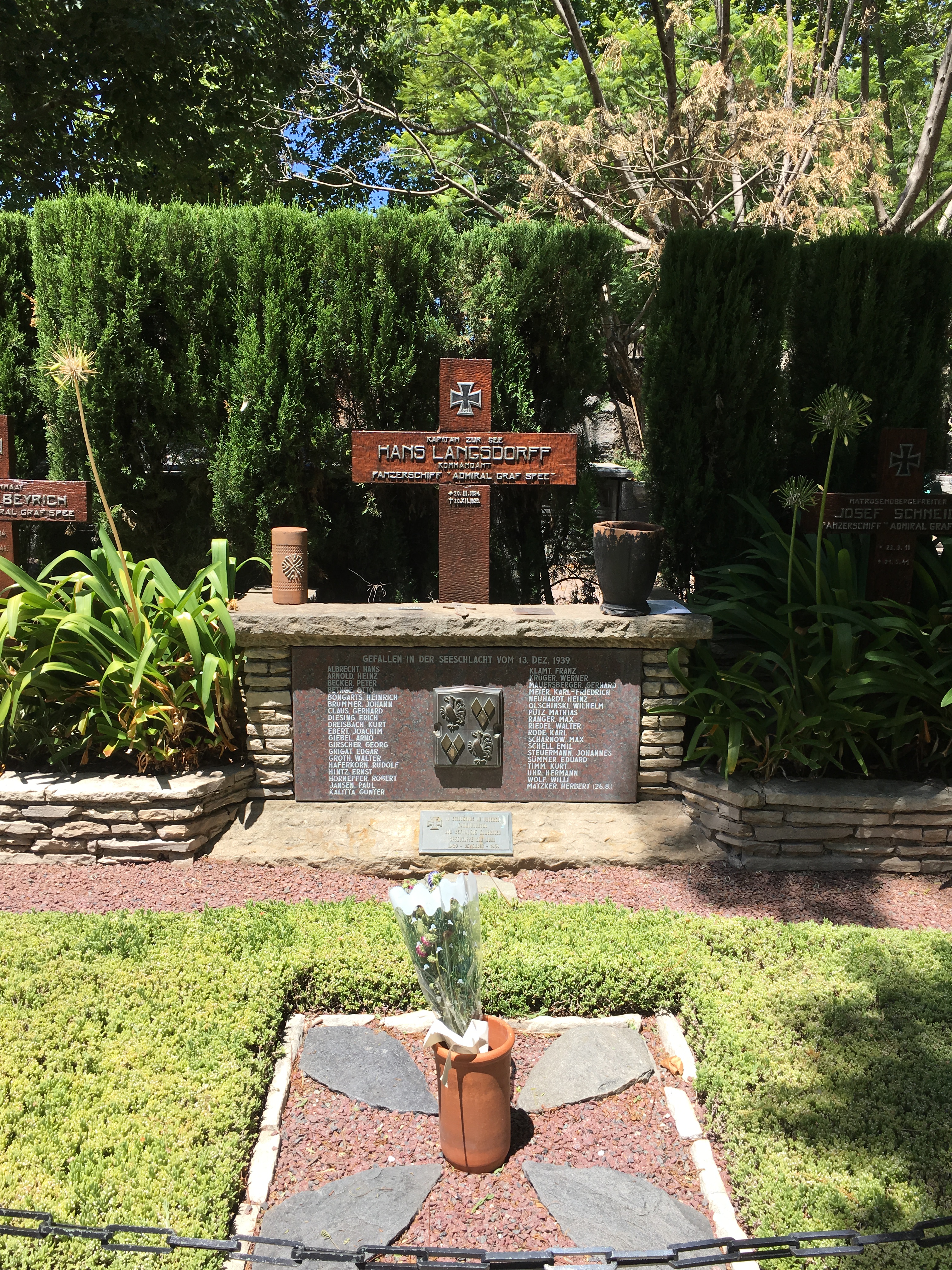
The grave of Captain Hans Langsdorff

The grave of Captain Hans Langsdorff

Author: Harvey MilliganLicense:CC-BY-SA-4.0
Source
Part of the British Cemetery, Montevideo. In the foreground on the left is the grave of sailors from HMS Achilles, including the telegraphists Neville Milburn and Frank Stennett, killed in the Battle of the River Plate in 1939.

Part of the British Cemetery, Montevideo. In the foreground on the left is the grave of sailors from HMS Achilles, including the telegraphists Neville Milburn and Frank Stennett, killed in the Battle of the River Plate in 1939.

Author: HegsterLicense:CC-BY-SA-4.0
Source
Hans Langsdorff, German ministers and the ship's crew at the burial of the German sailors killed on the Graf Spee. Rio de la Plata in December 1939. See also image from Getty

Hans Langsdorff, German ministers and the ship's crew at the burial of the German sailors killed on the Graf Spee. Rio de la Plata in December 1939. See also image from Getty

Author: Unknown authorUnknown authorLicense:PD
Source
Facsimile copy of the sheet from a naval signal pad on which Commodore H H Harwood drew the possible future movements of a German pocket battleship (later known to be the Admiral Graf Spee, with calculations for interception, after he received news of the attack on the SS Doric Star in the South Atlantic on 2 December 1939;  together with two captions added by the Imperial War Museum explaining the document.

Facsimile copy of the sheet from a naval signal pad on which Commodore H H Harwood drew the possible future movements of a German pocket battleship (later known to be the Admiral Graf Spee, with calculations for interception, after he received news of the attack on the SS Doric Star in the South Atlantic on 2 December 1939; together with two captions added by the Imperial War Museum explaining the document.

Author: Commodore H H HarwoodLicense:PD
Source
The cruiser HMS ACHILLES seen from HMS AJAX at the Battle of the River Plate.

The cruiser HMS ACHILLES seen from HMS AJAX at the Battle of the River Plate.

Author: Royal Navy official photographerLicense:PD
Source
On 23 February 1940 the cruiser HMS Achilles returned to New Zealand after its involvement in the Battle of River Plate. The Achilles was a Leander-class light cruiser, originally constructed by the Royal Navy. It was notable for being the first Royal Navy cruiser to have fire control radar, with the installation of the New Zealand-made SS1 fire-control radar in June 1940. After Second World War service in the Atlantic and Pacific, she was returned to the Royal Navy, then was sold to the Indian Navy in 1948 and recommissioned as INS Delhi. 
The Battle of River Plate was the first naval battle in the Second World War and the only episode of the war to take place in South America. It was the Allies’ first naval victory of the Second World War, and also the first time the current New Zealand flag was flown in battle. The crew of the Achilles during the battle was around 60 per cent New Zealanders. As nzhistory.net notes: ‘The crew of the Achilles were hailed as heroes when they returned to New Zealand in February 1940. Parades in Auckland and Wellington (on 2 April) drew huge crowds’
This painting by Frank Norton is part of the National Collection of War Art held by Archives New Zealand. The National Collection of War Art is composed of about 1,500 artworks, including portraits, battle scenes, landscapes and abstracts, depicting those who served New Zealand in times of war, and the arenas in which they served. It includes both official pieces of war art, by artists formally commissioned by the New Zealand government, and other unofficial art works that were acquired by or donated to the collection. The majority of artworks in the collection depict World War One and World War Two, however official war art continues to be commissioned by the New Zealand Defence Force up to the present day.
Archives reference: AAAC 898 584/ NCWA Q223
www.archway.archives.govt.nz/ViewFullItem.do?code=2249846...
With thanks to nzhistory.net: '100,000 welcome home HMS Achilles crew', URL: achilles-crew www.nzhistory.net.nz/page/100%2C000-welcome-home-hms-%26l... (Ministry for Culture and Heritage),
For updates on our On This Day series and news from Archives New Zealand, follow us on Twitter twitter.com/ArchivesNZ

Material from Archives New Zealand

On 23 February 1940 the cruiser HMS Achilles returned to New Zealand after its involvement in the Battle of River Plate. The Achilles was a Leander-class light cruiser, originally constructed by the Royal Navy. It was notable for being the first Royal Navy cruiser to have fire control radar, with the installation of the New Zealand-made SS1 fire-control radar in June 1940. After Second World War service in the Atlantic and Pacific, she was returned to the Royal Navy, then was sold to the Indian Navy in 1948 and recommissioned as INS Delhi. The Battle of River Plate was the first naval battle in the Second World War and the only episode of the war to take place in South America. It was the Allies’ first naval victory of the Second World War, and also the first time the current New Zealand flag was flown in battle. The crew of the Achilles during the battle was around 60 per cent New Zealanders. As nzhistory.net notes: ‘The crew of the Achilles were hailed as heroes when they returned to New Zealand in February 1940. Parades in Auckland and Wellington (on 2 April) drew huge crowds’ This painting by Frank Norton is part of the National Collection of War Art held by Archives New Zealand. The National Collection of War Art is composed of about 1,500 artworks, including portraits, battle scenes, landscapes and abstracts, depicting those who served New Zealand in times of war, and the arenas in which they served. It includes both official pieces of war art, by artists formally commissioned by the New Zealand government, and other unofficial art works that were acquired by or donated to the collection. The majority of artworks in the collection depict World War One and World War Two, however official war art continues to be commissioned by the New Zealand Defence Force up to the present day. Archives reference: AAAC 898 584/ NCWA Q223 www.archway.archives.govt.nz/ViewFullItem.do?code=2249846... With thanks to nzhistory.net: '100,000 welcome home HMS Achilles crew', URL: achilles-crew www.nzhistory.net.nz/page/100%2C000-welcome-home-hms-%26l... (Ministry for Culture and Heritage), For updates on our On This Day series and news from Archives New Zealand, follow us on Twitter twitter.com/ArchivesNZ Material from Archives New Zealand

Author: Archives New Zealand from New ZealandLicense:CC-BY-SA-4.0
Source
Watercolor depicting the cruisers HMS Exeter (foreground) and HMNZS Achilles (right center background) in action with the German armored ship Admiral Graf Spee (right background).


Original caption:  "Photo # NH 86397-KN   Battle of the River Plate, 13 Dec. 1939, by E. Tufnell"

Watercolor depicting the cruisers HMS Exeter (foreground) and HMNZS Achilles (right center background) in action with the German armored ship Admiral Graf Spee (right background). Original caption: "Photo # NH 86397-KN Battle of the River Plate, 13 Dec. 1939, by E. Tufnell"

Author: Cdr Eric Erskine Campbell Tufnell RN (Retired)License:PD
Source
HMNZS Achilles.

HMNZS Achilles.

Author: Unknown authorUnknown authorLicense:PD
Source
The Archers Crew - 1956 - The Battle of the River Plate - including Michael Powell (centre) and Charles Orme (far right, 4th row, 2nd in)

The Archers Crew - 1956 - The Battle of the River Plate - including Michael Powell (centre) and Charles Orme (far right, 4th row, 2nd in)

Author: Mr Rick BlaineLicense:CC-BY-SA-4.0
Source
Omschrijving: Tweede Wereldoorlog, zeeoorlog. Na de zeeslag bij Montevideo (eerste zeeslag van de oorlog) toespraak van kapitein Langsdorff (in de cirkel) van het Duitse pantserschip "Admiral Graf von Spee" tot de bemanning van het schip. Hij maakt hierin toespelingen op zijn naderende zelfdoding. Uruguay, Montevideo, 1939.

Omschrijving: Tweede Wereldoorlog, zeeoorlog. Na de zeeslag bij Montevideo (eerste zeeslag van de oorlog) toespraak van kapitein Langsdorff (in de cirkel) van het Duitse pantserschip "Admiral Graf von Spee" tot de bemanning van het schip. Hij maakt hierin toespelingen op zijn naderende zelfdoding. Uruguay, Montevideo, 1939.

Author: Unknown authorUnknown authorLicense:PD
Source

Historische Übersicht

Jagd auf das Panzerschiff Admiral Graf Spee im Südatlantik.

Fakten auf einen Blick

Ergebnis:Britischer Sieg.

Royal Navy

  • Befehlshaber: Henry Harwood
  • Truppenstärke: 3 Kreuzer
  • Verluste: 72 Tote

Deutsches Reich (Marine)

  • Befehlshaber: Hans Langsdorff
  • Truppenstärke: 1 Panzerschiff
  • Verluste: 36 Tote (Selbstvers.)

Strategischer Kontext

Ausschaltung deutscher Überwasser-Handelsstörer.

Weiterführende Literatur

Cover of Berlin: The Downfall 1945

Berlin: The Downfall 1945

Antony Beevor

SachbuchZweiter WeltkriegWW2-Ostfront

Englisch
Weltkriegs-Ära
Cover of Gulag: A History

Gulag: A History

Sachbuch20. JahrhundertSowjetunion

Englisch
Weltkriegs-Ära
Cover of Red Famine: Stalin's War on Ukraine

Red Famine: Stalin's War on Ukraine

Sachbuch20. JahrhundertSowjetunion

Englisch
Weltkriegs-Ära
Cover of Stalingrad

Stalingrad

Antony Beevor

Zweiter WeltkriegBerichtWW2-Ostfront

Englisch
Weltkriegs-Ära
Cover of The Gulag Archipelago

The Gulag Archipelago

Sachbuch20. JahrhundertSowjetunion

Englisch
Weltkriegs-Ära
Cover of Der Gulag

Der Gulag

Sachbuch20. JahrhundertSowjetunion

Deutsch
Weltkriegs-Ära
Cover of Die Schlacht um Berlin und das Ende des Dritten Reichs 1945

Die Schlacht um Berlin und das Ende des Dritten Reichs 1945

SachbuchZweiter WeltkriegWW2-Ostfront

Deutsch
Weltkriegs-Ära
Cover of Hunde, wollt ihr ewig leben: ein Stalingrad-Roman

Hunde, wollt ihr ewig leben: ein Stalingrad-Roman

Zweiter WeltkriegWW2-OstfrontHistorischer Roman

Deutsch
Weltkriegs-Ära
Cover of Roter Hunger: Stalins Krieg gegen die Ukraine

Roter Hunger: Stalins Krieg gegen die Ukraine

Sachbuch20. JahrhundertSowjetunion

Deutsch
Weltkriegs-Ära
Cover of So weit die Füße tragen

So weit die Füße tragen

20. JahrhundertSowjetunionGulag

Deutsch
Weltkriegs-Ära
Cover of Söldner ohne Sold: Die deutschen Freikorps 1918–1923

Söldner ohne Sold: Die deutschen Freikorps 1918–1923

Bericht20. JahrhundertDeutsche Geschichte

Deutsch
Weltkriegs-Ära
Cover of Vom Massensturm zur Stoßtrupptaktik: Die deutsche Landkriegtaktik im Spiegel von Dienstvorschriften und Publizistik 1906 bis 1918

Vom Massensturm zur Stoßtrupptaktik: Die deutsche Landkriegtaktik im Spiegel von Dienstvorschriften und Publizistik 1906 bis 1918

Sachbuch20. JahrhundertDeutsche Geschichte

Deutsch
Weltkriegs-Ära
Cover of Wir Wehr-Wölfe: Erinnerungen eines Freikorps-Führers

Wir Wehr-Wölfe: Erinnerungen eines Freikorps-Führers

Bericht20. JahrhundertDeutsche Geschichte

Deutsch
Weltkriegs-Ära
Cover of Zweiter Weltkrieg Erlebnisbericht Apokalypse Stalingrad: Untergang der 6. Armee 1942-1943

Zweiter Weltkrieg Erlebnisbericht Apokalypse Stalingrad: Untergang der 6. Armee 1942-1943

Walter Mönch

SachbuchZweiter WeltkriegWW2-Ostfront

Deutsch
Weltkriegs-Ära
Rise And Fall Of The Third Reich

Rise And Fall Of The Third Reich

William Shirer

20. JahrhundertDeutsche GeschichteNationalsozialismus

Weltkriegs-Ära

Historische Orte

Die interaktive Karte erfordert die Zustimmung zu Drittanbieter-Cookies.