Alle Schlachten

Brücke von Remagen

1945 Rheinland-Pfalz Brückenkopf

CROSS THE RHINE WITH DRY FEET COURTESY OF 9TH ARM'D DIV-LUDENDORFF BRIDGE POSTED SIGN

CROSS THE RHINE WITH DRY FEET COURTESY OF 9TH ARM'D DIV-LUDENDORFF BRIDGE POSTED SIGN

Author: US ArmyLicense:PD
Source
Sign erected by the 291st Engineer Combat Battalion declaring their bridge the first over the Rhine at Remagen

Sign erected by the 291st Engineer Combat Battalion declaring their bridge the first over the Rhine at Remagen

Author: Unknown authorUnknown authorLicense:PD
Source
WW2-USACE-291stECB-remagen-treadway-bridge

WW2-USACE-291stECB-remagen-treadway-bridge

Author: US Army 1st Army Signal Corp 165 S/3 AtchisonLicense:PD
Source
Troops of the 47th Infantry Regiment, attached to the 9th Infantry Division, march through Remagen to cross the Ludendorff Bridge on March 9, 1945. They were assigned to a task force of Combat Command B of the 9th Armored Division, consisting in part of the 47th Infantry Regiment, 27th Armored Infantry Battalion and the 14th Armored Battalion.

Troops of the 47th Infantry Regiment, attached to the 9th Infantry Division, march through Remagen to cross the Ludendorff Bridge on March 9, 1945. They were assigned to a task force of Combat Command B of the 9th Armored Division, consisting in part of the 47th Infantry Regiment, 27th Armored Infantry Battalion and the 14th Armored Battalion.

Author: U.S. Army (NARA)License:PD
Source
Pfc. Richard Schrame, with his quad-.50 caliber weapon, scans the skies for enemy aircraft near the Remagen bridge.

Pfc. Richard Schrame, with his quad-.50 caliber weapon, scans the skies for enemy aircraft near the Remagen bridge.

Author: United States ArmyLicense:PD
Source
For documentary purposes the German Federal Archive often retained the original image captions, which may be erroneous, biased, obsolete or politically extreme. Remagen, beschädigte Brücke Brücke von Remagen, zwischen 8.3. und 10.3.1945

For documentary purposes the German Federal Archive often retained the original image captions, which may be erroneous, biased, obsolete or politically extreme. Remagen, beschädigte Brücke Brücke von Remagen, zwischen 8.3. und 10.3.1945

Author: Helmut J. WolfLicense:CC-BY-SA-4.0
Source
Photographer not credited.

Photo Source: U.S. National Archives. Digitized by Signal Corps Archive.

Photographer not credited. Photo Source: U.S. National Archives. Digitized by Signal Corps Archive.

Author: Signal Corps Archive from United StatesLicense:PD
Source
M-2 steel treadway bridge spanning the 1032 ft breadth of the Rhine was built in 32 hours under heavy enemy fire by the 291st Engineer Combat Battalion supported by the 988 and 998 Treadway Bridge Companies.

M-2 steel treadway bridge spanning the 1032 ft breadth of the Rhine was built in 32 hours under heavy enemy fire by the 291st Engineer Combat Battalion supported by the 988 and 998 Treadway Bridge Companies.

Author: U.S. ArmyLicense:PD
Source
German bombs fall near the Ludendorff Bridge after it was captured by the U.S. Army

German bombs fall near the Ludendorff Bridge after it was captured by the U.S. Army

Author: U.S. Army Signal CorpsLicense:PD
Source
Gravestone of 4 officers who refused to blast the Ludendorff-Bridge in Remagen. They were executed by German military court in March 1945.

Gravestone of 4 officers who refused to blast the Ludendorff-Bridge in Remagen. They were executed by German military court in March 1945.

Author: WsombeckLicense:CC-BY-SA-4.0
Source
U.S. troops crossing the Rhine near Nierstein on 23 March 1945 in a LCVP.
U.S. troops crossing the Rhine near Nierstein on 23 March 1945 in a LCVP.

Author: U.S. Army Signal CorpsLicense:PD
Source
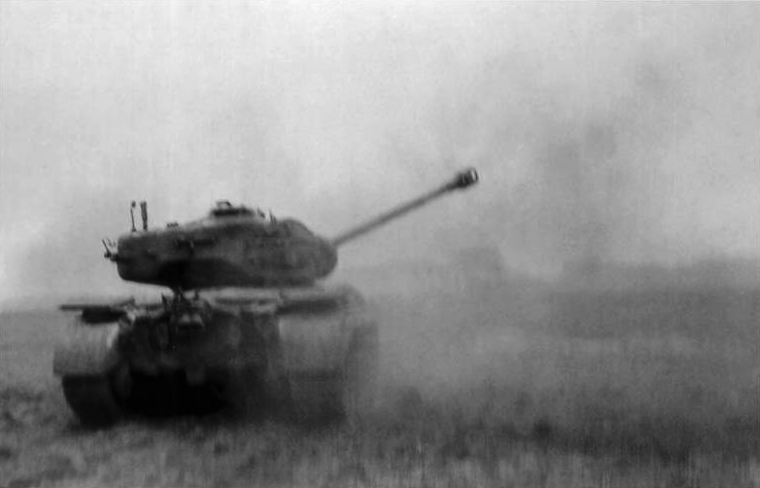
An M26 Pershing fires at German positions across the Rhine on March 7, 1945.

An M26 Pershing fires at German positions across the Rhine on March 7, 1945.

Author: U.S. Signal CorpLicense:PD
Source
An M26 Pershing T26E3 of A Company, 14th Tank Battalion, is transported aboard a pontoon ferry across the Rhine on March 12, 1945 built by the First Engineer Heavy Pontoon Battalion.

An M26 Pershing T26E3 of A Company, 14th Tank Battalion, is transported aboard a pontoon ferry across the Rhine on March 12, 1945 built by the First Engineer Heavy Pontoon Battalion.

Author: U.S. Army, National Archives and Records AdministrationLicense:PD
Source
Ludendorff Bridge and Erpeler Ley tunnel at Erpel (eastern side of the Rhine) – First U.S. Army men and equipment pour across the Remagen Bridge; two knocked out jeeps in foreground. Germany, 11 March 1945.

Ludendorff Bridge and Erpeler Ley tunnel at Erpel (eastern side of the Rhine) – First U.S. Army men and equipment pour across the Remagen Bridge; two knocked out jeeps in foreground. Germany, 11 March 1945.

Author: Camera Operator: Sgt. William SpangleLicense:PD
Source
American GIs pass trucks destroyed by German artillery on March 11, 1945 near Remagen, Germany.

American GIs pass trucks destroyed by German artillery on March 11, 1945 near Remagen, Germany.

Author: U.S. ArmyLicense:PD
Source
The Rozich Blackburn Tompkins Bridge, a pontoon bridge built by the 51st Combat Engineers across the Rhine, upstream from the Ludendorff Bridge at Remagen, between Kripp and Linz.

The Rozich Blackburn Tompkins Bridge, a pontoon bridge built by the 51st Combat Engineers across the Rhine, upstream from the Ludendorff Bridge at Remagen, between Kripp and Linz.

Author: U.S ArmyLicense:PD
Source
Poster printed by the US Army commemorating the capturing of the Ludendorff Bridge at Remagen.  The official description is:
"The Remagen Bridgehead - 7 March 1945"
Department of the Army Poster 21-32 

Here, on the Ludendorf Bridge crossing the Rhine at Remagen, Combat Command B, 9th Armored Division -- headed by the 27th Armored Infantry Battalion -- with "superb skill, daring and esprit de corps" successfully effected the first bridgehead across Germany's formidable river barrier and so contributed decisively to the defeat of the enemy. The 27th Battalion reached Remagen, found the bridge intact but mined for demolition. Although its destruction was imminent, without hesitation and in face of heavy fire the infantrymen rushed across the structure, and with energy and skill seized the surrounding high ground. The entire episode illustrates that high degree of initiative, leadership and gallantry toward which all armies strive but too rarely attain, and won for the Combat Command the Distinguished Unit Citation.

Poster printed by the US Army commemorating the capturing of the Ludendorff Bridge at Remagen. The official description is: "The Remagen Bridgehead - 7 March 1945" Department of the Army Poster 21-32 Here, on the Ludendorf Bridge crossing the Rhine at Remagen, Combat Command B, 9th Armored Division -- headed by the 27th Armored Infantry Battalion -- with "superb skill, daring and esprit de corps" successfully effected the first bridgehead across Germany's formidable river barrier and so contributed decisively to the defeat of the enemy. The 27th Battalion reached Remagen, found the bridge intact but mined for demolition. Although its destruction was imminent, without hesitation and in face of heavy fire the infantrymen rushed across the structure, and with energy and skill seized the surrounding high ground. The entire episode illustrates that high degree of initiative, leadership and gallantry toward which all armies strive but too rarely attain, and won for the Combat Command the Distinguished Unit Citation.

Author: US ArmyLicense:PD
Source
"The Remagen Bridgehead 7-24 March 1945" by H.C. Brewer Jr., from MacDonald, Charles B. (1973). US Army in WW II: The Last Offensive (CMH Pub 7-9-1). Washington D.C.: Center for Military History, Government Printing Office.

"The Remagen Bridgehead 7-24 March 1945" by H.C. Brewer Jr., from MacDonald, Charles B. (1973). US Army in WW II: The Last Offensive (CMH Pub 7-9-1). Washington D.C.: Center for Military History, Government Printing Office.

Author: U.S. ArmyLicense:PD
Source
A welder from the 1058th Bridge Construction and Repair Group repairs the Ludendorff Bridge after it was captured on 7 March 1945.

A welder from the 1058th Bridge Construction and Repair Group repairs the Ludendorff Bridge after it was captured on 7 March 1945.

Author: U.S. Army Signal CorpLicense:PD
Source

Historische Übersicht

Überraschende Einnahme der Ludendorff-Brücke über den Rhein.

Fakten auf einen Blick

Ergebnis:Allierter Sieg.

US 5. Armee

  • Befehlshaber: Courtney Hodges
  • Truppenstärke: ca. 10.000
  • Verluste: gering

Wehrmacht

  • Befehlshaber: Otto Hitzfeld
  • Truppenstärke: ca. 1.000
  • Verluste: hoch

Strategischer Kontext

Erster alliierter Übergang über den Rhein.

Weiterführende Literatur

Cover of Berlin: The Downfall 1945

Berlin: The Downfall 1945

Antony Beevor

SachbuchZweiter WeltkriegWW2-Ostfront

Englisch
Weltkriegs-Ära
Cover of Gulag: A History

Gulag: A History

Sachbuch20. JahrhundertSowjetunion

Englisch
Weltkriegs-Ära
Cover of Red Famine: Stalin's War on Ukraine

Red Famine: Stalin's War on Ukraine

Sachbuch20. JahrhundertSowjetunion

Englisch
Weltkriegs-Ära
Cover of Stalingrad

Stalingrad

Antony Beevor

Zweiter WeltkriegBerichtWW2-Ostfront

Englisch
Weltkriegs-Ära
Cover of The Gulag Archipelago

The Gulag Archipelago

Sachbuch20. JahrhundertSowjetunion

Englisch
Weltkriegs-Ära
Cover of Der Gulag

Der Gulag

Sachbuch20. JahrhundertSowjetunion

Deutsch
Weltkriegs-Ära
Cover of Die Schlacht um Berlin und das Ende des Dritten Reichs 1945

Die Schlacht um Berlin und das Ende des Dritten Reichs 1945

SachbuchZweiter WeltkriegWW2-Ostfront

Deutsch
Weltkriegs-Ära
Cover of Hunde, wollt ihr ewig leben: ein Stalingrad-Roman

Hunde, wollt ihr ewig leben: ein Stalingrad-Roman

Zweiter WeltkriegWW2-OstfrontHistorischer Roman

Deutsch
Weltkriegs-Ära
Cover of Roter Hunger: Stalins Krieg gegen die Ukraine

Roter Hunger: Stalins Krieg gegen die Ukraine

Sachbuch20. JahrhundertSowjetunion

Deutsch
Weltkriegs-Ära
Cover of So weit die Füße tragen

So weit die Füße tragen

20. JahrhundertSowjetunionGulag

Deutsch
Weltkriegs-Ära
Cover of Söldner ohne Sold: Die deutschen Freikorps 1918–1923

Söldner ohne Sold: Die deutschen Freikorps 1918–1923

Bericht20. JahrhundertDeutsche Geschichte

Deutsch
Weltkriegs-Ära
Cover of Vom Massensturm zur Stoßtrupptaktik: Die deutsche Landkriegtaktik im Spiegel von Dienstvorschriften und Publizistik 1906 bis 1918

Vom Massensturm zur Stoßtrupptaktik: Die deutsche Landkriegtaktik im Spiegel von Dienstvorschriften und Publizistik 1906 bis 1918

Sachbuch20. JahrhundertDeutsche Geschichte

Deutsch
Weltkriegs-Ära
Cover of Wir Wehr-Wölfe: Erinnerungen eines Freikorps-Führers

Wir Wehr-Wölfe: Erinnerungen eines Freikorps-Führers

Bericht20. JahrhundertDeutsche Geschichte

Deutsch
Weltkriegs-Ära
Cover of Zweiter Weltkrieg Erlebnisbericht Apokalypse Stalingrad: Untergang der 6. Armee 1942-1943

Zweiter Weltkrieg Erlebnisbericht Apokalypse Stalingrad: Untergang der 6. Armee 1942-1943

Walter Mönch

SachbuchZweiter WeltkriegWW2-Ostfront

Deutsch
Weltkriegs-Ära
Rise And Fall Of The Third Reich

Rise And Fall Of The Third Reich

William Shirer

20. JahrhundertDeutsche GeschichteNationalsozialismus

Weltkriegs-Ära

Historische Orte

Die interaktive Karte erfordert die Zustimmung zu Drittanbieter-Cookies.