Schlacht um Monte Cassino

74th anniversary of the end of World War II in Europe. Celebrations in Warsaw in Poland.

The ruins of Cassino, May 1944: a wrecked Sherman tank and Bailey bridge in the foreground, with Monastery Ridge and Castle Hill in the background. View of Cassino after heavy bombardment showing a knocked out Sherman tank by a Bailey bridge in the foreground with Monastery Ridge and Castle Hill in the background.

1944 Chapin map of the Battle of Monte Cassino in Italy during World War II for TIME Magazine

Dolinka Pamięci przy kościele św. Jana Pawła II w Warszawie-Wesołej.

2nd Moroccan Infantry Division 1944 belvedere

A British Sherman tank and jeep of 4th Armoured Brigade entering the ruins of Cassino, Italy, 18 May 1944. A Sherman tank and jeep of the 4th Brigade entering the ruins of Cassino. The monastery of Cassino had formed the focal point of the German Gustav Line which they had successfully defended since November 1943. The fourth offensive led by Polish and British troops secured Cassino for the Allies and caused the Germans to retreat north of Rome, which was then declared an 'open city'.

A Sherman tank of 19th Armoured Regiment, 4th New Zealand Armoured Brigade supporting infantry of 6th NZ Infantry Brigade, during a reconstruction of the action at Cassino, Italy, 8 April 1944. A Sherman tank of 19th Armoured Regiment, 4th New Zealand Armoured Brigade supports infantry of 24th Battalion, 6th NZ Infantry Brigade, during a reconstruction of recent action in Cassino, 8 April 1944.

A view looking towards Cassino, Italy, 17 March 1944. A view looking towards Cassino, 17 March 1944.

An RAMC medical orderly makes his way forward under cover of the Red Cross flag to recover a casualty during fighting at Cassino, 24 March 1944. The Medical Chain of Evacuation: An RAMC orderly makes his way forward under cover of the Red Cross flag to recover a casualty during fighting at Cassino.
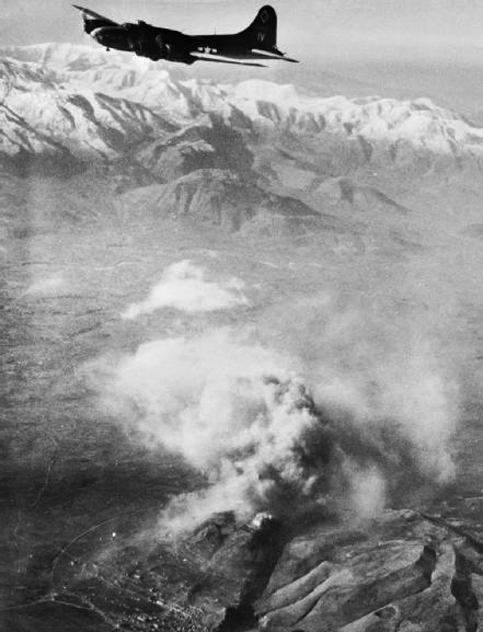
Flying Fortress over the Monte Cassino

IWM caption : THE BATTLE OF CASSINO, JANUARY-MAY 1944. The Commander of the Indian and New Zealand Divisions at Cassino, Lieutenant General Sir Bernard Freyberg VC. Freyberg also commanded the British and Commonwealth troops on Crete.

A 4.2-inch mortar of 'S' Troop, 307th Battery, 99th Light Anti-Aircraft Regiment, in action with the mortar for the first time, at Cassino, Italy.

British and South African soldiers hold up a Nazi trophy flag while combat engineers on bulldozers clear a path through the debris of the bombed out city of Cassino in 1944. ww2colorfarbe.blogspot.com: British and South African soldiers show off a prize, a swastika Nazi flag, after finally conquering Monte Cassino, 18 May 1944. By May 1944 the historic Benedictine Abbey of Monte Cassino had been reduced to rubble. As part of Operation Diadem, the task of capturing it was given to Polish II Corps, but their attack on the night of May 11th/12th failed. The German positions in and around the ruins high on the mountain (atop which the soldiers above are standing on) were simply too strong. Further to the south, however, French troops managed to find a way through the Aurunci Mountains, which the German's believed are impassable, and could now overlook the Liri Valley, through which highway 6 ran to Rome. A second attack on Monte Cassini by the Poles, on May 17th, made some progress, but because of the French advance German troops were already withdrawing from the Gustav Line. The following morning the Polish flag was hoisted over the ruins of the abbey. The capture of Monte Cassino came at a high price. The Allies suffered around 55,000 casualties in the Monte Cassino campaign. German casualty figures are estimated at around 20,000 killed and wounded. Total Allied casualties, spanning the period of the four Cassino battles and the Anzio campaign with the subsequent capture of Rome on 5 June 1944, were over 105,000. This image is in beautiful and original Kodachrome, and was taken by Carl Mydans (2007–2004) from LIFE magazine.

British troops examine a knocked-out German StuG III assault gun near Cassino, Italy, 18 May 1944. Troops examine a knocked-out German StuG III assault gun near Cassino, 18 May 1944. Two 75mm AP rounds from a Sherman tank have neatly penetrated its front armour.

Italien, italienische Geistliche, deutsche Soldaten

For documentary purposes the German Federal Archive often retained the original image captions, which may be erroneous, biased, obsolete or politically extreme. Scherl: Panzer im Kampf um Casino Obwohl der Feind den beschädigten Panzer erkannt hat und mit Granatwaffen schiesst, arbeitet die Besatzung fieberhaft, um ihren Panzer wieder flott zu machen, ohne Rücksicht auf die Splitter, die ihnen dabei um die Ohren sausen. Die Leistung der Panzermänner ist umso höher anzuerkennen, als ja jegliche Bewegungen in dem Trümmerfeld von Cassino während des Tages kaum möglich sind, vielmehr jegliches Instellunggehen und jegliche Versorgung der Truppe im Schutz der Dunkelheit geschehen muss. PK-Bildberichter Enz (Scherl)

Italien, getarnter Panzer V (Panther)

Italien, Panzer V (Panther) in Ortschaft

Italien, Soldaten vor Sturmgeschütz III posierend

Italien, deutsche u. italienische Soldaten bei Verpflegung

Italien, deutsche u. italienische Soldaten bei Verpflegung
![For documentary purposes the German Federal Archive often retained the original image captions, which may be erroneous, biased, obsolete or politically extreme. Der Feldmarschall und seine Soldaten
Ein Geschützführer erklärt dem Feldmarschall [Albert Kesselring] das Ziel, auf das sein Geschütz im indirekten Schuss feuert.
Bei Cassino, April 1944 ; PK XI.Flg. Kps.](https://upload.wikimedia.org/wikipedia/commons/2/28/Bundesarchiv_Bild_101I-580-1983-19A%2C_Italien%2C_Truppeninspektion_durch_Albert_Kesselring.jpg)
For documentary purposes the German Federal Archive often retained the original image captions, which may be erroneous, biased, obsolete or politically extreme. Der Feldmarschall und seine Soldaten Ein Geschützführer erklärt dem Feldmarschall [Albert Kesselring] das Ziel, auf das sein Geschütz im indirekten Schuss feuert. Bei Cassino, April 1944 ; PK XI.Flg. Kps.

Information added by Wikimedia users. Abbazia di Montecassino, Italia, 1943. Il vescovo Gregorio Vito Diamare, abate dell'abbazia di Montecassino (a sinistra, con al croce pettorale) supervisiona l'imballaggio di opere d'arte dell'abbazia pronte ad essere trasferite verso luoghi più sicuri. Il trasferimento fu organizzato dal tenente colonnello tedesco Julius Schlegel (un cattolico di Vienna), della Divisione "Hermann Göring" (a destra, in divisa da campagna). Montecassino Abbey, Italy, 1943. Bishop Gregorio Vito Diamare, Abbot of Montecassino Abbey (left, with Pectoral Cross) supervises the packing of artworks from the Abbey about to be transferred to more secure places. The transfer was organized by the German Oberstleutnant (Lieutenant Colonel) Julius Schlegel (a roman catholic from Wien), Division "Hermann Göring" (right, in field uniform).

Montecassino Abbey, Italy, 1943. Bishop Gregorio Vito Diamare, Abbot of Montecassino Abbey looks at a map during the packing of artworks from the Abbey about to be transferred to more secure places. The transfer was organized by the German Oberstleutnant (Lieutenant Colonel) Julius Schlegel (a roman catholic from Wien), Division "Hermann Göring" (background, in field uniform).

For documentary purposes the German Federal Archive often retained the original image captions, which may be erroneous, biased, obsolete or politically extreme. Cassino In Häusertrümmern, hinter einer letzten Mauer, versteckt, hat eine deutsche Granatwerferstellung Stellung bezogen. Unter diesen Umständen kämpfen heute die Helden von Cassino. PK.-Aufn.: Kriegsber. Luethge
Historische Übersicht
Die Schlachten am Monte Cassino waren vier unabhängige alliierte Angriffsoperationen zur Gewinnung eines Durchbruchs in der deutschen Abwehrstellung „Gustav-Linie“ zwischen dem 17. Januar und 18. Mai 1944. Wegen ihrer Dauer von vier Monaten gelten sie als eine der längsten Schlachten des Zweiten Weltkrieges mit schweren Verlusten auf beiden Seiten.
Fakten auf einen Blick
Allierte (Multinat.)
- Befehlshaber: Harold Alexander
- Truppenstärke: ca. 240.000
- Verluste: ca. 55.000
Wehrmacht
- Befehlshaber: Albert Kesselring
- Truppenstärke: ca. 140.000
- Verluste: ca. 20.000
Strategischer Kontext
Versuch, den Weg nach Rom freizumachen.
Weiterführende Literatur


Red Famine: Stalin's War on Ukraine


Die Schlacht um Berlin und das Ende des Dritten Reichs 1945

Hunde, wollt ihr ewig leben: ein Stalingrad-Roman

Roter Hunger: Stalins Krieg gegen die Ukraine


Söldner ohne Sold: Die deutschen Freikorps 1918–1923

Vom Massensturm zur Stoßtrupptaktik: Die deutsche Landkriegtaktik im Spiegel von Dienstvorschriften und Publizistik 1906 bis 1918

Wir Wehr-Wölfe: Erinnerungen eines Freikorps-Führers

Zweiter Weltkrieg Erlebnisbericht Apokalypse Stalingrad: Untergang der 6. Armee 1942-1943
Walter Mönch
Rise And Fall Of The Third Reich
William Shirer
Historische Orte
Die interaktive Karte erfordert die Zustimmung zu Drittanbieter-Cookies.