Schlacht in Galizien (Lemberg)
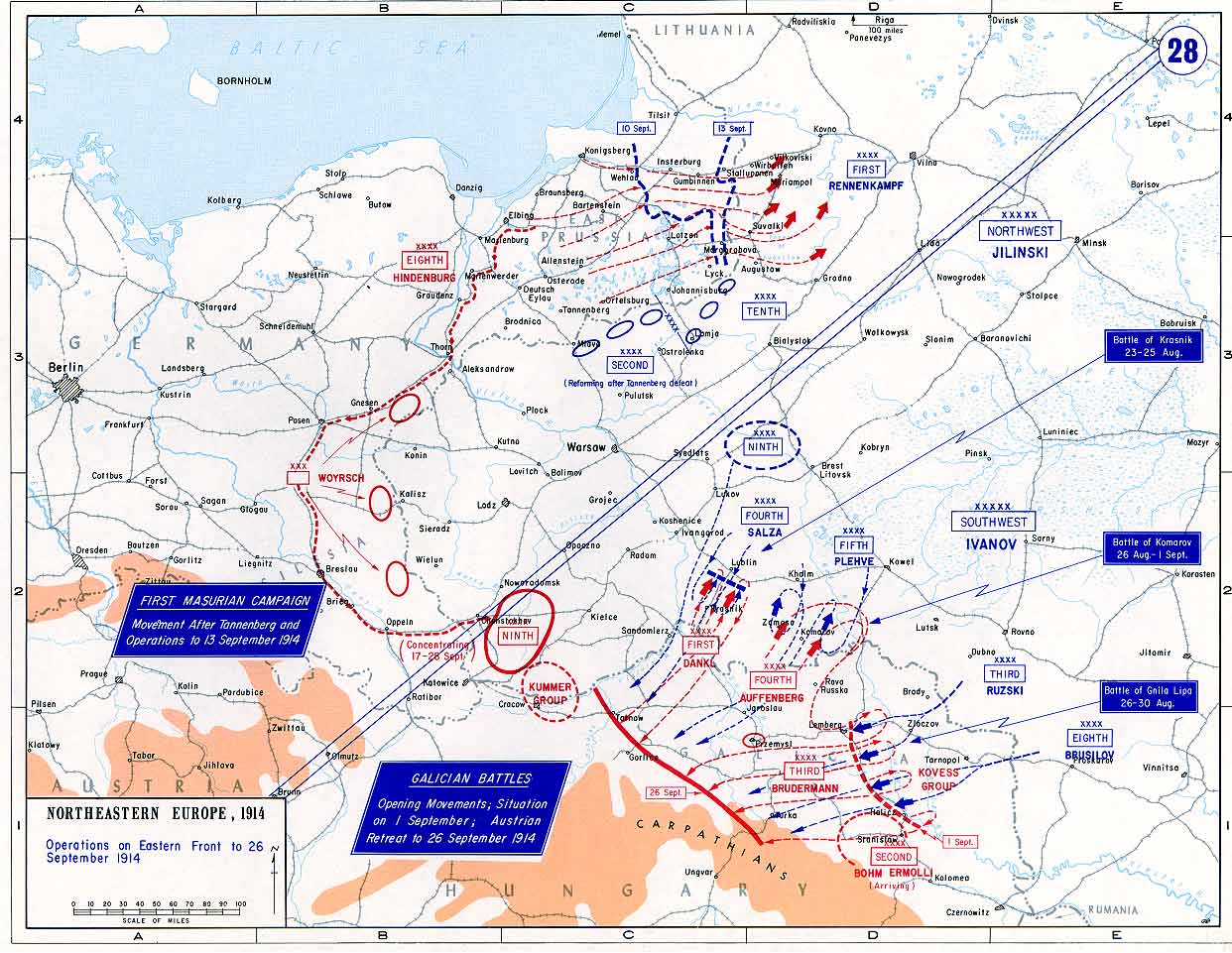
Eastern Front to September 26, 1914

"Das Massengrab des 32. Infanterie-Regiment" (um 1915) in Sanok, wurde jedoch gegen Anfang der kommunistischen Diktatur zerstört.

"The World War" ( Cigarette collection album published by Cigaret Picture Service Dresden ) - German field marshall Mackensen.

3 Maja Street in Sanok

Pogranicze kultur wschodu i zachodu na starej fotografii by Wojciech Wesołkin - Czytanie Europy project, Sanok 2011

Die Russen ziehen mit Trophaen aus Lemberg am 22. Juni 1915

Bombenabwurf aus einem Aviatik B.II um 1916

Fotografieren aus dem Flugzeug, Kolomea

Плакат: Шел австриец в Радзивилы да попал на бабьи вилы. Владимира Маяковского в соавторстве с Казимиром Малевичем

Battle of Galicia 1914. Russian front in 1st WW.

This military map depicts the Battle of Galicia, a series of major battles fought between Austria-Hungary and the Russian Empire in World War 1 in late August 1914. In the course of the battles, the Austro-Hungarian armies achieved victories at Kraśnik and Komarów, but were severely defeated at Gnila Lipa and in September at Rawa-Ruska, which resulted in the total withdrawal of their armies to the San river, leaving Lemberg (Lvov), the capital city of Galicia, and the eastern portion of the crownland to the Russians for approximately nine months.

This military map depicts the Battle of Galicia, a series of major battles fought between Austria-Hungary and the Russian Empire in World War 1 in late August 1914. In the course of the battles, the Austro-Hungarian armies achieved victories at Kraśnik and Komarów, but were severely defeated at Gnila Lipa and in September at Rawa-Ruska, which resulted in the total withdrawal of their armies to the San river, leaving Lemberg (Lvov), the capital city of Galicia, and the eastern portion of the crownland to the Russians for approximately nine months.
Cementeries from 1st World War in Biecz.

Bukowsko

Military cemetery in Brzozów

Graveyard of Austria-Hungarian Fortress of Przemyśl soldiers, Przemyśl, Poland.

Mausoleum of German Fortress of Przemyśl soldiers, Przemyśl, Poland.

Entgleiste Feldbahn - Die Feldbahn ist aus dem Gleis gehüpft. Galizien. Nr. 633

Feldbahn und k. u. k. Soldaten beim Vormarsch in Galizien

Fortalezas fronterizas rusas durante la Primera Guerra Mundial: Ivangorod, Novogeorgievsk, Kovno (Kaunas), Grodno y Osowiec. Según ISBN 9780671557096, pp. 23 y 131.

Field Marshal Friedrich Archduke of Austria, Duke of Teschen (1856-1936), supreme commander of Austria-Hungarian Armed Forces in WW1, visiting the Przemyśl fortress (today in South-Eastern Poland) after recapture in June 1915

Galicija – prevoz ranjencev v bolnišnico

Galicya Sehitligi

Galicya Sehitligi giris

Galicya Sehitligi
Historische Übersicht
Die sogenannte Schlacht in Galizien war eine Reihe von separat angesetzten Schlachten zwischen den aufmarschierenden Truppen des russischen Kaiserreichs und Österreich-Ungarn in der Anfangsphase des Ersten Weltkrieges an der Ostfront. Die Schlachten begannen ab 23. August 1914 und endeten trotz anfänglicher Erfolge mit einer Niederlage der österreichisch-ungarischen Truppen, die sich aus dem größten Teil des Kronlands Galizien zurückziehen mussten. Der russischen 3. Armee unter General der Infanterie Nikolai Russki gelang es, bis zum 2. September das nordöstliche Galizien samt der Hauptstadt Lemberg zu besetzen. Die russische 8. Armee unter General der Kavallerie Brussilow nahm währenddessen nördlich des Dnjestr die Städte Brody, Tarnopol und Buczacz ein und besetzte den Großteil der Bukowina.
Fakten auf einen Blick
Russisches Kaiserreich
- Befehlshaber: Nikolai Iwanow
- Truppenstärke: ca. 700.000
- Verluste: ca. 220.000
Österreich-Ungarn
- Befehlshaber: Conrad v. Hötzendorf
- Truppenstärke: ca. 850.000
- Verluste: ca. 450.000
Strategischer Kontext
Kampf um die Vorherrschaft im Karpatenvorland.
Weiterführende Literatur

Revolutionary Spring: Fighting for a New World 1848-1849
Christopher Clark

Spanish-American War: A Captivating Guide to the War Between the United States of America and Spain along with The Philippine–American War that Followed

The Philippine–American War

Frühling der Revolution: Europa 1848/49 und der Kampf für eine neue Welt
Christopher Clark

Risorgimento! Italiens Kampf um die Einheit im 19. Jahrhundert
Historische Orte
Die interaktive Karte erfordert die Zustimmung zu Drittanbieter-Cookies.