Operation Husky

Map operation husky landing

LCVPs from USS Joseph T. Dickman (APA-13) landing vehicles through the surf at Gela, Sicily, on 10-12 July 1943. The truck in the center appears to have stalled. Photograph from the U.S. Coast Guard Collection in the U.S. National Archives.

Troops en route to Oran, Algeria, 15 June 1943 Troops headed for the invasion of Sicily studying guidebooks for North Africa and otherwise passing the time in their bunks on board a U. S. Navy transport. The ship may be USS James O'Hara (APA-90). Note that these men are armed with bolt-action Springfield rifles. They are from the 45th Infantry Division. Official U.S. Navy Photograph, now in the collections of the National Archives.

Members of the 504th Parachute Infantry Regiment patrol Sicily after capturing the island from Germany in early July, 1943.

Vice Admiral Lisa M. Franchetti presents an award to the Mayor of Gela, Domenico Messinese, during the remembrance ceremony held in Gela, Sicily. This occasion marks the first time Gela has participated in the annual Ponte Dirillo and Operation Husky ceremony in nearly ten years.

GELA, Italy (July 10, 2020) Lucio Greco, mayor of Gela, gives a speech during a ceremony, jointly hosted by Naval Computer and Telecommunication Station Sicily and the City of Gela, for those who lost their lives during Operation Husky in 1943 at Ponte Dirillo, July 10. The Allied invasion of Sicily, codenamed Operation Husky, was a major large-scale World War II amphibious and airborne operation in which the Allies liberated the island of Sicily from the Axis Powers. (U.S. Navy photo by Mass Communication Specialist 2nd Class Josh Cote)
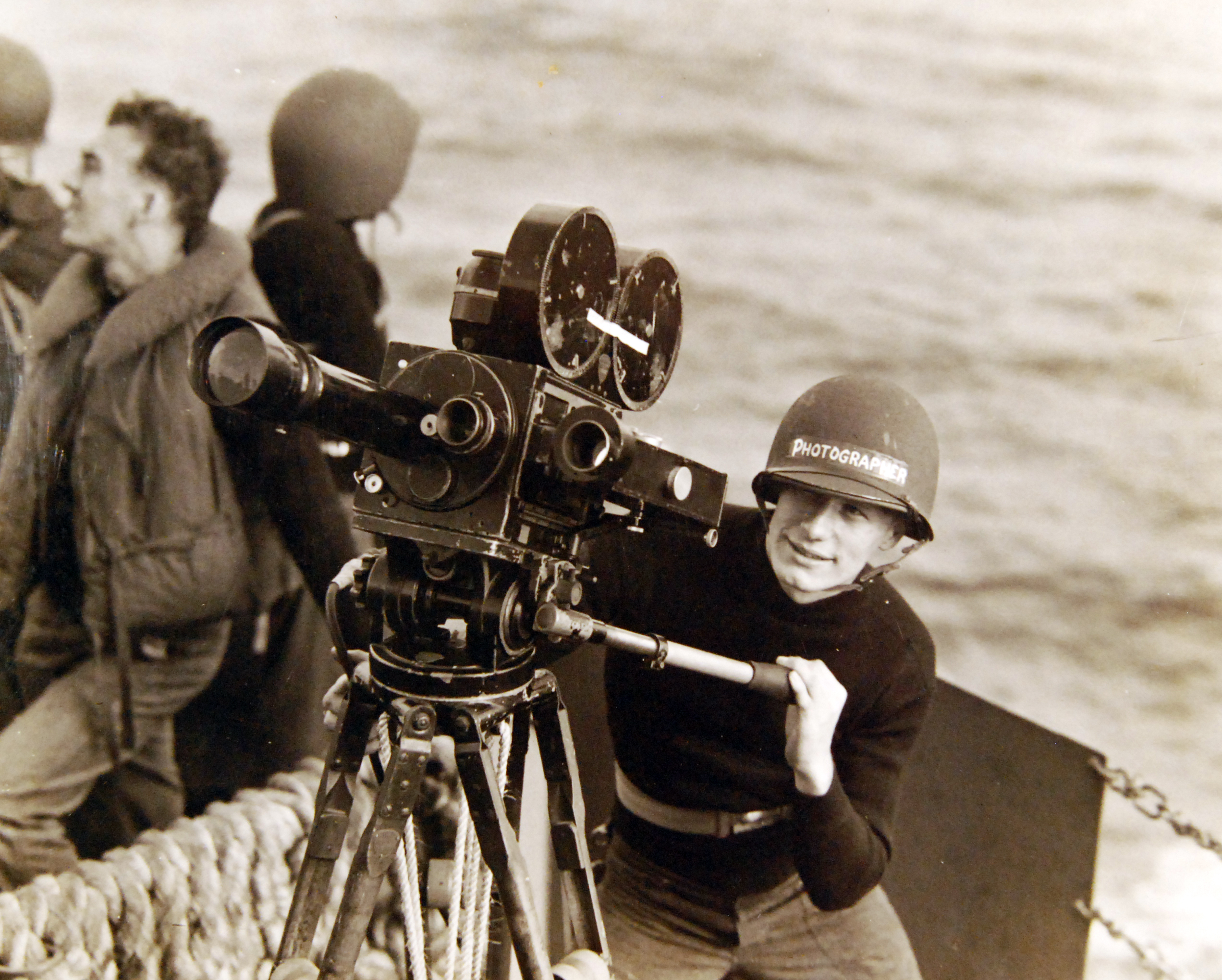
80-G-30315: Operation Torch, November 1942. Photography during the campaign. Shown: Photographer’s Mate 2/C William Wade, USN, trains his movie camera on a group of scout bombers. Official U.S. Navy Photograph, now in the collections of the National Archives. (2017/06/06).

GELA, Italy (July 10, 2020) Sailors parade the colors, during a ceremony, jointly hosted by Naval Computer and Telecommunication Station Sicily and the City of Gela, for those who lost their lives during Operation Husky in 1943 at Ponte Dirillo, July 10. The Allied invasion of Sicily, codenamed Operation Husky, was a major large-scale World War II amphibious and airborne operation in which the Allies liberated the island of Sicily from the Axis Powers. (U.S. Navy photo by Mass Communication Specialist 2nd Class Josh Cote)

GELA, Italy (July 10, 2020) Sailors parade the colors, during a ceremony, jointly hosted by Naval Computer and Telecommunication Station Sicily and the City of Gela, for those who lost their lives during Operation Husky in 1943 at Ponte Dirillo, July 10. The Allied invasion of Sicily, codenamed Operation Husky, was a major large-scale World War II amphibious and airborne operation in which the Allies liberated the island of Sicily from the Axis Powers. (U.S. Navy photo by Mass Communication Specialist 2nd Class Josh Cote)

GELA, Italy (July 10, 2020) Army Capt. Dustin Mondloch gives a speech during a ceremony, jointly hosted by Naval Computer and Telecommunication Station Sicily and the City of Gela, for those who lost their lives during Operation Husky in 1943 at Ponte Dirillo, July 10. The Allied invasion of Sicily, codenamed Operation Husky, was a major large-scale World War II amphibious and airborne operation in which the Allies liberated the island of Sicily from the Axis Powers. (U.S. Navy photo by Mass Communication Specialist 2nd Class Josh Cote)

GELA, Italy (July 10, 2020) Lucio Greco the mayor of Gela and Cayanne McFarlane, executive officer of Naval Computer and Telecommunication Station (NCTS) Sicily, pose for a photo during a ceremony, jointly hosted by NCTS and the City of Gela, for those who lost their lives during Operation Husky in 1943 at Ponte Dirillo, July 10. The Allied invasion of Sicily, codenamed Operation Husky, was a major large-scale World War II amphibious and airborne operation in which the Allies liberated the island of Sicily from the Axis Powers. (U.S. Navy photo by Mass Communication Specialist 2nd Class Josh Cote)

Liberty ship S.S. Robert Rowan explodes after being hit by a German air attack, during the invasion of Sicily, 11 July 1943. She had a cargo of ammunition.

80-G-30309: Operation Torch, November 1942. Gunnery, 40mm guns, during the U.S. Campaign in North Africa. Gun crews on an aircraft carrier after an “alert” has been sounded on the way to North Africa. Official U.S. Navy Photograph, now in the collections of the National Archives. (2017/06/06).

80-G-41775: Two hundred and four American patients, taken from USS West Point (AP 23) at Newport News, Virginia, on May 30th, 1943. They came from North Africa along with 2,944 captive Axis soldiers. A wounded soldier is being carried onto the hospital train. Photographed May 30, 1943. U.S. Navy Photograph, now in the collections of the National Archives. (2016/05/10).

80-G-41776: Two hundred and four American patients, taken from USS West Point (AP 23) at Newport News, Virginia, on May 30th, 1943. They came from North Africa along with 2,944 captive Axis soldiers. This African-American soldier is Private George William Curtis who was hurt at Oran on February 24th. Photographed May 30, 1943. U.S. Navy Photograph, now in the collections of the National Archives. (2016/05/10).

80-G-41777: Two hundred and four American patients, taken from USS West Point (AP 23) at Newport News, Virginia, on May 30th, 1943. They came from North Africa along with 2,944 captive Axis soldiers. Private Mason Parker and Lieutenant Viola Heyden review a small pamphlet on North Africa. Photographed May 30, 1943. U.S. Navy Photograph, now in the collections of the National Archives. (2016/05/10).

80-G-42501: Operation Husky, July-August 1943. Barbed wire enclosure in Sicily where Italian prisoners are being held for further transfer. Photographed: July 11, 1943. Official U.S. Navy photograph, now in the collections of the National Archives. (2016/05/17).

80-G-42797: Operation Husky, July-August 1943. British Army and Navy Officers and an American observer< Commander Walter Chappell, USNR, (standing left) liaison officer with the Eighth Army – watch landing parties pour in as they stand at a beach signal station, where the British flag has just been planted during the Sicilian Invasion, July 1943. Official U.S. Navy Photograph, now in the collections of the National Archives. (2017/08/01).

80-G-46566: Lieutenant Harold R. Fleck, USNR, poses against a photograph of his ship USS LST 386, as he recalls how the giant landing craft underweight the experiments which made it the first “junior aircraft carrier.” The event took place in North Africa. A light flight runway had been installed aboard the LST, “the plane took off like a bird leaving a tree,” Lieutenant Fleck says. He described the first combat use of the LST as a “carrier” during the Sicilian landings at Licata as a “matter of routine.” Released September 19, 1944. U.S. Navy Photograph, now in the collections of the National Archives. (2016/06/07).

80-G-54539: With the invasion fleet between North Africa and Sicily, Captain Carrell L. Tyler, USN, checks over documents of war onboard a U.S. warship. Photograph, June 28. 1943. Official U.S. Navy photograph, now in the collections of the National Archives. (2016/07/19).

80-G-54542: Night bombing by the Axis in North Africa. Attacking some of the assembled invasion shipping at Bizerte, Axis aerial raiders lighted in the sky with flares. The beautiful display of fireworks silhouetted the shoreline. No damage was reported. Photograph, July 1943. Official U.S. Navy photograph, now in the collections of the National Archives. (2016/07/19).

80-G-54604: Invasion of Sicily, September 1943. USS Rowan (DD 405). Three survivors smeared with oil and blood awaiting medical attention following the sinking of their ship in Italian waters as a result of an underwater explosion. Photograph released September 25, 1943. U.S. Navy Photograph, now in the collections of the National Archives. (2016/11/25).

80-G-54606: Invasion of Sicily, September 1943. USS Rowan (DD 405). Three survivors smeared with oil and blood awaiting medical attention following the sinking of their ship in Italian waters as a result of an underwater explosion. Photograph released September 25, 1943. U.S. Navy Photograph, now in the collections of the National Archives. (2016/11/25).

80-G-54624: Invasion of Sicily, September 1943. A captured German soldier shaves on the beach at Paestum, Salerno Bay, Italy, to be ready for his voyage as guest of the Americans. Photograph released September 29, 1943. U.S. Navy Photograph, now in the collections of the National Archives. (2016/11/25).

Beach group signalman directs USS LST-314 to her landing place on a Sicily beach.

80-G-55362: Italian Prisoners at Licata, Sicily, Italy. Photograph received November 11, 1943. (4/28/2015).
Historische Übersicht
Operation Husky war die Codebezeichnung für die alliierte Invasion Siziliens ab der Nacht vom 9. auf den 10. Juli 1943. Sie war der eigentliche Beginn des „Italienfeldzuges“ im Zweiten Weltkrieg.
Fakten auf einen Blick
Allierte (USA/UK)
- Befehlshaber: George S. Patton
- Truppenstärke: ca. 160.000
- Verluste: ca. 25.000
Achse (DE/IT)
- Befehlshaber: Hans-Valentin Hube
- Truppenstärke: ca. 300.000
- Verluste: ca. 150.000
Strategischer Kontext
Öffnung einer zweiten Front in Europa.
Weiterführende Literatur


Red Famine: Stalin's War on Ukraine


Die Schlacht um Berlin und das Ende des Dritten Reichs 1945

Hunde, wollt ihr ewig leben: ein Stalingrad-Roman

Roter Hunger: Stalins Krieg gegen die Ukraine


Söldner ohne Sold: Die deutschen Freikorps 1918–1923

Vom Massensturm zur Stoßtrupptaktik: Die deutsche Landkriegtaktik im Spiegel von Dienstvorschriften und Publizistik 1906 bis 1918

Wir Wehr-Wölfe: Erinnerungen eines Freikorps-Führers

Zweiter Weltkrieg Erlebnisbericht Apokalypse Stalingrad: Untergang der 6. Armee 1942-1943
Walter Mönch
Rise And Fall Of The Third Reich
William Shirer
Historische Orte
Die interaktive Karte erfordert die Zustimmung zu Drittanbieter-Cookies.