Operation Goodwood

IWM caption : THE BRITISH ARMY IN THE NORMANDY CAMPAIGN 1944. Sherman tanks carrying infantry wait for the order to advance at the start of Operation 'Goodwood'.

A Sherman tank and Crusader anti-aircraft tank of the Staffordshire Yeomanry, 27th Armoured Brigade, during Operation 'Goodwood', Normandy, 18 July 1944. A Sherman tank and Crusader AA Mk III of the Staffordshire Yeomanry, 27th Armoured Brigade, during Operation 'Goodwood', 18 July 1944.

British infantry and Sherman tanks wait to advance at the start of Operation 'Goodwood', Normandy, 18 July 1944. Infantry and Sherman tanks wait to advance at the start of Operation 'Goodwood', 18 July 1944. A Sherman Firefly is in the foreground.

Royal Air Force Bomber Command, 1942-1945. Vertical aerial photograph showing smoke from exploding bombs smothering the Colombelles steelworks, east of Caen, France during the attack by aircraft of Bomber Command in support of the Second Army's armoured advance in the Normandy battle area, (Operation GOODWOOD).

Vertical photographic-reconnaissance aerial photograph of the steelworks at Colombelles, east of Caen, France following a daylight attack on German fortified positions by aircraft of Bomber Command on the morning of 18 July 1944, in support of Operation GOODWOOD. The whole target area is studded with a dense concentration of craters and almost every building in the steelworks has been destroyed.

IWM caption : Vertical aerial photograph showing Handley Page Halifax B Mark III, LW127 'HL-F', of No. 429 Squadron RCAF, in flight over Mondeville, France, after losing its entire starboard tailplane to bombs dropped by another Halifax above it. LW127 was one of 942 aircraft of Bomber Command despatched to bomb German-held positions, in support of the Second Army attack in the Normandy battle area (Operation GOODWOOD), on the morning of 18 July 1944. The crew managed to abandon the aircraft before it crashed in the target area.

Décombres d'une maison pendant l'Opération Goodwood situé Rue des Parachutistes, après une détonation.
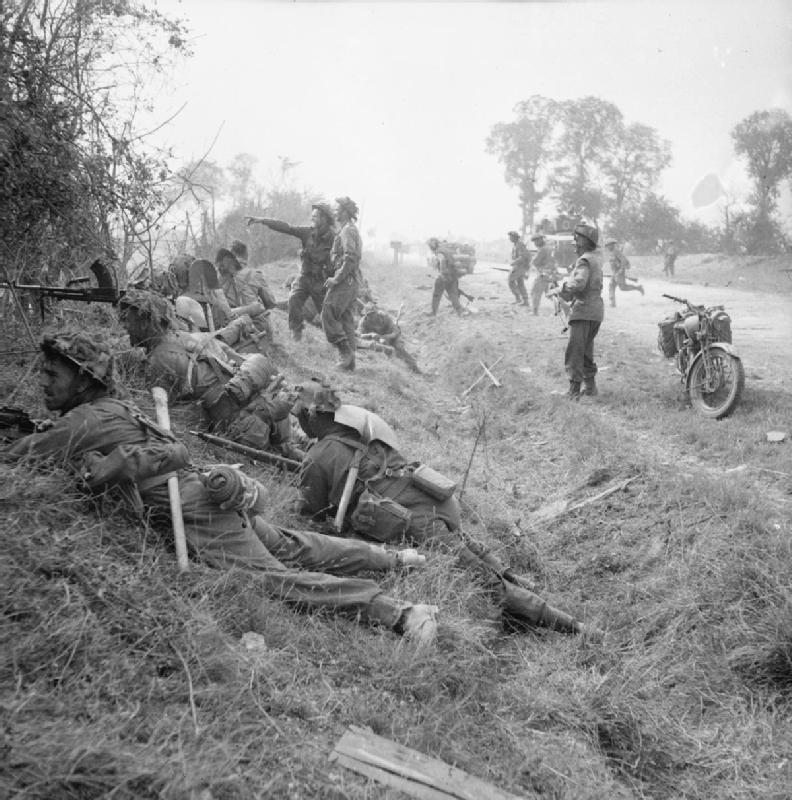
Soldiers of 1st Welsh Guards in action near Cagny during Operation Goodwood

The British Army in North-west Europe 1944-45 German prisoners taken during Operation 'Goodwood', 19 July 1944.

Infantry and tanks wait to advance at the start of Operation 'Goodwood'.

Guardsmen of 3rd Irish Guards in a Loyd carrier, wrapped up against the clouds of dust, during Operation 'Goodwood', Normandy, 18 July 1944. Guardsmen of 3rd Irish Guards in a Loyd carrier, wrapped up against the clouds of dust, during Operation 'Goodwood', 18 July 1944.

A Morris light reconnaissance car and, in the background, Sherman Crab flail tanks move up to the battle area for Operation 'Goodwood', 18 July 1944.

A King Tiger of the 503rd heavy tank battalion, after it has been rammed by a British Sherman commanded by Lieutenant John Gorman of the 2nd Armoured Irish Guards, Guards Armoured Division during Operation Goodwood. Gorman and his crew then captured most of the Tiger's crew. The event took place on 18 July 1944 to the west of Cagny, Normandy, France.

IWM caption : Avro Lancaster B Mark IIs of No. 514 Squadron RAF taxy onto the main runway at Waterbeach, Cambridgeshire, for a daylight attack on fortified villages east of Caen, in support of the Second Army's armoured offensive in the Normandy battle area (Operation GOODWOOD).

IWM caption : Avro Lancasters of No. 514 Squadron RAF, lined up at Waterbeach, Cambridgeshire, before taking part in a daylight attack on fortified villages east of Caen, in support of the Second Army's armoured offensive in the Normandy battle area (Operation GOODWOOD).

Medicsgoodwood

Historical panel and maps of the battle of Normandy around Sannerville in July 1944

Goodwood operation historical panel in Cuverville

Royal Air Force 1939-1945- Bomber Command Watched by the CO, Wing Commander D A Gardner (left), aircrew of No 166 Squadron at Kirmington, Lincolnshire, gather on 20 July 1944 to hear the Adjutant, Flight Lieutenant F C Tigh, read out a congratulatory message from Field Marshal Montgomery, thanking the bomber crews for their efforts supporting the British Second Army's armoured offensive in Normandy, Operation 'Goodwood'.

Royal Air Force Bomber Command, 1942-1945. Avro Lancasters and Handley Page Halifaxes fly through anti-aircraft fire to bomb fortified villages east of Caen, France in a dawn attack by 942 aircraft, before the commencement of the Second Army's armoured attack in the Normandy battle area (Operation GOODWOOD).
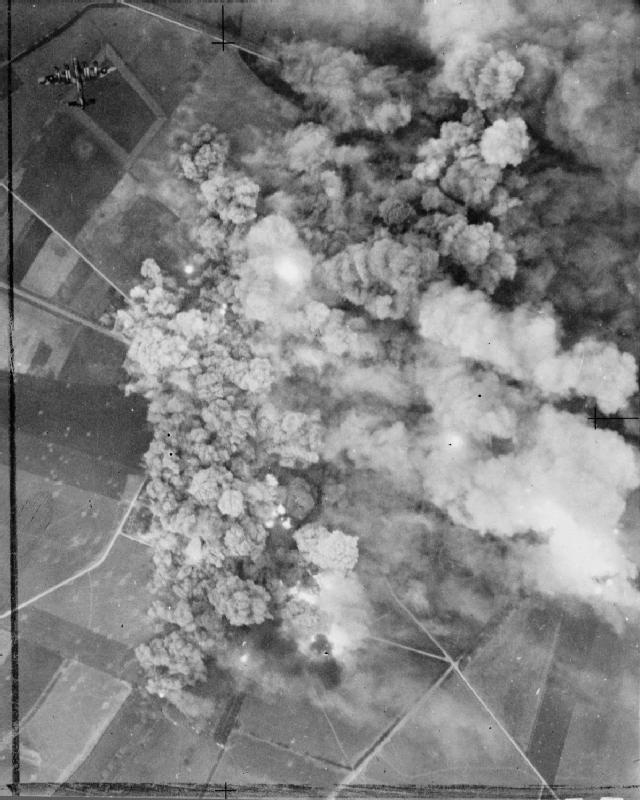
Royal Air Force Bomber Command, 1942-1945. An Avro Lancaster leaves the target area (top left), as smoke from exploding bombs smothers the village of Villers-Bocage, south-west of Caen, France. 942 aircraft of Bomber Command were despatched to bomb German-held positions, in support of the Second Army attack in the Normandy battle area (Operation GOODWOOD), on the morning of 18 July 1944.

Royal Air Force Bomber Command, 1942-1945. Four Avro Lancasters of No. 514 Squadron RAF flying over complete cloud cover during a daylight attack on fortified villages east of Caen, in support of the Second Army's armoured offensive in the Normandy battle area (Operation GOODWOOD).
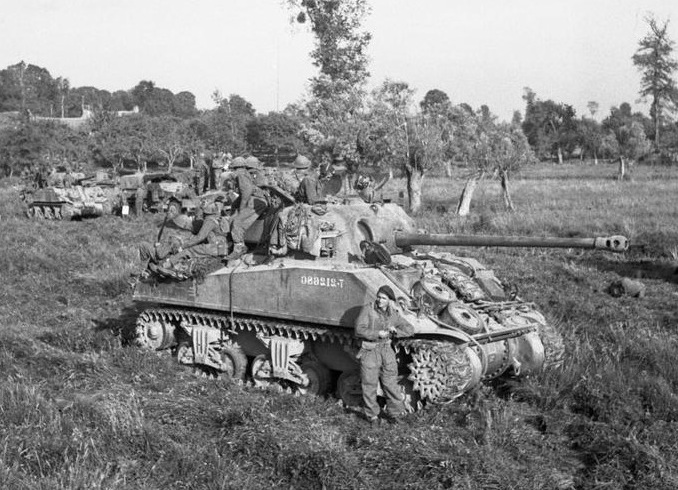
Sherman Firefly with its squadron await the order to move forward at the start of Operation Goodwood, 18 July 1944.

Sherman Firefly passes through Ecosville during Operation Goodwood, 18 July 1944

Sherman tanks carrying infantry wait to advance at the start of Operation 'Goodwood', Normandy, 18 July 1944. Sherman tanks carrying infantry wait to advance at the start of Operation 'Goodwood', 18 July 1944.

Sherman tanks of the Staffordshire Yeomanry, 27th Armoured Brigade, carrying infantry from 3rd Division, move up at the start of Operation 'Goodwood', Normandy, 18 July 1944. Sherman tanks of the Staffordshire Yeomanry, 27th Armoured Brigade, carrying infantry from 3rd Division, move up at the start of Operation 'Goodwood', 18 July 1944.
Historische Übersicht
Die Schlacht um Caen war eine Abfolge von militärischen Angriffsoperationen im Zweiten Weltkrieg, die sich im Zeitraum zwischen Juni und August 1944 in Nordfrankreich ereigneten. Die Eroberung der verkehrsstrategisch wichtigen französischen Stadt Caen war ursprünglich bereits für die ersten Tage nach Beginn der Landung in der Normandie am 6. Juni 1944 im Rahmen der Operation Neptune geplant. Trotz einer weitestgehend erfolgreichen Landung der ersten alliierten Angriffsverbände misslang der Versuch, Caen im ersten Anlauf zu erobern. Der alliierte Kommandeur Bernard Montgomery sah sich deshalb in den nachfolgenden Monaten zu mehreren Angriffen zur Eroberung der Stadt und zur Kontrolle ihres Umlandes gezwungen. Verteidigt wurde das Gebiet von Verbänden der deutschen Wehrmacht und der Waffen-SS.
Fakten auf einen Blick
Großbritannien
- Befehlshaber: M. Dempsey
- Truppenstärke: 3 Divisionen
- Verluste: 3500
Wehrmacht
- Befehlshaber: Hans Eberbach
- Truppenstärke: 3 Divisionen
- Verluste: 2500
Strategischer Kontext
Finaler Bruch der deutschen Verteidigung bei Caen.
Weiterführende Literatur


Red Famine: Stalin's War on Ukraine


Die Schlacht um Berlin und das Ende des Dritten Reichs 1945

Hunde, wollt ihr ewig leben: ein Stalingrad-Roman

Roter Hunger: Stalins Krieg gegen die Ukraine


Söldner ohne Sold: Die deutschen Freikorps 1918–1923

Vom Massensturm zur Stoßtrupptaktik: Die deutsche Landkriegtaktik im Spiegel von Dienstvorschriften und Publizistik 1906 bis 1918

Wir Wehr-Wölfe: Erinnerungen eines Freikorps-Führers

Zweiter Weltkrieg Erlebnisbericht Apokalypse Stalingrad: Untergang der 6. Armee 1942-1943
Walter Mönch
Rise And Fall Of The Third Reich
William Shirer
Historische Orte
Die interaktive Karte erfordert die Zustimmung zu Drittanbieter-Cookies.