Alle Schlachten

Gefecht auf der Doggerbank

1915 Nordsee Seeschlacht

The german armoured cruiser SMS Blücher sinks after receiving multiple hits from British warships at the Battle of Dogger Bank on 25 January 1915.

The german armoured cruiser SMS Blücher sinks after receiving multiple hits from British warships at the Battle of Dogger Bank on 25 January 1915.

Author: This photo was taken from the deck of the British cruiser HMS Arethusa. International Film Service.License:PD
Source
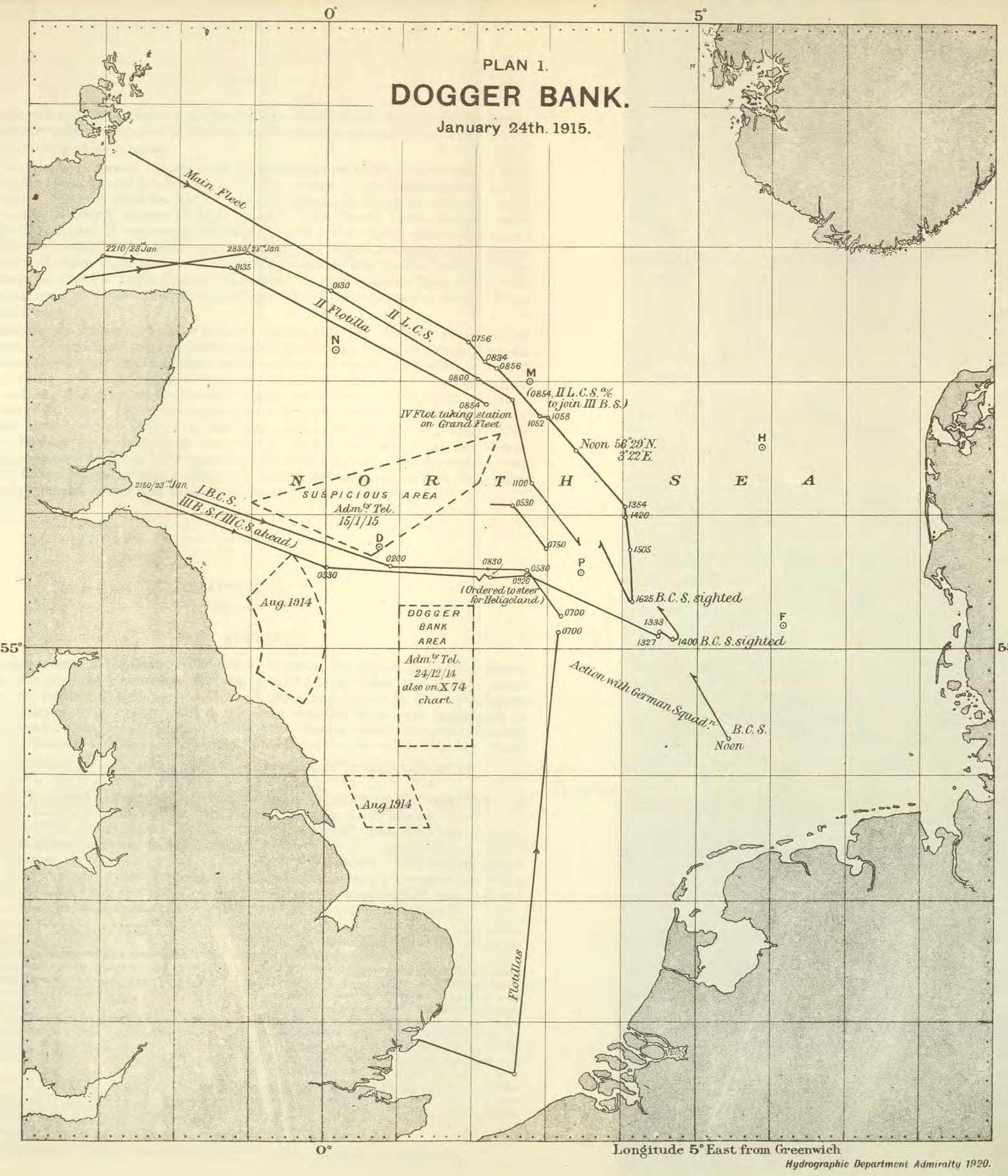
Map showing British and German ships and movements at the Battle of Dogger Bank, 24 January 1915.

Map showing British and German ships and movements at the Battle of Dogger Bank, 24 January 1915.

Author: William Oliver Stevens and Allan Westcott. Published by George H Doran Company, New York.License:PD
Source
'On board a light cruiser, six inch gun in action'; probably on the 'Aurora' at the Battle of the Dogger Bank, 24 January 1915
Inscribed, as title, and signed by the artist, 'W L Wyllie from nature', lower right. This is a fairly finished drawing of a scene on an 'Arethusa'-class light cruiser which is beyond reasonable doubt the 'Aurora' (1913), since a related one in colour wash (PAF1849) is almost identical and  titled 'Aurora 6" gun in action Dogger Bank'. The present monochrome version was certainly reproduced by Wyllie in his and M.F Wren's Sea Fights of the Great War' (1918), f. p. 136, as one of the illustrations to its account of that battle so may well have been done specifically for that purpose.  The 'Aurora' briefly engaged the German light cruiser 'Kolberg' (1908) of the 2nd Scouting Group in the early morning of 24 January 1915 and started the action that became known as the Battle of Dogger Bank. Wyllie was, of course, not present at the action and the related drawing mentioned is a preliminary study, probably done from watching a practice drill.

'On board a light cruiser, six inch gun in action'; probably on the 'Aurora' at the Battle of the Dogger Bank, 24 January 1915 Inscribed, as title, and signed by the artist, 'W L Wyllie from nature', lower right. This is a fairly finished drawing of a scene on an 'Arethusa'-class light cruiser which is beyond reasonable doubt the 'Aurora' (1913), since a related one in colour wash (PAF1849) is almost identical and titled 'Aurora 6" gun in action Dogger Bank'. The present monochrome version was certainly reproduced by Wyllie in his and M.F Wren's Sea Fights of the Great War' (1918), f. p. 136, as one of the illustrations to its account of that battle so may well have been done specifically for that purpose. The 'Aurora' briefly engaged the German light cruiser 'Kolberg' (1908) of the 2nd Scouting Group in the early morning of 24 January 1915 and started the action that became known as the Battle of Dogger Bank. Wyllie was, of course, not present at the action and the related drawing mentioned is a preliminary study, probably done from watching a practice drill.

Author: William Lionel WyllieLicense:PD
Source
This shows the sinking of the German armoured cruiser Blücher at the Battle of Dogger Bank, 24 January 1915. Blücher is shown capsizing to port, with the British battlecruiser Tiger of the 1st Battlecruiser Squadron in the right background. Incorrectly, the main armament of Tiger is shown trained fore and aft. The British destroyer on the left is much too close to Blücher at this stage, a case of artistic licence on Wyllie's part for compositional effect. The gunnery action commenced at 09.00 and Blücher capsized at 12.07, having sustained many shell hits and a reported seven torpedoes: 189 crew members were rescued by British destroyers. This drawing was reproduced in colour, with the title as given here, in Sea Fights of the Great War (1918), the book which Wyllie wrote with M.F. Wren, and for which Wyllie provided drawings and watercolours for the 24 colour and 26 black and white illustrations. It is fairly clear that not all were done specifically for the book, though this one may have been given that it  (unusually) bears a close execution date.
'The last of Blücher'

This shows the sinking of the German armoured cruiser Blücher at the Battle of Dogger Bank, 24 January 1915. Blücher is shown capsizing to port, with the British battlecruiser Tiger of the 1st Battlecruiser Squadron in the right background. Incorrectly, the main armament of Tiger is shown trained fore and aft. The British destroyer on the left is much too close to Blücher at this stage, a case of artistic licence on Wyllie's part for compositional effect. The gunnery action commenced at 09.00 and Blücher capsized at 12.07, having sustained many shell hits and a reported seven torpedoes: 189 crew members were rescued by British destroyers. This drawing was reproduced in colour, with the title as given here, in Sea Fights of the Great War (1918), the book which Wyllie wrote with M.F. Wren, and for which Wyllie provided drawings and watercolours for the 24 colour and 26 black and white illustrations. It is fairly clear that not all were done specifically for the book, though this one may have been given that it (unusually) bears a close execution date. 'The last of Blücher'

Author: William Lionel WyllieLicense:PD
Source
Battle of Dogger Bank January 1915.

Battle of Dogger Bank January 1915.

Author: User:Saburny (ja:Sabulyn - ja:talk:Sabulyn)License:PD
Source
A Trafalgar Day visit to the RN Museum (1)

A Trafalgar Day visit to the RN Museum (1)

Author: Basher EyreLicense:CC-BY-SA-4.0
Source
Batalla de Dogger Bank

Batalla de Dogger Bank

Author: UnknownLicense:PD
Source
British Ships of the First World War
HMS NEW ZEALAND.  INDEFATIGABLE class battlecruiser. Built for the Royal New Zealand Navy but presented to the Royal Navy on completion in 1912. Fought at Dogger Bank and Jutland.

British Ships of the First World War HMS NEW ZEALAND. INDEFATIGABLE class battlecruiser. Built for the Royal New Zealand Navy but presented to the Royal Navy on completion in 1912. Fought at Dogger Bank and Jutland.

Author: Symonds & CoLicense:PD
Source
British Ships of the First World War
HMS NEW ZEALAND.  INDEFATIGABLE class battlecruiser. Built for the Royal New Zealand Navy but presented to the Royal Navy on completion in 1912. Fought at Dogger Bank and Jutland.

British Ships of the First World War HMS NEW ZEALAND. INDEFATIGABLE class battlecruiser. Built for the Royal New Zealand Navy but presented to the Royal Navy on completion in 1912. Fought at Dogger Bank and Jutland.

Author: Symonds & CoLicense:PD
Source
Doggerbank, Seeschlacht

Doggerbank, Seeschlacht

Author: Willy StöwerLicense:PD
Source
Royal Scots Territorials firing a salute over the grave of Captain Erdmann, Commander of the SMS Bluecher sunk at the Battle of Dogger Bank

Royal Scots Territorials firing a salute over the grave of Captain Erdmann, Commander of the SMS Bluecher sunk at the Battle of Dogger Bank

Author: American Press AssociationLicense:PD
Source
De Britse slagkruiser HMS Lion (1912-1924), naamgever van haar klasse, nam deel aan de zeegevechten bij Doggersbank (1915) en in 1916 bij Jutland

De Britse slagkruiser HMS Lion (1912-1924), naamgever van haar klasse, nam deel aan de zeegevechten bij Doggersbank (1915) en in 1916 bij Jutland

Author: Fotoafdrukken Koninklijke MarineLicense:CC-BY-SA-4.0
Source
Treffer und Auswirkungen auf einem kapitalen Kriegsschiff im ersten Weltkrieg.

Treffer und Auswirkungen auf einem kapitalen Kriegsschiff im ersten Weltkrieg.

Author: Otto Groos (Übersetzer und Hochlader: Robert Denny)License:CC-BY-SA-4.0
Source
Skizze über Manöver deutscher und britischer Kriegsschiffe im Seegefecht auf der Doggerbank, Stellungen um 12:10 Uhr. (Erster Weltkrieg, 24. 01. 1915)

Skizze über Manöver deutscher und britischer Kriegsschiffe im Seegefecht auf der Doggerbank, Stellungen um 12:10 Uhr. (Erster Weltkrieg, 24. 01. 1915)

Author: Otto Groos (Übersetzer ins Englische: Robert Denny)License:CC-BY-SA-4.0
Source
Skizze über Manöver deutscher und britischer Kriegsschiffe im Seegefecht auf der Doggerbank. (Erster Weltkrieg, 24. 01. 1915, Stellung 12:10 Uhr)
Skizze über Manöver deutscher und britischer Kriegsschiffe im Seegefecht auf der Doggerbank. (Erster Weltkrieg, 24. 01. 1915, Stellung 12:10 Uhr)

Author: Otto Groos (Übersetzer: Robert Denny)License:CC-BY-SA-4.0
Source
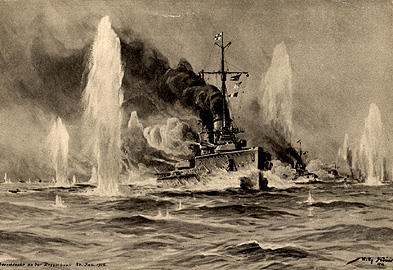
Deutsche Schlachtkreuzer im Gefecht an der Doggerbank am 24. Januar 1915
Deutsche Schlachtkreuzer im Gefecht an der Doggerbank am 24. Januar 1915

Author: Willy StöverLicense:PD
Source
Skizze der Bewegungen deutscher und britischer Kriegsschiffe im Seegefecht auf der Doggerbank, 24 Januar 1915 (09:45-12:06 GMT)

Skizze der Bewegungen deutscher und britischer Kriegsschiffe im Seegefecht auf der Doggerbank, 24 Januar 1915 (09:45-12:06 GMT)

Author: Unknown authorUnknown authorLicense:PD
Source
Skizze über Bewegungen der Kriegsschiffe im Seegefecht von Doggerbank, 24. Januar 1914

Skizze über Bewegungen der Kriegsschiffe im Seegefecht von Doggerbank, 24. Januar 1914

Author: Unknown authorUnknown authorLicense:PD
Source
Bewegungen der Kriegsschiffe im Seegefecht auf der Doggerbank, 24. Januar 1914 (09:45-12:06 GMT)

Bewegungen der Kriegsschiffe im Seegefecht auf der Doggerbank, 24. Januar 1914 (09:45-12:06 GMT)

Author: Unknown authorUnknown authorLicense:PD
Source
Omschrijving: Eerste Wereldoorlog, propaganda, ansichtkaarten, prentbriefkaarten. Zeeoorlogen. Foto van het grote Duitse oorlogsschip de kruiser S.M.S. Blücher dat getroffen door Engelse oorlogsschepen op zijn kant ligt en weldra zal zinken. Slag bij de Doggersbank, 24 januari 1915.

Omschrijving: Eerste Wereldoorlog, propaganda, ansichtkaarten, prentbriefkaarten. Zeeoorlogen. Foto van het grote Duitse oorlogsschip de kruiser S.M.S. Blücher dat getroffen door Engelse oorlogsschepen op zijn kant ligt en weldra zal zinken. Slag bij de Doggersbank, 24 januari 1915.

Author: Unknown authorUnknown authorLicense:PD
Source
Der Krieg 1914-19 in Wort und Bild, published 1919.

Der Krieg 1914-19 in Wort und Bild, published 1919.

Author: Paul TeschinskyLicense:PD
Source
HMS 'Lion' and 'Abdiel'
Wyllie would have had many opportunities to draw or paint watercolours of HMS ‘Lion’ during World War I when she was part of the First Battlecruiser Squadron of the Grand Fleet, as flagship of Vice-Admiral Beatty, taking part in the Battles of the Heligoland Bight, 1914, the Dogger Bank, 1915, and Jutland, 1916. His painting, 'Bringing in the wounded Lion', exhibited at the Royal Academy in 1915, shows the damaged 'Lion' returning to the Firth of Forth after the battle of the Dogger Bank. Wyllie wrote vividly of seeing HMS ‘Lion’ when he was with the fleet in 1915:
'When the ship began to swing to the flood I got a moving picture through my scuttle. First, 'Lion' with Sir David Beatty's flag at the fore. Many hoists of bright bunting were mounting in graceful curves to her masthead, but as I looked my picture drew away to the left, the bows of the flagship were hidden, and instead the quarterdeck and ladder came into view. Crowds of seamen were as busy as bees, barges and picket-boats were rushing up, and there was a constant coming and going of officers. But now this scene slipped farther to the left...'  (W. D. Kirkpatrick, C. Owen and W. L. Wyllie, ‘More Sea Fights of the Great War' [London: Cassell & Company Ltd., 1919]). 
This rough 'wet-work' study of the ship at moorings, from off the starboard bow,  is  post-Jutland, since her torpedo nets have been removed and these were taken away during the repairs to her Jutland battle damage.  Her initial repairs were completed  on 20 July 1916 but without Q-turret, which was not replaced until 23 September.  As Q-turret is shown in this drawing the date has to be later than September 1916 and before the fitting of the searchlight towers to her mainmast in mid-1917. The destroyer leader 'Abdiel', sketched in the top right corner, was completed in March 1916 and  is shown in her minelayer configuration.

HMS Lion

HMS 'Lion' and 'Abdiel' Wyllie would have had many opportunities to draw or paint watercolours of HMS ‘Lion’ during World War I when she was part of the First Battlecruiser Squadron of the Grand Fleet, as flagship of Vice-Admiral Beatty, taking part in the Battles of the Heligoland Bight, 1914, the Dogger Bank, 1915, and Jutland, 1916. His painting, 'Bringing in the wounded Lion', exhibited at the Royal Academy in 1915, shows the damaged 'Lion' returning to the Firth of Forth after the battle of the Dogger Bank. Wyllie wrote vividly of seeing HMS ‘Lion’ when he was with the fleet in 1915: 'When the ship began to swing to the flood I got a moving picture through my scuttle. First, 'Lion' with Sir David Beatty's flag at the fore. Many hoists of bright bunting were mounting in graceful curves to her masthead, but as I looked my picture drew away to the left, the bows of the flagship were hidden, and instead the quarterdeck and ladder came into view. Crowds of seamen were as busy as bees, barges and picket-boats were rushing up, and there was a constant coming and going of officers. But now this scene slipped farther to the left...' (W. D. Kirkpatrick, C. Owen and W. L. Wyllie, ‘More Sea Fights of the Great War' [London: Cassell & Company Ltd., 1919]). This rough 'wet-work' study of the ship at moorings, from off the starboard bow, is post-Jutland, since her torpedo nets have been removed and these were taken away during the repairs to her Jutland battle damage. Her initial repairs were completed on 20 July 1916 but without Q-turret, which was not replaced until 23 September. As Q-turret is shown in this drawing the date has to be later than September 1916 and before the fitting of the searchlight towers to her mainmast in mid-1917. The destroyer leader 'Abdiel', sketched in the top right corner, was completed in March 1916 and is shown in her minelayer configuration. HMS Lion

Author: William Lionel WyllieLicense:PD
Source
HMS Attack (1911) flying the flag of Vice-Admiral Beatty at the Battle of Dogger Bank

HMS Attack (1911) flying the flag of Vice-Admiral Beatty at the Battle of Dogger Bank

Author: Royal NavyLicense:PD
Source
HMS Lion was the flagship of Rear Admiral David Beatty during the Battle of Dogger Bank on 24 January
1915.
image: The British battlecruiser HMS Lion in action at sea, with large splashes in the water off her starboard side as a

result of enemy fire. Another warship is visible in the background to the left.

HMS Lion was the flagship of Rear Admiral David Beatty during the Battle of Dogger Bank on 24 January 1915. image: The British battlecruiser HMS Lion in action at sea, with large splashes in the water off her starboard side as a result of enemy fire. Another warship is visible in the background to the left.

Author: Burgess, Arthur J WLicense:PD
Source

Historische Übersicht

Zusammenstoß von Schlachtkreuzern; Untergang der SMS Blücher.

Fakten auf einen Blick

Ergebnis:Taktischer brit. Sieg.

Royal Navy

  • Befehlshaber: David Beatty
  • Truppenstärke: 5 Schlachtkreuzer
  • Verluste: 15 Tote

Kaiserliche Marine

  • Befehlshaber: Franz von Hipper
  • Truppenstärke: 4 Schlachtkreuzer
  • Verluste: 954 Tote

Strategischer Kontext

Abfangen deutscher Schlachtkreuzer auf dem Weg zur englischen Küste.

Weiterführende Literatur

Cover of Berlin: The Downfall 1945

Berlin: The Downfall 1945

Antony Beevor

SachbuchZweiter WeltkriegWW2-Ostfront

Englisch
Weltkriegs-Ära
Cover of Gulag: A History

Gulag: A History

Sachbuch20. JahrhundertSowjetunion

Englisch
Weltkriegs-Ära
Cover of Red Famine: Stalin's War on Ukraine

Red Famine: Stalin's War on Ukraine

Sachbuch20. JahrhundertSowjetunion

Englisch
Weltkriegs-Ära
Cover of Stalingrad

Stalingrad

Antony Beevor

Zweiter WeltkriegBerichtWW2-Ostfront

Englisch
Weltkriegs-Ära
Cover of The Gulag Archipelago

The Gulag Archipelago

Sachbuch20. JahrhundertSowjetunion

Englisch
Weltkriegs-Ära
Cover of Der Gulag

Der Gulag

Sachbuch20. JahrhundertSowjetunion

Deutsch
Weltkriegs-Ära
Cover of Die Schlacht um Berlin und das Ende des Dritten Reichs 1945

Die Schlacht um Berlin und das Ende des Dritten Reichs 1945

SachbuchZweiter WeltkriegWW2-Ostfront

Deutsch
Weltkriegs-Ära
Cover of Hunde, wollt ihr ewig leben: ein Stalingrad-Roman

Hunde, wollt ihr ewig leben: ein Stalingrad-Roman

Zweiter WeltkriegWW2-OstfrontHistorischer Roman

Deutsch
Weltkriegs-Ära
Cover of Roter Hunger: Stalins Krieg gegen die Ukraine

Roter Hunger: Stalins Krieg gegen die Ukraine

Sachbuch20. JahrhundertSowjetunion

Deutsch
Weltkriegs-Ära
Cover of So weit die Füße tragen

So weit die Füße tragen

20. JahrhundertSowjetunionGulag

Deutsch
Weltkriegs-Ära
Cover of Söldner ohne Sold: Die deutschen Freikorps 1918–1923

Söldner ohne Sold: Die deutschen Freikorps 1918–1923

Bericht20. JahrhundertDeutsche Geschichte

Deutsch
Weltkriegs-Ära
Cover of Vom Massensturm zur Stoßtrupptaktik: Die deutsche Landkriegtaktik im Spiegel von Dienstvorschriften und Publizistik 1906 bis 1918

Vom Massensturm zur Stoßtrupptaktik: Die deutsche Landkriegtaktik im Spiegel von Dienstvorschriften und Publizistik 1906 bis 1918

Sachbuch20. JahrhundertDeutsche Geschichte

Deutsch
Weltkriegs-Ära
Cover of Wir Wehr-Wölfe: Erinnerungen eines Freikorps-Führers

Wir Wehr-Wölfe: Erinnerungen eines Freikorps-Führers

Bericht20. JahrhundertDeutsche Geschichte

Deutsch
Weltkriegs-Ära
Cover of Zweiter Weltkrieg Erlebnisbericht Apokalypse Stalingrad: Untergang der 6. Armee 1942-1943

Zweiter Weltkrieg Erlebnisbericht Apokalypse Stalingrad: Untergang der 6. Armee 1942-1943

Walter Mönch

SachbuchZweiter WeltkriegWW2-Ostfront

Deutsch
Weltkriegs-Ära
Rise And Fall Of The Third Reich

Rise And Fall Of The Third Reich

William Shirer

20. JahrhundertDeutsche GeschichteNationalsozialismus

Weltkriegs-Ära

Historische Orte

Die interaktive Karte erfordert die Zustimmung zu Drittanbieter-Cookies.