Operation Crusader

AfricaMap3

Africa Settentrionale prigionieri del Commonwealth catturati nel novembre 1941 dall armata italo tedesca

Italian mobile artillery unit in the Bir el Gobi desert

אזור גבול מצרים-לוב ערב מבצע צלבן.
![For documentary purposes the German Federal Archive often retained the original image captions, which may be erroneous, biased, obsolete or politically extreme. Prop.-Kp. PZ, Afrika
Film-Nr.: 73/39
Bildberichter: Moosmüller
Ort: Afrika
Datum 21.11.41
General [Erwin] Rommel im Hauptquartier des ital. Armeekorps. Kartenbesprechung mit dem ital. Armeegeneral [Enea] Navarini u. dem Verbindungsoffizier Oberst Diesener](https://upload.wikimedia.org/wikipedia/commons/d/dc/Bundesarchiv_Bild_183-1982-0927-502%2C_Nordafrika%2C_Navarini%2C_Rommel%2C_Diesener.jpg)
For documentary purposes the German Federal Archive often retained the original image captions, which may be erroneous, biased, obsolete or politically extreme. Prop.-Kp. PZ, Afrika Film-Nr.: 73/39 Bildberichter: Moosmüller Ort: Afrika Datum 21.11.41 General [Erwin] Rommel im Hauptquartier des ital. Armeekorps. Kartenbesprechung mit dem ital. Armeegeneral [Enea] Navarini u. dem Verbindungsoffizier Oberst Diesener
![For documentary purposes the German Federal Archive often retained the original image captions, which may be erroneous, biased, obsolete or politically extreme. Prop.-Kp. PZ. Afr.
Film-Nr: 1/28 Bildberichter: Vielmetti
Ort: [Nordafrika] El, Aden
Datum 29.11.41
General [Erwin] Rommel an der Front südl-Tobruck](https://upload.wikimedia.org/wikipedia/commons/f/f7/Bundesarchiv_Bild_183-1989-0630-502%2C_Bei_Tobruk%2C_Rommel_mit_Offizieren.jpg)
For documentary purposes the German Federal Archive often retained the original image captions, which may be erroneous, biased, obsolete or politically extreme. Prop.-Kp. PZ. Afr. Film-Nr: 1/28 Bildberichter: Vielmetti Ort: [Nordafrika] El, Aden Datum 29.11.41 General [Erwin] Rommel an der Front südl-Tobruck

A British Crusader tank passes an abandoned German Panzer IV Ausf.A in November 1941.
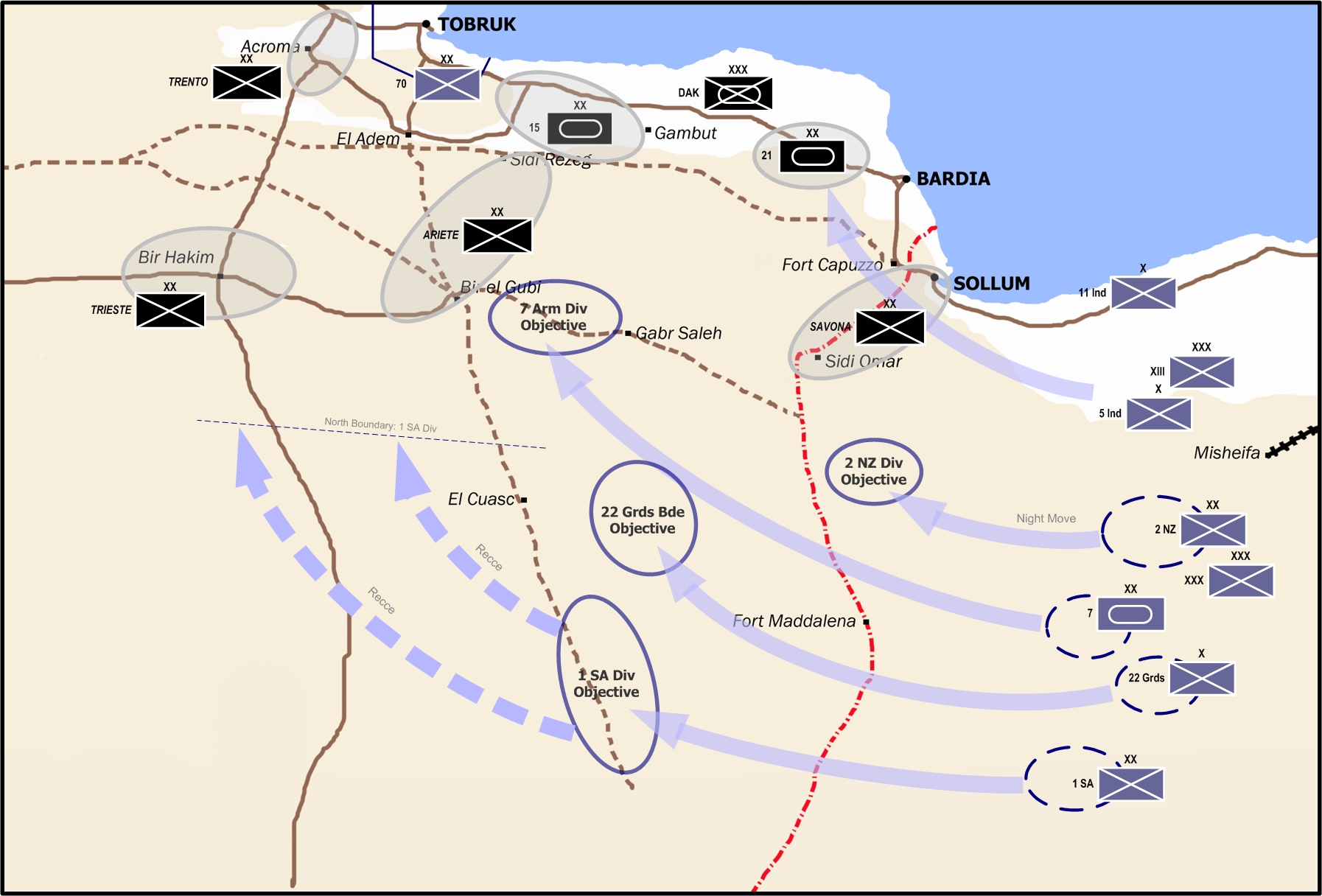
Map depicting the attack plan for Operation Crusader, 17 November 1941
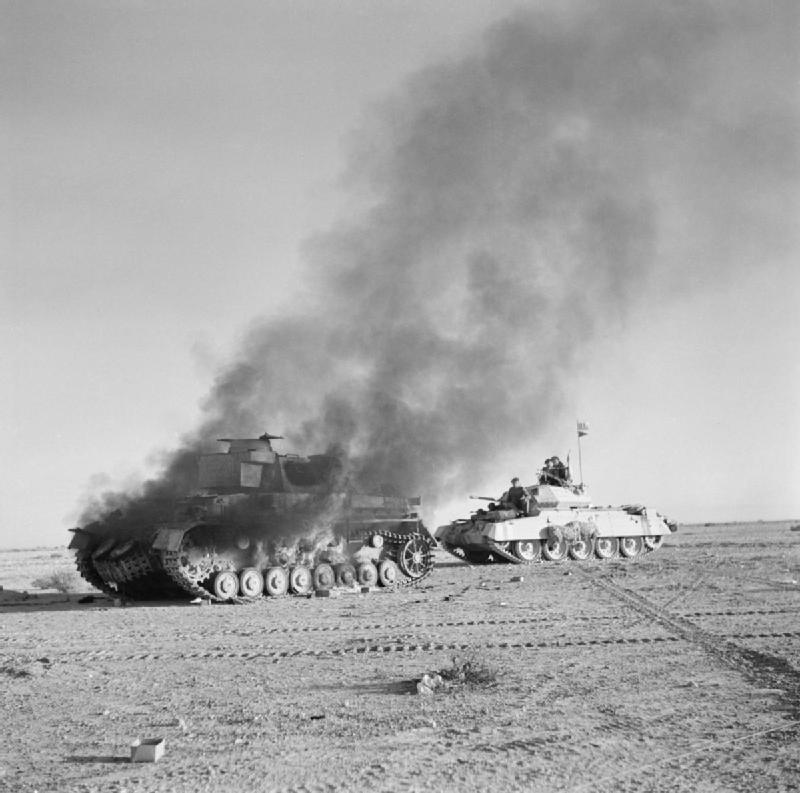
British Crusader tank passes a burning German Panzer IV tank during Operation Crusader

Damaged German Panzer IIIs in the "Valley of Death" near Belhamed, Libya, during "Operation Crusader".

Damaged German Panzer IIIs in the "Valley of Death" near Belhamed, Libya, during "Operation Crusader".

COMMONWEALTH FORCES IN NORTH AFRICA 1941. New Zealander soldiers recapture a Matilda tank, previously captured by the Germans, and take prisoner its German crew. It had been knocked out by an anti-tank gun after an attempt to break through the Allied lines, 3 December 1941.

Italian convoy sailing towards North Africa 1941

IWM caption : THE BRITISH ARMY IN NORTH AFRICA 1941. Crusader tanks moving to forward positions in the Western Desert.
IWM-E-6820-Marmon-Herrington-19411028

THE BRITISH ARMY IN NORTH AFRICA 1941; AEC Dorchester armoured command vehicle and staff.

IWM caption : THE BRITISH ARMY IN NORTH AFRICA 1941; A Crusader tank being put on a transporter ready to be taken back to the forward areas after receiving repair work at a tank repair depot

Disposició de les forces britàniques el vespre del 18 de novembre de 1941 amb les zones fortificades per les forces de l'Eix
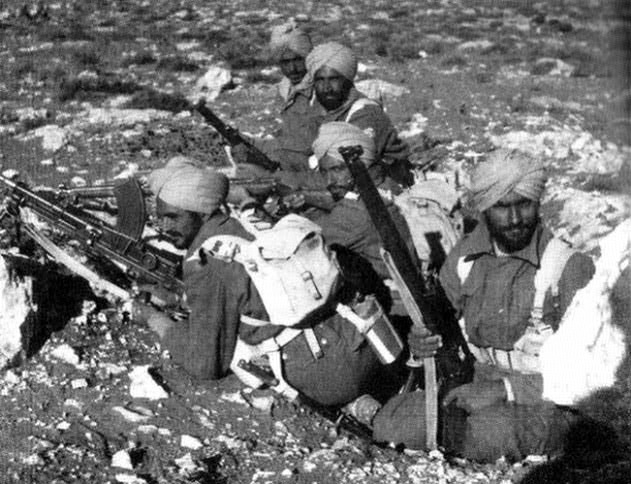
A group of Sikh soldiers from the British Indian Army during Operation Crusader.

A knocked-out German Panzer III Ausf. H from the 15th Panzerdivision in Libya.

Royal Air Force Operations in the Middle East and North Africa, 1939-1943. A petrol tanker and trailer on fire on the road between Homs and Misurata, Libya, after an attack by Bristol Blenheims interdicting enemy fuel supplies in support of Operation CRUSADER.

Royal Air Force Operations in the Middle East and North Africa, 1939-1943. Pilots of No. 80 Squadron RAF gather in front of one of their Hawker Hurricane Mark Is at a landing ground in the Western Desert, during Operation CRUSADER. In the middle of the group, wearing a white flying overall and smoking a pipe, is Squadron Leader M M Stephens, who commanded the Squadron from November until 9 December 1941 when he was shot down and wounded. During CRUSADER, 80 Squadron acted in close support of the Army, their Hurricane fighters being fitted with bomb racks to carry four 40 lb GP bombs, as seen here. Their first effective sorties as fighter-bombers were conducted against enemy vehicles south of Bir el Baheira on 20 November.

Royal Air Force Operations in the Middle East and North Africa, 1939-1943. Bombs exploding on Bardia and its harbour during a daylight attack by bombers of No. 3 Wing SAAF, in support of Operation CRUSADER.
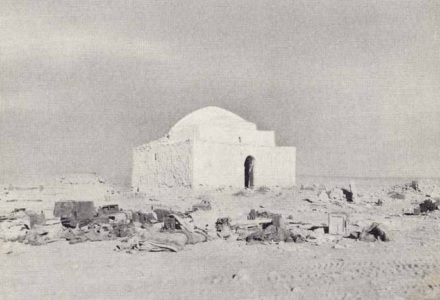
Senussi tomb south of Tobruk. Scenario of various combats during Operation Crusader

Battlefield remains at Sidi Regez, Western Desert, 1941
Historische Übersicht
Die Operation Crusader war eine militärische Operation der Alliierten im Zweiten Weltkrieg in Nordafrika. Sie dauerte vom 18. November 1941 bis zum 17. Januar 1942 und war der dritte, umfangreichste, längste und schließlich erfolgreiche Versuch, die Belagerung von Tobruk durch das Deutsche Afrikakorps zu brechen. In Deutschland und Italien wird manchmal auch die erfolgreiche Gegenoffensive vom 21. Januar bis 4. Februar 1942 hierzu gerechnet. Die chaotischen Kämpfe waren geprägt durch Logistikprobleme, Fehleinschätzungen, Kommunikationsprobleme und Kommandokrisen. Der Verlauf der Operation Crusader, mit ihren schnellen Vorstößen, räumlich ausgreifenden Bewegungen und ständig wechselnder Initiative veranschaulicht dabei wie keine andere militärische Operation die charakteristische Dynamik der Kämpfe in Nordafrika.
Fakten auf einen Blick
Großbritannien
- Befehlshaber: Claude Auchinleck
- Truppenstärke: 118000
- Verluste: ca. 17.000
Deutsches Afrikakorps
- Befehlshaber: Erwin Rommel
- Truppenstärke: 119000
- Verluste: ca. 38.000
Strategischer Kontext
Erster großer Rückschlag für das Afrikakorps.
Weiterführende Literatur


Red Famine: Stalin's War on Ukraine


Die Schlacht um Berlin und das Ende des Dritten Reichs 1945

Hunde, wollt ihr ewig leben: ein Stalingrad-Roman

Roter Hunger: Stalins Krieg gegen die Ukraine


Söldner ohne Sold: Die deutschen Freikorps 1918–1923

Vom Massensturm zur Stoßtrupptaktik: Die deutsche Landkriegtaktik im Spiegel von Dienstvorschriften und Publizistik 1906 bis 1918

Wir Wehr-Wölfe: Erinnerungen eines Freikorps-Führers

Zweiter Weltkrieg Erlebnisbericht Apokalypse Stalingrad: Untergang der 6. Armee 1942-1943
Walter Mönch
Rise And Fall Of The Third Reich
William Shirer
Historische Orte
Die interaktive Karte erfordert die Zustimmung zu Drittanbieter-Cookies.