Seegefecht bei Coronel
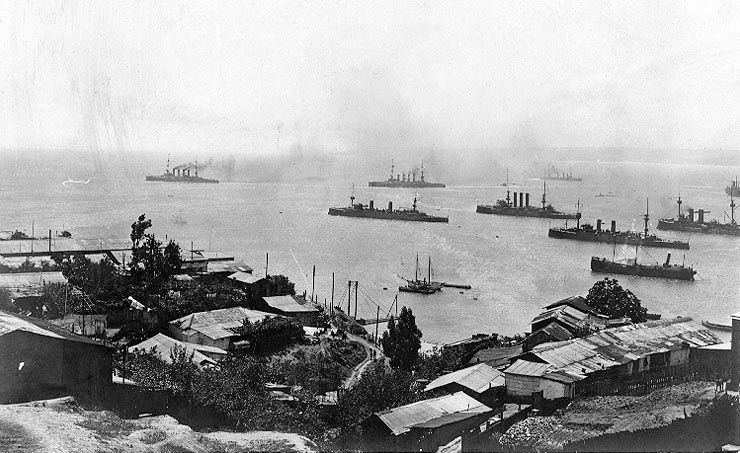
German Vice Admiral von Spee's cruiser squadron, leaving Valparaiso, Chile, circa 3 November 1914, following the Battle of Coronel. The German ships are in the distance, with the armored cruisers Scharnhorst and Gneisenau in the lead, followed by light cruiser Nürnberg. en:Chilean Navy warships in the middle distance include (from left to right): cruisers Esmeralda, O'Higgins and Blanco Encalda and old battleship Capitan Prat.

Map showing British and German ships and movements at the Battle of Coronel, 1 November 1914.

Бой у Коронеля 1 ноября 1914 года

Battle of Coronel map

Map of the Battle of Coronel, 1 November 1914. British ships & movements in red, German in blue.

Battle of Coronel
At the Battle of Coronel, the armoured cruiser HMS ‘Monmouth’ was set on fire during her encounter with the ‘Gneisenau’, the guns of the British ship being effectively out of range. She remained afloat after Admiral von Spee’s larger vessels lost contact in the dark at 20.00 hours. At about 21.20 she was found by the German light cruiser ‘Nürnberg’. ‘Monmouth’s’ engines were still running and her steering gear was undamaged. She did not haul down her flag nor return fire but seemed to be turning, either to ram her opponent or to bring her starboard guns to bear. ‘Nürnberg’ (on the left here) opened fire again and ‘Monmouth’ heeled over and capsized with the loss of all hands. It is this last moment which is dramatically depicted by Wyllie, with the technical inaccuracy that 'Monmouth's' forward turret had been blown over the side by the gunfire of the 'Gneisenau' but it still appears to be on the forecastle here. The 'Good Hope', flagship of Rear-Admiral Christopher Cradock had already been sunk about 20 minutes earlier, also with all hands, and only the other two British ships, the light cruiser 'Glasgow' and auxiliary cruiser 'Otranto', managed to make good an escape from von Spee's greatly superior force.
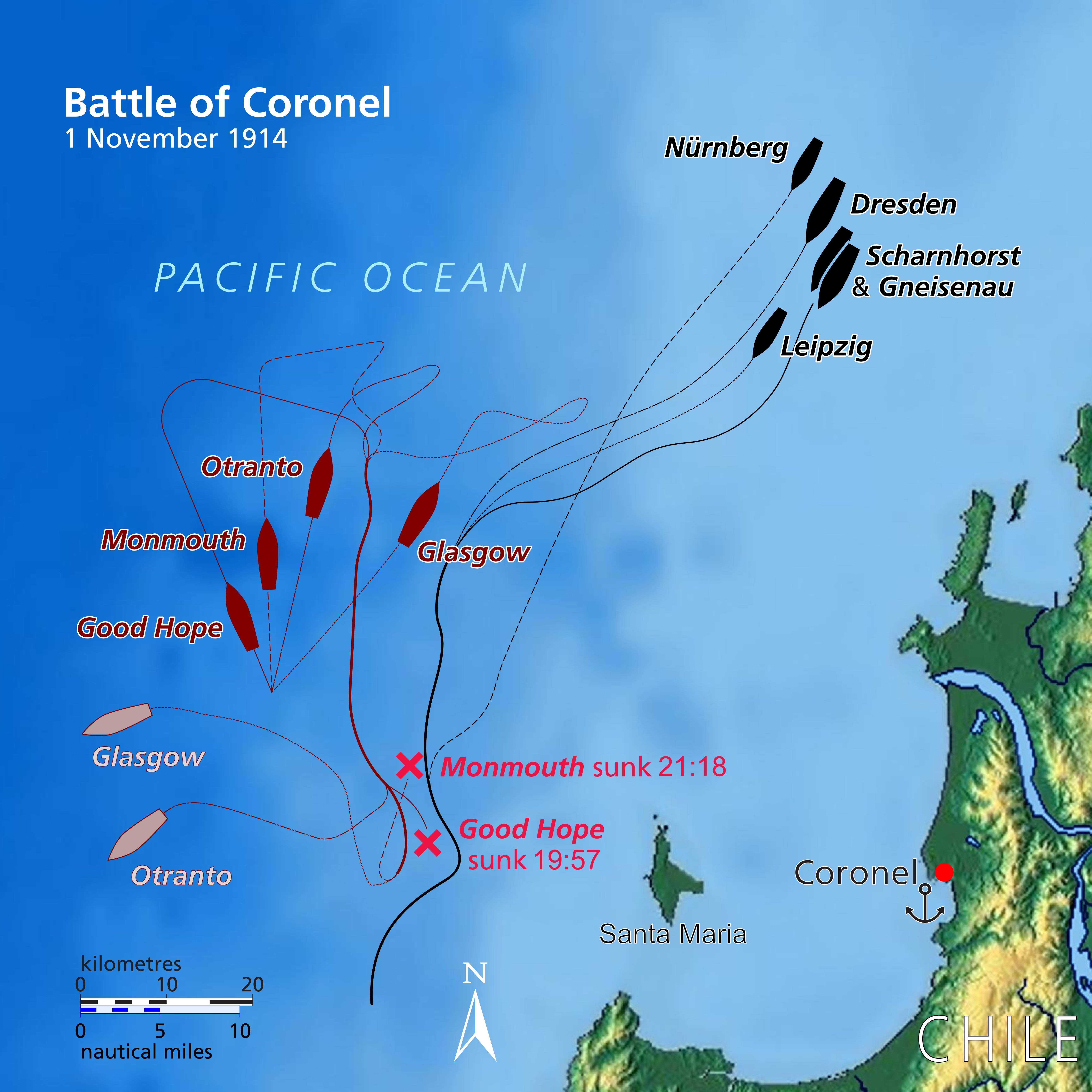
Map of the Battle of Coronel, 1 November 1914. British ships & movements in dark red, German in black.

Slaget ved Coronel 1. november 1914
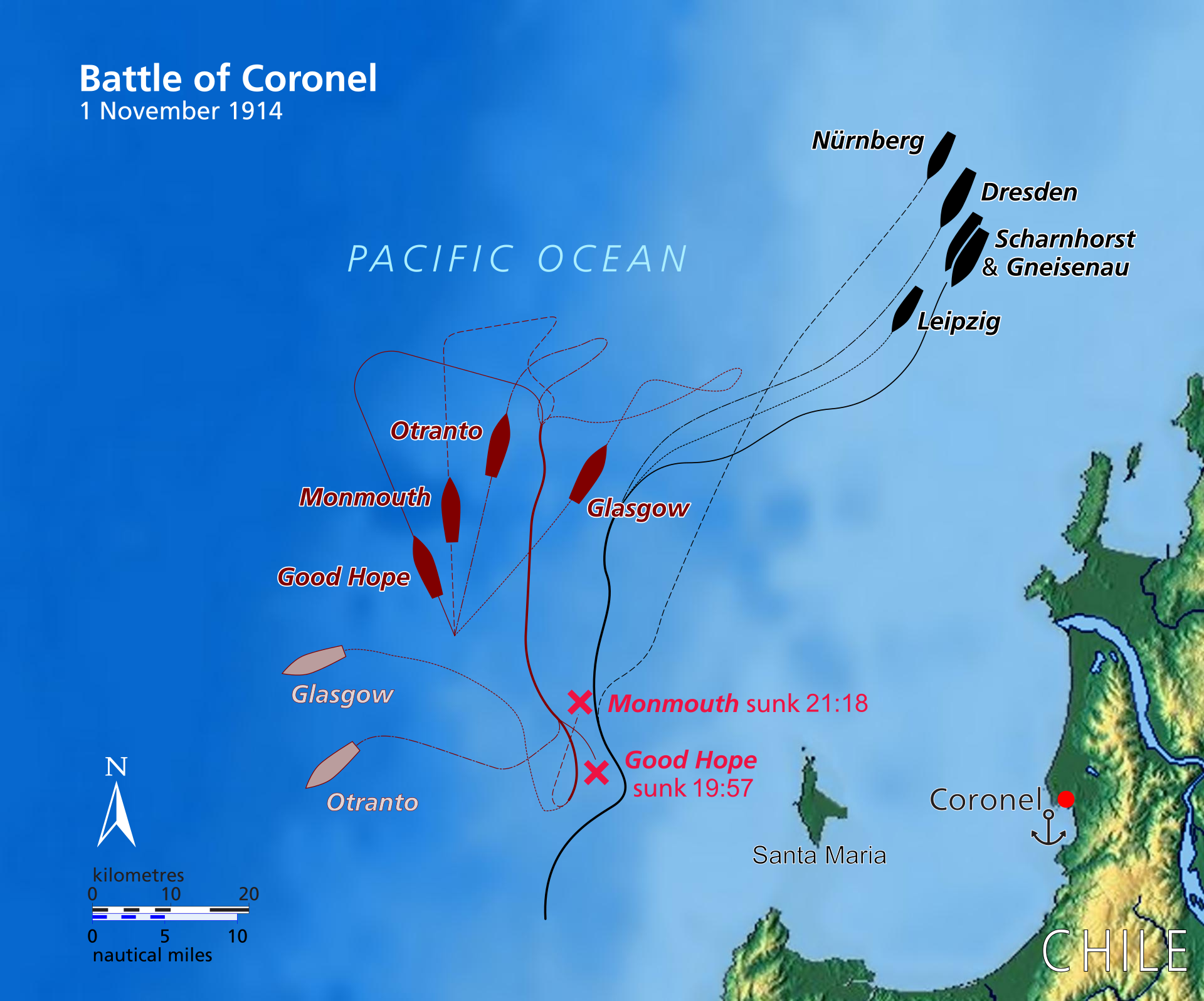
Map of the Battle of Coronel, 1 November 1914. British ships & movements in dark red, German in black.

Battle of Coronel map

Battle of Coronel, 1914-11-01

British and German Naval engagements off the coasts of South America

Royal Navy Captain Segrave was in command of the armed merchant cruiser HMS Orama when, together with HMS Glasgow and HMS Kent, it located and sank the German cruiser Dresden off the coast of Chile on 14 March 1915. Faces of the First World War Find out more about this First World War Centenary project at www.1914.org/faces. This image is from IWM Collections.

"Count Spee sinking Monmouth" : le croiseur léger allemand SMS Nürnberg (sur la gauche) achève le croiseur cuirassé britannique HMS Monmouth aux dernières heures de la bataille de Coronel, le 1er novembre 1914.

Battle of Coronel. Painting by Hans Bohrdt

Placa recordatoria de la Batalla de Coronel en la localidad del mismo nombre, en Chile Continental.

Placa recordatoria de la Batalla de Coronel en la localidad del mismo nombre, en Chile Continental.

Placa recordatoria de la Batalla de Coronel en la localidad del mismo nombre, en Chile Continental.

Placa recordatoria de la Batalla de Coronel en la localidad del mismo nombre, en Chile Continental.

Placa recordatoria de la Batalla de Coronel en la localidad del mismo nombre, en Chile Continental.
Rear-Admiral Christopher Cradock's flagship, HMS 'Good Hope', on fire before blowing up at the Battle of Coronel, 1 November 1914 Vice-Admiral Christopher Cradock’s flagship ‘Good Hope’ shown on fire, shortly before she exploded and sank with all hands during at the battle of Coronel. Her opponent 'Scharnhorst is outside the picture, her presence suggested by the splash of a shell. 'Gneisenau' is in the background to the right with the masts of 'Monmouth' seen through the smoke. ‘Good Hope’ was crewed with inexperienced reservists, and in the rough sea in which this action was fought, was effectively outgunned. The sunset sky behind the British ships meant that it was easier for the Germans to target their shells.

Royal Naval College of Canada plaque Battle of Coronel

Schlacht bei Coronel (1. November 1914), 2. Die Verfolgung

The destruction of HMS 'Good Hope' at the Battle of Coronel, 1 November 1914 This is a study of the armoured cruiser 'Good Hope', launched on 21 February 1901 and completed on 8 November 1902, meeting her end (with the loss of everyone on board) as flagship of Vice-Admiral Sir Christopher Cradock at the Battle of Coronel , off the southern coast of Chile, on 1 November 1914, at the hands of the German Pacific squadron of Maximilian von Spee.
Historische Übersicht
Das Seegefecht bei Coronel zwischen dem deutschen Ostasiengeschwader und einem Geschwader der Royal Navy trug sich am 1. November 1914 in neutralen Gewässern vor Coronel zu. Die Seeschlacht vor der Küste Chiles lieferten sich Vizeadmiral Maximilian Graf von Spee und Konteradmiral Sir Christopher Cradock. Beteiligte Schiffe waren auf deutscher Seite die Großen Kreuzer Scharnhorst und Gneisenau sowie die Kleinen Kreuzer Leipzig und Dresden. Auf britischer Seite kämpften die Panzerkreuzer Good Hope und Monmouth, der Leichte Kreuzer Glasgow und der Hilfskreuzer Otranto. Der deutsche Kleine Kreuzer Nürnberg traf gegen Ende des Gefechts ein, während das alte und langsame britische Linienschiff Canopus das Seegebiet nicht rechtzeitig erreichte. Die Schlacht endete mit der ersten größeren Niederlage der Royal Navy seit einem Jahrhundert.
Fakten auf einen Blick
Kaiserliche Marine
- Befehlshaber: Maximilian v. Spee
- Truppenstärke: 5 Kreuzer
- Verluste: 3 Verletzte
Royal Navy
- Befehlshaber: Christopher Cradock †
- Truppenstärke: 4 Kreuzer
- Verluste: 1.600 Tote
Strategischer Kontext
Deutsches Ostasiengeschwader vernichtet britisches Geschwader.
Weiterführende Literatur

Revolutionary Spring: Fighting for a New World 1848-1849
Christopher Clark

Spanish-American War: A Captivating Guide to the War Between the United States of America and Spain along with The Philippine–American War that Followed

The Philippine–American War

Frühling der Revolution: Europa 1848/49 und der Kampf für eine neue Welt
Christopher Clark

Risorgimento! Italiens Kampf um die Einheit im 19. Jahrhundert
Historische Orte
Die interaktive Karte erfordert die Zustimmung zu Drittanbieter-Cookies.