Operation Cobra

Organization of VII, VIII, and XIX U.S. Army Corps during Operation Cobra 25 July 1944
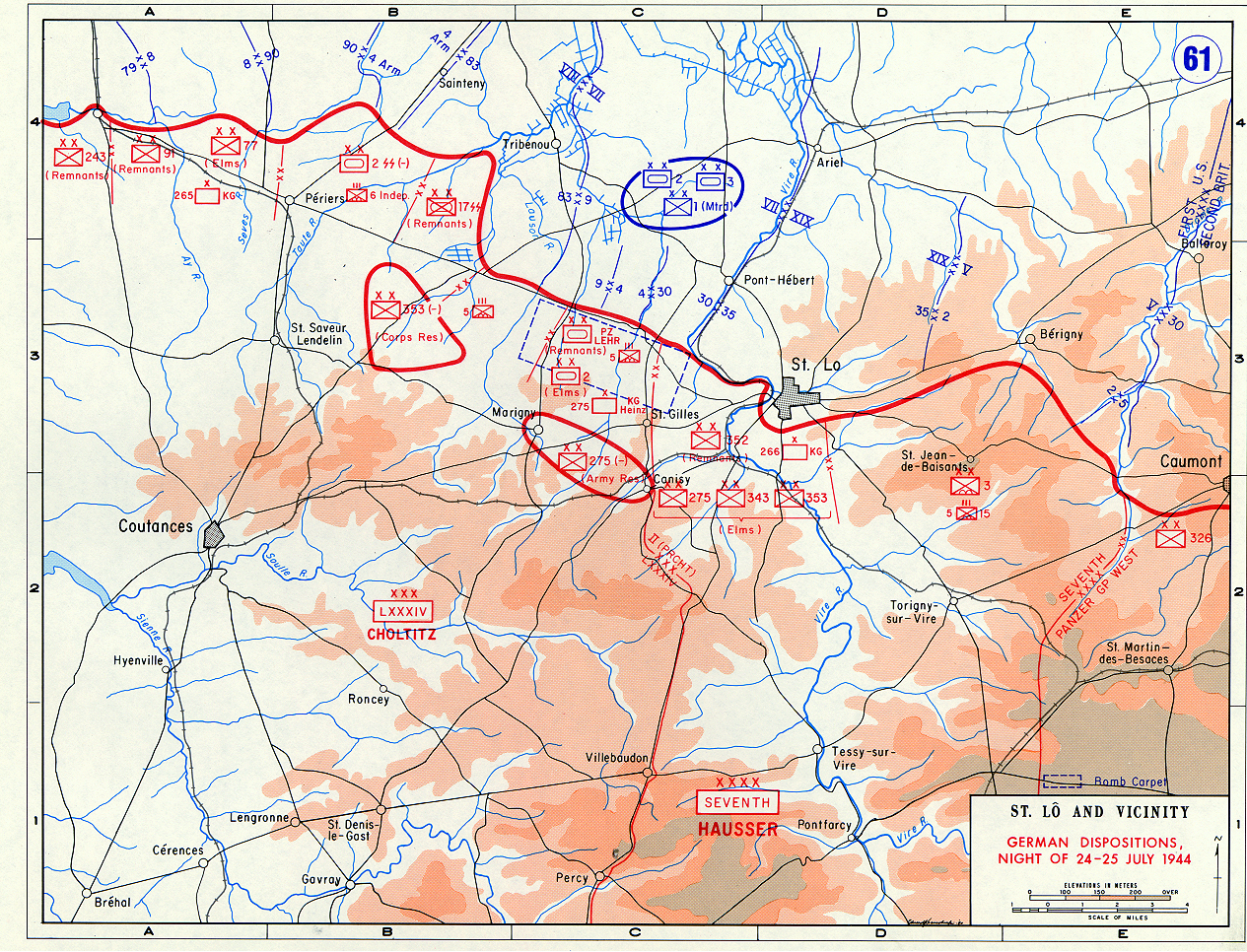
Saint Lo and Vicinity

Saint Lo and Vicinity - Operation Cobra - 25-29 July 1944.Background information: In 1938 the predecessors of what is today The Department of History at the United States Military Academy began developing a series of campaign atlases to aid in teaching cadets a course entitled, "History of the Military Art." Since then, the Department has produced over six atlases and more than one thousand maps, encompassing not only America’s wars but global conflicts as well. In keeping abreast with today's technology, the Department of History is providing these maps on the internet as part of the department's outreach program. The maps were created by the United States Military Academy’s Department of History and are the digital versions from the atlases printed by the United States Defense Printing Agency. We gratefully acknowledge the accomplishments of the department's former cartographer, Mr. Edward J. Krasnoborski, along with the works of our present cartographer, Mr. Frank Martini.

U.S. tanks pass through the wrecked streets of Coutances, France. This illustration was created using Adobe Photoshop, with added yellow box and text to highlight the significance of Operation Cobra and V Corps' contributions, and the photo was colorized using Photoshop restoration tools. (U.S. Army illustration by Tyler Brock)
Historische Übersicht
Die Operation Cobra war eine Offensive der alliierten Streitkräfte im Zweiten Weltkrieg an der Westfront im deutsch besetzten Frankreich. Sie dauerte vom 25. Juli bis zum 4. August 1944 und bedeutete den Ausbruch aus dem Normandie-Brückenkopf, der nach der Landung der Alliierten an der Küste der Normandie entstanden war. Die Operationen Cobra und Neptune waren Bestandteile der Operation Overlord.
Fakten auf einen Blick
US 5. Armee
- Befehlshaber: George S. Patton
- Truppenstärke: 160000
- Verluste: 5000
Wehrmacht
- Befehlshaber: G. v. Kluge
- Truppenstärke: 100000
- Verluste: hoch
Strategischer Kontext
Übergang vom Brückenkopf zum Bewegungskrieg.
Weiterführende Literatur


Red Famine: Stalin's War on Ukraine


Die Schlacht um Berlin und das Ende des Dritten Reichs 1945

Hunde, wollt ihr ewig leben: ein Stalingrad-Roman

Roter Hunger: Stalins Krieg gegen die Ukraine


Söldner ohne Sold: Die deutschen Freikorps 1918–1923

Vom Massensturm zur Stoßtrupptaktik: Die deutsche Landkriegtaktik im Spiegel von Dienstvorschriften und Publizistik 1906 bis 1918

Wir Wehr-Wölfe: Erinnerungen eines Freikorps-Führers

Zweiter Weltkrieg Erlebnisbericht Apokalypse Stalingrad: Untergang der 6. Armee 1942-1943
Walter Mönch
Rise And Fall Of The Third Reich
William Shirer
Historische Orte
Die interaktive Karte erfordert die Zustimmung zu Drittanbieter-Cookies.