Schlacht von Cambrai

For documentary purposes the German Federal Archive often retained the original image captions, which may be erroneous, biased, obsolete or politically extreme. I. Weltkrieg 1914-1918 Tank-Bergungskommando bei Bourlon
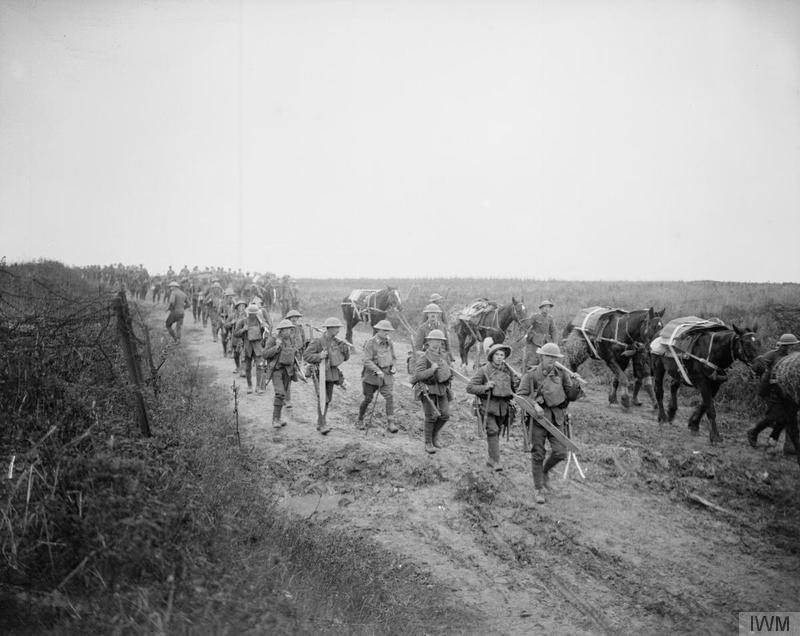
The Battle of Cambrai, November-december 1917 Men of the 16th Battalion, Royal Irish Rifles (Pioneers of the 36th Ulster Division) moving forward along the Ribecourt road, 20 November 1917.
![A tank leads the infantry into action and breaks down the wire entanglements. 1915.
Collection: The photographs appear in a variety of sizes, shapes and colours including shades of blue, green and brown. They record scenes of military life as experienced by the Indian and British armies in France during the First World War. The battle scenes are not real but staged from maneouvres.
Added: The image of the tank has been left-right inverted.
A stereo card version of this photograph was issued as #106 in set 200-3 of stereographs of the Great War issued after the war by Girdwood's company Realistic Travels - [1]
An equivalent (or at least highly similar) photograph was issued as #139 of Volume 2 of a set of 600 stereographs of the war. [2], as "Our monster tanks break down the belts of barbed wire and completely surprise the Hun at Cambrai".](https://upload.wikimedia.org/wikipedia/commons/c/c0/A_tank_leads_the_infantry_into_action_and_breaks_down_the_wire_entanglements_%281917%29_-_India_Office_Official_Record_of_the_Great_War_%281921%29_-_BL_Photo_21-153.jpg)
A tank leads the infantry into action and breaks down the wire entanglements. 1915. Collection: The photographs appear in a variety of sizes, shapes and colours including shades of blue, green and brown. They record scenes of military life as experienced by the Indian and British armies in France during the First World War. The battle scenes are not real but staged from maneouvres. Added: The image of the tank has been left-right inverted. A stereo card version of this photograph was issued as #106 in set 200-3 of stereographs of the Great War issued after the war by Girdwood's company Realistic Travels - [1] An equivalent (or at least highly similar) photograph was issued as #139 of Volume 2 of a set of 600 stereographs of the war. [2], as "Our monster tanks break down the belts of barbed wire and completely surprise the Hun at Cambrai".

For documentary purposes the German Federal Archive often retained the original image captions, which may be erroneous, biased, obsolete or politically extreme. I. Weltkrieg 1914-1918 Fontaine verladen von englischen Tanks
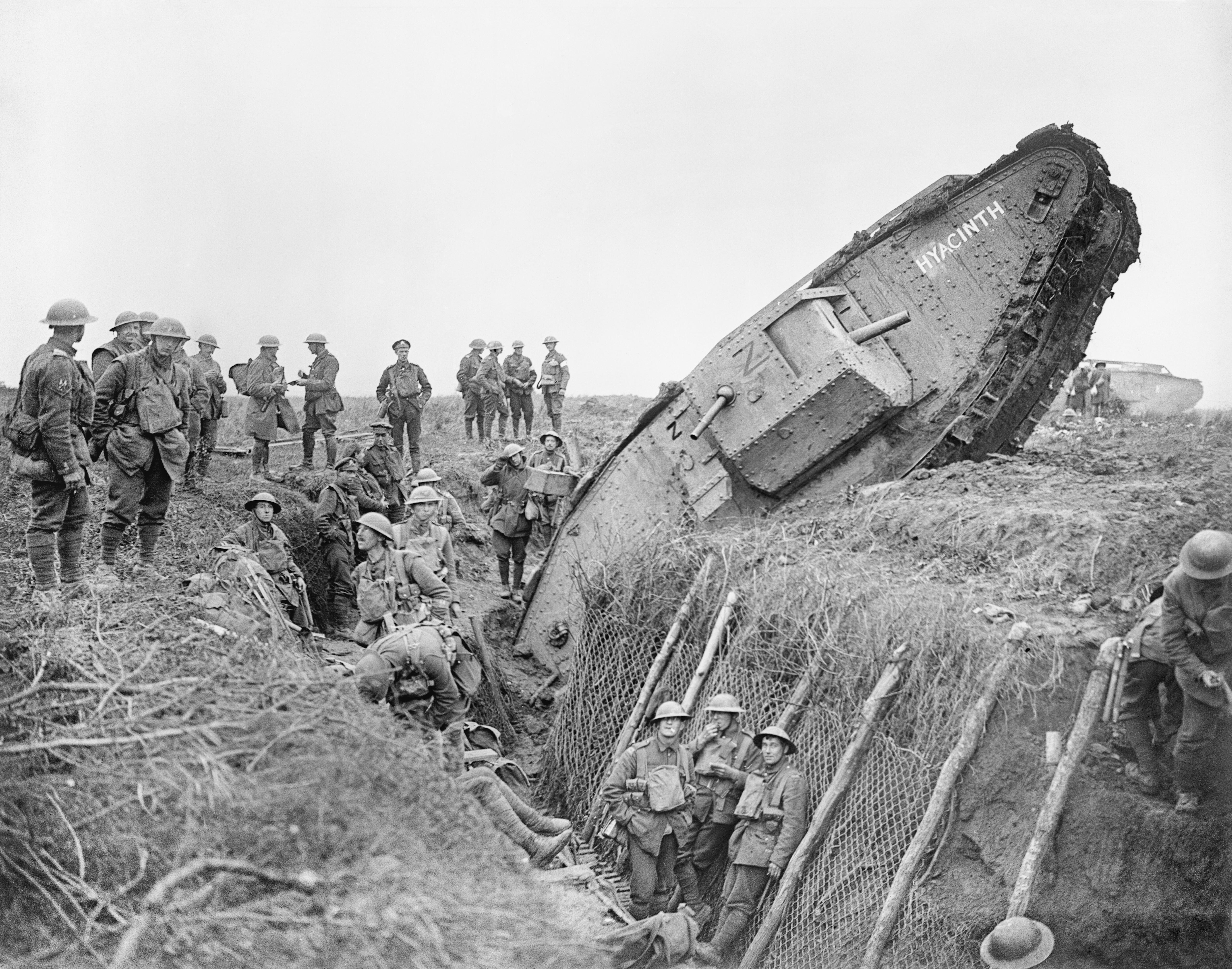
A Mark IV (Male) tank of 'H' Battalion, 'Hyacinth', ditched in a German trench while supporting 1st Battalion, Leicestershire Regiment near Ribecourt during the Battle of Cambrai, 20 November 1917. A Mark IV (Male) tank of ‘H’ Battalion ditched in a German trench while supporting the 1st Battalion, Leicestershire Regiment, one mile west of Ribecourt. Some men of the battalion are resting in the trench, 20 November 1917.

Det ... förlorade stora tanksslaget vid Cambrai i oktober fick befintliga engelska pansartanks borttransporteras med järnväg.

Front page of The Daily Mirror, January 17, 1918: ‘How the Germans saw the tanks’
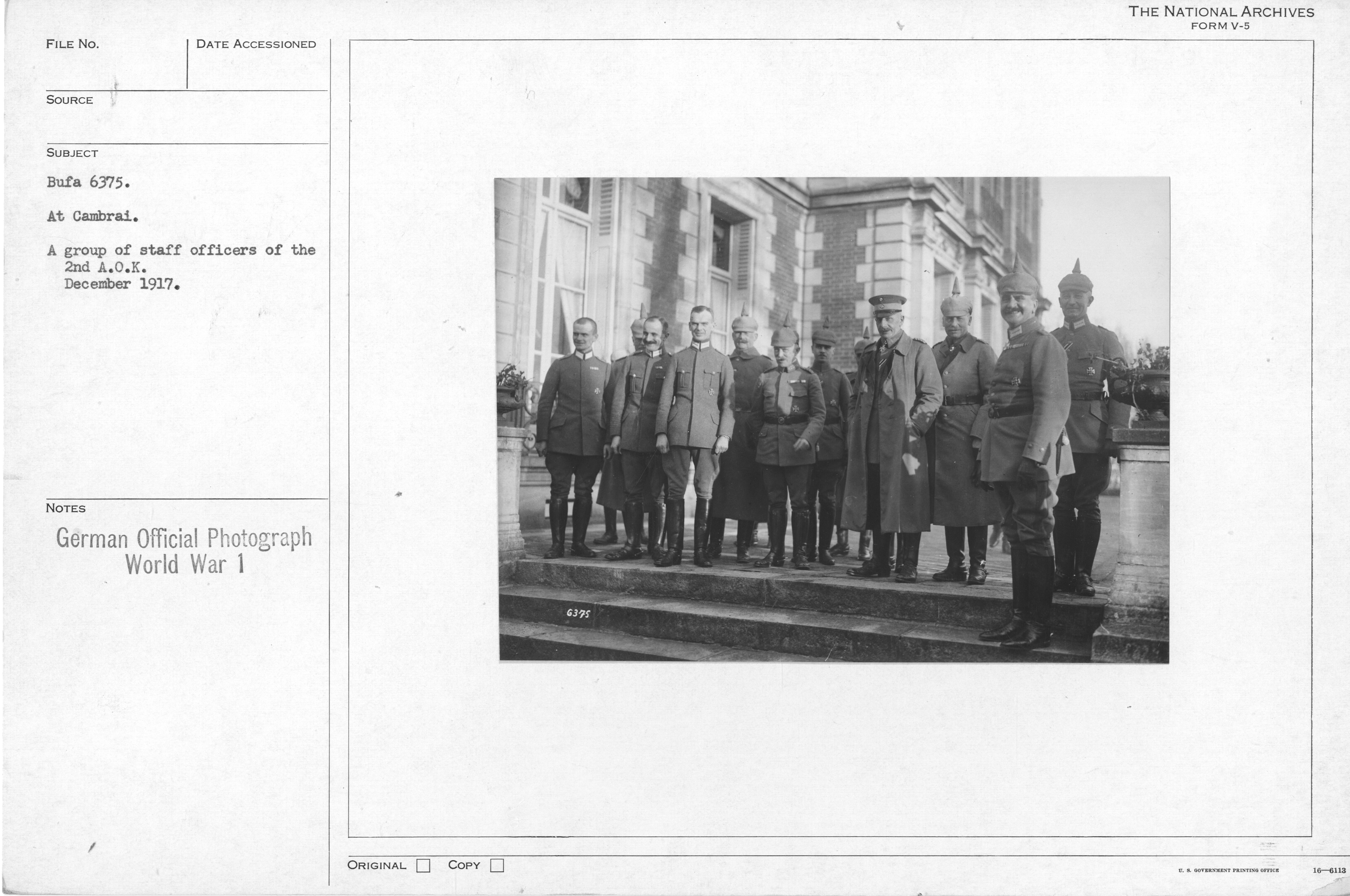
At Cambrai. A group of staff officers of the 2nd A.O.K. December 1917

Battle of Cambrai, November-december 1917 A German howitzer captured by the 1st/7th Gordon Highlanders, 51st Division at Flesquieres in its emplacement. 24 November, 1917. (2015 Comment: This is a "21 cm Turmhaubitze M 1891" as it was made by Krupp for the belgian forts Liege, Namur and Antwerp, converted to field guns by the Imperial German Army after they had captured the forts.)

Battle of Cambrai, November-december 1917 A German howitzer captured by the 1st/7th Gordon Highlanders, 51st Division at Flesquieres in its emplacement. 24 November, 1917. (2015 Comment: This is a "21 cm Turmhaubitze M 1891" as it was made by Krupp for the belgian forts Liege, Namur and Antwerp, converted to field guns by the Imperial German Army after they had captured the forts.)

IWM caption : A British Salvage Tank loaded aboard flat-bed railway trucks at Plateau Station in preparation for transportation to the forward area prior to the opening of the Battle of Cambrai. Plateau Station, also known as the Loop Station, was on the New Maricourt military railway line. Another name for this British rail network was the Plateau Line. Comment : These salvage vehicles were varients of the Gun Carrier Mark I.
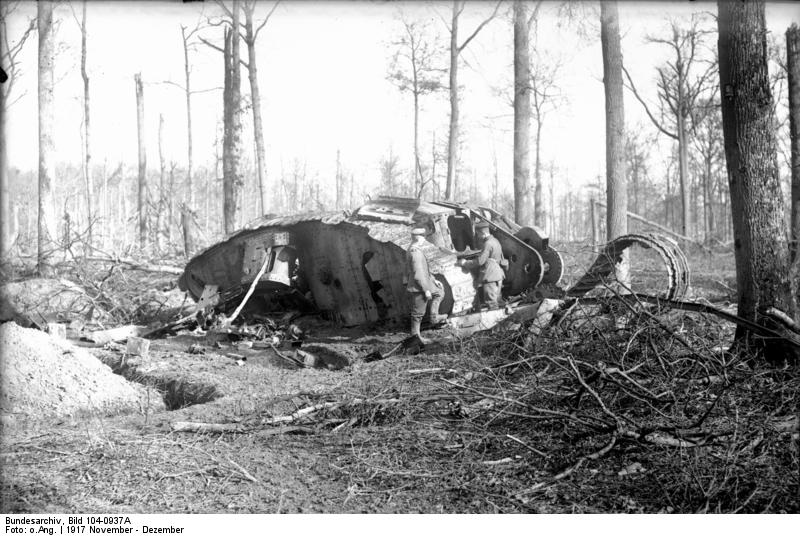
For documentary purposes the German Federal Archive often retained the original image captions, which may be erroneous, biased, obsolete or politically extreme. I. Weltkrieg 1914-1918 Gesprengter englischer Tank im Bourlon-Wald

For documentary purposes the German Federal Archive often retained the original image captions, which may be erroneous, biased, obsolete or politically extreme. I. Weltkrieg 1914-1918 Moenvres durch Volltreffer zerstörter englischer Tank

For documentary purposes the German Federal Archive often retained the original image captions, which may be erroneous, biased, obsolete or politically extreme. I. Weltkrieg 1914-1918 Moenvres Tank beim Überqueren eines Schützengrabens

For documentary purposes the German Federal Archive often retained the original image captions, which may be erroneous, biased, obsolete or politically extreme. I. Weltkrieg 1914-1918 Moenvres Gruppe von Tanks

For documentary purposes the German Federal Archive often retained the original image captions, which may be erroneous, biased, obsolete or politically extreme. I. Weltkrieg 1914-1918 Bonrlon Tank in der Falle

For documentary purposes the German Federal Archive often retained the original image captions, which may be erroneous, biased, obsolete or politically extreme. I. Weltkrieg 1914-1918 Tank bei Banteux

This appears to show a battery of 10 cm K 14 (10 cm field gun model 1914) in action.

For documentary purposes the German Federal Archive often retained the original image captions, which may be erroneous, biased, obsolete or politically extreme. Zerstörter englischer Tank in den Ruinen von Fontaine-Notre-Dame, 4 km westl. Cambrai (Nordfrankreich), Nov. 1917

For documentary purposes the German Federal Archive often retained the original image captions, which may be erroneous, biased, obsolete or politically extreme. Der Kaiser bei den siegreichen Cambrai-Kämpfern. Der Kaiser, rechts Exz. v. d. Marwitz und links vom Kaiser Kronprinz Rupprecht von Bayern auf dem Wege zur Truppenbesichtigung. Aufgenommen durch: Filmtrupp No. 7 Ort: Bei Cambrai Zeit: Dezember 1917

For documentary purposes the German Federal Archive often retained the original image captions, which may be erroneous, biased, obsolete or politically extreme. Res. Inf. Rgt. 120 Cambraistellung, M.G. in Bereitsch. Stellg.
![For documentary purposes the German Federal Archive often retained the original image captions, which may be erroneous, biased, obsolete or politically extreme. Bild- und Filmamt:
Die verlorene Tankschlacht der Enländer bei Cambrai. Erbeuteter eng[lischer] Tank an der Strasse Cambrai-Bapaume.
Herausgegeben: Dezember 1917](https://upload.wikimedia.org/wikipedia/commons/b/bf/Bundesarchiv_Bild_146-1981-134-14A%2C_bei_Cambrai%2C_erbeuteter_englischer_Panzer.jpg)
For documentary purposes the German Federal Archive often retained the original image captions, which may be erroneous, biased, obsolete or politically extreme. Bild- und Filmamt: Die verlorene Tankschlacht der Enländer bei Cambrai. Erbeuteter eng[lischer] Tank an der Strasse Cambrai-Bapaume. Herausgegeben: Dezember 1917
![For documentary purposes the German Federal Archive often retained the original image captions, which may be erroneous, biased, obsolete or politically extreme. Bild- und Filmamt
Die verlorene Tankschlacht der Engländer bei Cambrai.
Verladen (mit eigener Kraft) der erbeuteten engl [lischen] Tanks](https://upload.wikimedia.org/wikipedia/commons/9/99/Bundesarchiv_Bild_146-1981-134-23A%2C_bei_Cambrai%2C_erbeutete_Tanks.jpg)
For documentary purposes the German Federal Archive often retained the original image captions, which may be erroneous, biased, obsolete or politically extreme. Bild- und Filmamt Die verlorene Tankschlacht der Engländer bei Cambrai. Verladen (mit eigener Kraft) der erbeuteten engl [lischen] Tanks

For documentary purposes the German Federal Archive often retained the original image captions, which may be erroneous, biased, obsolete or politically extreme. Die verlorene Tankschlacht der Engländer bei Cambrai. Aufnahmen einer Reihe der zahlreichen erbeuteten Tanks. Im wiedereroberten Fontaine. Drei zerschossene engl. Tanks im Gelände vor Fontaine. Filmtrupp No. 7 Ort: Fontaine Zeit: Dezember 1917 6311 BUFA

For documentary purposes the German Federal Archive often retained the original image captions, which may be erroneous, biased, obsolete or politically extreme. Tankschlacht von Cambrai 1917, zerstörte Tanks in der Nähe des Dorfes Bourlon.

For documentary purposes the German Federal Archive often retained the original image captions, which may be erroneous, biased, obsolete or politically extreme. zerschossene Tanks in der Nähe von Bourlon, November 1917
Historische Übersicht
Die Schlacht von Cambrai im Ersten Weltkrieg war die erste große Panzeroffensive der Geschichte. Sie begann am 20. November 1917 nahe dem strategisch wichtigen Eisenbahnknotenpunkt Cambrai in Frankreich, 1917 eine Schlüsselversorgungsstellung für die deutsche Siegfriedstellung. Die Briten erhofften sich von dieser Schlacht nicht nur einen Durchbruch durch das deutsche Stellungssystem, sondern vor allem, dem Kriegsverlauf durch den Einsatz von Panzern eine entscheidende Wende zugunsten der Entente zu geben. Seit mehr als drei Jahren standen die Frontlinien mehr oder weniger still, und Millionen von Soldaten waren bei oftmals ergebnislosen Frontalangriffen gefallen. Die Entente wollte nun Ende 1917 mit Unterstützung neuer Waffentechniken und den USA als neuem Verbündeten vom Stellungskrieg in einen Bewegungskrieg gegen Deutschland übergehen – somit sah man die Schlacht von Cambrai als Auftakt zur endgültigen Niederringung des Deutschen Kaiserreiches.
Fakten auf einen Blick
Allianz (GB/NL/DE)
- Befehlshaber: Julian Byng
- Truppenstärke: ca. 476 Tanks
- Verluste: ca. 44.000
Deutsches Kaiserreich
- Befehlshaber: Georg v. d. Marwitz
- Truppenstärke: ca. 20 Div.
- Verluste: ca. 45.000
Strategischer Kontext
Durchbrechen der Hindenburg-Linie mittels neuer Technologie.
Weiterführende Literatur


Red Famine: Stalin's War on Ukraine


Die Schlacht um Berlin und das Ende des Dritten Reichs 1945

Hunde, wollt ihr ewig leben: ein Stalingrad-Roman

Roter Hunger: Stalins Krieg gegen die Ukraine


Söldner ohne Sold: Die deutschen Freikorps 1918–1923

Vom Massensturm zur Stoßtrupptaktik: Die deutsche Landkriegtaktik im Spiegel von Dienstvorschriften und Publizistik 1906 bis 1918

Wir Wehr-Wölfe: Erinnerungen eines Freikorps-Führers

Zweiter Weltkrieg Erlebnisbericht Apokalypse Stalingrad: Untergang der 6. Armee 1942-1943
Walter Mönch
Rise And Fall Of The Third Reich
William Shirer
Historische Orte
Die interaktive Karte erfordert die Zustimmung zu Drittanbieter-Cookies.