Unternehmen Bodenplatte

A German Focke-Wulf Fw 190D-9 of Jagdgeschwader 54 after a forced landing near Brussels, Belgium, on 1 January 1945.

Royal Air Force Bomber Command, 1942-1945. Fire crews cover an Avro Lancaster of Bomber Command with foam in an effort to save it from burning, at B58/Melsbroek, Belgium, following the attack on the airfield by Luftwaffe fighter-bombers, (Operation BODENPLATTE).

A German Focke-Wulf Fw 190 that crash landed at Sint-Truiden Airfield (A-92), Belgium, during "Operation Bodenplatte" on 1 January 1945. Mechanics of the 404th Fighter Group (USAAF) fixed up the plane and painted it bright red and decorated it with American markings.

A crashed German Focke-Wulf Fw 190 D-9 (W.Nr. 210194) of Stab I./JG 2 near Dorff/Stolberg, south-east of Aachen, Germany. Pilot Fw Werner Hohenburg was hit by flak during "Operation Bodenplatte" on 1 January 1945 and was taken prisoner. Note: The village "Munster" in the original description refers to "Kornelimünster" near Dorff.

Royal Air Force Transport Command, 1943-1945. A Douglas Dakota of RAF Transport Command, destroyed during the attack on B58/Melsbroek, Belgium, by Luftwaffe fighter-bombers (Operation BODENPLATTE), burns itself out in front of the hangars.

Focke Wulf Fw 190 A-8 of JG 4, flown Pvt. Wagner; the aircraft was downed by american anti-aircraft fire during operation "Bodenplatte". It was captured by american troops after making an emergency landing. The ETC 501 was removed and the engine repaired for ground trials.
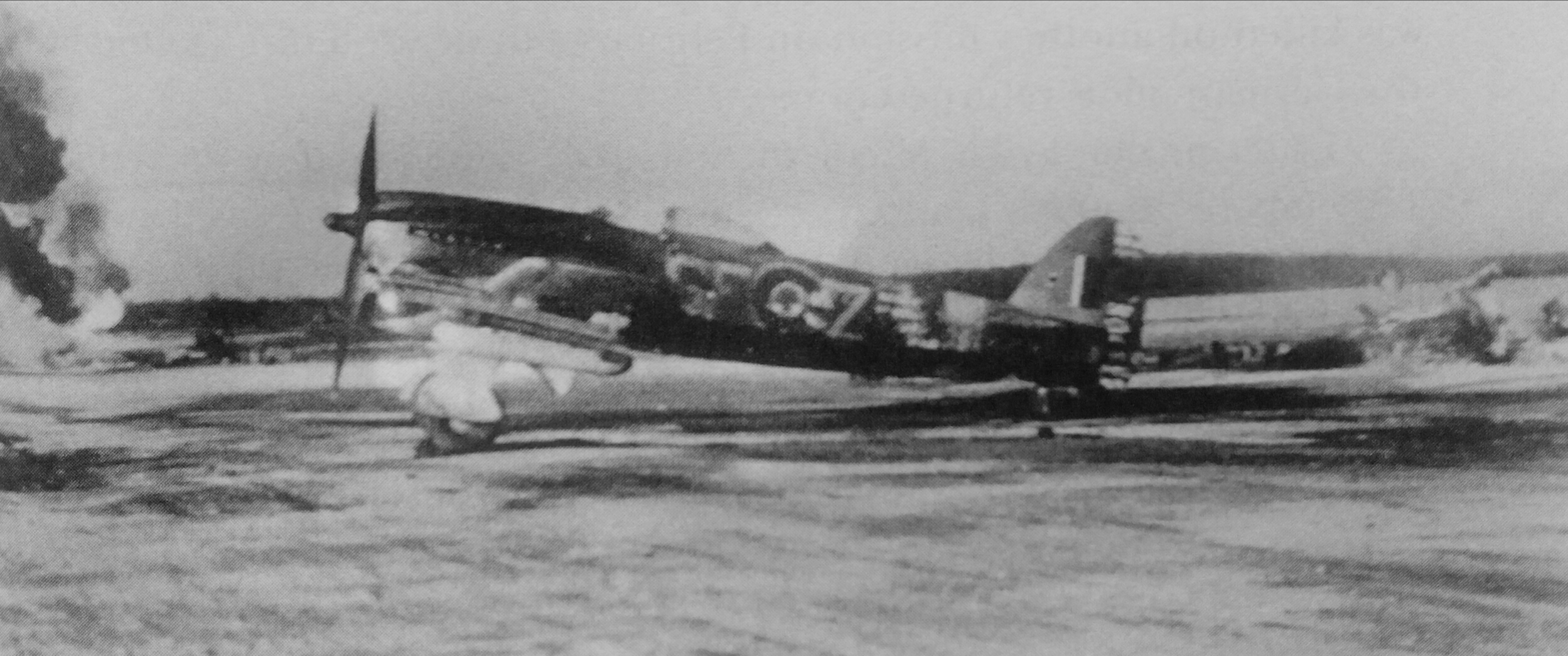
Hawker Typhoon du Squadron 137 endommagé sur la base d'Eindhoven après l'opération Bodenplatte.

Royal Air Force- 2nd Tactical Air Force, 1943-1945. Fire crews attempt to extinguish the last fires among burnt-out North American Mitchells of No. 139 Wing RAF at B58/Melsbroek, Belgium, after the major daylight attack on the airfield by Luftwaffe fighter-bombers, (Operation BODENPLATTE).

Royal Air Force- 2nd Tactical Air Force, 1943-1945. A Supermarine Spitfire PR Mark XI of No. 39 (PR) Wing taxying at B78/Eindhoven, Holland, seen through a roll of square mesh type tracking. To the right of the aircraft lies the wreckage of another Spitfire PR Mark XI, destroyed during the Luftwaffe attack on the airfield on 1 January 1945 (Operation BODENPLATTE).
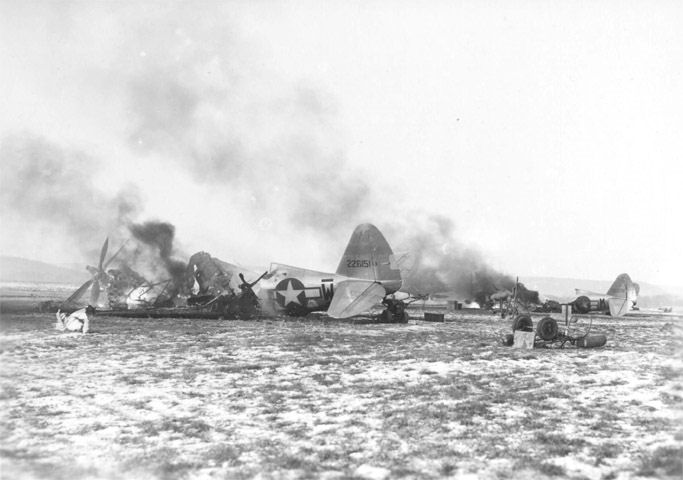
Y-34 Metz Airfield - Destroyed P-47s Operation Bodenplatte
Historische Übersicht
Das Unternehmen Bodenplatte fand am 1. Januar 1945 statt. Etwa 850 Jagdflugzeuge der deutschen Luftwaffe griffen Flugplätze der West-Alliierten in den Niederlanden, Belgien und Frankreich an. Die Luftwaffe plante, bei diesem Angriff 17 feindliche Frontflugplätze zu zerstören. Einige hundert alliierte Flugzeuge wurden zerstört oder beschädigt. Es war aber ein Pyrrhussieg: Die Verluste der Luftwaffe und die Verluste an erfahrenen Piloten waren hoch, knappe Kraftstoffvorräte wurden aufgebraucht.
Fakten auf einen Blick
Wehrmacht (Luft/See)
- Befehlshaber: Dietrich Pelz
- Truppenstärke: ca. 1.000 Flzg.
- Verluste: ca. 300 Flzg.
Allierte Luftstreitkr.
- Befehlshaber: -
- Truppenstärke: -
- Verluste: ca. 450 Flzg.
Strategischer Kontext
Versuch, die alliierte Luftüberlegenheit zu brechen.
Weiterführende Literatur


Red Famine: Stalin's War on Ukraine


Die Schlacht um Berlin und das Ende des Dritten Reichs 1945

Hunde, wollt ihr ewig leben: ein Stalingrad-Roman

Roter Hunger: Stalins Krieg gegen die Ukraine


Söldner ohne Sold: Die deutschen Freikorps 1918–1923

Vom Massensturm zur Stoßtrupptaktik: Die deutsche Landkriegtaktik im Spiegel von Dienstvorschriften und Publizistik 1906 bis 1918

Wir Wehr-Wölfe: Erinnerungen eines Freikorps-Führers

Zweiter Weltkrieg Erlebnisbericht Apokalypse Stalingrad: Untergang der 6. Armee 1942-1943
Walter Mönch
Rise And Fall Of The Third Reich
William Shirer
Historische Orte
Die interaktive Karte erfordert die Zustimmung zu Drittanbieter-Cookies.