Belagerung von Orléans
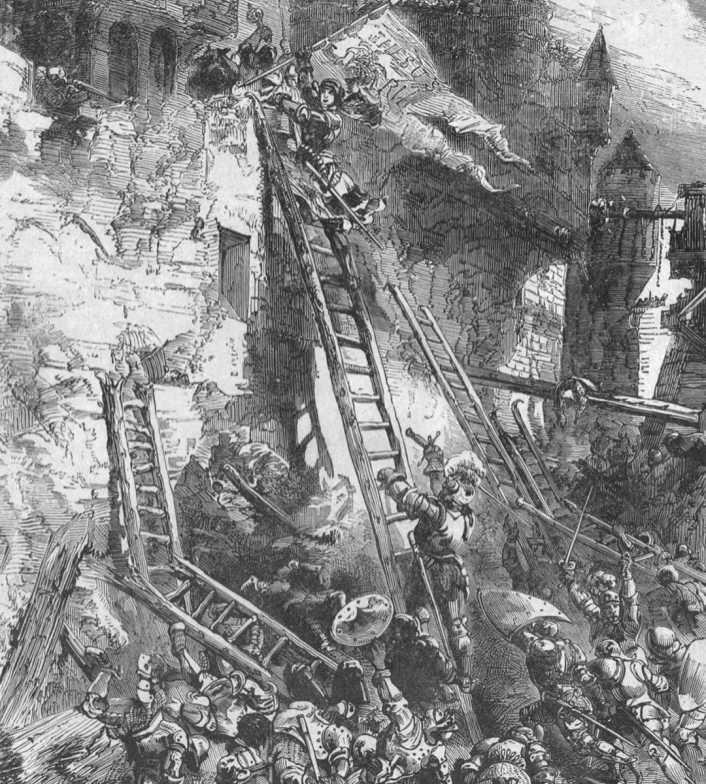
Взятие Турели

Jeanne d'Arc.

Jeanne d'Arc blessée durant le siège d'Orléans, gravure de Félix-Jean Gauchard, 1875.
![Jeanne d'Arc at the Siege of Orléans by Jules Eugène Lenepveu, painted 1886–1890. The painting is a highly romanticized representation. Jeanne did not wear plate mail; according to the testimony at her trial [1]:
Jeanne put off and entirely abandoned woman's clothes; with her hair cropped short and round like a young fop's, she wore shirt, breeches, doublet, with hose joined together and fastened to the said doublet by 20 points, long leggings laced on the outside, a short mantle reaching to the knees, or thereabouts, a close-cut cap, tightfitting boots and buskins, long spurs, sword, dagger, breastplate, lance and other arms in the style of a man-at-arms, with which she performed actions of war and affirmed that she was fulfilling the commands of God as they had been revealed to her.
The banner matches the description given at her trial:
Asked whether, when she went to Orléans, she had a standard or banner and what color it was, she answered she had a banner, with a field sown with lilies; the world was depicted on it, and two angels, one at each side; it was white, of white linen or boucassin, and on it were written, she thought, these names, Jhesus Maria; and it was fringed with silk.](https://upload.wikimedia.org/wikipedia/commons/e/e9/Lenepveu%2C_Jeanne_d%27Arc_au_si%C3%A8ge_d%27Orl%C3%A9ans.jpg)
Jeanne d'Arc at the Siege of Orléans by Jules Eugène Lenepveu, painted 1886–1890. The painting is a highly romanticized representation. Jeanne did not wear plate mail; according to the testimony at her trial [1]: Jeanne put off and entirely abandoned woman's clothes; with her hair cropped short and round like a young fop's, she wore shirt, breeches, doublet, with hose joined together and fastened to the said doublet by 20 points, long leggings laced on the outside, a short mantle reaching to the knees, or thereabouts, a close-cut cap, tightfitting boots and buskins, long spurs, sword, dagger, breastplate, lance and other arms in the style of a man-at-arms, with which she performed actions of war and affirmed that she was fulfilling the commands of God as they had been revealed to her. The banner matches the description given at her trial: Asked whether, when she went to Orléans, she had a standard or banner and what color it was, she answered she had a banner, with a field sown with lilies; the world was depicted on it, and two angels, one at each side; it was white, of white linen or boucassin, and on it were written, she thought, these names, Jhesus Maria; and it was fringed with silk.
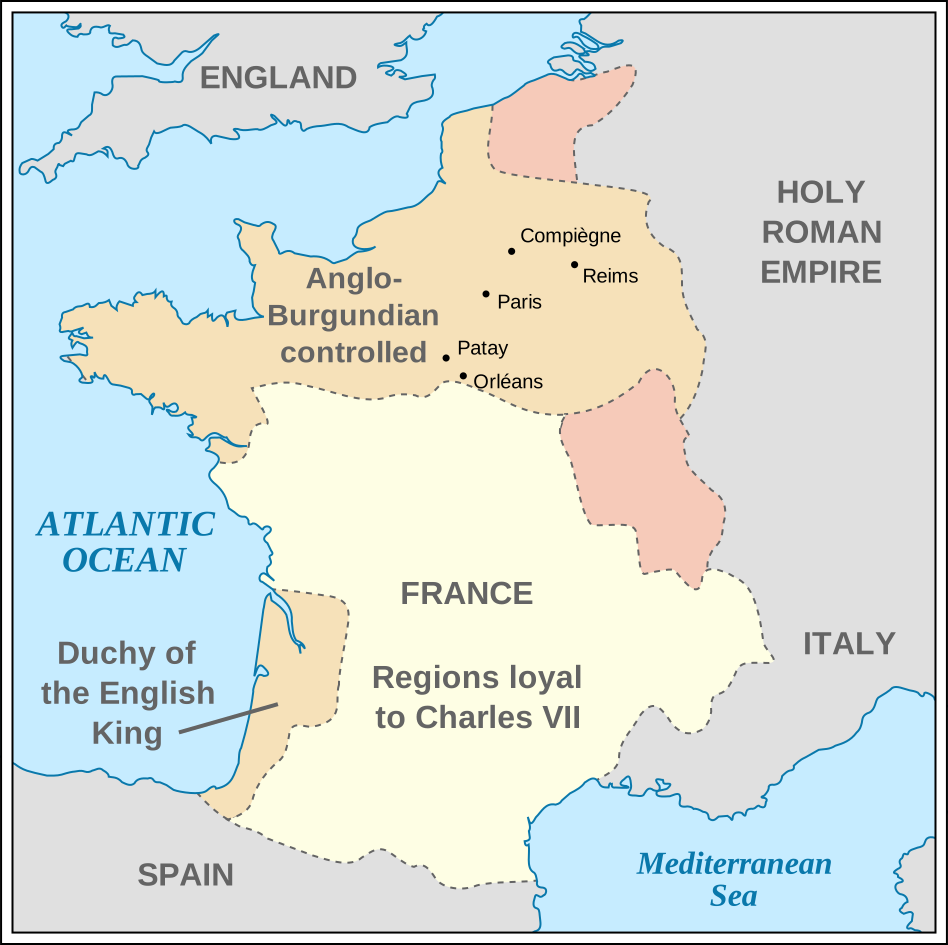
France during the 100 Years' War in 1435. Coastline from a 1991 CIA map. Relief shading based on GLOBE data. Country borders from File:Hundred years war france england 1435.jpg. City locations based on Lat/Long data in their Wikipedia entries, which are further sourced from open projects. (Included in svg point descriptions.)

Une des illustrations du tome 2 de l'ouvrage Dictionnaire populaire illustré d'histoire, de géographie, de biographie, de technologie, de mythologie, d'antiquités, des beaux-arts et de littérature, rédigé et édité par Edmond Alonnier & Joseph Décembre

Вільям Гласдейл звертається до Жанни д'Арк.

Illustration from Jules Janin's La Bretagne.

L.-M. Boutet de Monvel - Joan of Arc during the siege of Tournelles, 7 May 1429

Thomas Montagu, comte de Salisbury, est mortellement blessé durant le siège d'Orléans tandis qu'il examinait la situation de la ville depuis les Tournelles (24 octobre 1428).

Model of the fort des Tourelles of the movies Jeanne d'Arc by Luc Besson. Exhibition Gaumont 120 years of movies in the 104 theater (Paris, France).

Model of the fort des Tourelles of the movies Jeanne d'Arc by Luc Besson. Exhibition Gaumont 120 years of movies in the 104 theater (Paris, France).

Orlean fortification in 1429
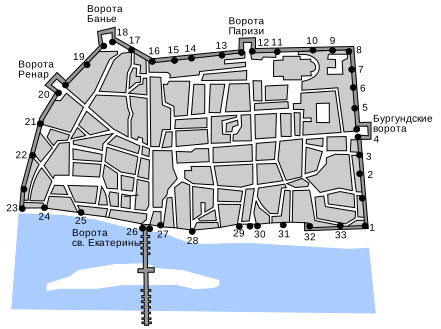
Orlean fortification in 1429

Orléans, Pierres provenant du Fort des Tourelles (Siège d'Orléans 1428-1429).

Stained glass window of Holy Cross cathedrale of Orléans (Loiret, France) : Jeanne d'Arc at the siege of Orléans

Stained glass window of Holy Cross cathedrale of Orléans (Loiret, France) : Jeanne d'Arc entering in Orléans

Stained glass window of Holy Cross cathedrale of Orléans (Loiret, France) : Jeanne d'Arc in the Holy Cross church

Cross, Augustines embankment, in Orléans (Loiret, France)

Groslot hotel, in Orléans (Loiret, France)

Statue of Joan of Arc, Augustines embankment, in Orléans (Loiret, France)

Les remparts d'Orléans pendant le siège (1428-1429).

Les remparts d'Orléans pendant le siège (1428-1429).

Une serpentine peinte à la fin du XVe siècle dans une représentation anachronique du siège d'Orléans de 1428-1429.
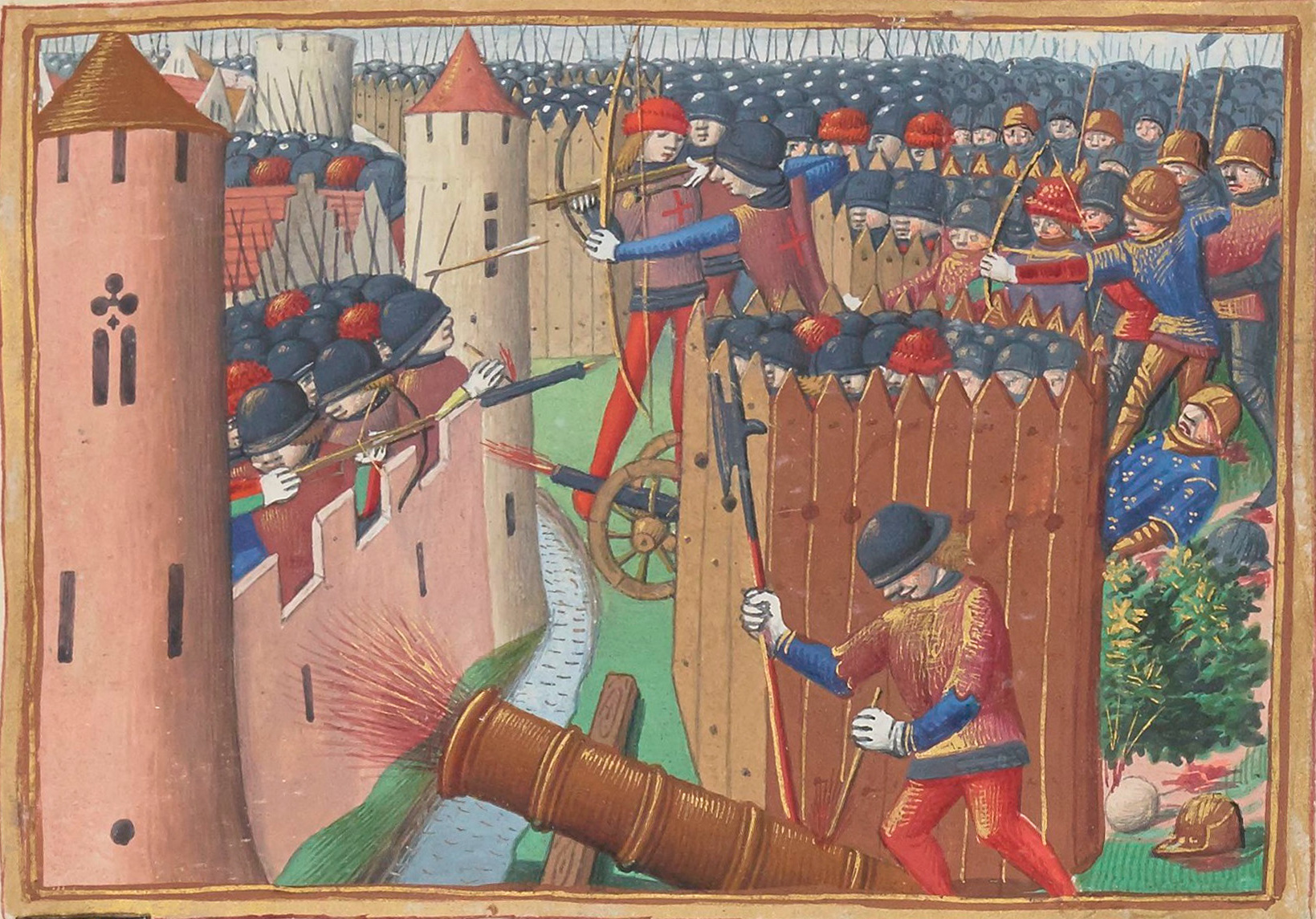
Siege of Orléans in 1428 (Vigiles de Charles VII, 15th century).

Siege of Orleans
Historische Übersicht
Die Belagerung von Orléans durch die Engländer im Hundertjährigen Krieg begann am 7. Oktober 1428 und endete am 8. Mai 1429; sie gilt als Wendepunkt des Krieges. Der Sieg brachte den Übergang über die Loire wieder in französische Hand und öffnete dem französischen König Karl VII. den Weg zur Krönung in der Kathedrale von Reims.
Fakten auf einen Blick
Königreich Frankreich
- Befehlshaber: Jeanne d’Arc
- Truppenstärke: ca. 6.000
- Verluste: Moderat
Angelsächsisches England
- Befehlshaber: Earl of Salisbury
- Truppenstärke: ca. 5.000
- Verluste: Hoch
Strategischer Kontext
Englischer Versuch, den Zugang zum Süden Frankreichs zu kontrollieren.
Konflikt / Krieg
Hundertjähriger Krieg
Weiterführende Literatur

A Distant Mirror: The Calamitous 14th Century
Barbara Tuchman

The Time Traveller's Guide to Medieval England: A Handbook for Visitors to the Fourteenth Century

The Time Traveller's Guide to Regency Britain: The immersive and brilliant historical guide to Regency Britain

1177 v. Chr.: Der erste Untergang der Zivilisation

Byzanz: Die erstaunliche Geschichte eines mittelalterlichen Imperiums

Das Mittelalter: Europa von 500 bis 1500


Im Mittelalter: Handbuch für Zeitreisende

Im Rausch des Vergnügens: Eine Reise in das England von Jane Austen und Lord Byron

Militärgeschichte des Mittelalters

Nach 1177 v. Chr.: Wie Zivilisationen überleben
Der ferne Spiegel: Das dramatische 14. Jahrhundert
Barbara Tuchman
Historische Orte
Die interaktive Karte erfordert die Zustimmung zu Drittanbieter-Cookies.