Belagerung von Akkon

Admiral William Sidney Smith and The Seige of Acre title QS:P1476,en:"Admiral William Sidney Smith and The Seige of Acre "label QS:Len,"Admiral William Sidney Smith and The Seige of Acre "

This is a photo of a place that is recognized as a heritage site by the Council for Conservation of Heritage Sites in Israel.The site's ID in Wiki Loves Monuments photographic competition is

Name: Acre-Memorial TabletDescription: Within the Old City, near the Orthodox compound, a memorial tablet was erected in the early twentieth century in memory of two British officers who died in battles to defend Acre alongside the Ottoman government against the armies of Napoleon and Muh
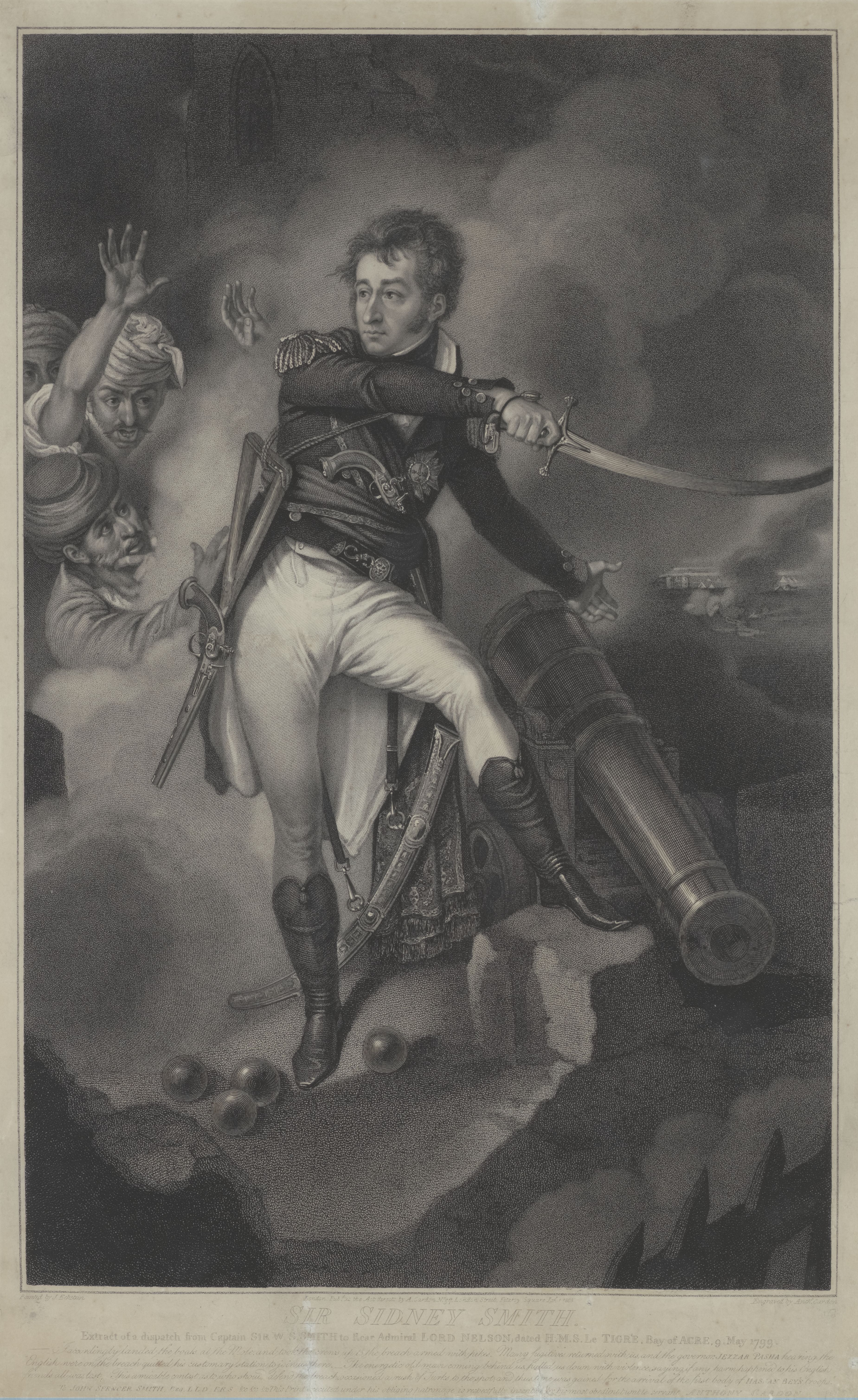
Portrait of Sir Sidney Smith, British admiral, at Acre (1764-1840)

Siege of Acre

Croquis du Siège de Saint Jean d'Acre tracé par Napoléon à S.te Helène pendant qu'il dictait ses mémoires.

Daniel Bryan, the sailor who so nobly Volunteered at the risk of his life to bury the French General during the Seige of Acre. Plate No. IV. Daniel Bryan was an old seaman, and captain of the foretop, who had been turned over from the Blanch into Sir Sidney's ship Le Tigre. During the siege of Acre, this hardy veteran made repeated applications to be employed on shore ; but, being an elderly man, and rather deaf, his request was not acceded to. At the first storming of the breach by the French, among the multitude of slain, fell one of the generals of that nation. The Turks, in triumph, struck off the head of this unfortunate officer ; and after inhumanly mangling the body with their sabres, left it naked, a prey to the dogs. Precluded from the rites of sepulture, it in a few days became putrescent ; a shocking spectacle, a dreadful momento of the horrors of war, the fragility of human nature, and the vanity of all sublunary ambition, hopes and expectations. Thus exposed, when any of the sailors who had been on shore returned to their ship enquiries were constantly made respecting the state of the deceased General. Dan frequently asked his messmates why they had not buried him; but the only reply that he received was, go and do it yourself. Dan swore he would ; observing that he had himself been taken prisoner by the French, who always gave their enemies a decent burial, not like those Turks, leaving them to rot aboveboard. In the morning, having at length obtained leave to go and see the town, he dressed himself, as though for an excursion of pleasure, and went ashore with the surgeon in the jolly boat. About an hour or two after, while the surgeon was dressing the wounded Turks in the hospital, in came honest Dan, who, in his rough good-natured manner exclaimed, " I've been burying the General, Sir, and now I'm come to " see the sick." Not particularly attending to the tar's salute, but fearful of his catching the plague,* the surgeon immediately ordered him out. Returning on board, the coxswain enquired of the surgeon if he had seen old Dan. " Yes, he " has been burying the French General." It was then that Dan's words in the hospital first recurred. The boat's crew who witnessed the generous action, an action truly worthy of a British sailor, in whose character are ever blended the noblest and the milder virtues, thus related its circumstances : —the old man procured a pickaxe, a shovel, and a rope, and insisted on being let down, out of a port hole, close to the breach. Some of his more juvenile companions ottered to attend him : " No ;" he replied, " you are too young to be shot yet; as for me, I am old and deaf, and my loss would be no great matter." Persisting in his adventure, in the midst of the firing, Dan was slung, and lowered down with his implements of action on his shoulder. His first difficulty, not a very trivial one, was to drive away the dogs.* The French now levelled their pieces; they were on the instant of firing at the hero ! it was an interesting moment ! but an officer, perceiving the friendly intentions of the sailor, was seen to throw himself across the ranks. Instantaneously the din of arms, the military thunder ceased ; a dead, a solemn silence prevailed ; and the worthy fellow consigned the corpse to its parent earth. He covered and another at its feet. it with mould and stones, placing a large stone at its head —But Dan's task was not yet completed. The unostentatious grave was formed, but no inscription recorded the fate or character of its possessor. Dan, with the peculiar air of a British sailor, took a piece of chalk from his pocket and attempted to write, " Here you lie old Crop!" He was then, with his pickaxe and shovel, hoisted into the town, and the hostile firing immediately recommenced. A few days afterwards, Sir Sidney having been informed of the circumstance, ordered Dan to be called into the cabin. " Well Dan, I hear you have buried the French " General?" " Yes, your honour!" " Had you any body " with you?" "Yes, your honour!" *' Why, Mr. Spilsbury " says you had not." " But I had, your honour." " Ah, who " had you?" God Almighty, Sir." " A very good assistant " indeed! Give old Dan a glass of grog." " Thank your " honour!" Dan drank his grog, and left the cabin highly gratified. Greenwich. He is now a pensioner in the Royal Hospital at Greenwich. At this time the plague was making great ravages among the wounded Turks : scarcely half a dozen of them escaped the mortality. It may be remarked here, that the dogs in this part of the world have lost that fidelity, and that noble generosity of character, which distinguish them in European countries. Ferocious and unsocial, suspicious, even of their masters, instead of protecting them, if they were not restrained by the. abject fears of their degenerated nature, they would fall upon and devour them. Abbey Travel 383.

Daniel Bryan, the sailor who so nobly Volunteered at the risk of his life to bury the French General during the Seige of Acre. Plate No. IV. Daniel Bryan was an old seaman, and captain of the foretop, who had been turned over from the Blanch into Sir Sidney's ship Le Tigre. During the siege of Acre, this hardy veteran made repeated applications to be employed on shore ; but, being an elderly man, and rather deaf, his request was not acceded to. At the first storming of the breach by the French, among the multitude of slain, fell one of the generals of that nation. The Turks, in triumph, struck off the head of this unfortunate officer ; and after inhumanly mangling the body with their sabres, left it naked, a prey to the dogs. Precluded from the rites of sepulture, it in a few days became putrescent ; a shocking spectacle, a dreadful momento of the horrors of war, the fragility of human nature, and the vanity of all sublunary ambition, hopes and expectations. Thus exposed, when any of the sailors who had been on shore returned to their shjp enquiries were constantly made respecting the state of the deceased General. Dan frequently asked his messmates why they had not buried him ; but the only reply that he received was, go and do it yourself. Dan swore he would ; observing that he had himself been taken prisoner by the French, who always gave their enemies a decent burial, not like those Turks, leaving them to rot aboveboard. In the morning, having at length obtained leave to go and see the town, he dressed himself, as though for an excursion of pleasure, and went ashore with the surgeon in the jolly boat. About an hour or two after, while the surgeon was dressing the wounded Turks in the hospital, in came honest Dan, who, in his rough good-natured manner exclaimed, " I've been burying the General, Sir, and now I'm come to " see the sick." Not particularly attending to the tar's salute, but fearful of his catching the plague,* the surgeon immediately ordered him out. Returning on board, the coxswain enquired of the surgeon if he had seen old Dan. " Yes, he " has been burying the French General." It was then that Dan's words in the hospital first recurred. The boat's crew who witnessed the generous action, an action truly worthy of a British sailor, in whose character are ever blended the noblest and the milder virtues, thus related its circumstances : —the old man procured a pickaxe, a shovel, and a rope, and insisted on being let down, out of a port hole, close to the breach. Some of his more juvenile companions ottered to attend him : " No ;" he replied, " you are too young to be shot yet; as for me, I am old and deat, and my loss would be no great matter." Persisting in his adventure, in the midst of the firing, Dan was slung, and lowered down with his implements of action on his shoulder. His first difficulty, not a very trivial one, was to drive away the dogs.* The French now levelled their pieces; they were on the instant of firing at the hero ! it was an interesting moment ! but an officer, perceiving the friendly intentions of the sailor, was seen to throw himself across the ranks. Instantaneously the din of arms, the military thunder ceased ; a dead, a solemn silence prevailed ; and the worthy fellow consigned the corpse to its parent earth. He covered and another at its feet. it with mould and stones, placing a large stone at its head —But Dan's task was not yet completed. The unostentatious grave was formed, but no inscription recorded the fate or character of its possessor. Dan, with the peculiar air of a British sailor, took a piece of chalk from his pocket and attempted to write, " Here you lie old Crop!" He was then, with his pickaxe and shovel, hoisted into the town, and the hostile firing immediately recommenced. A few days afterwards, Sir Sidney having been informed of the circumstance, ordered Dan to be called into the cabin. " Well Dan, I hear you have buried the French " General?" " Yes, your honour!" " Had you any body " with you?" "Yes, your honour!" *' Why, Mr. Spilsbury " says you had not." " But I had, your honour." " Ah, who " had you?" God Almighty, Sir." " A very good assistant " indeed! Give old Dan a glass of grog." " Thank your " honour!" Dan drank his grog, and left the cabin highly gratified. Greenwich. He is now a pensioner in the Royal Hospital at Greenwich. At this time the plague was making great ravages among the wounded Turks : scarcely half a dozen of them escaped the mortality. It may be remarked here, that the dogs in this part of the world have lost that fidelity, and that noble generosity of character, which distinguish them in European countries. Ferocious and unsocial, suspicious, even of their masters, instead of protecting them, if they were not restrained by the. abject fears of their degenerated nature, they would fall upon and devour them.

DEVAUX IN EGYPT. Near the mouth of the Nile, colonel Devaux routs an Ottoman force. Swebach, engraved by Hulk Fastes de la Nation Francaise volume one. 1799. (Devaux wounded at Acre 1799)

HMS "Tigre" in 1799, shortly after the siege of Acre. Plate No 1. The annexed view of Acre, from the sea, represents that city as it appeared after the late siege. In the fore-ground is his Majesty's ship Le Tigre; and, at a little distance from her, is a country boat, with her colours displayed. The first important object on the left, is the palace of Jezzar, distinguishable by the flatness of its roof; below it, nearer the foreground, are some black stones, the remains of the ancient Ptolemais. A little to the right of Jezzar's palace, are the ruins of the palace ofRichard the First ofEngland, surnamed Cceur de Lion, built by the Knights of St. John of Jerusalem under the cornice, above the arches, are figures of crowned heads in stone, according to the architectural style of those times. The large building with a cupola, in the centre of the town, is the governor's mosque, to the right and left of which appear the minarehs of smaller mosques. Towards the fore-ground, at this part, was a rope ladder up to one of the port-holes, through which the people sometimes went. After the second or third day of the siege, the ladder was removed. To the right of the grand mosque, and nearer to the sea, are some square bastions forming a part of the ancient enceinte. Between the first of these bastions and the minareh to the right of the mosque, is a caravanserai, or inn, the quarters of the English auxiliary party on shore during the siege. A little farther to the right is the south-west entrance gate, which, during the time of the blockade and siege, was fastened with only a single piece of timber. To the right of this is the harbour formed by an old mole ; and, still farther to the right, is a new bastion built since the retreat of the French army, who made a breach in the old wall, through which small boats sometimes passed. Below this were mounted two 68lb. carronades, two 321b. do, and a 24lb. howitzer, commanded by Mr. James Bray, carpenter of Le Tigre. To the right of the new bastion, in the harbour, is La Negresse, prize-gunboat, commanded, during the absence of Lieutenant Janverin, by Messrs. Simms and Spilsbury, junior, midshipmen: after experiencing a heavy gale of wind, their vessel was driven from her anchor off Yaffa ; all her sails were split to ribands, and she was helped into the harbour merely by a piece of her jib, and was obliged to remain there till she was supplied with a main-sail from Le Tigre. Above La NSgresse, a little to the right, is an old building which served the French for an hospital. Farther to the right are the light-house, and its battery, which were vigorously defended by Lieutenant Scroder, then a midshipman of his Majesty's ship Theseus; he kept possession of the battery until the guns were dismounted, and the castle itself a complete ruin. Considerably above the battery are the remains of an old building. Farther to the right, in the burial ground, is a small mosque, with a white cupola, where the French placed their ammunition. Between this mosque and the lantern-battery, are a three-gun and a fivegun battery. Three more batteries of five and three guns are concealed by the walls of the town. Considerably to right of the white mosque, is Richard Coeur de Lion's mound, on which the French threw up entrenchments. A little to the left, above the mount, where General Bonaparte was frequently observed during the siege, are the remains ofanother old building ; at the extremity of the picture^ to the right, are tents which were pitched by Jezzar, Pacha, after Bonaparte had raised the siege and retreated.

Louis André Bon (1758-1799), général de division de la Révolution française tué au siège de Saint-Jean-d'Acre.

Wall painting of Napoleon I of France, at the wall of Akko's Auditorium. Don't know the painters name though... More information (in Hebrew) about the paintings can be found here

The title is the same as the image caption above and in "Cassell's Illustrated History of England, Volume 6". The number shown is the page number. Follow image link to the full book vol.6

The remains of the internal fortification line erected by Farkhi and De-Phelipoux within the walls of Acre, during Napoleons siege, May, 1799. Today in Acre (Akko, Israel). קטע מקו הביצורים הפנימי שנבנה על ידי דה פליפו ופרחי בתוך העיר עכו במהלך המצור על ידי נפוליון במאי 1799, כיום בעכו, ישראל

Memory table for two British officers who fell in Acre

Cemetery of Napoleon's soldiers in Acre

Plan de St. Jean d'Acre. indiquant la position de l'armée française et des ouvrages qui ont servi au siège de cette place comanée le 29 Ventose An 7 et levé le 30 Floréal même année

Plan de St. Jean d'Acre. indiquant la position de l'armée française et des ouvrages qui ont servi au siège de cette place comanée le 29 Ventose An 7 et levé le 30 Floréal même année

This portrait of Royal Navy Commodore Sir Sidney Smith was painted by Robert Ker Porter in London in early 1802. It shows how Smith looked during the Battle of Alexandria when General Ralph Abercrombie was mortally wounded. Smith had been shot in the right shoulder by a spent musket ball causing a painful contusion. The arm sling is made from his Turkish sash he wore in the battle and at the Siege of Acre. This is a staged portrait. By the time had returned to London, he was fully recovered. This portrait was then engraved by Edward Mitchell in 1805 to help depict the scene of the Death of General Abercrombie.

An officer leading his troops up a bank beside a wall, an eastern figure in turban and robes pulls at his arm to attempt to prevent him; octagonal frame, illustration to Lyttleton's 'History of England'; after Henry James Richter. version at the RMG NMM

Tomb of general Caffarelli in Acre, Israel
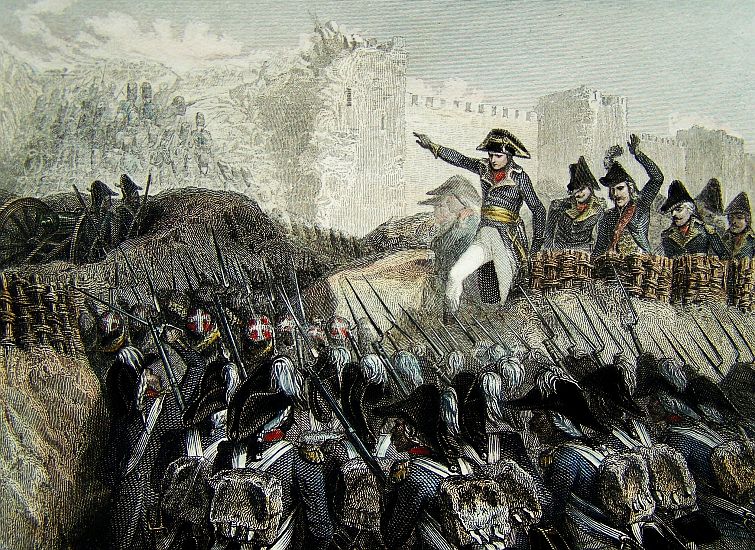
حصار عكا من قبل القوات الفرنسية بقيادة نابليون بونابرت 1799 Siege of Acre (1799)
Historische Übersicht
Die Belagerung von Akkon vom 20. März bis 21. Mai 1799 war der erfolglose Versuch der Franzosen unter Napoleon Bonaparte, die osmanische Stadtfestung Akkon zu erobern. Das Scheitern Napoleons vor Akkon war der Wendepunkt seiner Ägyptischen Expedition.
Fakten auf einen Blick
Osmanen & Briten
- Befehlshaber: Jezzar Pascha / Sidney Smith
- Truppenstärke: ca. 6.000
- Verluste: ca. 2.000
Französische Expedition
- Befehlshaber: Napoleon Bonaparte
- Truppenstärke: ca. 13.000
- Verluste: ca. 4.000
Strategischer Kontext
Napoleons Versuch, die Expansion über Syrien fortzusetzen.
Weiterführende Literatur

Trafalgar: Great Battles and Sieges

Historische Orte
Die interaktive Karte erfordert die Zustimmung zu Drittanbieter-Cookies.